2027 Does an Exercise Science Degree Require Internships or Clinical Hours?

Co-Founder and Chief Data Scientist
Before enrolling in an exercise science degree, students need to know whether the program includes supervised fieldwork. Internship and clinical hour requirements can affect your weekly schedule, graduation timeline, transportation costs, and readiness for jobs in fitness, wellness, rehabilitation support, sports performance, and related health fields.
Requirements vary by school, degree level, specialization, and delivery format. According to the National Society of Allied Health, over 65% of accredited exercise science programs include supervised practical experience as a graduation requirement. That means many students should expect some form of placement, even if the program is online or marketed as flexible.
This guide explains when internships or clinical hours are required, how long they typically last, whether they are paid, how online and accelerated programs handle placements, and how hands-on experience may affect job placement and early-career pay.
Key Things to Know About Exercise Science Degree Internships or Clinical Hours
- Exercise science degrees commonly require internships or clinical hours, crucial for hands-on experience, essential for graduation and often mandatory for certification or licensure.
- Online programs coordinate local or virtual internships, while campus-based programs integrate on-site clinical hours, affecting how students complete their practical experience requirements.
- These practical requirements increase time commitments but enhance career readiness, correlating with higher employment rates and better job placement within six months post-graduation.
Does a Exercise Science Degree Require Internships or Clinical Hours?
Many exercise science degrees require internships, practicums, field experiences, or clinical hours, but the rule is not universal. Some programs make supervised experience a graduation requirement, while others offer it as an elective or capstone option. The difference matters because required hours can affect course sequencing, tuition planning, commuting, and the amount of time you must reserve outside regular classes.
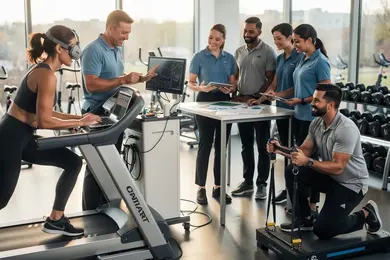
These experiences are designed to connect classroom topics—such as anatomy, biomechanics, exercise testing, nutrition, and program design—with real client or patient needs. Common placement sites include fitness centers, strength and conditioning facilities, wellness programs, rehabilitation clinics, hospitals, community health organizations, and sports performance settings.
Internships or clinical hours usually occur during the junior or senior year and may require completion of 100 to 400 hours, depending on the curriculum. During these placements, students may observe professionals, conduct fitness assessments, assist with exercise prescription, document client progress, communicate with supervisors, and learn workplace standards.
Prospective students should not assume that “online,” “accelerated,” or “career-focused” means fieldwork is optional. Before enrolling, ask the department the following:
- Is an internship, practicum, or clinical experience required for graduation?
- How many hours are required, and when are they completed?
- Does the school place students, or must students find their own sites?
- What qualifications must the site supervisor have?
- Can current employment count toward the requirement?
- Are there extra fees, background checks, immunizations, or liability insurance requirements?
Students comparing exercise science with other healthcare paths should also understand that some related degrees require much more formal clinical training. For example, a PharmD degree involves extensive practical training tied to pharmacy practice preparation.
Are Internships Paid or Unpaid in Exercise Science Programs?
Exercise science internships may be paid or unpaid. Compensation depends on the employer, location, responsibilities, and whether the placement is structured primarily as a student learning experience or as entry-level work. Recent data shows that roughly 40% of exercise science internships offer some form of compensation.
Students should evaluate pay alongside supervision quality, skill development, schedule fit, and the likelihood of future employment. A paid internship is helpful, but an unpaid placement at a strong clinical or sports performance site may still be valuable if it provides meaningful experience and references.
| Internship factor | What students should consider |
| Payment structure | Paid roles may offer hourly wages or stipends. Unpaid roles commonly provide academic credit and documented supervised experience. |
| Employer type | Larger healthcare facilities, corporate wellness programs, and established performance centers may be more likely to compensate interns. Smaller private practices, nonprofits, and community organizations may be unpaid. |
| Academic credit | Some programs require students to register for internship credits, which may add tuition costs even if the placement itself is unpaid. |
| Time commitment | Unpaid hours can create financial pressure if they limit paid work. Students should plan ahead for transportation, scheduling, and reduced work availability. |
| Career value | A high-quality unpaid placement can still lead to references, job leads, certification preparation, and stronger practical skills. |
Students who need a faster route into healthcare support roles sometimes compare exercise science with shorter clinical pathways, including an accelerated MA program. The better choice depends on whether the goal is broad exercise science preparation, direct clinical support employment, or a stepping stone toward graduate study.

What Is the Difference Between Internships or Clinical Hours in Exercise Science Degree Levels?
Internship and clinical expectations usually become more specialized and intensive as the degree level increases. Lower-division programs tend to emphasize observation and foundational skills, while graduate and professional programs often require more advanced assessment, documentation, and supervised decision-making.
| Degree level | Typical practical experience | Common focus |
| Associate degree | Short field experiences, practicums, or introductory internships may be included, depending on the school. | Fitness instruction, basic client interaction, wellness programming, and observation of professional practice. |
| Bachelor's degree | Many programs include an internship or capstone placement, often in the junior or senior year. | Fitness assessment, exercise programming, strength and conditioning, community wellness, rehabilitation support, or preparation for graduate study. |
| Master's degree | Clinical hours are often more structured and may be tied to a specialty track. | Advanced testing, exercise prescription, chronic disease considerations, research application, and clinical exercise physiology preparation. |
| Doctoral or professional degree | Practical training is typically the most rigorous, with closer oversight and more complex responsibilities. | Interdisciplinary collaboration, advanced clinical decision-making, and preparation for highly specialized practice or academic work. |
At the associate and bachelor's levels, students are usually building broad workplace readiness. At the master's level, fieldwork often becomes more closely connected to a clinical, research, or performance specialty. Doctoral or professional-level experiences are generally more complex and may require more formal supervision.
Students comparing health science options should avoid choosing a program only because its admission process appears easier. Related pathways, such as easy nursing programs to get into, may have different clinical expectations, accreditation requirements, and career outcomes.
How Do Accelerated Exercise Science Programs Handle Internships or Clinical Hours?
Accelerated exercise science programs usually do not remove internship or clinical requirements; they compress the academic calendar around them. Students may complete fieldwork during intensive terms, summer sessions, overlapping course blocks, or carefully sequenced capstone periods.
This structure can help students finish faster, but it also reduces flexibility. A student who works full time, has caregiving responsibilities, or lives far from approved sites should confirm whether the accelerated schedule is realistic before enrolling. Recent data shows that around 40% of students in these fast-paced health science programs complete clinical hours within six months.
How accelerated programs commonly fit in fieldwork
- Early planning: Students may be asked to identify potential sites before upper-level coursework begins.
- Concurrent scheduling: Internship hours may run alongside demanding lecture or lab courses.
- Summer placements: Programs may use summer terms to prevent fieldwork from delaying graduation.
- Local partnerships: Schools may rely on clinics, gyms, wellness centers, or sports facilities that regularly accept interns.
- Hybrid oversight: Some placements combine in-person supervision at the site with remote faculty check-ins.
The main advantage is speed. The main risk is workload. Students should ask for a sample weekly schedule showing classes, assignments, commute time, and expected internship hours. A program that looks manageable on paper may be difficult if fieldwork requires daytime availability during normal business hours.
When I spoke with a graduate of an accelerated exercise science degree about handling clinical hours, he described it as a “constant juggling act.” He explained that “some weeks felt overwhelming, having to switch from lectures to hands-on sessions almost daily.”
Despite the pressure, he valued the structure and mentorship. He said supportive supervisors “helped me stay organized and focused,” and added, “It was tough but rewarding to apply what I learned in real settings so quickly.”
Are Internship Requirements the Same for Online and On-Campus Exercise Science Degrees?
Internship and clinical hour requirements are often similar for online and on-campus exercise science degrees, especially when the program is designed to meet the same learning outcomes. Enrollment in online health-related degrees, including exercise science, has increased by over 30% annually, reflecting demand for flexible study options.
The key difference is usually not the number of hours. It is how placements are arranged, approved, supervised, and documented. Online students often complete required fieldwork near where they live, while on-campus students may use sites connected to the university or nearby community partners.
| Program format | How internships are typically handled | What to verify before enrolling |
| Online | Students may locate approved sites in their local area, with remote faculty oversight and onsite professional supervision. | Whether the school helps secure placements, which sites qualify, and whether there are state or location restrictions. |
| On-campus | Students may access university-affiliated gyms, clinics, labs, athletic departments, or local partner organizations. | Whether placements are guaranteed, competitive, or dependent on student applications and interviews. |
| Hybrid | Coursework may be partly online, while labs, assessments, or fieldwork occur in person. | How often campus visits are required and whether travel costs are manageable. |
Students considering an online bachelor's in exercise science should pay close attention to placement support. A flexible course format is only useful if the program also provides clear guidance for completing supervised hours.
Before committing, ask whether the school has approved sites in your area, whether you must pass a background check, and what happens if a placement falls through. Strong programs are transparent about fieldwork logistics rather than leaving students to solve them late in the degree.
How Do Exercise Science Degree Specialization Choices Affect Internship Requirements?
Specialization choices can significantly change the type, intensity, and setting of an exercise science internship. Approximately 75% of exercise science students complete at least one internship, and the most useful placement is usually the one that matches the student's intended career direction.
A student focused on sports performance may need experience in a strength and conditioning facility, while a student interested in rehabilitation support may need exposure to clinical or therapeutic environments. Wellness-focused students may complete placements in community health, corporate wellness, or lifestyle coaching programs.
| Specialization | Common placement settings | Typical internship emphasis |
| Sports performance | Strength and conditioning centers, athletic departments, performance gyms, sports teams. | Performance testing, training plans, athlete monitoring, coaching communication, and injury-risk awareness. |
| Clinical or rehabilitation-focused exercise science | Hospitals, rehabilitation clinics, cardiac or pulmonary wellness programs, physical therapy support settings. | Exercise prescription, patient interaction, safety procedures, documentation, and supervised clinical decision-making. |
| Wellness coaching or health promotion | Community health organizations, corporate wellness programs, public health initiatives, fitness centers. | Behavior change, health education, program planning, fitness screening, and client accountability. |
| Fitness management | Commercial gyms, recreation centers, boutique fitness studios, campus fitness programs. | Client services, facility operations, group programming, sales awareness, and staff communication. |
Clinical-based tracks often involve stricter schedules and more formal supervision because students may work around patients or medically complex populations. Fitness, wellness, or coaching tracks may offer more scheduling flexibility, but students should still seek placements with strong mentoring rather than basic front-desk or administrative tasks.
Students interested in healthcare roles with broader clinical exposure may also compare exercise science with an online nursing program. The programs can overlap in health-related interests, but they lead to different training requirements and career paths.
Can Work Experience Replace Internship Requirements in a Exercise Science Degree?
Work experience can sometimes replace or reduce internship requirements, but only when the program allows it and the experience clearly matches the required learning outcomes. Schools usually require formal documentation, not just a resume or job title.
A certified personal trainer, wellness coordinator, strength coach, or fitness manager may have experience that overlaps with an exercise science practicum. However, the school may still require a supervised academic component to verify competencies such as assessment, program design, communication, ethics, safety, and documentation.
What schools may require as proof
- Employer verification: A signed letter confirming dates of employment, hours worked, duties, and supervisor contact information.
- Competency evidence: Documentation showing relevant skills, such as client assessments, program plans, progress notes, or professional certifications.
- Comparable supervision: Proof that the work involved oversight by a qualified professional.
- Minimum hours: Evidence that the experience meets or exceeds the program's required fieldwork hours.
- Faculty approval: Review by an academic advisor, internship coordinator, or department chair before credit is granted.
Traditional entry-level programs may be less flexible because internship requirements help ensure consistent training across all students. Programs designed for working adults or applied professionals may be more open to prior learning assessment or internship substitution.
When I spoke with a recent exercise science graduate, she said balancing full-time work with a required internship initially felt overwhelming. “It was tough trying to fit in the hours while working, but since I had years of experience training clients and managing fitness programs, I was able to document my skills thoroughly,” she explained.
Her program required detailed employer letters and proof of competencies, but the review allowed her to bypass the traditional internship route. “It felt validating that my real-world work counted towards my degree—it was challenging, but made the effort worthwhile,” she said.
How Long Do Internships or Clinical Rotations Last in a Exercise Science Degree?
Internship length varies by program, degree level, specialization, and accreditation expectations. Industry data reveals that about 75% of exercise science programs mandate at least 200 hours of clinical or internship experience before graduation.
Students should think about internship length in both hours and calendar time. A 200-hour internship can feel very different if it is completed across a full semester, during a short summer term, or alongside a full-time job.
| Internship format | Typical length | Best fit |
| Short-term internship | Usually 6 to 8 weeks. | Students who need a focused experience, have limited availability, or are completing a specific practical requirement. |
| Semester-long rotation | Commonly 12 to 15 weeks, often requiring roughly 200 to 300 hours of supervised practice. | Students who want steady exposure while completing regular coursework. |
| Extended clinical rotation | May run across multiple semesters. | Students in clinically oriented or highly structured tracks that require deeper supervised practice. |
Several factors can lengthen or shorten the experience, including full-time or part-time enrollment, site availability, supervisor schedules, academic calendars, and whether the student is completing one broad internship or multiple rotations. Students should also ask whether evening or weekend hours are available, since many clinical and wellness sites operate mainly during standard weekday hours.
Does Completing Internships Improve Job Placement After a Exercise Science Degree?
Completing an internship can improve job placement after an exercise science degree because it gives employers evidence that a graduate can apply academic knowledge in real work settings. Studies show that 60% of employers prefer candidates with relevant internship experience.
Internships are especially useful in exercise science because many entry-level roles require interpersonal judgment, safety awareness, and the ability to modify exercise plans based on client needs. These skills are difficult to demonstrate through coursework alone.
- Stronger resume evidence: Students can list specific assessments, populations, equipment, software, or training methods used during the placement.
- Better interview examples: Internship experiences help graduates explain how they handled real clients, safety issues, scheduling problems, and professional feedback.
- Professional references: Site supervisors may provide references that carry more weight than classroom-only recommendations.
- Networking access: Students may hear about openings before they are widely posted.
- Job conversion potential: Some employers use internships as extended evaluations for future hires.
However, not all internships have equal value. A placement with limited supervision, repetitive administrative work, or little client contact may do less for job placement than a structured experience with clear learning goals. Students should ask past interns about the quality of supervision and the types of tasks they actually performed.
Students comparing healthcare education costs and career mobility may also review cheap RN to BSN online programs to understand how related health science pathways structure affordability and workforce preparation.
Do Employers Pay More for Exercise Science Graduates With Hands-On Experience?
Hands-on experience can improve early salary prospects, but it does not guarantee higher pay in every role or location. A workforce study revealed that those with such experience earned 10-15% more in entry-level positions compared to peers without it.
The salary benefit is usually strongest when the experience is directly relevant to the job. For example, a graduate applying for a clinical exercise role may benefit more from hospital or rehabilitation experience than from a general gym internship. A sports performance applicant may gain more leverage from supervised strength and conditioning work than from unrelated wellness administration.
- Reduced training burden: Employers may value graduates who already understand workplace procedures, client communication, and safety expectations.
- Clearer proof of skill: Documented fieldwork gives applicants concrete examples of assessments, exercise plans, and client outcomes.
- Better job matching: Internships help students target roles that fit their strengths, which can lead to stronger performance and retention.
- Negotiation support: Candidates with relevant supervised experience may be better positioned to discuss starting pay, responsibilities, or advancement paths.
Pay differences also depend on specialization, employer type, geographic market, and whether the position requires certifications or graduate study. Clinical exercise physiology, athletic performance, rehabilitation support, corporate wellness, and general fitness roles may reward experience differently.
The most practical approach is to choose internships that build marketable skills, not just hours. Students should document projects, populations served, tools used, and measurable responsibilities so they can present the experience clearly during applications and interviews.
What Graduates Say About Their Exercise Science Degree Internships or Clinical Hours
- Sammi: "Completing my internship through the online exercise science program was an eye-opening experience that connected theory with real-world practice. The program's affordable cost, averaging around $3,000 for the internship portion, made it accessible without compromising quality. This hands-on experience directly contributed to my current role as a strength and conditioning coach."
- Ezra: "The internship requirement in the online exercise science degree was challenging, but it gave me a structured way to apply classroom knowledge in clinical settings. Because the overall cost was reasonable compared to traditional programs, I considered it a worthwhile investment. The experience strengthened my professional skills and opened doors to opportunities in physical therapy support."
- Jillian: "From a professional standpoint, the online exercise science internship gave me broad exposure without requiring me to relocate. The cost was notably lower than many on-site internships, which let me focus more on learning than expenses. Ultimately, the experience strengthened my foundation and improved my employability in sports performance training."
Other Things You Should Know About Exercise Science Degrees
Yes, there are liability and insurance considerations for exercise science students during internships in 2027. Students are often required to have personal liability insurance, and institutions may provide coverage. It's crucial to verify these details with both your academic institution and the internship provider.
Exercise science clinical or internship experiences often occur in various facilities, such as hospitals, rehabilitation centers, fitness centers, and sports training facilities. Educational institutions may also partner with community health agencies, providing students comprehensive practical learning environments.
References
- Accelerated Pathways: 3-Year B.S. and 4-Year M.S. | Exercise Science | ESU https://www.esu.edu/exercise-science/accelerated-pathways.cfm
- What Can You Do With an Exercise Science Degree? https://willamette.edu/academics/college/exercise-health-science/career-options
- Internships https://www.brockport.edu/academics/kinesiology/exercise-science/internship/
- Internship Programs – United States Sports University https://ussu.edu/academics/resources/internships/
- Credits https://www.eastern.edu/exercise-science-internships
- Experiential Learning in Exercise Science (BS) https://www.lindenwood.edu/science/kinesiology/exercise-science-bs/experiential-learning/
- Practical Experience for Sports Science Jobs | ETA College https://etacollege.com/the-importance-of-practical-experience-in-sports-science-and-management-courses/
- Frequently Asked Questions - EXER - College of Health and Human Services https://health.charlotte.edu/student-advising-center/frequently-asked-questions/frequently-asked-questions-exer/
- Exercise Science Student Internship - UW Health - Remarkable Careers https://careers.uwhealth.org/exercise-science-student-internship/