2027 Evaluating an MPH Practicum in A Maternal and Child Health Coalition

Co-Founder and Chief Data Scientist
A maternal and child health coalition can offer an MPH student access to community partners and real decisions about family-serving programs. But a worthwhile placement needs more than a recognizable mission: it must provide approved supervision, substantive work, feasible deliverables, and permission to use the information the project requires.
This guide is for students comparing coalition placements and MPH programs. It explains what to verify before committing, how to judge a proposed project, and when another placement—or a narrower training opportunity—would better support your goals.
Key Things You Should Know
- A coalition placement is strongest when the student owns a defined public health task, receives regular feedback, and produces work the partner can use; attending meetings alone is unlikely to suffice.
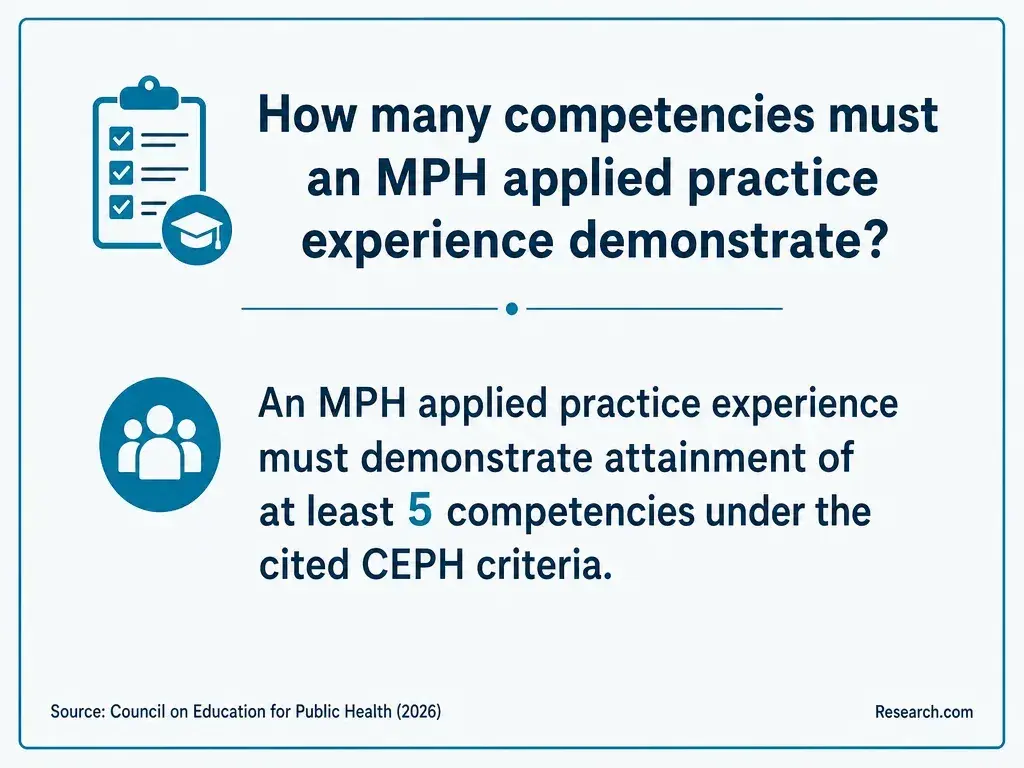
- Under CEPH's MPH applied practice experience criteria, students document at least two products demonstrating at least five competencies, including at least three foundational competencies; the program determines how its requirements are met.
- Confirm academic approval, preceptor availability, data permissions, scheduling, and any unpaid work or travel costs before accepting a site.
What is an MPH practicum in a maternal and child health coalition?
An MPH practicum—often called an applied practice experience, or APE—is supervised work in a public health setting. A maternal and child health (MCH) coalition brings organizations together around priorities affecting pregnant people, infants, children, adolescents, and families. Members might include a health department, community organizations, healthcare providers, schools, and family representatives. The coalition's structure and authority vary by site.
A student might help partners assess a service gap, improve referral information, or design measures for an existing initiative. The distinction is contribution rather than attendance: the placement should result in assessable work, not simply exposure to meetings. A generalist MPH can support this work; students comparing MPH and related public health graduate pathways should look at the actual fieldwork and methods available, not assume an MCH concentration is required.
What practicum requirements apply to MPH students in public health programs?
For an MPH covered by Council on Education for Public Health (CEPH) accreditation, the APE must be planned and assessed against competencies. CEPH criteria call for at least two products demonstrating at least five competencies, including at least three foundational ones. A program may impose additional rules about hours, credits, timing, preceptor qualifications, written agreements, or acceptable products. Its academic coordinator—not the coalition alone—decides whether a proposed placement qualifies.
Separate four approvals before work begins: the program's approval of the experience, the host's agreement to supervise it, authorization to access or use information, and permission to share any final product. Admission to an MPH is a different question. Even if a student is considering MPH programs with less restrictive admissions, they should independently check each program's APE rules; admission flexibility does not imply flexible fieldwork standards.
How can a maternal and child health coalition strengthen MPH career preparation?
Coalition work teaches students to turn population-health evidence into decisions made across organizations with different budgets, priorities, and responsibilities. A student who prepares a partner-approved evaluation plan, for example, can explain how they selected measures, handled incomplete information, incorporated feedback, and revised a usable product. That is stronger career evidence than describing meetings attended.
For an early-career student, the experience can support applications for program coordinator, health education, community engagement, or evaluation-assistant roles. It does not establish readiness to direct a coalition or practice clinical care. Someone whose immediate goal is entry-level community work may first compare public health degree choices for undergraduate students and supervised employment; an MPH is not automatically the shortest route to relevant experience.
Choose competencies from the actual work and products, rather than assigning labels after the placement ends. A service-inventory brief could demonstrate assessment and interpretation of information; a co-developed outreach plan might demonstrate planning, communication, and partnership skills. Claims about leadership or advanced analysis need evidence of what the student personally did.
Before approval, the student and faculty adviser should map each proposed product to the program's selected competencies and identify how the preceptor will observe or review the work. If a student's longer-term aim is independent research or senior practice leadership, comparing DrPH and PhD program goals can help clarify that later direction. Neither doctoral pathway changes what an MPH practicum must demonstrate now.
The best project answers a question the coalition already needs to address and fits the student's access, skills, and placement period. These examples are possible scopes, not claims about any particular coalition:
| Possible project | Useful output | Boundary to check |
| Map local family-support referrals | Verified resource inventory and gap summary | Who will confirm that listings are accurate and current? |
| Plan evaluation of an existing initiative | Logic model, measures, and collection plan | Is the student designing an evaluation rather than claiming unmeasured results? |
| Improve partner communications | Audience-specific materials and a review record | Who approves language, accessibility, and distribution? |
A project involving interviews, records, or partner-held data needs an explicit plan for consent or other applicable permissions, privacy, storage, and review. Students should not assume they can publish what a coalition lets them analyze. For someone seeking a smaller first step rather than an MPH requirement, affordable public health BS study options may be worth comparing with community work or targeted evaluation training; those alternatives do not substitute for an approved MPH APE.
Either format can support a local coalition placement if the program approves the site and provides faculty oversight. An online student may work with a coalition near home, but remote coursework does not make partner meetings asynchronous. A campus student may have easier access to established local partners yet still face travel, daytime meeting, or site-selection constraints.
Ask who finds the site, whether remote precepting is permitted, how faculty check progress, and whether required meetings occur during working hours. Working students and caregivers should test the fieldwork schedule, not just the class schedule. When comparing affordable distance learning MPH degrees, include placement travel, unpaid hours, and any required campus visits alongside tuition.
A suitable preceptor needs relevant public health practice experience, enough time to supervise, authority to shape the assigned work, and willingness to provide feedback and assessment. An MPH credential alone is not the test; the student's program sets its own approval standards. Where a coalition is a network rather than a staffed organization, identify who signs the agreement, assigns work, controls information, and remains available when members disagree.
Before accepting an offer, ask the prospective preceptor and academic coordinator these questions:
- Who will review drafts, how often will we meet, and who covers supervision during an absence?
- What decision will the products support, and who can approve their use?
- Which information can I access, and what restrictions apply to storage and sharing?
- Has the program approved this specific site, supervisor, scope, and work arrangement?
When reviewing a CEPH-accredited MPH program selection, verify that accreditation covers the MPH under consideration. Then examine the programs' site-approval process: accreditation does not mean every proposed coalition or preceptor is automatically acceptable.
There is no single coalition-practicum duration that applies to every MPH. The program sets its hours, credits, enrollment window, and deadlines. The practical timeline also includes time to secure agreements, define a project, obtain any needed data permissions, gather feedback, and revise products. A short placement with slow partner approvals can leave too little time for meaningful work.
Before scheduling, ask for the current APE handbook and calculate the weeks available after approval—not just the academic term's length. Agree on interim deadlines and a fallback output if data access is delayed. If unpaid hours or a lighter course load would extend enrollment, compare the resulting costs as well as tuition; guides to low-cost public health master's degrees cannot determine your placement-related expenses.
Coalition experience is most directly relevant to community engagement, health education, program coordination, and evaluation support in nonprofits, health departments, and health systems. The fit depends on the demonstrated task: developing an evaluation plan is different from conducting epidemiologic analysis, and neither an MPH nor a practicum grants clinical licensure.
For salary research, match the job's duties to a named Bureau of Labor Statistics occupation, such as health education specialist, rather than treating an MPH-wide figure as an offer. An occupation's national median includes workers with varied experience, employers, and credentials; local postings are more useful for estimating an entry-level offer. Comparisons of MPH-related occupations and earnings are a starting point, not evidence that a coalition placement causes a particular salary or promotion.
How should students evaluate an MPH program's maternal and child health practicum?
Compare programs on placement access, project quality, supervision, and total feasibility. A published partnership is encouraging but does not prove that a place is available, that students can select it, or that it meets your learning objectives. Ask for the current APE handbook and examples of permissible redacted products, then speak with the fieldwork coordinator about your proposed site.
A useful comparison follows this sequence:
- Confirm the exact MPH's CEPH coverage and its competency, product, and approval requirements.
- Describe one realistic coalition decision you could support and identify the preceptor who would supervise it.
- Check meeting times, accessibility, data permissions, unpaid hours, travel, and a backup plan.
- Compare what you could show an employer afterward without disclosing confidential partner information.
Choose another site if the coalition can offer only observation or cannot commit to supervision and a feasible output. If your goal is primarily advanced research rather than supervised MCH practice, investigate that separately—including funding through resources such as a public health PhD affordability guide—instead of expecting an MPH placement to serve as doctoral research training.
Other Things You Should Know About Public Health
Not necessarily. The program must approve the placement, and your preparation must fit the work. Relevant electives and supervised experience may matter more than a concentration label.
Only with the partner's permission. Remove restricted information and clarify which parts you created; if approval is unavailable, describe your methods and responsibilities without sharing the document.
No. Population-health planning, partnership, and evaluation work do not replace clinical education, supervised clinical hours, or licensure requirements.
Possibly, but not simply because the activity is called a practicum. Confirm partner permission and applicable consent, privacy, and institutional review requirements before recruitment or data collection.
- Mission, Vision, and Work | MCHB - HRSA https://mchb.hrsa.gov/about-us/mission-vision-work
- Protecting Privacy and Confidentiality | Scientific Integrity https://www.cdc.gov/scientific-integrity/php/protecting-privacy-confidentiality/index.html
- 10 Years of Partnership in Public Health Program Evaluation | nih.gov https://pmc.ncbi.nlm.nih.gov/articles/PMC10621656/
- PRACTICUM MANUAL | Long Island University https://www.liu.edu/cwpost/~/media/2809C539C09D4B02B49940F5FD666D72.ashx
- MPH Practicum | Program in Public Health https://publichealth.stonybrookmedicine.edu/academics/practicum
- Maternal, Child and Family Health Concentration | UNC Gillings School of Global Public Health https://sph.unc.edu/resource-pages/maternal-child-and-family-health-concentration/
- MPH in Maternal & Child Health | Colorado School of Public Health https://coloradosph.cuanschutz.edu/education/degrees-and-programs/master-of-public-health/mph-in-maternal-child-health
- Our Mission | AMCHP https://amchp.org/our-mission/