2027 Public Health BS Field Placements at Your Current Workplace

Co-Founder and Chief Data Scientist
Your current workplace may offer a practical setting for a public health BS field placement, but having a job there does not make your regular duties eligible for academic credit. The distinction matters if you need to keep earning while finishing your degree.
This guide explains how to evaluate your workplace, propose a supervised project, secure the necessary approvals, and judge whether a program's scheduling and costs make the arrangement worthwhile.
Key Things You Should Know
- A workplace-based placement is possible only if your BS program approves the site, supervisor, learning objectives, and proposed work; your employer's consent alone is not enough.
- Plan for work that adds public health learning beyond your usual job, such as a supervised program evaluation or health communication project, with a deliverable the school can assess.
- Before enrolling, ask whether placement hours can occur during paid shifts and whether your employer can provide protected time, supervision, and permission to use project information.
What is a public health bachelor's degree, and what does it prepare you to do?
A public health BS is an undergraduate degree focused on improving health across populations rather than providing individual clinical care. Programs commonly combine epidemiology, data literacy, health behavior, policy, and community health with general education and applied work. The exact curriculum - and whether a field placement is required - depends on the school.
For someone already employed by a health department, nonprofit, health system, or community organization, the degree may help connect daily tasks to population-health methods. It does not, by itself, authorize clinical practice or qualify a graduate for every specialist role. If you already hold a bachelor's degree, first ask whether a second undergraduate degree serves your goal better than targeted training or graduate study. Graduate admissions operate separately from BS fieldwork rules; public health graduate applications with outstanding requirements are one issue to investigate if that route fits your background.
Can you complete public health field placements at your current workplace?
Often, yes - but only with advance approval from both the academic program and the employer. A workplace can be an appropriate field site when it offers population-health work, qualified supervision, assessable learning, and a schedule that meets the program's rules. Some schools restrict placements within a student's existing position or require a different department or supervisor.
The strongest proposal identifies a project that differs from routine paid duties. For example, a nonprofit program assistant might help develop an evaluation plan for an outreach initiative rather than claim credit for ordinary appointment scheduling. A health department employee might prepare a supervised summary of aggregate service patterns rather than simply continue assigned data entry. In each case, the school must decide whether the work meets its competencies and assessment standards.
Ask the fieldwork coordinator about employee placements before promising a project to your manager. If you are still choosing a school, compare its written placement policy alongside distance learning options for public health undergraduates; online classes do not imply automatic approval of your workplace.
What are the requirements for a public health bachelor's degree field placement?
Requirements vary by institution, so obtain the handbook and forms for your intended entry term. The following sequence separates the approvals students most often mistake for one another:
- Ask the academic coordinator to confirm site eligibility, required hours or credits, permitted paid work, prerequisites, and the approval deadline.
- Define learning objectives and a specific public health deliverable, including how the work differs from your regular job description.
- Identify a workplace supervisor who can provide feedback and complete required evaluations; confirm whether the school permits your direct manager to serve.
- Secure the required site agreement and employer permission for your schedule, materials, data access, and any final presentation.
- Confirm privacy, community-partner, data-use, and institutional review requirements before collecting or analyzing information.
A feasible deliverable could be an outreach workflow, evaluation plan, or analysis of data the organization has authorized you to use. The right scope depends on your undergraduate preparation: advanced analysis may require support beyond a BS placement. If your goal is deeper quantitative work, compare that project with the training offered by biostatistics graduate programs for busy professionals rather than assuming a field placement substitutes for specialist instruction.
CEPH accreditation is a public health-specific quality review; institutional accreditation is a separate consideration. Check the CEPH directory and the school's documentation for the exact accredited school, unit, or program and whether your proposed BS is covered. A university's accreditation - or a different public health degree at that university - does not establish that this BS has CEPH coverage.
CEPH status can matter if a future employer, graduate program, or credential pathway specifies it. It does not settle the workplace-placement question: you still need the BS program's approval of your site and project. If graduate study is a possibility, compare the undergraduate program's scope separately from CEPH-accredited Master of Public Health programs; the two credentials and their applied-experience requirements are not interchangeable.
Relevant coursework usually introduces population health, epidemiology, basic statistics, social and behavioral influences on health, health policy, and program planning. A BS may also require science courses, but requirements differ. For workplace fieldwork, the useful test is whether you can apply a taught method responsibly - for example, defining an outreach measure, explaining a limitation in available data, or tailoring a health message with community input.
Choose a proposed placement that builds on courses you will have completed by the placement term. A student who has learned introductory evaluation might draft indicators and a data-collection plan; that is different from independently claiming a program caused improved health outcomes. If your intended role calls for more specialized preparation, choosing a public health master's specialization is a later decision, not a substitute for meeting your BS project requirements.
They can be a good fit for employed students if the school permits a local employer as a site and can supervise and assess the work at a distance. Check whether classes have live meetings, whether field hours must follow a fixed schedule, and whether campus visits or presentations are required. An asynchronous course schedule does not necessarily make a supervisor or community partner available outside business hours.
Ask how faculty will communicate with your site supervisor, what happens if your employment changes, and whether projects involving restricted data can be assessed without sending that data to the school. Do not confuse convenient online admissions with flexible fieldwork: even online public health master's programs without recommendation letters have separate academic and applied-learning rules. Check the BS program's rules directly.
A bachelor's degree commonly requires around 120 semester credits, but the credits and time remaining for you depend on the school's degree audit, transfer evaluation, course sequence, and residency rules. An accepted transfer course may count as an elective rather than satisfy a major requirement. Request a written degree plan showing when placement prerequisites and the fieldwork course are offered.
Compare tuition and mandatory fees with less visible placement costs: time away from paid duties, travel if the project is not at your usual worksite, and any required background checks or materials. Employer tuition assistance and paid placement hours could change the calculation, but neither should be assumed. When comparing public health program speed and career value, prioritize a verified completion plan over an advertised timeline that does not account for your remaining courses or placement approval.
A public health BS can support applications for roles such as program assistant, outreach coordinator, community health worker, health education support staff, or entry-level evaluation assistant. Actual duties and qualifications vary by employer. A workplace placement is most useful when it lets you show evidence of the work you want to do next: an approved communication product for outreach roles, for instance, or a clearly documented measurement plan for program-support roles.
Start with your existing experience. If you already coordinate community services, a BS project may strengthen a move into program planning; if you want a specialist analyst position, you may need substantially more methods training and experience. A second degree is not always the most direct route. Compare employer training and supervised projects with lower-cost public health master's career pathways only if the jobs you want actually call for graduate preparation.
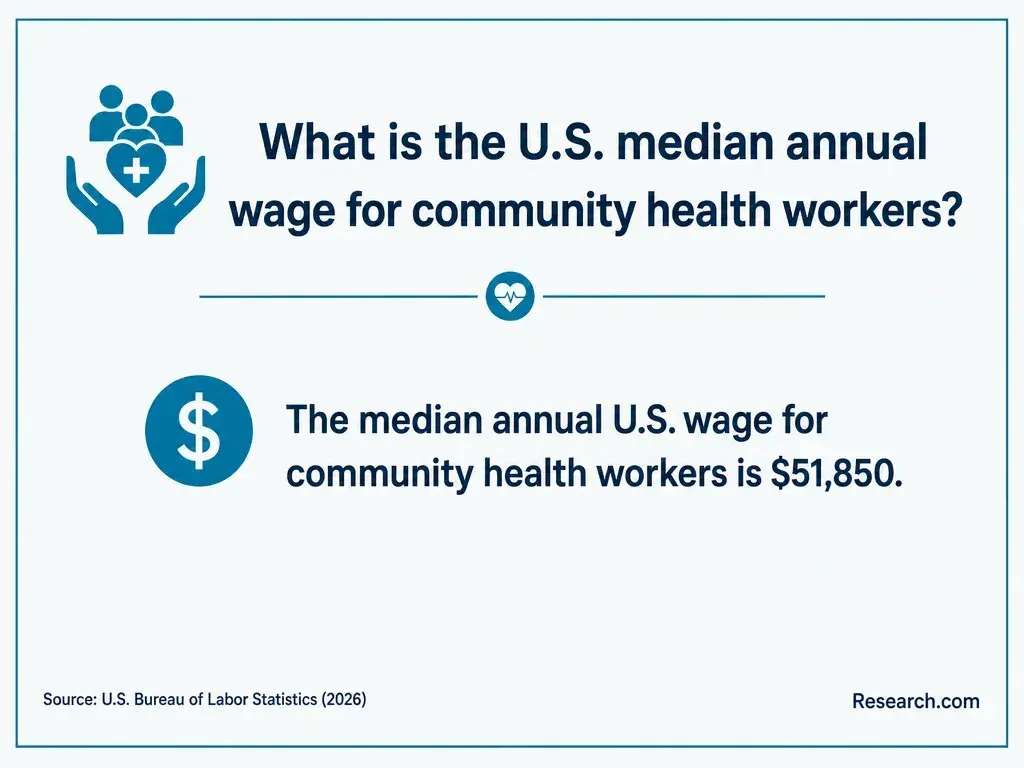
There is no reliable single salary for "public health BS graduates." Pay depends on the occupation, location, employer, responsibilities, and prior experience - not just the degree. For a useful comparison, identify the jobs you would pursue and consult the U.S. Bureau of Labor Statistics wage information for the closest defined occupations, such as community health worker or health education specialist. An occupation-wide median is not an entry-level offer or an estimate of what your particular degree will earn.
For an employed student, the near-term financial question is often whether the degree or placement helps qualify you for a specific internal role without giving up income to finish fieldwork. Compare posted pay ranges and hiring requirements at your employer before borrowing for additional education. If a master's degree is part of that plan, assess its actual net price rather than assuming an award is available; online MPH net tuition after scholarships is a separate calculation from the cost of completing your BS.
Do public health careers require certification, licensure, or graduate education?
Requirements attach to the job, not to public health work as a whole. Some entry-level program and outreach positions do not require a separate license. Certain health education, community health, clinical, analytical, or leadership roles may specify a certification, state credential, professional license, graduate degree, or experience. Check current job postings and the responsible credentialing or state authority before assuming your BS makes you eligible.
Ask whether the next responsibility you want requires a credential or simply stronger evidence of practice. A well-scoped workplace project may demonstrate useful skills without another degree; it will not replace a required license or advanced qualification. Doctoral study is a different, longer-term decision. If a leadership role explicitly calls for it, comparing public health doctorate tuition and length belongs in that later assessment, not in deciding whether your current BS placement is eligible.
Other Things You Should Know About Public Health
Yes. Agree on what your instructor may review before starting. Your school may accept a redacted product or another assessment method, but it must approve that arrangement.
Do not assume you own it. Ask your employer and school about intellectual property and permitted academic use before developing or sharing the product.
Notify your fieldwork coordinator promptly. The school may need to approve a replacement supervisor or revise the placement agreement before you continue counting hours.
Describe your responsibilities, methods, and lessons learned without disclosing protected data or internal findings. Get employer permission before showing a work product.
- Q and A: Online Bachelor of Science in Public Health - UTA https://academicpartnerships.uta.edu/healthcare-nursing-online-programs/bachelor-of-science-public-health/public-health-bachelors-degree/
- Practicum Site Supervisor | UW School of Public Health https://sph.washington.edu/mph-practicum/site
- Policies and Guidelines for Assessment of Student Learning | Academic Programs and Planning https://academicprograms.calpoly.edu/content/policies-and-procedures-assessment-student-learning
- Practical Experience - UTHealth School of Public Health https://sph.uth.edu/enroll/workforce/
- Health Internships | College of Education | University of Houston https://www.uh.edu/education/degree-programs/health-bs/internships/
- counting current work as field placement hours | cswe.org https://spark.cswe.org/discussion/counting-current-work-as-field-placement-hours