2027 Choosing MPH Coursework for Environmental Exposure Assessment

Co-Founder and Chief Data Scientist
An MPH can introduce environmental health without teaching you how to estimate what people actually inhale, ingest, or absorb. That distinction matters if you want to work with air, water, workplace, or community exposure data.
This guide is for prospective MPH students and early-career practitioners choosing courses - not merely a concentration name. It explains which methods belong in a useful course sequence, how to judge hands-on opportunities, and when a different qualification may better match a technical career goal.
Key Things You Should Know
- Prioritize a sequence that connects sampling or monitoring, exposure estimation, epidemiology, and uncertainty - not an environmental health survey course alone.
- CEPH accreditation establishes MPH-wide standards, not the availability of a particular exposure assessment course, laboratory, or field placement; verify all three separately.
- A CEPH-accredited MPH generally includes at least 42 semester credits, but its length and price do not indicate how much of that study develops exposure assessment skills.
What is environmental exposure assessment in public health?
Environmental exposure assessment estimates whether, how much, how often, and for how long people encounter a hazard. An assessment might combine air-monitor readings, information about where people spend time, and assumptions about ventilation to estimate exposure to a pollutant. The result is an estimate with limitations - not automatically a measure of disease risk or proof that an exposure caused an illness.
Public health work asks whose exposures may be missed by the available measurements and how the estimates could inform prevention. Environmental monitoring measures a condition in a place; personal exposure assessment considers what reaches a person.
Risk assessment goes further by considering potential health effects. If you are still completing a bachelor's degree, online public health bachelor's admissions and coursework can help you assess foundational preparation, but undergraduate exposure to the topic is not equivalent to graduate-level measurement practice.
What MPH courses teach environmental exposure assessment skills?
Look for a sequence rather than a single course title. Environmental health fundamentals provide context; quantitative methods let you estimate and compare exposures; applied work tests whether you can make defensible choices with imperfect data. The table distinguishes the contributions to look for in a course catalog and syllabus.
| Course or experience | Contribution to exposure assessment | Limitation if taken alone |
| Environmental health foundations | Introduces hazards, pathways, prevention, and population context | May not involve measurement or estimation |
| Exposure assessment or industrial hygiene | Addresses sampling strategies, monitoring, time patterns, and uncertainty | May emphasize workplaces rather than community settings |
| Biostatistics and data analysis | Supports data cleaning, summaries, modeling, and interpretation | Does not establish that measurements represent personal exposure |
| Environmental epidemiology | Connects exposure estimates to study design and health outcomes | Does not by itself teach instrument use or sampling design |
| Supervised applied project | Brings together a question, data limitations, analysis, and communication | Depends on site approval, supervision, and available data |
A feasible order is foundational environmental health and statistics first, followed by exposure assessment and environmental epidemiology, then an applied project. Students aiming for intensive modeling may need more quantitative preparation than their MPH requires; online biostatistics program planning for workers offers a comparison point for that deeper route.
How do you choose an accredited MPH environmental health program?
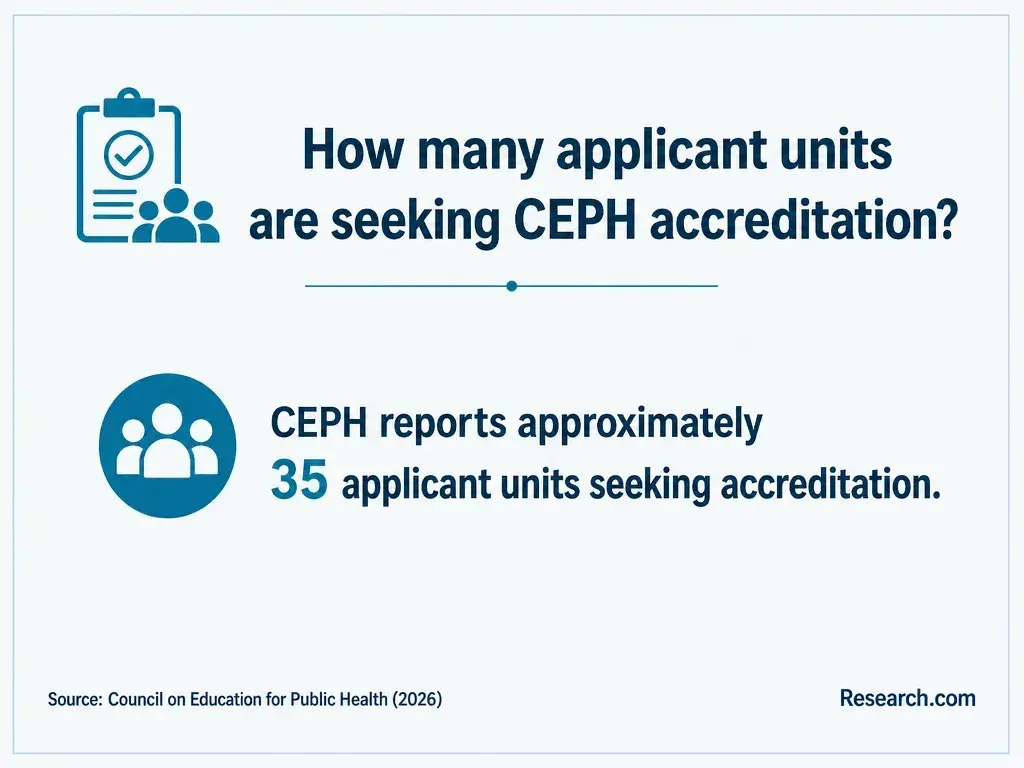
Check both institutional accreditation and the Council on Education for Public Health (CEPH) listing. Confirm that the specific school, unit, or MPH program offering the degree falls within CEPH's accredited scope. Checking CEPH accreditation before MPH enrollment is a starting point; use the accreditor's listing and the school's current catalog for the final check.
Then ask the program for recent syllabi and a course rotation. An environmental health concentration may offer strong policy or toxicology coursework but little instruction in sampling or exposure estimation. Ask whether the relevant courses are required or electives, how often they run, what preparation they assume, and whether MPH students can enroll in courses housed in engineering or occupational health. Request examples of approved types of applied projects, not promises of a particular placement.
The strongest coursework follows the path from a potential source to a defensible estimate. Topics may include routes of exposure; sampling design; personal, area, and biological measurements; detection limits; geographic and time-activity data; and the difference between measured concentrations and estimated individual exposure. Toxicology helps students interpret why an exposure might matter, while environmental epidemiology examines how measurement error can affect a study.
Pay particular attention to representativeness and uncertainty. A monitor near a roadway, for example, cannot automatically describe every resident's exposure. Useful assignments require students to document assumptions, compare plausible estimates, and communicate what the data cannot establish.
If your goal is to lead original exposure-and-health research rather than apply established methods in practice, discuss research supervision and funding before committing to a doctorate; epidemiology doctorate aid and affordability comparisons address that distinct, longer pathway.
Online study can work well for exposure-data analysis, literature appraisal, GIS exercises, and projects using appropriately authorized datasets. Campus study may make it easier to access instruments, laboratories, and nearby field partners. Neither format guarantees hands-on practice: an on-campus MPH may have few measurement electives, while an online program may arrange local supervised fieldwork.
Compare the actual requirements: live-session times, campus visits, instrument training, placement assistance, and who approves a remote project. Students balancing work or caregiving should also check whether sampling must occur during business hours. If you have not yet earned a bachelor's degree, public health BS programs with shorter academic terms address an earlier scheduling decision; a faster undergraduate calendar does not establish that a later MPH will offer flexible fieldwork.
Requirements vary by school. Applicants generally need a qualifying bachelor's degree and the program's specified application materials; a prior public health major is not necessarily required. For this coursework, statistics and relevant science preparation can matter even when they are recommendations rather than formal admission prerequisites. Check separately for prerequisites attached to exposure assessment, toxicology, GIS, or engineering electives.
If you are moving from another field, document transferable skills such as laboratory practice, data analysis, community work, or occupational safety. Ask admissions whether a missing course must be completed before enrollment or only before a particular elective. Recommendation-letter policies also differ; public health master's applications without recommender submissions may help applicants compare that requirement, but the current policy of each environmental health program controls.
CEPH-accredited MPH programs generally require at least 42 semester credits. Calendar time depends on course load, elective rotation, and when an applied experience can be completed. A program that fits your budget but offers exposure assessment only occasionally may delay the sequence you need.
Compare the full price of completing your intended courses: tuition by credit or term, mandatory fees, travel for fieldwork or campus visits, equipment or software charges, and earnings you might forgo during an unpaid placement. Confirm whether aid, employer assistance, and part-time enrollment can be combined under the applicable rules. Affordable online public health degrees can help create a cost shortlist; obtain a program-specific estimate and course plan before treating a lower advertised tuition as the cheaper route.
The coursework can support applications for environmental health specialist, exposure-data analyst, research assistant, or occupational and environmental health roles. Duties differ: a public agency may investigate environmental concerns and communicate findings, while a research team may build exposure estimates for a study. Some specialist positions require particular science coursework, field experience, or state credentials; an MPH does not replace those requirements.
For an early-career applicant, the strongest evidence is often a supervised project showing how you selected data, assessed their quality, documented uncertainty, and explained the result to a defined audience. Seek fieldwork aligned with the job's actual tasks. A doctorate is a different investment, generally more relevant to advanced research or leadership goals than to obtaining a first exposure-assessment role; use a public health doctorate career value guide only if those later responsibilities are your target.
There is no reliable single "MPH environmental exposure assessment salary." The U.S. Bureau of Labor Statistics reports wages by occupation, not by this coursework or concentration. Its environmental scientists and specialists category is a useful reference for some environmental health roles, but it includes workers with different degrees, duties, industries, and experience. Industrial hygiene and research positions may fall under different occupational categories.
For a meaningful comparison, match a prospective job's duties and location to an appropriate BLS occupation, then review local postings for required experience and pay. Do not treat an occupation-wide median as an entry-level offer or as an MPH return on investment. Budget-conscious MPH study and career outcomes can frame the financial comparison, but your decision should also account for tuition, time away from work, and whether the curriculum opens roles you could not otherwise pursue.
What certifications and professional standards apply to environmental exposure assessment?
No single certification is required for every exposure assessment job. The Certified in Public Health (CPH) credential addresses broad public health competency; the Certified Industrial Hygienist (CIH) is more closely tied to specialized occupational exposure work and has its own education, experience, and examination rules. State environmental health credentials and employer requirements can also apply to particular positions. Verify eligibility with the certifying body or regulator rather than assuming an MPH confers it.
Regardless of credentials, credible practice requires appropriate sampling methods, documented quality controls, honest treatment of uncertainty, and protection of identifiable information. Check permissions before using workplace or community data for a class project. If a later doctorate is under consideration, comparing online doctorate admission routes in public health addresses academic entry routes - not a substitute for meeting technical certification or job-specific standards.
Other Things You Should Know About Public Health
Not necessarily. Check the prerequisites for the courses you want. Familiarity with units, basic statistics, and careful data recording may be more useful at entry than prior experience with a specific instrument.
Yes, if the question fits the data. Document where and when measurements were collected, what they represent, and why they may not estimate any individual's exposure.
GIS is useful when location matters, but it is not the whole method. Sampling design, time patterns, data quality, and interpretation remain important even when a project produces a map.
Only with the necessary school and site permissions. Remove restricted or identifying information, follow any data-use agreement, and describe your methods and contribution without implying that a proposed analysis is a validated finding.
- Effective Practices for Teaching the Biostatistics Core Course for the MPH Using a Competency-Based Approach - PMC https://pmc.ncbi.nlm.nih.gov/articles/PMC4037466/
- Risk Assessment Syllabus | US EPA https://assessments.epa.gov/risk/document/&deid%3D358164
- MPH in Environmental and Occupational Health Sciences | CUNY Graduate School of Public Health & Health Policy https://sph.cuny.edu/academics/degrees-and-programs/masters-programs/mph-in-environmental-and-occupational-health-sciences/
- MPH in Environmental Health Sciences | Yale School of Public Health https://ysph.yale.edu/school-of-public-health/graduate-programs/master-of-public-health-mph-degree/environmental-health-sciences/
- Environmental Monitoring and Sampling - 575.727 https://ep.jhu.edu/courses/575727-environmental-monitoring-and-sampling/
- Online Part-Time MPH in Global Environmental Health | Emory University https://sph.emory.edu/degrees-programs/mph/online-part-time-mph-global-environmental-health/course-sequence
- MPH in Environment, Climate & Health | Colorado School of Public Health https://coloradosph.cuanschutz.edu/education/degrees-and-programs/master-of-public-health/mph-in-environment-climate-health