2027 Choosing a Public Health Capstone Question With Available Data

Co-Founder and Chief Data Scientist
A compelling public health topic can become an unworkable capstone if the needed data are unavailable, too limited, or restricted. For students planning a research brief, evaluation, or other applied project, the best question is one they can answer responsibly within their course timeline.
This guide shows how to move from a population-health concern to a focused question, test possible data sources, choose a suitable method, and produce findings that a defined audience can use.
Key Things You Should Know
- Choose the question and dataset together: confirm that the population, outcome, geography, and time period actually appear in accessible data.
- Before committing, check suppression, missingness, measurement definitions, permissions, and whether the analysis fits your deadline and skills.
- Scope the deliverable around one primary question and a defensible method; descriptive findings can be valuable without claiming causation.
How do you choose a public health capstone question with available data?
Start with a decision someone could make from the answer, such as where a health department should investigate a service gap. Then work backward from data you can obtain, not data you hope a partner might release. A workable question connects a defined population, measure, place, and period to a feasible analysis.
Use this sequence before asking an advisor to approve the topic:
- Identify the intended audience and the decision the project should inform.
- Find a candidate dataset and read its documentation, including measure definitions and access conditions.
- Draft a question using only variables, geographies, and periods the dataset supports.
- Check whether the smallest useful subgroup has reportable, interpretable data.
- Confirm the method, permissions, deliverable, and deadline with your faculty advisor and any project partner.
For example, a county-level comparison of age-adjusted diabetes mortality may be possible with publicly reported mortality data. A question about why particular residents missed diabetes care would require different evidence, potentially including interviews and additional approvals.
Students in compressed courses should settle data feasibility early; public health bachelor's programs with compressed classes may leave less time to resolve an access delay.
What makes a public health capstone question focused and researchable?
A researchable question identifies what will be measured and avoids asking the data to establish more than they can. "What causes poor health in my community?" is too broad.
"How do reported diabetes mortality rates compare across counties in one state during a specified period?" names an outcome, geography, comparison, and time frame. It supports description, not a conclusion about what caused any difference.
Test the wording against four boundaries: population (who or which places), measure (the documented outcome or indicator), comparison (between whom or against what benchmark), and period (when). Add an exposure or intervention only if its timing and measurement support the proposed analysis. If the source reports county estimates, do not rewrite the question as though it tracks individuals.
Capstone expectations differ across degrees and courses. An undergraduate student considering public health undergraduate program comparisons should check whether the required final project is a research paper, an applied product, or another form of assessment before adopting a question designed for a different format.
Which public health data sources can support a capstone project?
Public datasets often make a short capstone more feasible, while approved organizational data can make it more useful to a specific partner. This comparison shows what several US sources can, and cannot, typically support; availability varies by measure and geographic level:
| Source | Potential capstone use | Important constraint |
| CDC WONDER | Descriptive analyses of available mortality measures | Small counts may be suppressed; cause-of-death coding and rate definitions need careful interpretation. |
| Behavioral Risk Factor Surveillance System (BRFSS) | Adult health-behavior and self-reported condition estimates | Survey design, weights, and geographic availability affect valid comparisons. |
| CDC PLACES | Small-area estimates for selected adult health indicators | Estimates are modeled, not direct observations of every local resident. |
| US Census Bureau American Community Survey | Population and social-context measures | Sampling uncertainty and differences between estimate periods matter. |
| Approved organization records | Program reach, service use, or implementation measures | Access, definitions, privacy rules, and permission to share findings depend on the organization. |
Match sources cautiously. Joining a county health estimate to a county income estimate can describe a geographic pattern; it cannot establish that income caused an individual's health outcome.
If a capstone might later grow into doctoral work, durable access and reuse rights should also figure into public health doctoral program cost-benefit considerations.
"Publicly available" is not the same as "fit for this question." Read the data dictionary and methodology before building an analysis. Confirm who was counted, how the indicator was defined, when it was collected, whether geographic boundaries changed, and whether missing or suppressed values undermine the planned comparison.
Access needs its own test. A downloadable aggregate table may be usable immediately, whereas a restricted file can require an application, data-use agreement, secure environment, or partner authorization.
Ask who approves access, how long approval may take, whether a student may retain the file, and what can appear in the final submission. Do not build a deadline-dependent project around an unapproved request.
For the county mortality example, suppressed counts may make some county comparisons impossible. A defensible adjustment is to use a broader geography or longer reporting period if the source permits it - not to fill suppressed cells with guesses.
Document that choice and explain how it changes the question. Students exploring affordable public health PhD pathways should apply the same access test to any dataset they hope to use beyond the capstone; enrollment does not grant continuing data rights.
Let the question and data structure select the method. For differences across counties, descriptive rates, clearly labeled maps, and comparisons with a state benchmark may be sufficient. If the question concerns how a program operates, an approved process evaluation using defined service records may fit better.
Interviews can illuminate experiences or implementation barriers, but they require a sampling, consent, and oversight plan rather than being treated as a quick substitute for missing quantitative data.
Use a statistical model only when it answers a specific question and you can assess its assumptions. County-level associations are vulnerable to confounding and ecological misinterpretation; a model does not turn them into individual-level or causal findings.
For survey data, account for the source's sampling design and uncertainty rather than treating estimates as simple counts.
Method depth should fit the course and available supervision. If the main goal is to demonstrate a particular analytic skill, a supervised methods project may be more direct than another full qualification.
When considering further study, compare that option with efficient public health degree pathways and earnings based on the skills you actually need, not a capstone's title alone.
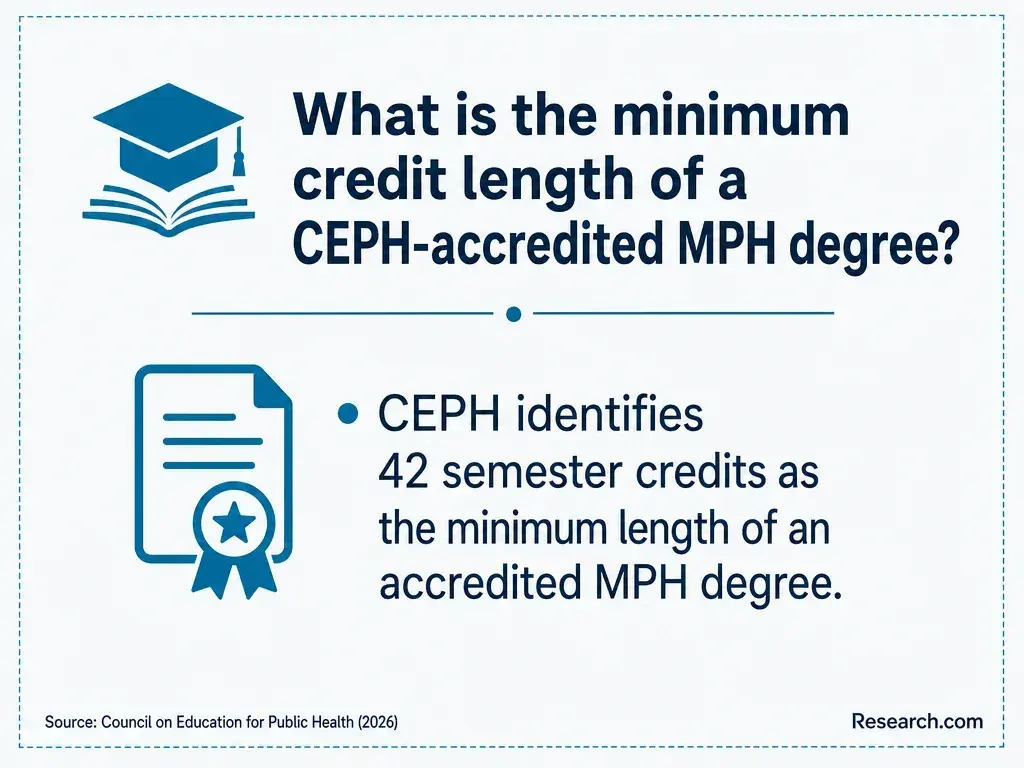
For a student in a CEPH-accredited public health program, competency alignment means showing what the completed work demonstrates, not merely naming a competency in the proposal.
A county mortality brief might demonstrate interpretation of population-health data, communication of uncertainty, and discussion of how structural conditions warrant further investigation.
A partner evaluation plan might instead demonstrate program planning, stakeholder engagement, and selection of meaningful measures.
Ask your advisor which competencies and assessment criteria apply to your degree and capstone. CEPH accreditation covers specified schools, programs, or units; it does not mean every institution uses the same rubric or that every public health degree at an institution has identical accreditation coverage.
Students weighing programs can use comparing accreditation across online MPH programs as a starting point, then confirm the exact degree's coverage and current project requirements with the school.
Data access and ethical permission are separate decisions. A public aggregate table may pose limited privacy risk, while service records, interview responses, or small-area results can expose people or communities even after direct identifiers are removed.
Use the minimum information needed, follow storage and retention rules, and avoid publishing small cells or descriptions that could permit identification.
Before collecting or receiving nonpublic information, ask the faculty advisor and relevant institutional office whether the activity needs human-subjects review or a formal determination.
Also confirm any site permission, data-use agreement, consent procedure, and community expectations. Neither "it is for a class" nor "the partner gave me a file" settles those questions. Partners may also need to review a public-facing product without controlling the academic interpretation of findings.
Good supervision helps students navigate these boundaries, but a capstone partner is not obligated to provide a future admissions reference. If that becomes an application constraint, finding MPH programs without recommendation letters is a separate decision; it should not influence whether you request unnecessary access to sensitive capstone data.
Objectives should describe work you can complete and assess, not promise a health improvement the project cannot deliver. For the illustrative county mortality question, the primary objective could be to compare available age-adjusted county rates for a specified period.
Supporting objectives could be to identify suppressed results, compare reportable rates with a state reference, and prepare a brief explaining uncertainty and appropriate uses of the comparison.
For each objective, specify the indicator, data source, population or geography, analysis, output, and completion point in the course schedule.
An advisor should be able to tell whether the objective was met without requiring a statistically significant result. If the data cannot support an objective, revise it before analysis rather than changing the interpretation afterward.
A capstone can show preparation for later study, but it does not waive admission prerequisites. Students considering conditional entry into public health master's programs should check those programs' actual requirements separately from what their project demonstrates.
Choose a question that produces evidence of a task you want to perform professionally. An aspiring analyst might document reproducible cleaning, measure definitions, and cautious interpretation.
A future program coordinator might develop an approved evaluation plan that connects service activities to useful indicators. A health communicator might translate defensible findings into a plain-language brief for a defined audience.
That work is portfolio evidence, not proof of independent professional authority or a job offer. Describe your own contribution, the supervision received, and the limits of the analysis.
If you are considering an MPH for career advancement, understanding salary variation after an MPH can inform the broader decision, but occupation-wide pay figures cannot establish the return from a particular capstone or degree.
How do you present capstone findings for academic and professional audiences?
An academic submission should make the question, source, definitions, method, assumptions, and limitations traceable. Include enough detail for a reviewer to understand how a reported measure was produced. A professional brief should lead with the decision the findings can inform, show a small number of clearly labeled results, distinguish observations from recommendations, and state what remains unknown.
Before sharing either version, check the school's submission rules and any partner restrictions. Remove identifiers and confidential operational details from a portfolio copy, and share code or data only when their terms allow it. If results are incomplete or inconclusive, explain what was learned about measurement and what additional evidence the decision-maker would need; do not manufacture a positive finding.
A capstone brief is not a dissertation proposal, though it may clarify future interests. If continued study is the goal, comparing DrPH and PhD program goals can help distinguish a practice-improvement project from a research-focused pathway.
For this capstone, the next step is simpler: have your advisor and, where applicable, your partner review a question, data inventory, and draft output before you finalize the analysis.
Other Things You Should Know About Public Health
Not necessarily. Use software your program supports and that can handle your data and method correctly. Clear documentation and accurate interpretation matter more than using a particular package.
Report that result accurately. Explain the uncertainty, data limitations, and what the findings can and cannot rule out. A useful capstone does not require a dramatic result.
Often, but seek advisor approval and update the objectives, methods, and any applicable site or ethics documentation. A change in question may change what permissions you need.
Do not assume you can publish or reuse them. Check your school's policies, partner agreement, and dataset terms; request explicit permission before putting project materials in a public portfolio.
- Elements of an Evaluation Plan | Agency for Healthcare Research and Quality https://www.ahrq.gov/talkingquality/assess/evaluation-plan.html
- Conducting High-Value Secondary Dataset Analysis - PMC https://pmc.ncbi.nlm.nih.gov/articles/PMC3138974/
- Publicly Available NCHS Data | RDC https://www.cdc.gov/rdc/public-nchs-data/index.html
- Finding Data: Search Strategy for Datasets - Guides https://guides.hshsl.umaryland.edu/finding-data/searching
- Practicum and Capstone: COPHP MPH | Health Systems and Population Health https://hspop.uw.edu/cophpmph/program-experience/practicum-capstone/
- Missing data: Issues, concepts, methods | sciencedirect.com https://www.sciencedirect.com/science/article/pii/S1073874624000082
- 5. Descriptive and Analytical Epidemiological Study Designs | Windsor & Downs Press https://iopn.library.illinois.edu/pressbooks/epidemiologyaprimer/chapter/chapter-5-descriptive-and-analytical-epidemiological-study-designs/
- De-identification and Confidentiality of Research Data | ucsf.edu https://irb.ucsf.edu/content/de-identification-and-confidentiality-of-research-data