2027 MPH vs MS in Population Health for Health System Work

Co-Founder and Chief Data Scientist
A health system may need someone to improve screening outreach, evaluate a care program, or analyze outcomes across patient groups. Those jobs overlap, but they do not demand identical training. An MPH often emphasizes putting population-health initiatives into practice; an MS in Population Health may provide deeper research or analytical preparation.
For clinicians, analysts, and career changers considering either degree, this comparison shows how to judge curricula, applied experience, cost, and career fit - so you can choose for the work you want to do, not the degree label alone.
Key Things You Should Know
- Choose an MPH for health system roles centered on program implementation, community partnerships, and evaluation; favor a methods-intensive MS when the target role involves substantial study design or analysis.
- Compare actual courses and projects: "population health" in a degree title does not establish proficiency with clinical data, advanced statistics, or health system operations.
- The U.S. Bureau of Labor Statistics reported a $83,980 median annual wage for epidemiologists in 2024. That occupation-wide figure is not a starting salary or a predicted outcome for either degree.
What is the difference between an MPH and an MS in Population Health?
An MPH is generally a professional public health degree designed to apply evidence to population-level problems. An MS in Population Health may focus more heavily on research methods, data analysis, or health services research. Neither description is universal: an MPH can be quantitatively rigorous, while an MS can include substantial applied work.
In health systems, population health means examining outcomes and needs across a defined group - such as patients with a condition or residents served by a hospital - and using that evidence to improve care, prevention, and access. It is distinct from treating an individual patient. The comparison below shows the likely emphasis to test against each school's published requirements.
| Decision factor | MPH | MS in Population Health |
| Typical emphasis | Public health practice, implementation, and evaluation | Research questions, analytical methods, and interpretation |
| Common culminating work | Applied experience and practice-oriented project, depending on program requirements | Thesis, research project, or other culminating work, depending on the program |
| Best initial fit | Turning evidence into programs and partnerships | Producing or critically testing evidence |
Both are graduate degrees. If you have not yet completed a bachelor's degree, compare undergraduate completion options first; public health bachelor's cost comparisons can help frame that earlier financial decision.
Which degree better prepares you for health system careers?
For implementation-focused work, start by examining MPH programs. A strong fit would connect prevention and health equity coursework with supervised work on outreach, quality improvement, or program evaluation. For research-intensive work, examine MS programs first - particularly their statistics sequence, study-design training, faculty supervision, and opportunities to analyze appropriate health system data.
The deciding factor is the target job's tasks, not its title. A "population health analyst" may build dashboards from established measures at one employer and design complex studies at another. Read several relevant job postings, identify the methods and experience they request, then check whether a program requires students to demonstrate those skills in a project. Also ask who helps arrange placements or research supervision; access to an employer's data should never be assumed.
If your goal is primarily budgeting, staffing, and service-line operations, an MHA or relevant management experience may be more direct than either degree. If you already lead population-health initiatives and are considering advanced practice leadership, an online public health doctorate selection guide offers a separate comparison; a doctorate is not ordinarily needed for entry-level health system work.
What careers can you pursue with an MPH or MS in Population Health?
Both degrees can support applications to health system roles, but hiring depends on previous experience, technical skills, and the employer's requirements. These are useful role distinctions - not jobs reserved for one degree.
| Role | Typical work | Evidence to bring to an application |
| Population health program coordinator | Organizes outreach, partner workflows, and performance reporting | Implementation work, communication, and basic evaluation |
| Quality improvement specialist | Tracks measures and supports changes to care processes | Process mapping, measurement, and collaboration with clinical teams |
| Population health or health services analyst | Defines measures, analyzes data, and explains results | SQL or other relevant tools, statistical reasoning, and clear reporting |
| Research coordinator or analyst | Supports study protocols, data management, and research reporting | Study methods, documentation, and appropriate data-governance practice |
For someone already working in care coordination or community outreach, an MPH project may demonstrate readiness for a broader program role. Someone with strong computing or statistics experience may gain more from an MS with supervised research. Neither degree alone qualifies a graduate for clinical practice or an experienced manager's position. For additional occupation-level context, see career salary ranges for MPH degree holders, then check compensation for the specific job and location.
MPH curricula commonly cover epidemiology, biostatistics, health policy, social and structural determinants of health, and the design and evaluation of public health programs. An MS may spend more of its available coursework on statistics, research design, data management, and a defined research problem. Course titles alone reveal little about depth: an introductory biostatistics class is not preparation to independently design a complex outcomes study.
For health system work, inspect syllabi and culminating-project rules for opportunities to define a population, choose defensible measures, assess missing or biased data, and communicate limitations to decision-makers. Also look for instruction on privacy and data-use approvals. A student project does not automatically permit access to patient records.
Quantitative prerequisites can change which route is feasible immediately. Ask whether a required statistics course must be completed before admission or can be taken as part of the degree; public health master's conditional admission options may be worth investigating when preparation is incomplete. Confirm the policy with the particular program rather than treating an option elsewhere as a waiver.
Yes, programs in both categories may offer online study, but availability and delivery vary by school. An online MPH may still require an approved applied placement; an online MS may require scheduled research meetings, campus visits, or access to a suitable project. Neither "online" nor "asynchronous" means that every fieldwork or group-project obligation can be completed at any hour.
Working applicants should request a sample course schedule and ask about live sessions, placement hours, thesis supervision, and whether an existing job can serve as a project site. Employer participation, academic approval, and permission to use workplace data are separate matters. Compare the full schedule and cost - not just advertised speed - when reviewing online public health cost-duration tradeoffs.
Both routes generally require a completed bachelor's degree, an application, academic records, and evidence that the applicant can succeed in graduate study. Individual schools set their own GPA policies, prerequisite courses, essays, recommendations, tests, and deadlines. An MS with substantial quantitative work may expect more prior statistics or programming preparation than a particular MPH; that is a program-level requirement, not a rule for every MS.
Applicants from clinical, business, social science, computing, or other backgrounds should map their prior coursework and work projects to the program's stated requirements. Distinguish a required statistics course from a recommended one, and ask whether professional analysis experience can strengthen an application without formally replacing a prerequisite. If academic performance is a concern, review public health master's entry with a modest GPA while checking each school's actual review and exception policies.
Completion time depends on required credits, full- or part-time enrollment, course availability, and the culminating experience. A thesis can take longer if a research question, supervisor, or permitted data source is not ready; an MPH placement can also delay graduation if site approval or scheduling takes time. Compare each program's published plan of study with a schedule you can actually maintain while working.
Ask when required courses run, whether the program permits a change of pace, and how long students have to finish a placement or thesis. Applicants still completing an undergraduate degree should settle that timeline separately; undergraduate public health programs with faster course cycles may be relevant, but shorter courses do not guarantee earlier graduation or accepted transfer credit.
There is no reliable universal price advantage for an MPH or an MS. Compare written estimates for the same enrollment plan, including charges that may arise from fieldwork or research. Request these prices and terms from each school before estimating the amount you would need to fund:
- Tuition price per credit, term, or full program, with the required credit load
- Mandatory fee prices, including online, technology, or graduation charges
- Placement, travel, campus-visit, software, or research-related costs where applicable
- The net price after any aid you are actually awarded, not an advertised maximum award
Add the value of work hours you would forgo, especially if a placement is unpaid or a thesis limits your availability. Employer tuition assistance may change the comparison, but confirm eligible programs and any repayment conditions. For a closer look at award terms, use comparing university scholarships for MPH study.
There is no defensible single salary for MPH or MS in Population Health graduates. Pay depends on the role, region, employer, prior experience, and technical responsibilities. As one benchmark, the U.S. Bureau of Labor Statistics reported a $83,980 median annual wage for epidemiologists in 2024. That figure covers workers in the occupation across employers and experience levels; it does not describe the pay of new graduates or every health system analyst.
For a useful return-on-investment comparison, find pay ranges in postings for jobs you could realistically qualify for, then weigh any plausible increase against your net education cost and reduced earnings during study. An MS may be worth a higher cost if a target research role requires the methods it teaches; a less costly MPH or targeted training may be better if you already have the necessary analytical skills. Tuition-conscious pathways to a public health master's can help you organize that cost-versus-career comparison without treating projected earnings as guaranteed.
Does accreditation or certification matter for health system jobs?
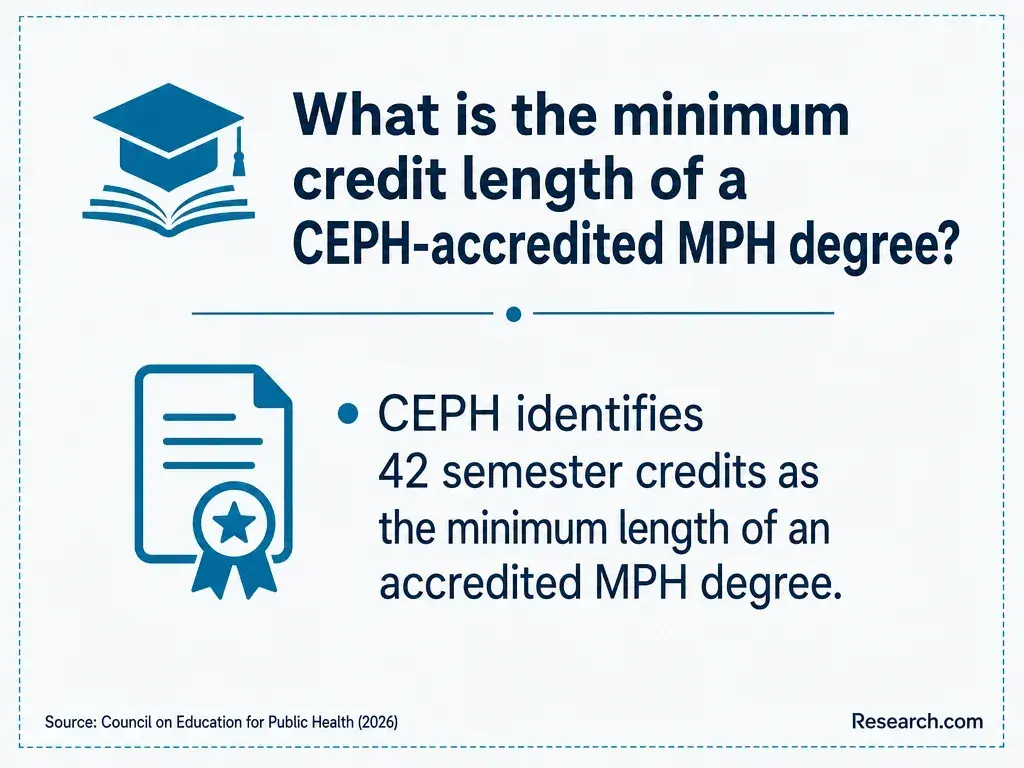
Check both the institution's accreditation and the scope of any Council on Education for Public Health (CEPH) accreditation. CEPH status belongs to an accredited school, unit, or program as specified by the accreditor; it should not be assumed to cover every degree with a related name. Confirm that the particular MPH or MS you would enter is included if CEPH recognition matters to you or a prospective employer.
Certification is a separate decision. A public health degree does not automatically award the Certified in Public Health (CPH) credential, a health education credential, or a clinical license. Check the certifying organization's current eligibility rules and the job posting before paying for an exam or choosing a degree to pursue it. Accreditation also says nothing by itself about admission selectivity: if access is a concern, compare the actual requirements of MPH programs with broader admissions criteria separately from their accreditation status and curriculum.
Other Things You Should Know About Public Health
Often, yes. A clinician may be able to join an employer's quality improvement or outreach project and build relevant experience first. A degree is more useful when target positions require skills or credentials that experience alone has not provided.
Not always. Some projects use approved aggregate measures or appropriately deidentified information. Access to restricted or identifiable data requires the organization's permissions and applicable privacy safeguards; enrollment in a degree does not grant access.
No. Their coursework may overlap, but titles do not establish equivalent methods training. Compare required epidemiology, statistics, and research courses if an epidemiologist role is your goal.
If you already work in a health system, speak with your manager or education-benefits office first. Ask which skills the target team needs, whether you can join a supervised project, and whether either program qualifies for tuition assistance.
- Competencies for Public Health Professionals | cdc.gov https://www.cdc.gov/infrastructure/training-professional-development/competencies-for-public-health-professionals.html
- Employer Demand and Desired Skills for Public Health Graduates: Evidence From Job Postings - PubMed https://pubmed.ncbi.nlm.nih.gov/39361905/
- Evolution of Master of Public Health Core Curriculum - PMC https://pmc.ncbi.nlm.nih.gov/articles/PMC11574769/
- Population & Public Health - Health IT Playbook https://playbook.healthit.gov/playbook/population-public-health/
- Curriculum: Master of Public Health | northwestern.edu https://www.feinberg.northwestern.edu/sites/mph/degree-options/mph/curriculum.html
- Practicum and Capstone: COPHP MPH | Health Systems and Population Health https://hspop.uw.edu/cophpmph/program-experience/practicum-capstone/
- Curriculum - Master of Public Health - The University of Chicago https://publichealth.bsd.uchicago.edu/about/curriculum/
- Tuition & Funding - Rollins School of Public Health | Emory University https://sph.emory.edu/admissions/tuition-funding
- MPH vs MS vs MHA: Which Public Health Master's Degree Is Right for You? | Tulane WSPH https://sph.tulane.edu/mph-vs-ms-vs-mha
- Section 2. MPH Practicum - Master of Public Health Practicum Manual - Academic Guides at Walden University https://academicguides.waldenu.edu/masters-public-health-practicum-manual/practicum-overview