2027 From Maternal Health Program Support to Public Health: Choosing a Graduate Pathway

Co-Founder and Chief Data Scientist
Supporting a maternal health program gives you a close view of community needs, service gaps, and the work required to keep programs running. Moving into public health may mean taking responsibility for program design, evaluation, policy, or population-level research - but those goals call for different preparation.
This guide is for program coordinators, outreach staff, and nonprofit or health-system professionals deciding whether graduate school will help. It explains which pathways build on your experience, what each may cost in time and money, and how to choose a program that develops the skills your target role requires.
Key Things You Should Know
- An MPH is usually the most direct graduate route from maternal health program support into public health practice; choose an MS for deeper research or quantitative training and consider a DrPH only when experienced practice leadership is the goal.
- Match the degree to a target task - such as evaluating a maternal health initiative - not just a maternal and child health label. Check the exact program's fieldwork, methods courses, accreditation coverage, and total cost. A degree does not guarantee advancement or a particular wage.
- The U.S. Bureau of Labor Statistics reported a $83,980 median annual wage for epidemiologists in May 2024; that occupation-wide figure is not a starting salary for MPH graduates.
What graduate degrees lead from maternal health program support to public health careers?
Start with the work you want to do next. If you coordinate referrals, outreach, grant activities, or partner meetings and want to plan or improve population-level programs, an MPH is generally the closest fit. An MPH with maternal and child health coursework can connect that experience to epidemiology, evaluation, policy, and community-engaged practice. Check whether maternal and child health is an official concentration, a set of electives, or simply a topic addressed in a few courses.
If your goal is to conduct studies or become a specialist in analysis, consider an MS in epidemiology, biostatistics, or a related field. If you already direct programs and want to lead organizational or systems change, a DrPH may fit later. A PhD is a different route for people seeking sustained research training. None is automatically the next step after a support role.
A graduate certificate or supervised evaluation project may be more efficient if your immediate goal is to improve reporting or qualify for a modest expansion of duties. If you do not yet hold the bachelor's degree required for graduate admission, compare completion routes first; low-cost public health bachelor's programs online are one option, though an eligible bachelor's degree need not have a public health major.
What is the difference between an MPH, MS, and DrPH in public health?
These degrees differ chiefly in the kind of work they prepare you to perform. The comparison below is a starting point; a school's curriculum and graduation requirements determine the actual training.
| Degree | Primary orientation | Strongest fit for a maternal health professional | Key limitation to check |
| MPH | Professional population-health practice | Planning, implementing, or evaluating programs with community and health-system partners | Whether the methods and applied experience are deep enough for the intended role |
| MS | Specialized methods or research; structure varies by program | Developing stronger epidemiology, statistical, or research skills | Prerequisites, thesis expectations, and opportunities for applied program work |
| DrPH | Advanced public health practice and leadership | Leading complex improvements across organizations or systems after substantial experience | Experience expectations, doctoral project access, and time away from work |
An MPH may be sufficient for a program-management move, while an MS may be the better investment if job postings repeatedly require study design or substantial analysis. A DrPH is not a substitute for the experience needed to lead large initiatives. Experienced practitioners exploring online graduate advancement through public health doctorates should examine leadership expectations and required in-person or partner-site work before applying.
Why does CEPH accreditation matter when choosing a public health graduate program?
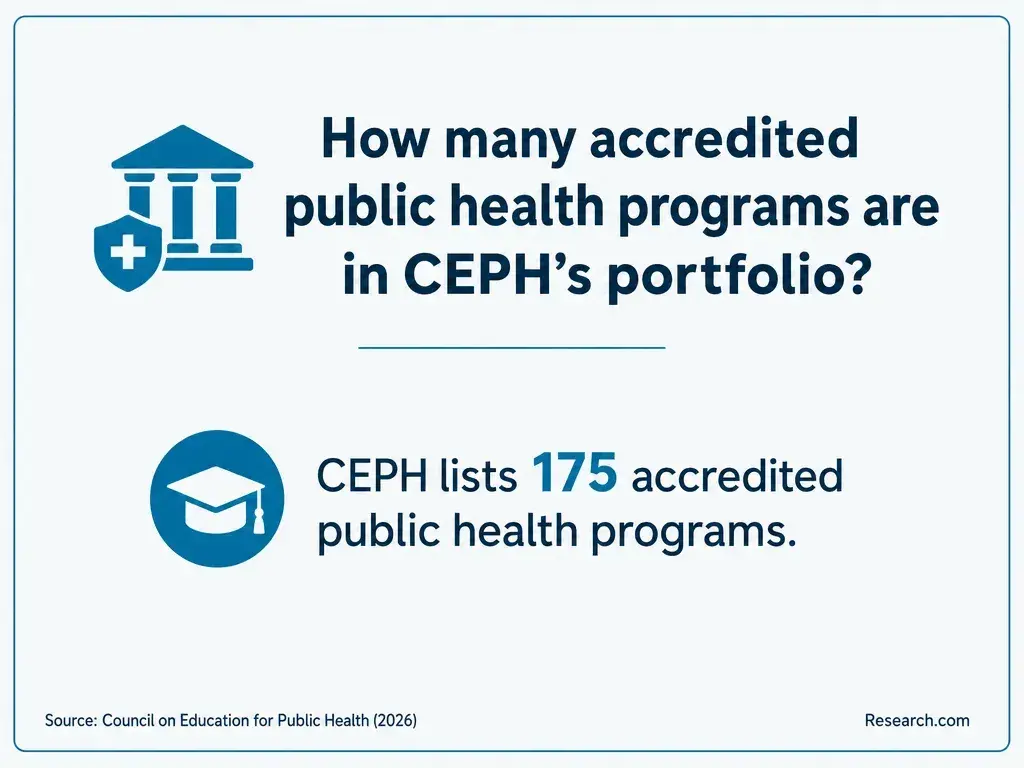
The Council on Education for Public Health (CEPH) accredits eligible public health schools and programs. Its review offers evidence that an accredited school or program meets public health education standards. It can also matter for specific jobs or certification pathways. Institutional accreditation and CEPH accreditation are different: a university's recognition does not establish that its public health degree is covered by CEPH.
Look up the school or program in CEPH's current directory, then confirm with the institution that the exact degree and entry term fall within its accreditation scope. Ask how that degree's applied learning is supervised and assessed. Do not assume that every degree offered by an accredited university - or every similarly named degree within a school - is covered.
Price does not answer that question. When choosing a budget-friendly online MPH, verify CEPH coverage and the curriculum before using tuition to break a tie between programs.
The most realistic move often builds on a function you already know. Outreach and partner coordination can support a move into program implementation; grant reporting can lead toward evaluation; and experience translating community concerns can strengthen policy or health communication work. Graduate study is most useful when it fills a specific gap between those responsibilities and the next job.
Potential paths include maternal and child health program specialist, health education specialist, evaluation associate, policy analyst, and - after appropriate methods preparation - epidemiologist or research analyst. Titles are not standardized. A program specialist may manage contracts and partners at one employer but mainly coordinate events at another. Epidemiology positions generally expect stronger quantitative and study-design skills than program-support jobs.
Before enrolling, collect several postings for your target role and separate required qualifications from preferences. Compare them with work you can document: a needs assessment you supported, an indicator you helped track, or a partner process you improved. Use career salary ranges for MPH degree holders as context, not as a forecast for a particular graduate or maternal health job.
An MPH typically develops population-health reasoning across epidemiology, biostatistics, social and structural determinants of health, policy, ethics, and program planning. For someone in maternal health support, the crucial step is applying those subjects to decisions: defining whom a program reaches, choosing useful measures, interpreting incomplete data, and working with communities without treating them merely as data sources.
Compare the depth of methods training with your target job. A coordinator seeking to monitor referrals may need sound data management and evaluation design. Someone aiming to analyze birth outcomes may need more advanced statistics, study design, and supervised analytical work; career-compatible online biostatistics study can help frame that more specialized choice.
Ask to see course descriptions and examples of permitted applied projects. A strong fit might let you develop an evaluation plan with defined indicators and a community partner, but access to records, approval to use data, and permission to share a deliverable must be established separately. Coursework alone does not demonstrate independent research competence.
Online delivery can make continued employment possible, but it does not eliminate scheduled classes, group meetings, fieldwork, or occasional campus visits. Campus study may make faculty contact and local partnerships easier to arrange, but commuting or reducing work hours can increase its effective cost. Neither format is inherently better for maternal health practice.
Ask each program for a sample term schedule and its rules for field placements near your home or workplace. Confirm who finds a site, whether an existing job can be used, what duties would count as new learning, and who approves the supervisor. Employer willingness, school approval, and permission to access or publish program data are separate decisions.
Delivery format and admission accessibility are separate, too. If you are comparing online MPH admission options for varied backgrounds, check scheduling and applied-experience requirements as carefully as entry criteria. An accessible application process does not make a program workable alongside a full-time maternal health job.
Master's programs generally require an eligible bachelor's degree and application materials set by the institution. They may request transcripts, a statement of purpose, recommendations, and evidence of preparation; prerequisites and entrance-test policies vary. An undergraduate major outside public health does not automatically rule you out. Describe your maternal health responsibilities precisely, including the populations served, partners involved, and decisions you helped inform - without claiming outcomes you cannot document.
For a methods-intensive MS, check statistics, mathematics, programming, or research prerequisites before applying. For an MPH, ask whether relevant work can strengthen the application and whether any foundational coursework must be completed before or after admission. DrPH applicants should also verify how the school defines qualifying practice and leadership experience.
If grades are a concern, review each school's stated policy rather than assuming one cutoff applies everywhere. Guidance on public health master's options after a weak GPA can help you plan how to document later academic preparation and professional growth; only the program can determine eligibility or grant an exception.
Full-time master's study commonly spans multiple academic terms; part-time study takes longer, and doctoral timelines depend heavily on progression and project requirements. Do not compare programs by advertised duration alone. Check required credits, course rotation, summer availability, and whether a practicum or thesis can be completed while employed.
For an apples-to-apples cost comparison, request an estimate for your intended enrollment pace. Include tuition and mandatory fees, travel or campus visits, fieldwork expenses, and any reduction in earnings. Ask whether your employer funds study, what grades or continued employment it requires, and whether funding must be renewed. University scholarships for online public health master's study may change a comparison, but an advertised award is not an individual aid offer.
A useful return-on-investment test is whether the degree develops qualifications for jobs you would actually pursue - not whether a broad public health salary figure exceeds tuition. A targeted course or employer-supported project may cost less if you need one skill rather than a new degree.
Public health is not one occupation, so no single salary describes its graduates. As one relevant benchmark, the U.S. Bureau of Labor Statistics reports a $83,980 median annual wage for epidemiologists in May 2024. That figure covers workers across employers and career stages; it is not an expected wage for a new MPH graduate or a maternal health program coordinator.
The bureau projects 16% employment growth for epidemiologists from 2024 to 2034. That projection describes an occupation, not the likelihood of landing a particular position. Entry requirements, local budgets, methods skills, and prior experience still matter.
When reviewing public health master's tuition and salary comparisons, check which occupation supplies each wage figure. For your decision, compare local postings for the role you want with your likely total education cost and the skills you can demonstrate on graduation.
Which public health certifications or licenses do graduates need?
Most nonclinical maternal health program, evaluation, and public health analyst roles do not have a single universal license. Employers may prefer particular credentials, but an MPH or MS does not itself confer one. Clinical work - such as practicing nursing, midwifery, medicine, or social work in a regulated capacity - has separate state licensing requirements that a public health degree does not replace.
The Certified in Public Health (CPH) credential and health education credentials such as CHES and MCHES have distinct eligibility and examination rules. Check the responsible certifying organization's current criteria and then compare them with target job postings before paying for an exam or choosing courses around it. If you are considering online MPH study without reference letters, remember that an application policy says nothing by itself about later certification eligibility; degree coverage and the certifier's rules are separate checks.
Other Things You Should Know About Public Health
Describe the decisions and processes you supported, not just your job title. Name your responsibilities in outreach, partner coordination, data reporting, or implementation, and distinguish your contribution from the team's results.
Usually only with the organization's permission and appropriate protection of confidential information. A redacted process map or independently written methods summary may be safer than sharing client records or unpublished results.
Choose the curriculum that closes your skill gap. A named concentration can be valuable if its courses and partners fit your goals; a broader MPH with strong evaluation training may serve you better if you expect to work across health topics.
Bring a proposed program, schedule, cost estimate, and explanation of how the training would benefit your work. Ask about reimbursement limits, approval deadlines, required grades, and any obligation to remain employed afterward.
- Competencies for Public Health Professionals | cdc.gov https://www.cdc.gov/infrastructure/training-professional-development/competencies-for-public-health-professionals.html
- Graduate | EducationUSA https://educationusa.state.gov/your-5-steps-us-study/finance-your-studies/graduate
- Accreditation in the U.S. | ed.gov http://www.ed.gov/laws-and-policy/higher-education-laws-and-policy/college-accreditation/accreditation-in-the-us
- Public Health (MPH) - Graduate Admissions | The University of Iowa https://grad.admissions.uiowa.edu/academics/public-health-mph
- Master of Public Health in Maternal and Child Health | umn.edu https://online.umn.edu/master-public-health-maternal-and-child-health
- MPH Concentration in Maternal and Child Health | University of Illinois Chicago https://publichealth.uic.edu/academics/public-health-degrees/master-public-health/mph-maternal-child-health/
- Graduate Employment Outcomes Dashboard | Johns Hopkins https://publichealth.jhu.edu/offices-and-services/office-of-student-affairs/career-services/graduate-employment-outcomes-dashboard
- MPH in Maternal & Child Health | Colorado School of Public Health https://coloradosph.cuanschutz.edu/education/degrees-and-programs/master-of-public-health/mph-in-maternal-child-health
- Admissions - Master of Public Health - The University of Chicago https://publichealth.bsd.uchicago.edu/about/admissions/
- Public Health Employment Outcomes | Columbia University Mailman School of Public Health https://www.publichealth.columbia.edu/become-student/career-services/public-health-employment-outcomes