2027 Public Health BS Admissions With a Three-Year International Diploma

Co-Founder and Chief Data Scientist
A three-year international diploma may qualify you to apply for a U.S. public health Bachelor of Science (BS), but it does not automatically count as a U.S. bachelor's degree - or as three years of transferable college credit. That distinction can change whether you need a BS, how much coursework remains, and what the degree will cost.
This guide is for international diploma holders comparing U.S. programs. It explains the admissions and credit decisions schools make, how study format affects immigration plans, and which documents to obtain before committing money or time.
Key Things You Should Know
- A three-year diploma can support a public health BS application, but the university decides whether it meets entry requirements and how its courses count.
- Three decisions matter separately, admission to the university, admission to the public health major, and application of accepted credits to BS requirements.
- Do not assume three years of prior study leaves one year to finish, obtain a course-level evaluation and degree audit before comparing cost or completion dates.
Can you pursue a U.S. public health BS with a three-year international diploma?
Yes, potentially. U.S. universities assess what your diploma represents in its education system, the institution that awarded it, and the coursework you completed. A three-year credential might be postsecondary study suitable for transfer review, an undergraduate degree a university considers comparable to a U.S. bachelor's, or a qualification that does not meet its transfer-entry rules. Its duration alone settles none of those questions.
First establish whether another BS is necessary. If a university recognizes your diploma as comparable to a completed bachelor's degree, a second undergraduate degree may be an expensive route to your goal. Ask whether you are eligible for graduate admission instead; building a realistic online MPH application list still requires checking each school's credential-equivalency policy. If the diploma is not treated as a bachelor's, a BS may be the appropriate pathway, subject to the school's admission and credit decisions.
Also check whether your target university accepts applicants seeking a second bachelor's degree if it regards your diploma as a completed first degree. That policy is distinct from transfer-credit eligibility.
What admission requirements apply to international diploma holders seeking a public health BS?
Requirements vary by university and entry route. Undergraduate admissions may ask for official secondary and postsecondary records, proof that the awarding institution is recognized in its home system, English translations, and an approved credential evaluation. Schools may also require evidence of English proficiency, with exemptions determined by their own policies. Ask whether you should apply as a first-year student, a transfer student, or a second-degree applicant before ordering an evaluation.
Admission to the university does not necessarily grant entry to the public health major. Some departments have separate applications or require introductory statistics, science, or other courses before students can declare the major. A prior course may satisfy an admission prerequisite yet fail to satisfy a BS degree requirement.
Before applying, assemble records that allow both admissions and faculty reviewers to assess your work:
- Official transcripts showing courses, grades, credit values, and grading scale, plus the diploma or completion certificate.
- Certified translations where required and detailed syllabi for courses you hope will satisfy statistics, laboratory, general-education, or major requirements.
- Any requested credential-evaluation report and evidence of English proficiency or eligibility for an exemption.
If your credential is judged bachelor's-equivalent, graduate prerequisites become a separate question; applying to an MPH with incomplete prerequisites is not the same as qualifying for undergraduate transfer admission. Get the relevant policy from the undergraduate admissions office and the public health department rather than relying on a general international-applicant checklist.
How do universities evaluate a three-year international diploma for transfer credit?
The receiving university has final authority over transfer credit. It may use an outside evaluator to describe your credential and recommend U.S. credit equivalencies, but its registrar and academic department decide what to award and how those credits apply. The table separates outcomes that are often mistakenly treated as one decision.
| Decision | What it establishes | What it does not establish |
| Institutional admission | You may enroll under a specified applicant category. | That prior courses count toward graduation. |
| Transfer-credit award | The university accepts identified prior courses or credits. | That they fulfill public health major requirements. |
| Requirement placement | Accepted credits fulfill specified general-education, prerequisite, elective, or major requirements. | That no additional residency or upper-level courses remain. |
| Graduation audit | The university identifies requirements still outstanding. | That courses will be available in every desired term. |
Course content, contact hours, laboratory work, grades, and the institution's policies can affect equivalency. Where the prior school uses a different credit system, the receiving school determines the conversion. Even a substantial credit award may leave a long sequence of required public health courses, university general education, or credits that must be earned in residence.
Request a written, course-level evaluation and a public health degree audit, then ask how to appeal any disputed equivalency with a syllabus. If your diploma is recognized as a bachelor's, compare the remaining BS requirements against graduate options, including lower-cost Master of Public Health study online. Graduate admission is not automatic, but this comparison can prevent an unnecessary second degree.
First verify that the university holds recognized institutional accreditation. Then check whether the particular public health bachelor's program is included in accreditation by the Council on Education for Public Health (CEPH). CEPH can accredit public health schools, programs, and standalone baccalaureate programs; a university's institutional accreditation, or CEPH accreditation of a different unit, does not establish that your BS is covered.
Confirm the exact degree name and accredited unit against the accreditor's listing and the school's current program information. CEPH status can matter if you want an externally reviewed public health curriculum or later pursue credentials with program-specific eligibility rules. It does not guarantee transfer credit, professional certification, employment, or entry to graduate school. If you later compare public health master's programs accredited by CEPH, check their accreditation scope separately from that of the undergraduate degree.
A public health BS generally introduces population health and prevention, epidemiology, biostatistics, environmental health, health policy, social and behavioral influences on health, and ethical community engagement. Programs differ in how much science, quantitative work, and applied learning they require. A BS course in epidemiology can build the ability to interpret patterns of disease without providing the depth expected of an epidemiologist in a specialist role.
For a diploma holder, course sequencing matters as much as subject coverage. Statistics or science prerequisites may need to be completed before upper-level courses, and a capstone or internship may have its own eligibility rules. Compare your syllabus-based transfer evaluation with the BS course sequence to find gaps early. If your longer-term aim is intensive statistical analysis rather than generalist public health work, compare the undergraduate preparation you still need with the entry expectations of biostatistics graduate programs for busy professionals; the two offer different levels of methods training.
Neither format is universally better. Online study may let you remain in your home country and avoid relocation, but a university must permit enrollment from your location. Check time-zone requirements for live classes, access to learning platforms, payment arrangements, and whether you can complete any required internship or project locally. "Online" does not necessarily mean self-paced.
Campus study may offer easier access to faculty, student services, and local field placements, but it brings relocation costs and immigration requirements. Admission to a university is separate from eligibility for a visa; online enrollment does not itself provide U.S. immigration status or work authorization. If studying in the United States is essential to your plan, ask the university's international student office whether the specific program and enrollment pattern can support the applicable student-status requirements.
Compare schedules and required visits before comparing advertised prices. A guide to online public health cost-duration tradeoffs can help frame that comparison, but your transfer audit, not a program-wide estimate, determines which courses you still need.
A full U.S. bachelor's degree is commonly planned as four years of full-time undergraduate study, but that is not a reliable estimate for someone with a three-year diploma. Your remaining time depends on credits the university accepts, where they fit in the degree, prerequisite order, required university coursework, and when needed classes are offered. A diploma with many accepted electives can leave more time to completion than a smaller set of credits that satisfies key requirements.
Likewise, no single tuition figure describes your likely cost. Obtain the university's current international or nonresident tuition rate and fees for your intended enrollment format, then calculate costs using the remaining courses in your degree audit. Include credential evaluation, translations, required technology, health insurance if applicable, travel or relocation, and any unpaid fieldwork. Ask about scholarships or aid for your applicant category rather than assuming U.S. domestic-student aid applies.
Use a public health bachelor's affordability guide to identify programs worth investigating, then compare school-issued estimates for the remaining degree. The lower advertised tuition rate may not yield the lower total cost if fewer diploma courses apply or required classes delay graduation.
A public health BS can prepare you to seek entry-level work supporting health programs, community outreach, health education, data collection, or program evaluation. Job titles and minimum qualifications vary. Employers may value evidence that you can work respectfully with communities, explain health information clearly, maintain accurate records, and contribute to a supervised project - not just the degree title.
Seek an internship, approved capstone, or other experience that produces work you can describe without disclosing confidential information. A BS alone does not qualify someone for clinical practice, senior management, or a specialist epidemiologist position. If your goal is academic public health research, further study and research experience are usually more relevant than treating the BS as a direct route to doctoral admission. Even when reviewing selectivity in public health doctoral study, examine research fit and preparation rather than assuming an accessible admissions pathway makes a doctorate the right next step.
For jobs based in the United States, distinguish academic eligibility from the legal right to work. An employer's interest and a U.S. degree do not by themselves provide employment authorization.
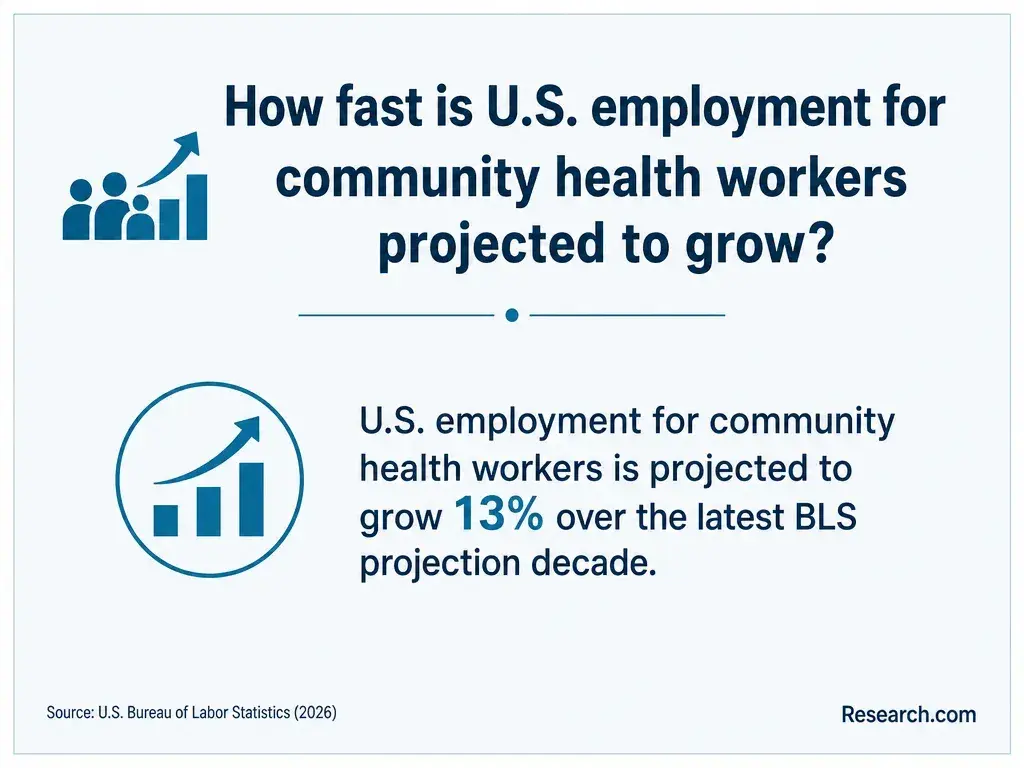
There is no dependable single salary or growth rate for "public health BS graduates": public health is a field of study, not one occupation. The U.S. Bureau of Labor Statistics reports wages and projected employment by occupation, such as community health worker or health education specialist. Those occupation-wide figures include workers with differing degrees, experience, employers, and locations, so they are not a starting-salary forecast for your BS.
Choose a target job title first, check its current Bureau of Labor Statistics occupational profile, and compare actual job postings for degree, experience, language, and work-authorization requirements. When weighing future education, do not treat broad earnings comparisons - including affordable public health graduate study and earnings - as proof that an additional credential will increase your pay. Its value depends on the role you can realistically pursue and the cost of qualifying for it.
Which certifications or graduate degrees improve public health career opportunities?
Choose additional education only after identifying a role's requirements. The Certified in Public Health (CPH) and health education credentials such as Certified Health Education Specialist (CHES) have their own eligibility and examination rules; a public health BS does not award them automatically. Confirm current eligibility with the certifying organization, including whether it accepts your particular degree and coursework.
An MPH may make sense for professional public health practice roles requiring graduate preparation. A methods-focused master's degree may be better for a quantitative goal, while a PhD is a research-training commitment rather than a routine step after a BS. If doctoral research eventually fits your goals, compare funding and supervision alongside lower-cost public health PhD degree pathways. For an immediate entry-level goal, relevant supervised experience or targeted skills training may offer more direct value than another degree.
Other Things You Should Know About Public Health
Follow the evaluator's and university's instructions exactly. Many require records sent through an approved channel by the awarding institution; sending your own copies may not satisfy the requirement. Keep personal copies of all documents.
Some universities allow an application to start with an evaluation pending, but may not make a final decision until it arrives. Ask admissions for its deadline and whether a preliminary review is available.
Do not assume so. Ask whether the school requires a certified translation, who may prepare it, and whether the original-language record must accompany it.
Ask your former institution for an archived description or official outline, then ask the receiving department what alternative evidence it accepts. Without enough detail, it may award elective credit rather than a specific course equivalency.
- English Proficiency Information - Office of Admissions https://admissions.tc.umn.edu/admissions/international-admission/english-proficiency-information
- How Do Transfer Credits Work When You Go Back to School? | Whitworth Online https://online.whitworth.edu/news-articles/how-do-transfer-credits-work-when-you-go-back-to-school/
- Frequently Asked Questions - Transfer Student Success https://transferstudents.fsu.edu/frequently-asked-questions
- Undergraduate Admissions | uci.edu https://publichealth.uci.edu/admission/undergraduate-admissions/
- Transfer of Credits | Bryan University https://catalog.bryanuniversity.edu/transfer-of-credits
- Undergraduate Admissions | umich.edu https://sph.umich.edu/undergrad/apply/
- Agencies That Certify Foreign Degrees | Dallas College https://www.dallascollege.edu/hr/foreign-degrees/