2027 Choosing Public Health BS Coursework for Family Support and Home Visiting Programs

Co-Founder and Chief Data Scientist
Family support and home visiting programs need staff who can build trust with families, recognize when to make a referral, and document services responsibly. A public health BS can develop those skills, but course titles alone will not show whether a program prepares you for the work.
This guide is for prospective and current undergraduates choosing courses, field experiences, and a degree pathway. It explains what to prioritize, what to verify with schools and employers, and when a more direct route into supervised family-support work may make sense.
Key Things You Should Know
- Prioritize maternal and child health, child development, communication, social determinants of health, and program evaluation; pair them with supervised family-facing experience.
- Home visiting roles vary by program model and employer: a public health BS can support entry-level work, but it does not provide a nursing or social work license.
- A bachelor's degree commonly takes about four years of full-time study; compare each school's actual remaining requirements, placement schedule, and total cost before enrolling.
What is a public health BS for family support and home visiting careers?
A public health Bachelor of Science studies health at the population level: why health outcomes differ, how prevention programs work, and how communities and services can respond. In family support, that perspective helps a graduate understand the conditions affecting parents, caregivers, infants, and children while working within the boundaries of a specific home visiting role.
Home visiting generally means planned visits with families to offer education, support, screening or referral, and connections to services under a defined program model. The visitor's tasks depend on the employer, funding requirements, model, and position. A BS does not authorize clinical assessment, therapy, or other licensed practice. If your goal is nursing care or clinical social work, compare those qualifying degrees first. Graduate specialization choices in public health graduate study are a later decision, not a substitute for checking the qualifications of the job you want now.
What coursework prepares public health students for home visiting programs?
Choose a combination of population-health knowledge, interpersonal skills, and basic evaluation skills. The table shows what to look for in course descriptions; it does not imply that every BS offers these subjects as separate courses or an official home visiting concentration.
| Course area | Relevance to home visiting | Limit to recognize |
| Maternal and child health; child development | Provides context for family well-being and developmental concerns | Does not qualify a student to diagnose a condition |
| Community health; social and behavioral sciences | Explores family strengths, structural barriers, and prevention | Classroom knowledge does not replace relationship-building practice |
| Health communication; interviewing | Supports listening, plain-language education, and referrals | Role-play is not the same as supervised family contact |
| Epidemiology; introductory statistics; evaluation | Helps staff interpret needs data and monitor program activities | Introductory courses do not establish advanced analyst competence |
For most entry-level family-facing roles, sound data literacy is more useful than an advanced statistical sequence at the expense of communication or fieldwork. Students seeking research or specialist analytic roles may eventually consider online biostatistics master's programs for working professionals, but that is a different preparation goal.
How do you choose an accredited public health BS program?
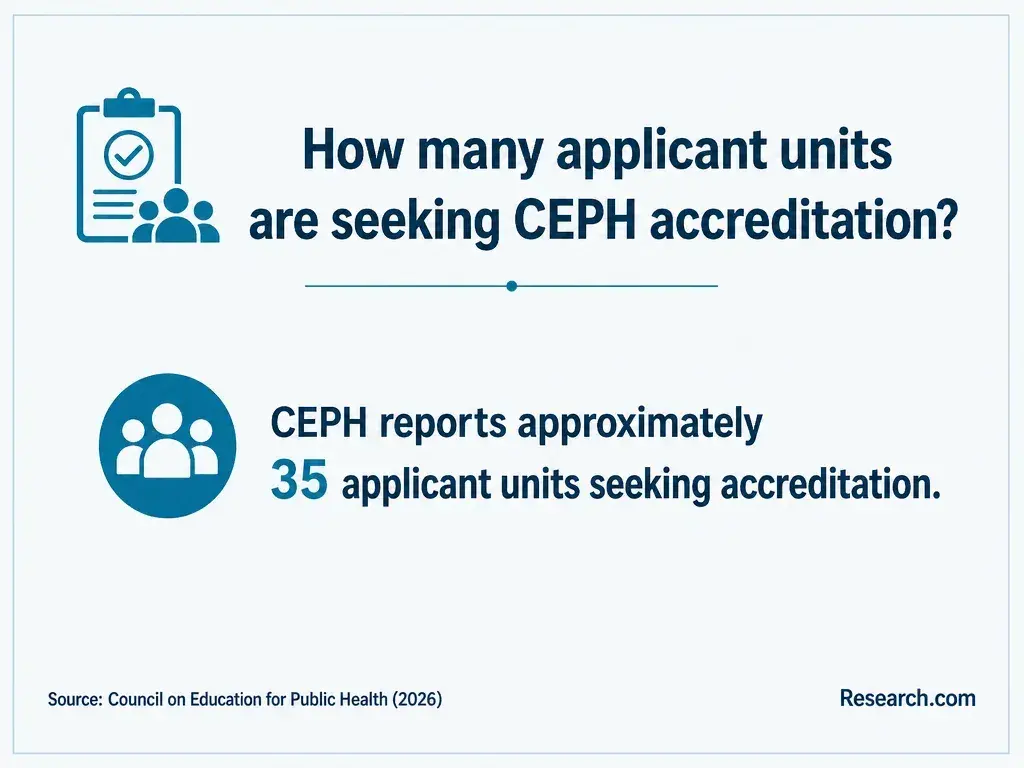
First confirm that the institution holds recognized institutional accreditation. Then check the Council on Education for Public Health (CEPH) directory and the school's published accreditation information for the exact public health unit or program and degree under consideration. Institutional accreditation and CEPH accreditation answer different questions; do not infer that every degree at a university is within CEPH's scope.
Accreditation is only one filter. Request the current degree plan and ask when maternal and child health electives run, who arranges placements, whether local family-serving agencies accept students, and what recent graduates actually did. A program with a relevant elective but no feasible supervised experience may be a weaker fit than one with a strong community partnership. If you later start comparing lower-tuition MPH programs, check their accreditation scope separately rather than assuming your BS school's status carries over.
Beyond broad BS requirements, select electives for the service decisions you expect to encounter. Maternal and child health can introduce prevention across pregnancy, infancy, and childhood. Child and family development provides context for age-appropriate education. Health equity, housing or food security, and health policy can clarify why a referral may be difficult to use even when a service exists.
Look closely at what a course teaches students to do. A useful program-planning or evaluation course might cover logic models, referral follow-up, respectful survey questions, and interpreting incomplete service data. Trauma-informed practice, disability inclusion, and culturally responsive communication may appear in public health, social work, education, or interdisciplinary electives; verify their availability and prerequisites. Coursework on research is distinct from direct service: online epidemiology doctoral funding options would matter only to someone pursuing a substantially different, advanced research path.
Programs may offer internships, community projects, service learning, or a capstone, but the school determines which experiences earn credit. For home visiting preparation, seek approved work with a family resource center, maternal and child health agency, early-childhood organization, or home visiting provider. Appropriate student tasks might include observing with permission, preparing educational materials, mapping referral resources, or helping evaluate a service process under supervision.
Before accepting a placement, ask the academic coordinator and host site who will supervise you, what contact with families is permitted, how travel and scheduling work, and which deliverable meets degree requirements. Family records are not automatically available for coursework or a portfolio; confirm confidentiality, data-use, and any required institutional review before collecting or sharing information. An unpaid placement also has a real opportunity cost. Graduate university awards for online public health graduate education should not be assumed to fund a bachelor's placement.
Yes, if the online program offers relevant coursework and a workable way to complete supervised experience near you. Online classes can help students who work or care for family members, but live sessions, group projects, daytime placements, and required campus visits can still constrain the schedule. Ask for a sample term calendar, not just an "online" label.
Confirm who finds and approves a local site, whether a placement can occur with your current employer, and how faculty assess practical skills. An accelerated schedule may shorten calendar time while increasing weekly demands; public health bachelor's accelerated study schedules are worth comparing only against the time you can realistically reserve for classes and fieldwork.
Requirements depend on whether you are applying as a first-year student, a transfer student, or a current student seeking entry to the major. A school may admit you to the university before you qualify for upper-division public health courses. Check its published requirements for prior coursework, GPA, statistics or science prerequisites, and application deadlines.
Transfer applicants should request a written degree evaluation showing not only which credits are accepted but which satisfy general education, major, prerequisite, and residency requirements. Ask which office can approve substitutions and whether required courses are offered in the term you need them. Entry flexibility in public health master's programs follows different admissions rules and should not be used to predict BS admission or credit decisions.
A full-time bachelor's pathway commonly spans about four years; transfer credits, part-time enrollment, prerequisite order, and internship availability can change the finish date. Obtain a term-by-term degree plan from each school before comparing advertised completion times.
For cost, request an estimate covering tuition and mandatory fees across your remaining terms, then add books, travel, placement-related expenses, and any income you would forgo during fieldwork. Compare aid eligibility and the cost of staying enrolled if a required course is delayed. If you already hold a bachelor's degree, a second BS may be less direct than relevant employment, targeted coursework, or - in roles that call for it - inexpensive online public health master's options. Make that comparison against actual job requirements, not a promised earnings return.
Look at duties and eligibility rather than title alone. The table distinguishes plausible early-career targets from roles that commonly require different credentials or substantial experience; an individual posting controls the actual requirements.
| Role type | Typical work | Qualification question |
| Family support or home visiting worker | Builds relationships, provides approved education, documents visits, and connects families with services | Does the program model require specific training or prior family-service experience? |
| Community health worker | Helps people navigate services and communicates community needs | Does the state or employer require a credential? |
| Program assistant or coordinator | Supports scheduling, outreach, reporting, and partner communication | How much independent responsibility and experience are expected? |
| Nurse or clinical social worker in home visiting | Performs duties within a licensed clinical scope | Which professional degree and state license are required? |
A strong first application can pair coursework with a supervised project that demonstrates communication, referral knowledge, and careful documentation. Management and research-leadership positions usually demand more experience or advanced preparation. Weigh public health doctoral program cost-benefit considerations only if those later responsibilities become your actual goal.
What certifications and salaries apply to home visiting professionals?
There is no single certification that licenses every US home visitor. Employers may require training in a particular home visiting model, safeguarding, documentation, or other procedures. Community health worker certification varies by state; CHES eligibility depends on the certifying organization's rules. Neither a public health BS nor CHES replaces a nursing or social work license. Check the job posting and the responsible credentialing body before paying for training.
Salary comparisons need the same care. The US Bureau of Labor Statistics publishes occupation-wide wage and outlook information for community health workers and health education specialists, but "home visitor" may not map neatly to either occupation. Those figures are not starting salaries for BS graduates and do not capture every local nonprofit pay scale. Compare the duties, location, hours, benefits, and advancement terms of real openings. Understanding salary variation after an MPH may help with a later graduate-degree decision, but MPH-wide figures should not be used to estimate pay for a BS-level home visiting offer.
Other Things You Should Know About Public Health
Language skills can be valuable, but fluency alone does not qualify someone for a role. Ask employers how they assess proficiency, provide interpretation support, and train staff to stay within their responsibilities.
That depends on the employer, program model, and stage of training. Before accepting a position, ask about shadowing, visit protocols, supervisor availability, travel expectations, and safety procedures.
No. Models differ in whom they serve, visit frequency, staff qualifications, and required practices. Learn the model used by a prospective employer rather than assuming one internship prepares you for every program.
Keep work samples you are authorized to share, such as a resource guide or a deidentified, approved project summary. Remove family information and obtain permission before presenting materials created for a host organization.
- Social Determinants of Health (SDOH) | cdc.gov https://www.cdc.gov/about/priorities/why-is-addressing-sdoh-important.html
- FERPA | Protecting Student Privacy - Department of Education https://studentprivacy.ed.gov/ferpa
- Maternal, Infant, and Early Childhood Home Visiting (MIECHV) Program | MCHB https://mchb.hrsa.gov/programs-impact/maternal-infant-early-childhood-home-visiting-miechv-program
- Bachelor of Science in Public Health Online | SDSU Global Campus https://globalcampus.sdsu.edu/program/health-care/public-health-online-degree-completion/
- Public Health (BS) | University of North Texas https://pahs.unt.edu/academics/public-health-bs.html
- Bachelor of Science in Public Health | sfsu.edu https://publichealth.sfsu.edu/bs-public-health
- Family Home Visiting Program | state.mn.us https://www.health.state.mn.us/communities/fhv/index.html