
2027 MPH vs MS in Psychology for Behavioral Prevention Research

Co-Founder and Chief Data Scientist
Behavioral prevention research sits between two disciplines: psychology helps explain behavior, while public health tests how prevention strategies work across populations and settings. If you are choosing a graduate degree for this work, the better option depends less on its label than on the questions you want to study and the research experience you can gain. This comparison is for prospective researchers and career changers weighing an MPH against an MS in psychology. It will help you identify the curriculum, supervision, and project opportunities worth checking before you enroll.
Key Things You Should Know
- Choose an MPH when your target work centers on population-level prevention, community partnerships, implementation, or evaluation in public health settings.
- Choose an MS in psychology when you need deeper training in behavioral theory, measurement, experimental design, or preparation for psychology-focused doctoral research.
- Neither degree alone qualifies you to practice as a psychologist or guarantees a research job. Compare supervised projects, methods courses, total cost, and employer requirements before deciding.
What Is the Difference Between an MPH and MS in Psychology for Behavioral Prevention Research?
Behavioral prevention research investigates how to prevent health problems by changing conditions, services, or behaviors. A study might examine whether a community-designed intervention improves participation in a smoking-cessation program, why participation differs across neighborhoods, or how a health system can deliver the intervention reliably.
An MPH is a professional public health degree. Its usual frame is the population: who is reached, how an intervention is implemented, and whether outcomes differ across groups or settings. An MS in psychology generally approaches the work through psychological constructs and research methods, such as motivation, decision-making, behavior change, and measurement. Neither description substitutes for examining a particular program's courses and faculty.
The distinction matters even before graduate school. Applicants still choosing a major can use comparing public health undergraduate study options to explore one possible foundation; psychology, statistics, and other majors can also provide relevant preparation.
This table compares the degrees by the research decisions they commonly prepare students to make, not by prestige.
| Decision point | MPH | MS in psychology |
| Primary emphasis | Population health and prevention in real-world systems | Psychological processes and behavioral research |
| Likely strength | Community engagement, epidemiology, program planning, and evaluation | Theory, behavioral measurement, study design, and research specialization |
| Experience to seek | Approved applied work with a public health or community partner | Supervised lab or field research, ideally with a substantial analysis or thesis |
| Potential gap to address | Depth in psychological theory or experimental methods | Population-level methods, implementation, and public health systems |
Which Degree Better Prepares You for Behavioral Prevention Research Careers?
Choose by the work you want to do first. For evaluation or implementation research in a health department, nonprofit, or health system, an MPH with strong methods training and a relevant applied project is often the more direct route. For research on how an intervention changes cognition or behavior - and especially for psychology-focused doctoral study - an MS with an active research mentor may be stronger.
The degree label can reverse that recommendation. An MPH student who joins a prevention trial, learns longitudinal analysis, and produces a rigorous thesis may be better prepared for a research-assistant role than an MS student with little supervised research. Conversely, a research-intensive psychology MS can outperform a largely practice-oriented MPH for intervention-development work. Ask what students actually do with data, how faculty supervise them, and whether projects involve the population and setting you hope to study.
If independent research leadership is your eventual goal, investigate doctoral expectations separately; neither master's degree automatically leads to a principal-investigator position. A later comparison of online public health doctoral costs and professional opportunities may help with financial planning, but a public health doctorate and a psychology research doctorate serve different aims.
What Careers Can You Pursue With an MPH or MS in Psychology?
Both graduates may pursue research coordinator, project specialist, program evaluator, or research assistant positions. Responsibilities can include recruiting participants under an approved protocol, coordinating community partners, maintaining study records, analyzing permitted data, and reporting findings. An MPH may align particularly well with public health program evaluation or implementation roles; an MS in psychology may align with behavioral research teams and intervention studies.
Entry requirements depend on the job, not just the degree. Some research assistant positions accept a bachelor's degree plus relevant experience, while analyst roles may require demonstrated statistical skills. Epidemiologist positions often call for graduate-level epidemiology training that neither degree necessarily provides. Research directors and independent investigators generally need substantial experience and, often, doctoral preparation.
For a broader view of occupational pay - not a promise about either degree - see public health graduate salaries by career. Compare the tasks and qualifications in actual postings with your coursework, supervised work, and portfolio rather than assuming all behavioral research jobs share one pay scale.
An MPH commonly combines epidemiology, biostatistics, social and behavioral sciences, public health systems, and applied learning. An MS in psychology may devote more coursework to psychological theory, psychometrics, experimental or observational design, and a specialized research area. Program titles alone do not establish how advanced the statistics courses are or whether a thesis is available.
For behavioral prevention research, look for a sequence that lets you define an intervention, measure meaningful outcomes, evaluate effects without overstating causation, and examine who was reached. Depending on the project, useful training may include survey design, qualitative interviewing, longitudinal methods, causal reasoning, implementation science, and reproducible analysis. Ask to see course descriptions and recent student projects rather than counting course titles.
Applicants finishing an undergraduate degree should protect time for statistics and hands-on research preparation; planning an accelerated public health bachelor's workload is particularly relevant if a faster schedule would leave little room for those experiences. A short methods course or supervised research position may also close a specific skill gap more directly than a second degree.
Start by confirming that the institution has recognized institutional accreditation. For an MPH, check whether the Council on Education for Public Health (CEPH) accredits the school or program and whether the specific degree is within that accreditation's scope. Comparing accreditation across online MPH programs can help frame the search, but confirm each school's status directly with CEPH before applying.
An MS in psychology does not need CEPH accreditation merely because its research concerns health. Do not assume accreditation of a university, psychology department, or different degree covers the MS you are considering. For this nonclinical research goal, assess institutional accreditation alongside the program's faculty, research infrastructure, graduate outcomes, and any accreditation relevant to a different credential you might later seek.
Research and program-evaluation roles generally do not require a psychologist license simply because they study behavior. An MPH does not confer a clinical license, and an MS in psychology does not by itself qualify someone to practice independently as a licensed psychologist. Clinical assessment, diagnosis, and treatment are distinct from prevention research and are governed by state-specific professional rules.
Check a job posting and the relevant state board if your intended duties involve regulated services. For community outreach or program support without clinical duties, a master's degree may not be necessary at all; affordable public health BS study options may be more proportionate for someone who has not yet completed a bachelor's degree. If you already hold one, targeted training and supervised experience may be less costly than another degree.
Online study can preserve access to a current job or local community partner. Campus-based study may make lab meetings, faculty collaboration, and research assistantships easier to access. Neither format guarantees those advantages: an online program can have live sessions, fixed group meetings, and in-person fieldwork, while a campus program may offer few relevant projects.
Ask how students join research teams, who helps arrange applied placements, whether research supervision is available remotely, and when meetings occur. Confirm any campus visits, data-security requirements, and whether an online student can complete a thesis. If an online MPH fits your research interests, cost-conscious online MPH program choices provide a starting point for comparing price - after you establish that the needed mentorship and methods courses are available.
Both routes generally expect a bachelor's degree and an application showing readiness for graduate work, but prerequisites, tests, GPA policies, and research-experience expectations vary by program. MPH programs may value community or public health experience; research-oriented psychology MS programs may put greater weight on methods preparation, faculty fit, and evidence that you can carry out a study. An unrelated undergraduate major is not automatically disqualifying.
Before applying, compare each program's published requirements with your transcript and experience. If statistics or research methods are missing, ask whether a course completed before enrollment would satisfy the requirement. If grades are a concern, improving low-GPA MPH application prospects may help you plan evidence of recent academic readiness; only the individual program can determine admission or a waiver.
Completion time and cost depend on required credits, enrollment pace, tuition structure, and whether a thesis, applied experience, or research placement extends the schedule. A lower advertised tuition rate may not mean a lower total cost if mandatory fees, travel, unpaid fieldwork, or extra terms apply. Psychology MS applicants should also ask whether research assistantships are available and what funding, if any, is guaranteed.
Request an itemized estimate for the same enrollment pace at each school, including the likely completion term. Budget-conscious accelerated public health education can help identify shorter options, but speed has a cost if it prevents you from gaining the supervised research experience your target job requires.
What Are the Salary and Job Outlook Differences Between These Degrees?
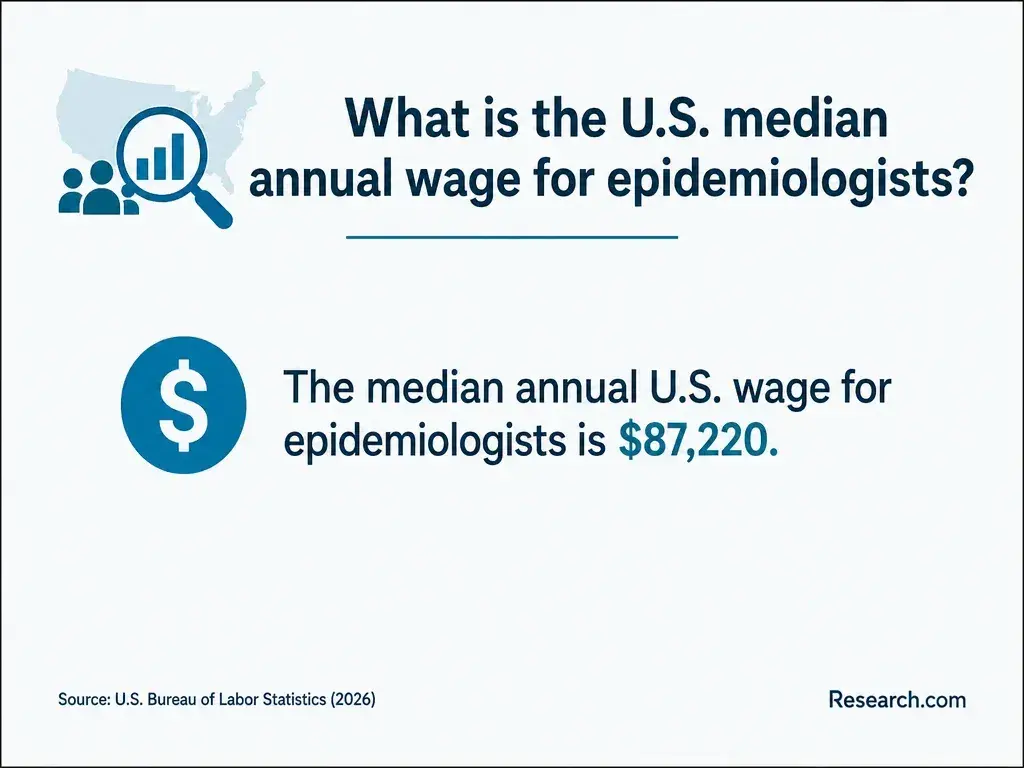
There is no reliable occupation-wide salary or job-growth figure that isolates MPH graduates doing behavioral prevention research from MS psychology graduates doing the same work. The U.S. Bureau of Labor Statistics reports outcomes by occupation, not by this degree comparison. A wage figure for an epidemiologist, for example, would describe that occupation - not the expected pay of everyone with an MPH or MS in psychology.
For a useful comparison, select the roles and locations you would actually pursue, then examine their posted qualifications and compensation. Consider whether the program gives you access to paid research work or requires unpaid experience. Comparing tuition with public health graduate outcomes can inform the MPH side of the calculation, but published earnings should not be treated as causal returns to a degree or as a comparison with psychology MS graduates.
The soundest choice is the affordable program that helps you demonstrate the methods, supervised work, and setting-specific experience your target employers seek. If you can build that evidence in your current role or through targeted training, a new degree may not be the necessary next step.
Other Things You Should Know About Public Health
Yes. Research teams also need people to coordinate recruitment, maintain protocols, work with partners, manage data responsibly, and communicate results. Those contributions can be valuable early research experience.
No. The purpose and design matter, and the classification may affect required oversight. Check your institution's review process and the partner's data and publication permissions before collecting or sharing information.
A concise, authorized example of your contribution: the question, your methods, your role, and the limits of the findings. Remove confidential information and obtain permission before sharing work produced with a partner or research team.
Seek a supervised role on a prevention study or evaluation, then note which tasks you want to do more deeply. That experience can clarify whether your gap is in public health practice, psychology research, or a narrower method.
- Master of Public Health Education in the United States Today | nih.gov https://pmc.ncbi.nlm.nih.gov/articles/PMC10467497/
- Community-Based Prevention - NCBI - NIH https://www.ncbi.nlm.nih.gov/books/NBK206935/
- Psychologist Licensure Snapshot | Department of State https://www.pa.gov/agencies/dos/department-and-offices/bpoa/boards-commissions/psychology/psychologist-licensure-snapshot
- MSPH vs. MPH: Which Public Health Degree Is Right for You? | Kent State Online https://onlinedegrees.kent.edu/college-of-public-health/community/msph-vs-mph
- 4 Careers With a Master's in Psychology | Notre Dame de Namur University https://www.ndnu.edu/articles/psychology/four-careers-with-a-masters-in-psychology.html
- What you need to know to get licensed | apa.org https://www.apa.org/gradpsych/2004/01/get-licensed
- Research Opportunities & Applied Practice Experience | Yale School of Public Health https://ysph.yale.edu/admissions-financial-aid/applied-practice-and-research/
- MS vs. MA in Psychology: Differences & How to Choose | ollusa.edu https://www.ollusa.edu/blog/ms-vs-ma-in-psychology.html
- MPH in Population Mental Health & Wellbeing | Colorado School of Public Health https://coloradosph.cuanschutz.edu/education/degrees-and-programs/master-of-public-health/mph-in-population-mental-health-wellbeing
- MPH Social and Behavioral Sciences | ufl.edu https://phhp.ufl.edu/academics/masters-programs/mph/mph-concentrations/mph-social-and-behavioral-sciences/


