2027 Public Health PhD Interviews: Explaining a Feasible Dissertation Question

Co-Founder and Chief Data Scientist
A strong dissertation idea can falter in a public health PhD interview if the applicant cannot explain how the study would actually be done. Admissions committees want to hear more than an important topic: they want evidence of a researchable question, appropriate methods, realistic data access, and a willingness to revise the plan.
This guide is for research-oriented applicants preparing to discuss an early proposal. It shows how to present a question without pretending that an advisor, dataset, or ethics approval is already secured - and how to judge whether a program can support the work.
Key Things You Should Know
- State one population, comparison, measurable outcome, and time frame; explain whether the proposed study estimates an association or could support a causal claim.
- Feasibility depends on three checks: plausible data access, suitable supervision, and a study that fits the program's dissertation and funding timeline.
- Bring a backup design if access or measurement fails. An interview proposal demonstrates research judgment, not a promise that the final dissertation question is fixed.
What makes a public health PhD dissertation question feasible?
A feasible dissertation question is narrow enough to investigate with available methods and time, yet substantial enough to contribute to public health knowledge. In an interview, distinguish importance from researchability: a major health problem does not, by itself, identify a population, comparison, outcome, or credible source of evidence.
For example, an applicant interested in hypertension could propose studying whether completion of an initial community health worker visit within 30 days of referral is associated with documented blood-pressure control six months later among patients at participating clinics. This is an illustrative question, not a claim about an existing dataset or result. The applicant should explain that patients who complete visits may differ from those who do not, and that missing follow-up measurements could distort the comparison. Without a design that addresses those problems, the study should not be presented as proof that the visit caused better control.
Use this sequence to turn an interest into an interview-ready explanation:
- State the population, exposure or comparison, outcome, and measurement window in one sentence.
- Explain why answering the question would inform a public health decision or resolve a specific evidence gap.
- Identify a plausible data source and the variables it would need; separate public availability from access that would require permission.
- Name the principal threats to interpretation, such as confounding, missing records, or inconsistent outcome measurement, and a defensible way to assess them.
- Describe a narrower backup question if access, sample size, or follow-up data prove inadequate.
Then connect the proposal to faculty whose published work and methods fit the question. Ask about supervision capacity rather than assuming a named professor will advise you. Clinic records, partner data, interviews, and identifiable information may also require data-use agreements, institutional review, consent, or community permission; an interview cannot settle those approvals. If methods preparation is the weak point, lower-cost epidemiology research training and aid may be worth comparing before committing to a doctoral project.
How does a public health PhD differ from a DrPH?
A public health PhD generally trains students to produce original research, while a DrPH generally emphasizes advanced practice and leadership. Both can demand rigorous inquiry, but they may judge the same interview idea differently.
This comparison helps determine whether the proposed question and intended career match the degree:
| Consideration | Public health PhD | DrPH |
| Central aim | Develop and test a scholarly research contribution | Address a consequential public health practice or leadership problem |
| Typical project emphasis | Research question, methods, theory, and contribution to evidence | Organizational or population-health application and usable change |
| Interview evidence | Research reasoning, methods preparation, and faculty fit | Practice responsibility, leadership judgment, and project-site feasibility |
If the aim is to study why an intervention works across settings, a PhD may fit. If the immediate aim is to improve implementation within an organization you help lead, a DrPH - or targeted evaluation training - may be more direct. Actual dissertation and applied-project rules vary by school. Compare doctoral public health costs and pay alongside project expectations rather than choosing by degree label alone.
What accreditation should public health PhD applicants verify?
Verify the university's institutional accreditation and check whether the school, unit, or program has Council on Education for Public Health (CEPH) accreditation. CEPH accreditation of a school does not automatically establish that every doctoral degree has the same accreditation status or scope. Ask the institution to identify exactly what is accredited and confirm it against the accreditor's current listing.
For dissertation feasibility, accreditation is a baseline check, not a substitute for examining faculty availability, research infrastructure, and doctoral completion policies. If an MPH is also under consideration, comparing CEPH-accredited MPH options addresses a different credential decision; an MPH listing should not be used as proof about a PhD.
Requirements vary by program and specialization. Applicants commonly need to document prior academic preparation, research interests, recommendations, and evidence that they can undertake advanced methods work. A master's degree, thesis, publication, GRE score, or prior public health major may be required by a particular program, but none should be assumed universal.
For the interview, separate eligibility from readiness. A transcript may satisfy entry rules while leaving a gap in statistical modeling; conversely, substantial research work can demonstrate skill that a course title does not capture. Prepare to describe your contribution to a prior project, a methodological choice you made, what you learned from a limitation, and which skills you still need to develop. Applicants weighing applying to an MPH with incomplete prerequisites should check that program's rules separately; admission to a master's pathway does not establish PhD readiness.
Coursework depends on the field but may include epidemiology, biostatistics, causal inference, qualitative or mixed methods, research ethics, and subject-specific theory. Students also typically progress through supervised research and program-defined milestones before and during dissertation work. The interview question should reveal which methods the applicant can already use and which ones the proposed study would require them to learn.
Foundational public health coursework is not interchangeable with doctoral research training. Someone exploring accelerated courses in public health bachelor's study can use that route to build background knowledge, but should not treat a faster introductory sequence as preparation for an advanced analytic design. Ask prospective programs whether the required methods courses, research groups, and advising structure support your particular question.
Online delivery can support doctoral study, but the decisive issue is whether it supports the research. Check how often students meet advisors, whether methods courses require live attendance, how committees are formed, and whether campus visits, residencies, teaching, or local data collection are required. A remote applicant also needs a realistic route to data access and approvals; online enrollment does not create permission to use an employer's records.
Credibility should be evaluated through accreditation, named faculty expertise, dissertation expectations, and evidence of student support - not format alone. Admissions conveniences offered by online graduate public health options without letters, for example, do not answer whether a PhD program can provide sustained research supervision.
Completion time depends on coursework, examinations, dissertation scope, data access, and the school's progression rules. A project that depends on a new partner agreement or years of prospective follow-up may extend beyond the available funding period. Ask when students normally select advisors, advance to candidacy, and begin collecting or analyzing dissertation data; request the program's published completion outcomes where available.
Compare written funding terms rather than advertised tuition alone. Check guaranteed support, renewal conditions, stipend and health-benefit provisions, summer coverage, teaching or research duties, fees, travel, and any charges after funding ends. A lower tuition figure can be less attractive if it comes with weaker support or a data-intensive dissertation that takes longer. Use economical routes to a public health PhD as a starting point, then obtain a current, program-specific funding offer before deciding.
A PhD can prepare researchers for academic appointments, research institutes, government science roles, health systems, and policy or evaluation teams. The work may involve designing studies, securing funding, managing data and collaborators, publishing findings, or communicating evidence to decision-makers. Job eligibility still depends on specialization, research output, methods skills, and employer requirements; a doctorate alone does not confer clinical licensure or a faculty appointment.
Use the interview question as a career-fit test. If you want to build an independent research agenda, ask whether the program offers mentorship and opportunities to develop that record. If your goal is to implement established interventions rather than lead original research, public health graduate programs with accessible entry may offer a more direct starting point, depending on your experience and the roles you seek.
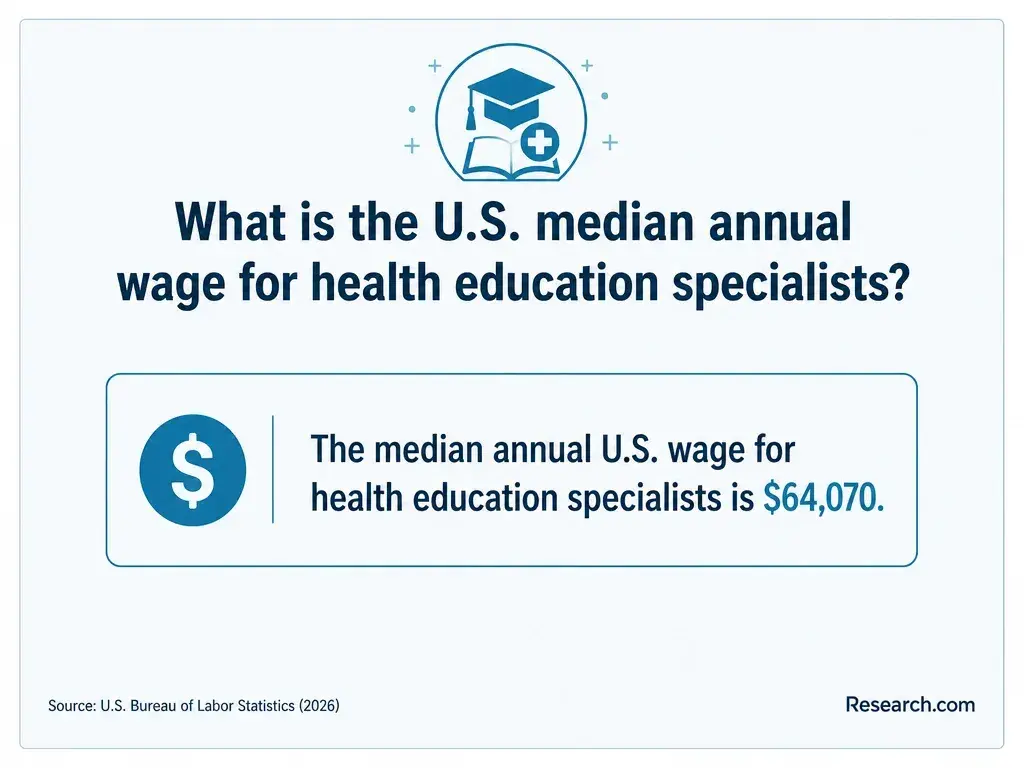
There is no reliable single salary for "public health PhD graduate." Pay depends on the occupation, employer, location, experience, and whether the position is a training appointment, a staff research role, or a senior investigator role. U.S. Bureau of Labor Statistics wage figures describe occupations - not the earnings of people with a particular degree - and some relevant roles do not require a PhD.
Before using salary in a return-on-investment calculation, identify the jobs you would realistically pursue and compare their posted qualifications and compensation with the funding and time the PhD would require. For practice-oriented roles that accept a master's degree, affordable online MPH degree programs may warrant comparison; paying for more education is not automatically associated with higher pay in the job you want.
What is the job outlook for public health PhD careers?
Job outlook must be tied to a defined occupation. Federal projections for epidemiologists, statisticians, and postsecondary teachers describe different labor markets and cannot be combined into a single forecast for PhD graduates. Academic research jobs also depend on grants, institutional hiring, and the applicant's specialty, so broad occupational growth cannot predict an individual offer.
Assess demand by reviewing openings for the methods and topic you propose to study, noting required experience and whether the employer asks for a doctorate. If the openings that appeal to you chiefly require applied public health skills rather than independent scholarship, affordable online public health degrees or supervised work experience may be a better next investment. A feasible dissertation question matters most when it advances a research career you actually want.
Other Things You Should Know About Public Health
Not necessarily. Research interests often change with coursework, advising, and evidence about available data. Present the idea as a well-reasoned starting point, and ask how the program approves a final proposal.
Yes, if you clearly distinguish your contribution from the team's work and respect any confidentiality or unpublished-work restrictions. Do not imply ownership of shared data or ideas you are not authorized to use.
Follow the program's instructions. If materials are optional, a brief outline can help you organize your thinking, but be ready to explain the question conversationally without reading from it.
Explain your reasoning, acknowledge the limitation, and consider the alternative they raise. A thoughtful revision usually demonstrates more research readiness than defending an untenable claim.
- Institutional Review Boards: Purpose and Challenges - PMC https://pmc.ncbi.nlm.nih.gov/articles/PMC4631034/
- Lesson 2: Ethical Considerations for Responsible Research | wisc.edu https://learn.library.wisc.edu/responsible-data/lesson-2/
- PhD Dissertation - Health Systems and Population Health https://hspop.uw.edu/healthservicesphd/program-experience/dissertation/
- Review Process - Human Research Protection Program https://hrpp.umich.edu/irb-health-sciences-and-behavioral-sciences-hsbs/irb-review-process/
- Chapter 5: Preparing a Proposal | Academic Research | CSUSB https://www.csusb.edu/academic-research/pi-handbook/chapter-5
- The importance of ethical considerations in research and clinical trials | Penn LPS Online https://lpsonline.sas.upenn.edu/features/importance-ethical-considerations-research-and-clinical-trials
- Demystifying the Public Health PhD Application Process | Boston University https://www.bu.edu/ewl/2025/06/09/demystifying-the-public-health-phd-application-process/