2027 Public Health BS Course Sequencing When Chemistry Is Offered Once a Year

Co-Founder and Chief Data Scientist
If your public health BS requires chemistry but offers it only once a year, missing one enrollment window may affect several later courses - not just chemistry itself. This guide is for incoming, transfer, and returning students building a graduation plan around that constraint.
You'll learn how to identify the courses chemistry actually unlocks, place it in a workable sequence, and check alternatives before paying for a course elsewhere or assuming a later graduation date.
Key Things You Should Know
- Find the next chemistry offering and every course that requires it; an annual course can create a wait of up to an academic year if no approved alternative is available.
- Confirm whether the requirement includes a laboratory and obtain written approval before taking chemistry at another institution; transferable credit may not satisfy the BS requirement.
- Build the plan backward from capstone, internship, and graduation terms, using an official degree audit rather than the catalog alone.
How Should You Sequence a Public Health BS When Chemistry Is Offered Annually?
Put chemistry in the earliest term in which you are eligible to take the exact required course, then schedule its dependent courses afterward. Start with the catalog and course schedule for your entry term. Confirm whether "chemistry" means a particular general, introductory, or applied chemistry course; whether a separate lab is required; and whether math or another science is a prerequisite.
Next, work backward from courses with their own limited availability. A capstone may require senior standing, while an environmental health course may require chemistry and be offered only in spring. If chemistry runs only in fall, taking it in the wrong fall - or overlooking a prerequisite needed to enroll - can change when you can take both courses.
A reliable sequence has four checks:
- Mark the next scheduled chemistry and lab sections, including enrollment restrictions and seat availability.
- Trace every prerequisite and corequisite from chemistry through upper-division courses and the capstone.
- Place statistics, introductory public health, general education, and other independent requirements in terms where they fit without overloading the chemistry term.
- Ask an academic advisor to confirm the plan against your official degree audit and the department's expected course rotation.
Keep future graduate-school prerequisites separate from this undergraduate plan. Some students later explore starting public health graduate study with prerequisite gaps, but that possibility does not waive a requirement for your current BS.
What Courses Are Required for a Public Health Bachelor's Degree?
Requirements vary by institution and by degree: a public health BS may have more prescribed science or quantitative coursework than a BA, but the letters alone do not establish a universal chemistry requirement. Most plans combine general education, foundational science or math, public health coursework, electives, and an applied or culminating experience. Your catalog year and approved degree audit determine which courses count.
The table distinguishes common course groups by their relationship to chemistry. It describes possibilities, not requirements at every school.
| Course group | Possible relationship to chemistry | Why it matters to the sequence |
| General education and introductory public health | Often independent | May fill a term before chemistry without delaying progress |
| Statistics, epidemiology, and research methods | Usually follow their own math or course prerequisites | Can often proceed alongside the science sequence |
| Biology and environmental health | May require or recommend chemistry | Can become bottlenecks if offered infrequently |
| Internship, capstone, or senior seminar | May require completed major courses or senior standing | May have a later enrollment window even without a direct chemistry prerequisite |
For a transfer or returning student, the distinction is credit accepted versus requirement satisfied. A college may accept prior chemistry as elective credit while still requiring its own lab or a different chemistry course for the major. Graduate admissions are a separate decision: information about public health graduate GPA requirements and alternatives should not be used to infer undergraduate course or transfer-credit rules.
How Can You Avoid Delaying Graduation When Chemistry Is Offered Once a Year?
Act before registration opens, not after the course fills. Ask the chemistry department whether the course and any required lab will run as scheduled, then ask public health advising which later requirements depend on them. A published rotation is a planning aid, not a guarantee that a section will have a seat.
If the home-campus offering does not fit, investigate alternatives in this order:
- Request a written prerequisite and degree-audit review to establish exactly what you still need.
- Ask whether another campus, summer term, or approved online lecture and lab provides an equivalent course.
- Before registering elsewhere, submit the proposed institution, course number, syllabus, credit hours, and lab details for written equivalency and major-requirement approval.
- Confirm transfer-credit limits, residency requirements, deadlines for sending transcripts, and whether the outside course affects financial aid or your enrollment status.
- If no alternative works, rearrange independent requirements and ask whether the remaining schedule permits a manageable final term.
Compare the total cost of each option, including lab fees, travel, an extra term, and any change in aid eligibility. Budget planning for a public health bachelor's can help frame that comparison, but only your school can determine how a proposed course applies to your degree.
Chemistry can support understanding of contaminants, exposure pathways, water quality, and toxicology. In a public health BS, its role is usually to provide scientific foundations for population-level questions - not to qualify a graduate to perform clinical care or specialized laboratory work.
That distinction helps when deciding how much chemistry to take. If the BS requires one course and lab, additional chemistry may be worthwhile for a specific environmental science, laboratory, or further-study goal, but it should not displace required statistics, epidemiology, or applied experience without a clear reason. Check whether an advanced elective has prerequisites you can realistically complete before graduation.
A student considering research training later should evaluate that path separately from the BS sequence. Public health research doctorate tuition options concern a different degree and should not be treated as evidence that extra undergraduate chemistry is required.
Possibly - but an online public health major does not necessarily mean online chemistry or an online lab. Ask where the science course is delivered, whether its lab has scheduled meetings or campus visits, and whether local sections are available to online students. Also check whether the annual offering is reserved for a particular campus or cohort.
For students balancing work or caregiving, compare the actual weekly obligations rather than the "online" label. A remote lecture with a fixed-time lab, group project, or daytime field placement may be less flexible than expected. If you intend to pursue graduate study afterward, affordable online graduate MPH pathways are a separate comparison; they do not resolve an unfinished BS chemistry requirement.
Admission to a university and admission to its public health major may be separate steps. Schools may admit first-year students directly, require a later major application, or set minimum grades in prerequisite courses. Transfer applicants may also need a specified number of credits or completed foundational courses. Check the requirements that apply to your entry term rather than assuming that admission to the institution reserves a chemistry seat.
Submit transcripts early enough for an official evaluation. If you previously took chemistry, provide the syllabus and laboratory documentation when requested, and ask whether the result satisfies general education, a major prerequisite, both, or neither. A returning student should also check course-recency and repeat rules. These undergraduate decisions differ from comparing public health doctorate entry requirements, which apply only to a much later academic pathway.
A full-time bachelor's plan is commonly built around four academic years, but your remaining time depends on credits that apply to requirements, course rotations, enrollment intensity, and any internship or capstone schedule. An annual chemistry course is a graduation risk only if missing it pushes a required successor course beyond your intended final term.
Ask for two term-by-term audits: one using the next available chemistry section and one using any proposed approved equivalent. Include lab scheduling and the earliest eligible capstone term in both. The difference shows the potential time cost more accurately than counting accepted transfer credits alone.
If you are weighing a longer educational pathway, public health doctoral program cost-benefit considerations belong in a separate long-range decision, not in the estimate for finishing this BS.
Check institutional accreditation with the institution and its recognized accreditor, then verify any public health-specific claim directly with the Council on Education for Public Health (CEPH). CEPH accreditation has a defined scope: an accredited school, unit, or standalone program does not automatically mean every degree at the institution is covered. Confirm the exact BS and the status applicable to your enrollment period.
Accreditation does not establish that chemistry will be offered when you need it. Review the current catalog and course rotation separately. If you later compare graduate programs, accreditation-focused online MPH comparisons address a different degree level and still require checking each program's current CEPH scope.
A public health BS can prepare applicants for entry-level community outreach, program support, health communication, environmental health support, and research-assistant work, depending on coursework and experience. Employers may expect evidence of data handling, community engagement, writing, or supervised project work; the degree alone does not qualify someone for clinical practice or every specialist role.
Use the chemistry bottleneck to protect - not crowd out - relevant experience. If your target is environmental health, an approved exposure-related project may strengthen your preparation.
For program support, an internship demonstrating implementation or evaluation may be more valuable than an extra, unrelated science elective. Graduate study can become relevant for other roles, but online MPH university scholarship planning is a later financing decision, not a substitute for completing the BS or gaining experience.
What Salaries and Job Outlook Can Public Health Graduates Expect?
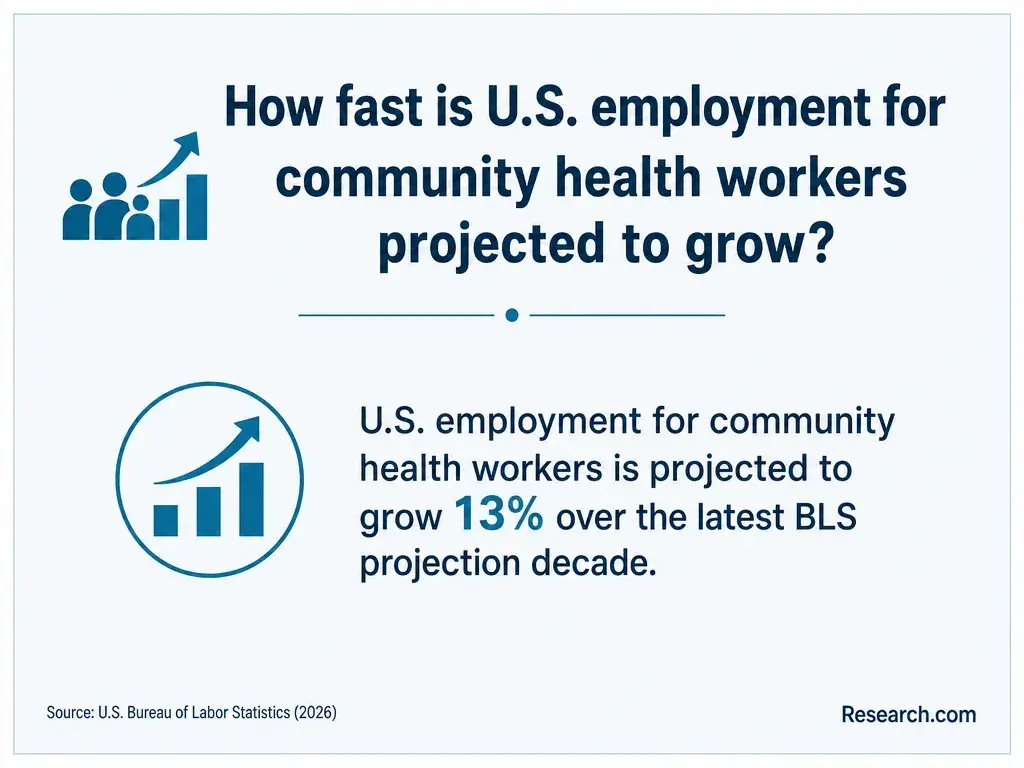
There is no single salary or employment-growth figure for "public health BS graduates." The US Bureau of Labor Statistics reports outcomes by occupation, not by degree major, and jobs open to bachelor's graduates can differ substantially in duties and entry requirements. Compare the current Occupational Outlook Handbook entry for the specific job you want - such as community health worker or health education specialist - with local postings that state their degree and experience requirements.
When evaluating the cost of an extra term caused by chemistry, compare that expense with realistic entry-level opportunities in your area rather than an occupation-wide median wage. MPH salary and career earnings outlook describes a different educational pathway and should not be used as an expected return on a BS.
Other Things You Should Know About Public Health
Join a waitlist if offered, contact the department about expected capacity, and ask your advisor immediately about approved alternatives. Do not assume a waitlist place guarantees enrollment.
Only if your institution explicitly awards the relevant requirement or approved credit through that process. Placement into a higher course is not necessarily credit for the required course or lab.
Follow the school's corequisite rules. Even if separate enrollment is permitted, confirm when the lab runs; an annual lab can create its own delay.
Ask the registrar and major advisor which catalog-year and change-of-major policies apply to you. Get any substitution or exception recorded in your degree audit before relying on it.
- Academic Years, Academic Calendars, Payment Periods, and Disbursements | 2025-2026 Federal Student Aid Handbook https://fsapartners.ed.gov/knowledge-center/fsa-handbook/2025-2026/vol3/ch1-academic-years-academic-calendars-payment-periods-and-disbursements
- 42 CFR Part 493 -- Laboratory Requirements | ecfr.gov https://www.ecfr.gov/current/title-42/chapter-IV/subchapter-G/part-493
- Chemistry Placement - Natural Sciences - University of Oregon https://naturalsciences.uoregon.edu/chemistry-biochemistry/undergraduate-programs/chemistry-placement
- Transfer Credit | Department of Chemistry https://chemistry.washu.edu/transfer-credit
- Policies: Undergraduate Program: Department of Chemistry | rochester.edu https://www.sas.rochester.edu/chm/undergraduate/policies.html
- Transfer Policy - Chemistry - Lafayette College https://chemistry.lafayette.edu/transfer-policy/