2027 Comparing Outputs and Outcomes in an Undergraduate Prevention Project

Co-Founder and Chief Data Scientist
A prevention project can deliver every planned workshop and still leave unanswered whether participants gained useful knowledge or changed a practice. For undergraduates, separating what a project produced from what changed is essential to an honest evaluation. This guide shows students and project supervisors how to select feasible indicators, interpret limited evidence, and build a credible final report. It also explains which program features matter if you are choosing a degree to develop these skills.
Key Things You Should Know
- Outputs document activities and reach; outcomes document changes among a defined group. Neither, by itself, proves a project caused a population-wide health improvement.
- For a short undergraduate project, pair at least one delivery measure with a feasible near-term outcome measure, then state the denominator, timing, data source, and limitations for each.
- Choose a project and degree format that allow approved supervision, community input, and responsible data access; a polished count of activities cannot substitute for those conditions.
What Are Outputs and Outcomes in an Undergraduate Prevention Project?
Outputs are the direct products of project activity: sessions delivered, materials distributed, referrals offered, or people reached. Outcomes are changes the project seeks among a specified population, such as improved understanding, greater use of a prevention service, or reduced disease incidence. An outcome can be short-term, intermediate, or long-term; a student project seldom has the time or evidence needed to assess the last of these.
The distinctions below use a hypothetical heat-safety education project. They illustrate possible measures, not results from an actual community program.
| Measure | Illustrative indicator | What it can establish |
| Activity and output | Number of sessions delivered; number of attendees | Whether planned delivery occurred and who was reached |
| Short-term outcome | Change in attendees' ability to identify heat-illness warning signs | Whether measured knowledge differed after the session |
| Intermediate outcome | Attendees' reported use of a heat-safety plan at follow-up | Whether a reported practice changed among respondents |
| Long-term impact | Change in heat-related illness across a community | A population-health question requiring much stronger evidence |
Reach is not the same as benefit: attendance counts may include repeat visitors, and a knowledge gain does not establish that illness was prevented. When comparing educational pathways, also check the degree level: choosing an MPH with CEPH accreditation concerns graduate preparation, not the requirements or evaluation depth of an undergraduate project.
How Do Undergraduate Prevention Projects Measure Community Health Impact?
Start with a precise claim the available evidence could support. A student might assess whether participants' knowledge changed immediately after a session, but should not call that a reduction in community disease rates. For each indicator, specify who is counted, when it is measured, how the information is collected, and what comparison - if any - is available.
A simple before-and-after questionnaire can be practical, but incomplete follow-up, changes in who responds, and participants remembering the questions can distort results. If no comparison group exists, describe the observed change rather than attributing it solely to the project. Ask the community partner whether the measure reflects a priority they recognize; an easy-to-count outcome is not necessarily a meaningful one.
Population-level impact generally requires longer observation and a stronger design than a semester project can provide. Students interested in eventually conducting independent research can investigate advanced training, including the affordability of online public health PhD study, without treating a doctoral degree as necessary to conduct a sound undergraduate evaluation.
What Does a Public Health Degree Teach About Disease Prevention?
An undergraduate public health degree can teach students to identify population health risks, examine social and environmental conditions, appraise prevention evidence, communicate with communities, and distinguish implementation from effectiveness. Introductory epidemiology and statistics help students interpret patterns and uncertainty; program-planning courses connect those findings to feasible activities and measures.
The value for a prevention project lies in combining these skills rather than treating disease knowledge as a complete intervention plan. A recommendation supported in published studies may still need adaptation to a partner's resources, language needs, and priorities. Students should seek coursework or supervised experience that includes both community engagement and evaluation, not assume that a course titled "prevention" covers either in depth.
A bachelor's degree need not be followed by graduate study to complete this work. If an eventual graduate program serves a specific methods or practice goal, compare its actual preparation and cost; inexpensive online public health master's options are a separate decision from choosing a workable undergraduate project.
Build the evaluation backward from the decision a community partner needs to make: continue the activity, revise it, or stop it. Agree on a small set of measures the project can collect responsibly during its actual timeline.
- Define the population and prevention problem. Use appropriate existing evidence and ask the partner what needs clarification; do not assume that a student's initial diagnosis is the community's priority.
- Draft a simple logic model. Connect resources and activities to outputs, plausible near-term outcomes, and longer-term goals without presenting the connections as proven effects.
- Set measurement rules. Specify indicator definitions, eligible participants, denominators, collection dates, missing-response handling, and who maintains the records.
- Confirm permissions before collection. Check faculty requirements, partner approval, consent or notice needs, privacy protections, and whether institutional review or a data-use agreement is required.
- Review and report. Compare observed measures with the project's stated aims, document deviations and uncertainty, and ask the partner whether the proposed interpretation is fair and useful.
The final deliverable might be an evaluation brief with a logic model, indicator definitions, an approved summary of findings if data were collected, and recommendations proportional to the evidence. If access or approvals fall through, an evaluation plan can remain a valid academic deliverable when the instructor agrees; it must not be presented as a completed evaluation. A documented project may also help a student explain their interests in later applications, but public health graduate GPA requirements and alternatives vary by program and are separate from the quality of this deliverable.
Course names and required sequences vary among public health bachelor's programs. For this project, the most useful preparation usually comes from introductory epidemiology, statistics, social and behavioral health, health communication, research methods, and program planning or evaluation. An internship or capstone may offer a place to apply those subjects, but its availability and approval rules must be checked with the program.
Compare course descriptions by the work students actually perform. Does a statistics course require interpretation of uncertain results? Does an evaluation course require an indicator plan? Does an applied course provide feedback from a qualified supervisor and a community partner? If the main gap is designing a short questionnaire or managing data securely, a targeted course or supervised training may be more efficient than an additional degree. Students considering graduate study later should compare public health graduate tuition after institutional funding with that narrower training need rather than assuming aid or a graduate credential is necessary.
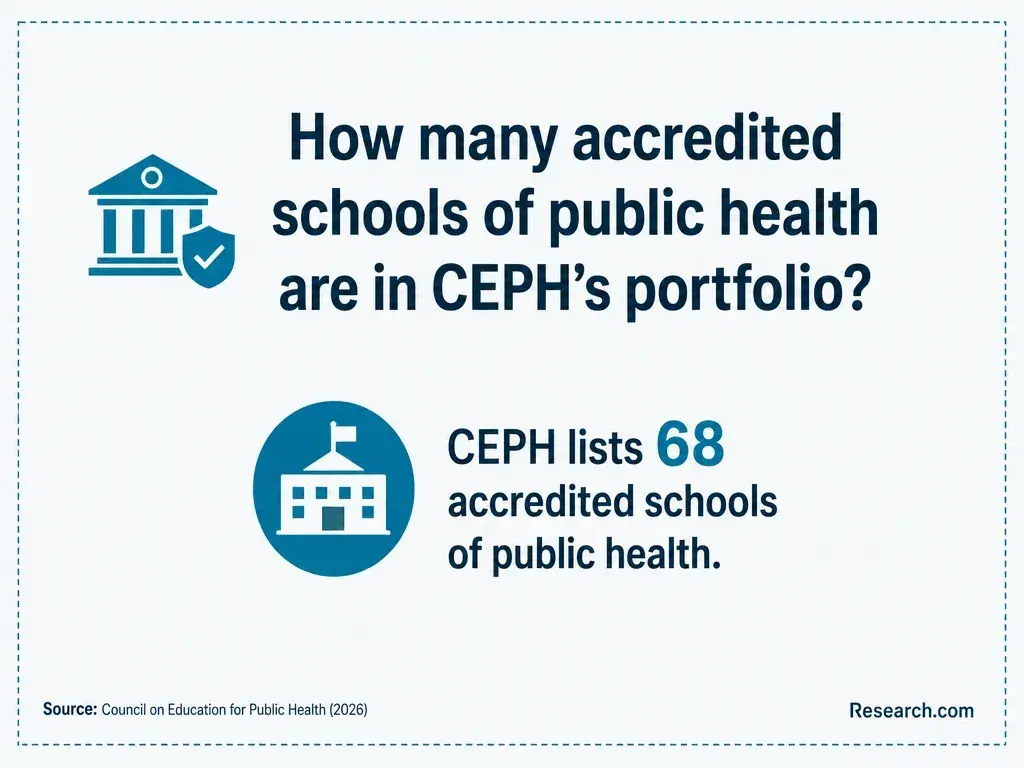
The Council on Education for Public Health (CEPH) accredits specified public health schools and programs; institutional accreditation is a separate matter. Check the accreditor's listing and the institution's documentation to determine whether the particular undergraduate degree you are considering is within the accredited scope. A university's CEPH-accredited MPH does not, by itself, establish that its bachelor's degree is covered.
Within that scope, programs can still differ in quantitative coursework, community partnerships, capstone requirements, supervision, and opportunities to evaluate a real prevention activity. For a student focused on outputs and outcomes, access to a well-supervised project may matter more than an elective's title. Compare the actual undergraduate curriculum first; cost-conscious online MPH program choices concern a different credential and should not be used as evidence about a bachelor's program's project opportunities.
Requirements depend on whether a student is entering college, changing majors, or transferring. Admission to the university may not be the same as admission to a public health major. Ask the school about prerequisite courses, minimum academic standing, application timing, and whether statistics or other courses must be completed before upper-level project work.
Transfer students should request a written degree audit showing not only which credits are accepted but which satisfy general education, major, prerequisite, and residency requirements. That distinction can determine when they can enroll in a capstone and whether an intended community project fits the remaining schedule. Graduate application topics - including MPH admissions without faculty recommendations - should not be mistaken for bachelor's admission rules.
For this project, the decisive issue is not where lectures occur but whether students can obtain supervision, approved data access, and a feasible relationship with a community partner. An online program may support a project near home, while a campus-based program may offer established local partnerships. Neither format automatically provides a placement or permission to use partner data.
Before enrolling, ask how often project teams meet, whether sessions are live, who secures a site, whether field visits are required, and how faculty review evaluation plans. Working students should compare those obligations with their actual weekly availability. Use online public health undergraduate education options to identify programs to investigate, then confirm each program's current project, scheduling, and supervision policies directly.
A carefully documented prevention project can provide evidence of entry-level skills relevant to program assistant, outreach coordinator, community health worker, or health education support roles. Responsibilities may include scheduling activities, preparing accessible materials, tracking participation, maintaining approved records, and reporting basic indicators. Job qualifications differ by employer and, for some roles or credentials, by state.
In a portfolio or interview, explain your own contribution: how you defined an output, chose an outcome, handled missing responses, and avoided overstating impact. Remove identifiable information and obtain any required partner permission before sharing work. These examples show readiness for supervised tasks, not independent authority to direct a research program or provide clinical care. If considering later graduate education for a different role, examine Master of Public Health earning potential as a separate career question rather than assuming an undergraduate project or an MPH guarantees advancement.
What Are Public Health Salaries and Job Outlooks After Graduation?
There is no single salary or job-growth figure for graduates who complete an undergraduate prevention project. The US Bureau of Labor Statistics publishes occupation-specific wages, projected employment, and typical entry-level education in its Occupational Outlook Handbook. For a realistic comparison, look up the current entry for the actual job you seek - such as community health worker or health education specialist - and check the wage reference year, projection period, and education description. An occupation-wide median is not a starting offer or a bachelor's-graduate outcome.
Compare job postings in your intended location with your project experience, then weigh the degree's total cost, remaining study time, and any unpaid fieldwork against plausible entry-level responsibilities. A shorter program is not necessarily cheaper if credits do not apply to the major or required courses are unavailable. Resources on comparing public health tuition and study length can frame the questions, but obtain a program-specific degree audit and cost estimate before making a financial decision.
Other Things You Should Know About Public Health
Often, yes, if anonymous counts meet the evaluation purpose and the site approves the method. Plan how to avoid double-counting repeat attendance and do not collect identifiers merely for convenience.
Review the measure definitions, missing information, and alternative explanations together. Document substantive disagreements rather than treating the student's interpretation as the final account of community experience.
Usually only after checking school and partner rules. Remove confidential information, share only material you have permission to disclose, and state which parts were your own work.
Not every class activity does, but the student cannot make that determination from the course label alone. Ask the instructor and appropriate institutional office before recruiting participants or collecting information, particularly if findings may be shared beyond the class.
- Quasi-experimental study: comparative studies | GOV. UK https://www.gov.uk/guidance/quasi-experimental-study-comparative-studies
- Outcome Definition and Measurement - NCBI - NIH https://www.ncbi.nlm.nih.gov/books/NBK126186/
- Chapter 3 - Performance Evaluation: Outputs and Outcomes https://highways.dot.gov/safety/hsip/shsp/shsp-evaluation-process-model/chapter-3-performance-evaluation-outputs-and
- Target-Setting Methods - Healthy People 2030 - odphp https://odphp.health.gov/healthypeople/objectives-and-data/data-sources-and-methods/target-setting-methods
- CDC Approach to Program Evaluation https://www.cdc.gov/evaluation/php/about/index.html
- An Introduction to the Quasi-Experimental Design... - PMC https://pmc.ncbi.nlm.nih.gov/articles/PMC11741180/
- Primary, Secondary, and Tertiary Prevention of Substance Use Disorders through Socioecological Strategies - NAM https://nam.edu/perspectives/primary-secondary-and-tertiary-prevention-of-substance-use-disorders-through-socioecological-strategies/
- Experimental and quasi-experimental designs in implementation research - ScienceDirect https://www.sciencedirect.com/science/article/pii/S0165178119306833
- Transforming our world: the 2030 Agenda for Sustainable Development | Department of Economic and Social Affairs https://sdgs.un.org/2030agenda