2027 Evaluating a Public Health Campaign Approval Workflow: A DrPH Applied Project Planning Guide

Co-Founder and Chief Data Scientist
A public health campaign can be delayed or weakened when no one knows who may approve its evidence, language, accessibility, or release. For an experienced practitioner considering a DrPH applied project, that problem offers a focused opportunity to study how an organization makes decisions - and improve the process without assuming faster approval is always better.
This guide explains how to scope the workflow, secure appropriate permissions, measure its performance, and judge whether a DrPH program can support the work.
Key Things You Should Know
- Define the project around a specific campaign and approval decision; assess both turnaround and safeguards such as accuracy, accessibility, and community review.
- Keep academic project approval, organizational permission, and any required data-use or ethics review distinct; none automatically grants the others.
- A credible DrPH deliverable pairs a documented baseline with a feasible workflow change and measures that decision-makers can use, not an unsupported claim that the campaign improved health.
What is a public health campaign approval workflow in a DrPH applied project?
A campaign approval workflow is the sequence by which a public health organization reviews and authorizes campaign materials before release. A vaccination outreach campaign, for example, might require review of clinical claims, translated messages, accessibility, community feedback, legal concerns, and the final publishing decision. The DrPH project evaluates whether those decisions have clear owners, appropriate evidence, reasonable timing, and a record of revisions.
The practice problem is not simply that approval takes time. An extra review may catch a harmful error; an unclear handoff may add delay without improving the message. A workable project therefore asks which steps protect the public, which create avoidable rework, and who has authority to change them. Unlike an MPH-level exercise focused primarily on producing a communication plan, this DrPH project should demonstrate leadership in organizational change. Readers comparing earlier training routes can review the types of public health master's degrees without treating them as substitutes for an approved doctoral project.
How does a DrPH applied project meet CEPH accreditation requirements?
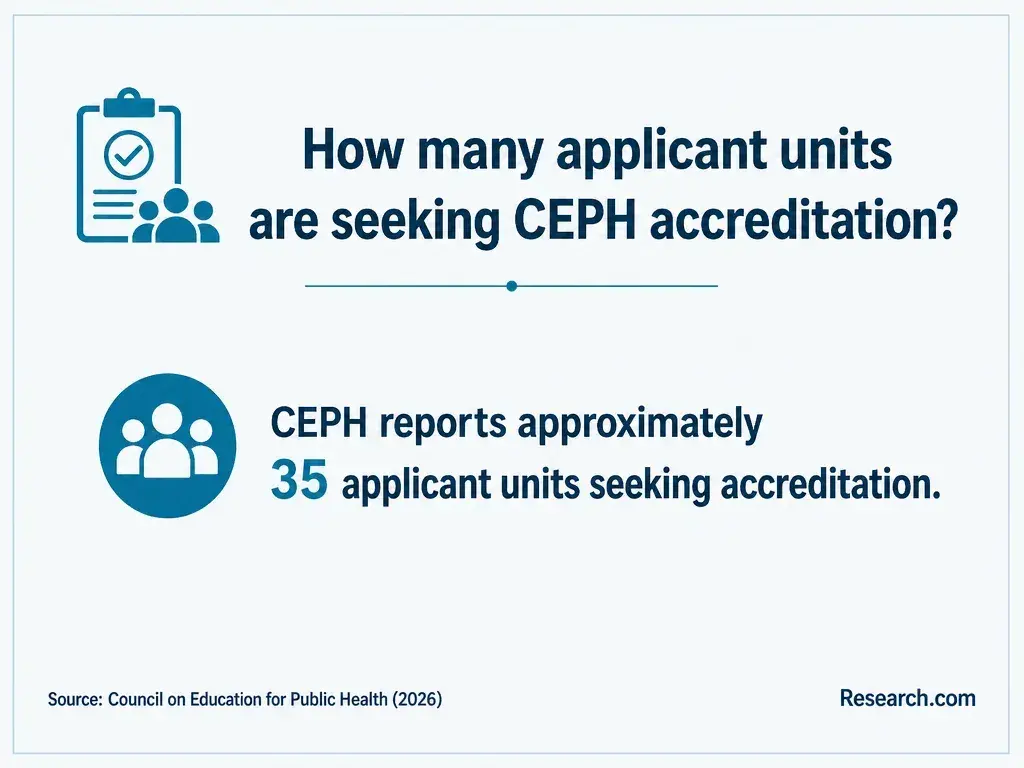
CEPH accreditation concerns the accredited public health school or program and the degrees within its stated scope; institutional accreditation alone does not establish that a particular DrPH is CEPH-accredited. CEPH's doctoral expectations address advanced public health practice and the demonstration of competencies, but the school determines its project milestones, supervision, assessment, and required deliverables. A campaign workflow project must satisfy that school's current DrPH handbook and faculty review process - not merely address a relevant topic.
Before committing to a partner, ask the program to identify the competencies the project may demonstrate, the required written or presentation outputs, and who approves changes in scope. Also check the exact degree covered by the accreditation listing. Accreditation and coursework questions arise at other degree levels too, but online public health bachelor's admissions and coursework cannot establish the requirements of a DrPH project.
What does a strong public health campaign approval project include?
Start with one organization's defined campaign type, rather than every communication it produces. The proposed output might be a revised approval map, decision-rights matrix, and measurement plan. Its value depends on whether staff and community partners can use it within their actual authority and resources.
The following sequence keeps the project bounded while leaving room for findings to change the proposed solution:
- Establish scope and permission: Name the campaign, intended audience, sponsoring organization, faculty supervisor, process owner, and people authorized to release records or approve changes.
- Describe the existing process: Map submissions, reviewers, handoffs, version control, escalation, community input, and the final release decision using records the partner permits you to examine.
- Assess a baseline: Define measures such as time between submission and decision, number of revision cycles, completeness of evidence checks, and whether accessibility and language reviews occurred. Record what is missing rather than filling gaps with estimates.
- Co-design a feasible change: Test whether clearer decision rights, review criteria, or parallel reviews would reduce avoidable rework without bypassing essential scrutiny.
- Evaluate and hand off: Document what was implemented, what could not be tested, measure definitions, unintended consequences, and who will maintain the workflow after the project.
Process measures are not population-health outcomes. A shorter approval interval cannot by itself show that people understood the message, trusted it, or changed behavior. If rollout or audience evaluation falls outside the academic timeline, present a prospective evaluation plan rather than claiming impact. Nor does prior study through accelerated courses in public health bachelor's study replace access to a partner, usable baseline records, and doctoral-level supervision.
The strongest competency alignment comes from decisions the student can document. Systems thinking appears in the map of how review stages affect one another; leadership and change management appear in negotiated decision rights and a realistic implementation plan. Evidence appraisal supports accurate claims, while health communication and equity-oriented practice shape language, accessibility, and meaningful community review. Evaluation skills appear in measures that distinguish delays from protective checks.
Ask a faculty advisor how the program requires these competencies to be evidenced. A polished diagram alone does not demonstrate partnership skill if affected reviewers had no voice in its design. For applicants who still need foundational population-health preparation, conditional entry into public health master's programs is a separate question from readiness to lead a DrPH organizational project.
Useful preparation combines health communication and evidence appraisal with program evaluation, implementation or organizational change, qualitative methods, and public health ethics. Policy or public health law coursework may help when the campaign involves a government release process. A course title matters less than whether the student can interview reviewers responsibly, define reproducible measures, interpret limited records, and present a change that fits the organization's authority.
An experienced communications manager may need more evaluation-methods training; an analyst may need more practice facilitating community and cross-department decisions. If an MPH is the more appropriate next step, compare its actual methods and applied opportunities rather than assuming flexible admission means suitable preparation. Online MPH admissions flexibility comparisons address a different decision from doctoral project fit.
DrPH programs set their own requirements for prior education, professional experience, references, statements, and, where applicable, interviews or tests. Some expect an MPH or equivalent preparation; others evaluate applicants with different graduate degrees and relevant practice experience. A job title alone is weak evidence of readiness. An applicant should show responsibility for decisions, partnerships, budgets, implementation, or evaluation - and explain what additional authority or skill the doctorate would develop.
For this project, distinguish admission eligibility from project feasibility. A strong application might describe a prospective partner and problem, but it should not claim organizational consent, data access, or academic approval before those are granted. Applicants concerned about academic history can consult guidance on public health graduate GPA requirements and alternatives, then ask each DrPH program how it weighs graduate performance against documented leadership. A master's admissions policy is not automatically a doctoral policy.
Either format can support a campaign workflow project if faculty can supervise organizational work and the partner can participate. Online delivery does not guarantee asynchronous meetings, remote-only fieldwork, or permission to use an existing job as the project site. Campus-based study may ease in-person collaboration but can add commuting and scheduling costs. The decisive comparison is the project's actual supervision and access requirements.
Request the project handbook and a realistic schedule covering live classes, partner meetings, committee reviews, residencies, and presentations. Ask how the program handles a delayed approval or a partner withdrawal. An overview of online graduate advancement through public health doctorates can help identify formats to investigate; confirm each program's current attendance and project rules directly before enrolling.
There is no reliable universal timeline or price for a DrPH campaign approval project. Completion depends on the program's credit and milestone requirements, enrollment pace, committee availability, and the partner's review cycles. The relevant budget includes tuition and mandatory fees as well as possible travel, residencies, continued enrollment, reduced work hours, and time spent securing project permissions. Do not assume employer support or project access until confirmed.
Compare written, program-specific estimates using the same enrollment pace and ask what charges continue if the project extends beyond the planned term. Broad online public health cost-duration tradeoffs can frame the financial question, but they cannot substitute for a DrPH fee schedule and a realistic project timeline. If the sole goal is to improve an employer's approval process, supervised evaluation work or targeted training may be faster and less costly than a doctorate.
A well-executed project may provide evidence of readiness for public health program leadership, health communication management, government or nonprofit operations, and implementation or evaluation roles. Employers will still assess prior responsibility, sector experience, and the duties of the specific vacancy. A DrPH does not confer clinical licensure or guarantee promotion.
There is no defensible single "DrPH salary" for these different roles. To assess pay, match the intended job's duties - not the degree name - to a current US Bureau of Labor Statistics occupation, its wage reference year, and the relevant local job postings. Public-sector grades and nonprofit budgets may matter more than a national occupational median. A research-focused PhD is a different investment; public health PhD program cost comparisons are useful only if the applicant is also weighing research training against practice leadership.
How can you evaluate an accredited DrPH program for career goals?
Choose a program only after testing whether its rules allow the project you can actually conduct. Confirm the exact DrPH's CEPH accreditation scope, then compare project supervision, organizational-partner rules, ethics-review procedures, scheduling, full cost, and evidence of graduates doing the kind of work you seek. Published program outcomes should be read with attention to the cohort and reporting period, not as a promise of an individual career result.
Before applying, send an advisor a short, nonconfidential project concept: the campaign type, proposed process decision, likely partner, possible records, intended deliverable, and known access uncertainties. Ask who decides site eligibility, what happens if organizational approval is refused, and whether the project can be scoped to a process evaluation rather than a campaign rollout. An online public health doctorate admissions guide may help build a shortlist, but admission convenience should not outweigh workable project governance and career fit.
Other Things You Should Know About Public Health
Only with permission and appropriate redaction. Ask the employer and program what may be shared publicly; remove confidential strategy, identifiable information, and restricted drafts.
Tell your faculty advisor promptly. A revised scope may be possible, but the program and partner must approve any change affecting deliverables, data access, or timelines.
Follow program and employer policies. Any permitted draft still needs human checks for evidence, accessibility, cultural context, privacy, and the organization's release requirements.
Not necessarily. Ask your program whether a documented evaluation and implementation-ready recommendation can meet its requirements when adoption lies outside the student's authority.
- Elements of an Evaluation Plan | Agency for Healthcare Research and Quality https://www.ahrq.gov/talkingquality/assess/evaluation-plan.html
- Qualitative Methods in Implementation Research - PMC - NIH https://pmc.ncbi.nlm.nih.gov/articles/PMC7023962/
- Step 4 - Gather Credible Evidence | Program Evaluation https://www.cdc.gov/evaluation/php/evaluation-framework-action-guide/step-4-gather-credible-evidence.html
- Choose an Evaluation Design | IDEAS Impact Framework https://ideas.developingchild.harvard.edu/evaluation/choose-an-evaluation-design/
- Chapter 40., Section 3. Obtaining and Using Feedback from Participants - Main Section | Community Tool Box https://ctb.ku.edu/en/table-of-contents/maintain/maintain-quality-performance/feedback-from-clients/main
- 6.2 Quality Improvement Measures | University of West Florida Pressbooks https://pressbooks.uwf.edu/nursingleadership/chapter/9-3-measuring-and-improving-quality/
- Understanding Workflow Stages and Workflow Steps | University of Delaware https://services.udel.edu/TDClient/32/Portal/KB/Article/822/Understanding-Workflow-Stages-and-Workflow-Steps
- ISO/IEC Directives, Part 1 - Procedures for the technical work https://www.iso.org/sites/directives/current/consolidated/index.html
- Communicating Digital Accessibility Requirements - AEM Center https://aem.cast.org/acquire/communicating-accessibility-requirements