2027 Choosing Public Health BS Coursework for Migrant Farmworker Health Outreach

Co-Founder and Chief Data Scientist
Choosing a public health BS for migrant farmworker health outreach means looking beyond a course catalog's general promise to improve health. Outreach depends on trust, practical knowledge of agricultural work, language access, and the ability to connect people with services without compromising their privacy.
This guide is for students who want to compare coursework and applied opportunities before committing to a program. It explains which classes matter most, how to assess fieldwork and program fit, and when a shorter training route may serve the same goal.
Key Things You Should Know
- Prioritize community health practice, occupational and environmental health, health communication, and supervised work with a relevant community partner over a program's concentration label alone.
- Ask whether fieldwork can accommodate agricultural schedules, travel, language needs, and partner supervision; an online BS does not necessarily make those obligations remote.
- A public health BS can support entry-level outreach work, but it does not confer clinical licensure or replace employer-specific training in safety, interpretation, privacy, or community health work.
What Is a Public Health BS for Migrant Farmworker Health Outreach?
A public health Bachelor of Science is an undergraduate degree focused on population health and prevention. For migrant farmworker outreach, its value lies in applying that training to the conditions shaping access to care: work schedules, transportation, housing, occupational exposures, language access, and eligibility or documentation concerns that may affect trust. "Migrant farmworker" is not a description of one language, immigration status, or set of health needs; effective outreach begins by learning what a particular community identifies as priorities.
The BS is usually a generalist degree, not a dedicated farmworker-health qualification. A student might prepare to help a health center plan outreach visits, develop accessible information, make referrals, and track whether a program reaches its intended audience. Those tasks differ from diagnosing illness, providing legal advice, or independently assessing hazardous exposures.
If the goal is to start supervised outreach as soon as possible, compare the degree with community health worker training and relevant paid or volunteer experience. A later MPH may make sense for program design or management, but it is not a prerequisite for every outreach role. Students considering that longer route can separately review MPH admission when some requirements are incomplete.
What Coursework Prepares Students for Migrant Farmworker Health Outreach?
The strongest course plan builds from public health fundamentals toward supervised practice. Course titles differ by school, so inspect syllabi and assignments rather than assuming that an elective mentioning rural health teaches outreach skills.
This comparison shows what each course area should enable a beginning outreach worker to do - and where classroom learning needs a practical counterpart.
| Course area | Useful preparation | What to verify |
| Community health and program planning | Identify community-defined priorities, plan activities, and assess participation | Whether assignments involve partner feedback rather than only hypothetical campaigns |
| Health communication | Develop understandable, culturally responsive messages and referral materials | Whether instruction covers language access and testing materials with intended users |
| Environmental and occupational health | Recognize exposure pathways and appropriate referral or prevention roles | Whether agricultural work, heat, and pesticide safety are addressed without implying clinical or regulatory authority |
| Epidemiology and introductory statistics | Interpret patterns and evaluate outreach reach without overstating results | Whether students practice data quality, denominators, confidentiality, and interpretation |
| Practicum or community project | Apply skills under supervision and produce a useful, approved deliverable | Whether a relevant site, supervisor, schedule, and partner permission are available |
Take introductory population-health and methods courses before an applied project where the curriculum allows it. Then use electives to fill a specific gap, such as occupational health or qualitative interviewing. An elective is not a formal concentration, and an undergraduate methods course does not establish specialist competence. If advanced program evaluation is the longer-term goal, compare that future training separately from affordable online MPH degree programs.
How Do You Choose an Accredited Public Health BS Program?
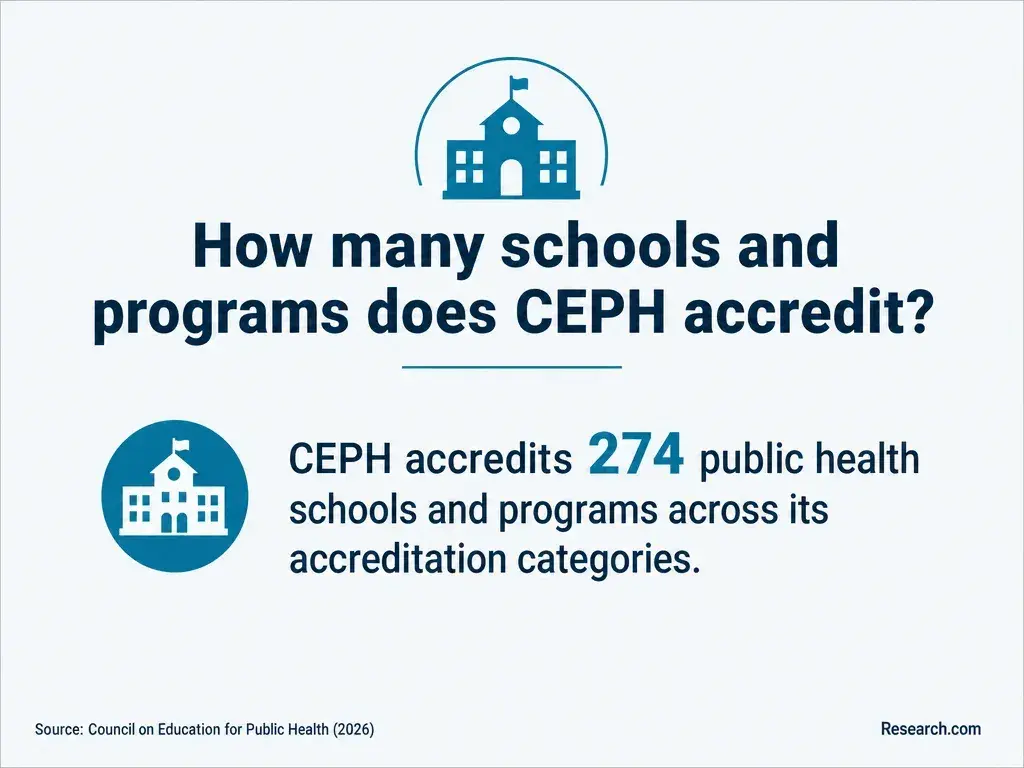
First confirm the institution's recognized accreditation and the exact status of its public health degree. The Council on Education for Public Health (CEPH) accredits public health schools and programs, but accreditation of a university - or of one graduate program - does not establish that its BS is within the accredited scope. Ask the school to identify the accredited unit and confirm whether the degree you would enter is covered.
For this particular goal, accreditation is only one filter. Compare the required curriculum, availability of occupational and community-health electives, and whether students can arrange approved fieldwork with a migrant health center, farmworker-serving organization, or another suitable partner. Ask who finds placements, who supervises students, and whether the school has an existing relationship with a site. A list of possible partners is not a placement commitment.
The distinction between institution and program scope also matters if you later consider graduate study; CEPH accreditation for online MPH study concerns a different degree decision. Before enrolling in a BS, obtain the current catalog and ask an advisor to confirm that the courses and fieldwork you need are actually available in your expected terms.
Choose courses that explain why an outreach approach may succeed or fail, not ones that merely catalog health problems. Social and structural determinants of health can connect work conditions, service availability, transportation, and policy to access to care. Occupational and environmental health can examine prevention of heat-related illness and exposure risks. Health systems or policy courses can clarify how referral networks and eligibility rules shape access without training students to make legal determinations.
Qualitative methods and community-engaged practice are especially useful when a program needs to understand barriers identified by workers themselves. Students should learn to ask appropriate questions, avoid treating one person as representative of a whole community, and recognize when consent, organizational permission, privacy safeguards, or institutional review must be checked. A useful course assignment might be a proposed outreach evaluation plan - not an unsupported claim that a community has endorsed a particular intervention.
For a first outreach role, prioritize these applied skills over advanced research specialization. Students whose eventual goal is to lead independent research or senior organizational change can assess public health doctoral programs and professional goals later; a doctorate is not needed to make an undergraduate course plan relevant to farmworkers.
Either format can teach public health concepts. The better choice is the one that lets you complete relevant fieldwork safely and reliably. Online coursework may reduce commuting, but required live sessions, group projects, exams, and on-site placement hours can still conflict with employment or caregiving. On-campus study may offer easier access to faculty and local partners, but a campus near agricultural communities does not guarantee a suitable placement.
Ask each program whether its fieldwork can be completed near your home, who approves a proposed site, and what happens if a partner cannot host you during the required term. Outreach may follow agricultural and clinic schedules rather than standard class hours; travel and evening availability may matter more than the lecture format. If finishing a degree quickly is also a priority, compare affordable shorter online public health degrees against their actual course sequence and fieldwork rules, not just advertised flexibility.
Admission rules depend on the school and whether you enter as a first-year or transfer student. A university may admit you before you can declare the public health major; the major may have separate prerequisite or grade requirements. Review the current catalog for mathematics or statistics preparation, science courses, general education, and any application to the major.
Transfer students should request a written degree audit showing not only which credits the institution accepts, but which ones satisfy major, prerequisite, general-education, and residency requirements. The receiving institution makes those decisions. A course accepted as an elective may still leave a required public health course unfinished.
If earlier grades are a concern, ask the undergraduate admissions office about its own review and repeat-course policies rather than assuming graduate admissions advice applies. Building an MPH application with weaker grades is a separate, later decision with different requirements.
Completion time depends on the school's credit requirements, your accepted and applicable prior coursework, course availability, and fieldwork timing. A transfer student with many accepted credits may still need several terms if prerequisites must be taken in sequence or a required placement is offered only at certain times. Ask for a term-by-term plan based on an official evaluation before relying on an advertised completion estimate.
Compare the full cost of the routes available to you: tuition, mandatory fees, books, travel to field sites, any unpaid placement hours, and the earnings you may give up to attend. A lower tuition rate is less useful if limited course availability extends enrollment. For a starting comparison, see public health undergraduate program affordability, then obtain each school's current charges and financial-aid information for your enrollment level. Do not assume a placement is paid or that existing employment will meet its academic requirements.
A relevant BS, paired with community experience, may support applications for outreach assistant, community health worker, patient navigator, health education support, or program coordinator positions. Duties vary: one employer may emphasize referrals and follow-up, while another needs event planning, data entry, or educational materials. Language skills and established community relationships may be particularly valuable, but employers should still provide training, supervision, and clear boundaries for the role.
Read job postings for the area where you hope to work. Identify required credentials, travel, schedule, language proficiency, and experience before selecting electives or a placement. If your target is to manage programs or conduct more advanced evaluation, experience may be necessary alongside further education; compare lower-cost public health master's career pathways only after defining the responsibilities you want. A BS alone does not qualify someone to practice nursing, provide clinical care, or assume a senior public health leadership role.
There is no single wage or growth forecast for "public health BS graduates." For a prospective outreach worker, the US Bureau of Labor Statistics community health worker occupation is a more relevant starting point than a broad public health or management category. Its Occupational Outlook Handbook entry reports occupation-wide pay and projected employment change, not outcomes for graduates of a particular degree or for farmworker outreach jobs specifically.
Check the latest published wage reference year and projection period, then compare those figures with current local postings. Employer type, location, funding, language requirements, travel, and experience can affect an offer. If you are comparing eventual graduate study, a public health master's graduate pay guide addresses a different education level; neither set of figures promises an individual salary or establishes that another degree will pay for itself.
Which Certifications and Standards Support Farmworker Health Outreach?
Start with the requirements of the actual job and state. Community health worker certification or registration varies by state and employer. The Certified Health Education Specialist (CHES) credential has its own coursework-based eligibility and examination rules; a public health BS or a health education elective does not automatically award it. Verify eligibility with the responsible certifying organization before choosing courses primarily to pursue a credential.
Practical training may matter more immediately: language-access procedures, confidentiality, safe travel and field practices, referral protocols, and employer-approved instruction on heat and pesticide safety. Outreach workers should know when to refer a clinical, exposure, or legal question to a qualified professional. Those standards protect community members and define what a supervised outreach role can responsibly do.
Credentials should match the work you intend to perform. Even doctoral public health study costs and career directions are a separate consideration from the training needed to begin farmworker outreach; additional degrees do not replace site-specific preparation or community trust.
Other Things You Should Know About Public Health
Language needs vary by community and job. Do not assume all workers speak Spanish or that conversational ability qualifies you to interpret sensitive health information. Check employer expectations and use qualified interpretation services when needed.
Usually only with the school's and partner's permission. Remove identifying information and restricted data, and describe your own contribution and the project's limitations without implying that a proposed tool has been validated.
Possibly, but only if the program approves the site, supervision, learning objectives, and distinct academic work. Existing employment is not automatic practicum credit.
No. Community health, health education, social work, and other relevant paths may fit particular roles. Compare each option with local job requirements and opportunities for supervised community experience.
- Language Access - Equitable Community Engagement Toolkit https://engagement-toolkit.phila.gov/guides/language-access
- Identifying and Providing Health Education Materials for Migrant Farmworkers | NNLM https://www.nnlm.gov/training/class/identifying-and-providing-health-education-materials-migrant-farmworkers
- Competencies for Public Health Professionals | cdc.gov https://www.cdc.gov/infrastructure/training-professional-development/competencies-for-public-health-professionals.html
- Community Health Workers' Role in Addressing Farmworker Health Disparities - PMC https://pmc.ncbi.nlm.nih.gov/articles/PMC9395548/
- H-2A Temporary Agricultural Workers | uscis.gov https://www.uscis.gov/working-in-the-united-states/temporary-workers/h-2a-temporary-agricultural-workers
- Farm Labor | Economic Research Service - USDA http://www.ers.usda.gov/topics/farm-economy/farm-labor
- National Farmworker Jobs Program | dol.gov https://www.dol.gov/agencies/eta/agriculture
- Agricultural Workforce Health and Safety Education Program | Community Development https://communitydevelopment.ces.ncsu.edu/nc-state-extension-farmworker-health-and-safety-education-program/