2027 From Disability Services Coordinator to Public Health: Planning a Bachelor's Pathway

Co-Founder and Chief Data Scientist
Disability services coordinators already navigate systems that shape health: access to care, transportation, housing, benefits, and community support. A public health bachelor's degree can turn that experience toward population-level work, but it is not automatically the fastest route to a new job.
This guide helps working coordinators decide whether to pursue the degree, plan around prior credits and employment, and choose coursework and applied experience that support a specific career move.
Key Things You Should Know
- A public health bachelor's is most useful when your target role requires population-health, evaluation, or program-planning skills you cannot readily gain through your current job or targeted training.
- Relevant disability services experience strengthens a career transition, but it does not automatically replace major requirements, qualify as an internship, or establish eligibility for a new occupation.
- Compare programs using a written degree audit, the schedule for required courses and fieldwork, total remaining cost, and evidence that graduates enter roles like the one you want.
What Is a Public Health Bachelor's Degree?
A public health bachelor's degree studies how organizations and communities prevent harm and improve health across populations. Unlike training for direct clinical care, it emphasizes factors such as access to services, environmental conditions, policy, health communication, and evidence about whether programs work.
For a disability services coordinator, that shift can mean moving from arranging support for individual clients to assessing service gaps across a county, improving referral processes, or evaluating whether outreach reaches people with disabilities. Bachelor of Arts and Bachelor of Science programs may differ in quantitative, science, and general-education requirements; the degree title alone does not reveal which better fits your goal.
A bachelor's may be unnecessary if you already hold one and want to expand your current duties. Employer-supported evaluation training, an accessible-design course, or supervised project work may be more direct. If your eventual goal requires graduate study, compare undergraduate preparation against the skills described in specialization choices in public health graduate study rather than assuming every bachelor's curriculum prepares you equally well.
How Do You Become a Public Health Professional With a Bachelor's Degree?
Start with a job function, not a degree label. Disability services coordination can provide evidence of community partnership, accessible communication, service navigation, documentation, and awareness of barriers to care. Public health employers may also expect skills your current role has not required, such as summarizing population data, building an evaluation plan, or managing a grant-funded program.
A practical transition has three parts: identify postings for the work you want, compare their required tasks with your experience, and build evidence for the gaps. For example, a coordinator seeking a community program role could help document referral patterns, develop an accessible outreach resource with organizational approval, and learn to report aggregate results without exposing client information. An internship or supervised project can provide similar evidence if your employer cannot offer those responsibilities.
A bachelor's can support applications for assistant, outreach, and some health education positions; it does not confer a protected professional title or qualify someone for every epidemiology or management role. If you already have a bachelor's and postings consistently request graduate preparation, investigate online MPH admission options for varied backgrounds before committing to a second undergraduate degree. Admission flexibility and job readiness are separate questions.
Is a Public Health Bachelor's Degree Accredited?
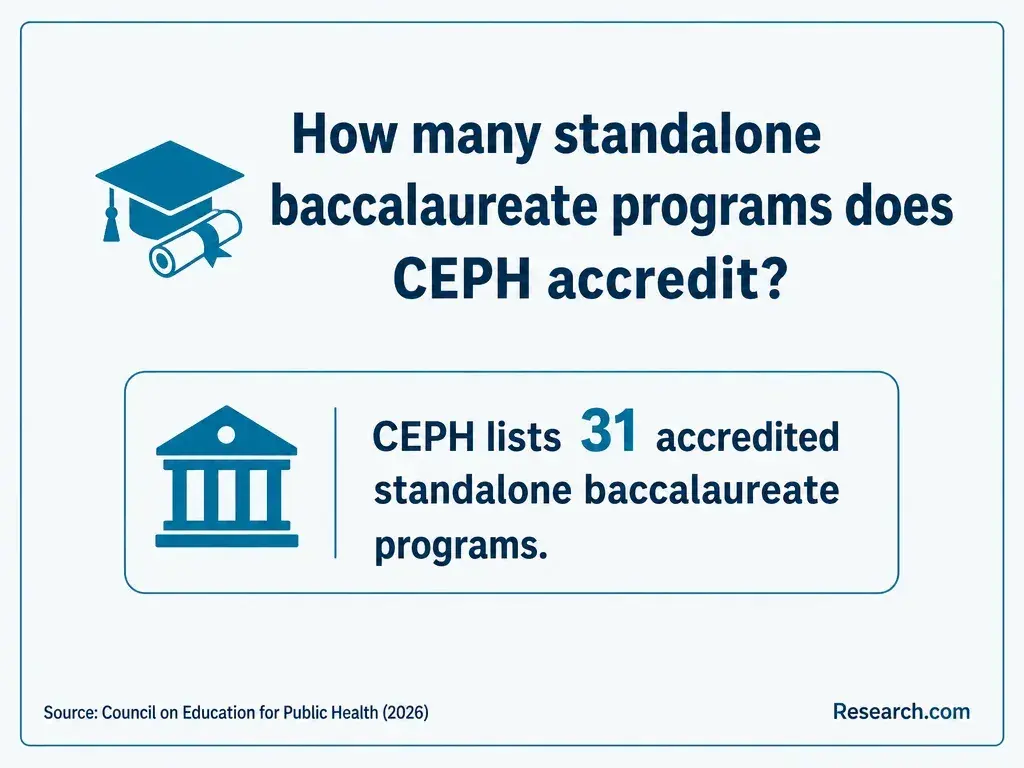
Check two different things. Institutional accreditation applies to the college or university and matters for matters such as credit recognition and federal student aid eligibility. The Council on Education for Public Health (CEPH) accredits eligible public health schools and programs; its status does not automatically extend to every degree offered by an institution.
Ask the school to identify the bachelor's degree's academic home and show whether that degree falls within its current CEPH-accredited scope. Confirm the status directly with CEPH and the institution before enrolling, especially if accreditation affects a future credential or graduate application. Do not mistake an institution's accredited MPH for proof that its bachelor's is covered. The same scope check matters if you later use a guide to finding an online MPH with CEPH accreditation.
Common subjects include epidemiology, introductory statistics, health policy, social and behavioral influences on health, community engagement, and program planning. Course names vary. For this transition, the important test is whether assignments let you apply those subjects to accessibility, service delivery, and equitable participation - not simply whether disability appears in a course description.
Prioritize coursework that helps you distinguish a service problem from a measurement problem. An evaluation course, for instance, should help you define who a program reaches, identify an appropriate denominator, recognize missing data, and explain limits on what the results show. Policy and communication courses can help you translate findings into accessible materials and feasible changes for an organization.
If you want advanced independent research or senior practice leadership, a bachelor's provides a foundation rather than the full preparation. Reviewing public health doctoral degree choices can clarify much later options, but a doctorate is not a prerequisite for doing useful community program work. Choose bachelor's electives for the next role you can realistically pursue.
An online program can teach the same academic subjects, but its usefulness for a working coordinator depends on how learning and fieldwork actually operate. Recorded lectures do not make scheduled discussions, group projects, examinations, or community placements asynchronous. Campus programs may offer easier access to local partners; online programs may let you remain employed and work with a nearby organization.
Ask for a sample course schedule and the fieldwork policy. Check required live sessions, campus visits, placement hours, accessibility support, and whether a project at your workplace could be approved. Your existing job should count only if the program authorizes distinct learning objectives, appropriate supervision, and an acceptable deliverable. Do not assume access to client records or permission to publish work products.
Compare the full cost of each format, including travel and time away from work, rather than tuition alone. If an online bachelor's is part of a longer education plan, look separately at institutional scholarships for public health graduate students; graduate awards should not be treated as funding for the bachelor's or assumed available later.
Requirements depend on whether you are entering college, transferring, returning after a break, or applying to a major after admission to the university. A school may accept a course for transfer credit without applying it to statistics, general education, or the public health major. An associate degree or extensive work history does not settle that question.
Before applying, collect transcripts and, for courses that may satisfy major requirements, syllabi or catalog descriptions. Request a written degree audit showing accepted credits, requirements fulfilled, prerequisites still needed, institutional residency rules, and the term each remaining course is offered. Ask the registrar or transfer office about credit decisions and the department about substitutions; seek an appeal if a relevant course was assigned only elective credit.
Do not borrow requirements from graduate applications. For example, online public health master's no-letter application paths address a different admissions level. Use the bachelor's program's current rules for your entry term, including any separate major application.
The standard full-time pathway is commonly described as four years, but that is not a reliable completion estimate for a working transfer student. Your remaining time depends on credits that satisfy actual requirements, prerequisite sequencing, course availability, enrollment pace, and fieldwork scheduling. A single required course offered infrequently can matter more than the number of credits a school accepts.
For each prospective school, request a term-by-term plan and an estimate covering remaining tuition and mandatory fees. Add books, technology, travel or placement expenses, and any wages you would forgo. Check whether changing your enrollment pace affects aid eligibility, employer tuition assistance, or satisfactory academic progress. Do not count transfer-related savings until the school has evaluated your record.
If you may later pursue an MPH, keep that potential expense separate from the bachelor's decision. Budget-friendly Master of Public Health programs may be worth comparing at that stage; a lower advertised graduate price does not justify paying for undergraduate credits you do not need.
The strongest opportunities build on your existing work rather than erase it. Job titles vary by employer, so compare responsibilities and minimum qualifications in actual postings. This table distinguishes plausible transitions from roles that usually need substantially more preparation.
| Target role | Connection to coordination experience | Likely gap to address |
| Community health or outreach coordinator | Service navigation, accessible communication, and partner relationships | Population-level outreach planning and reporting |
| Program assistant or evaluation assistant | Documentation, referral processes, and follow-up | Data quality, basic analysis, and evaluation methods |
| Health education specialist | Adapting information to participant needs | Employer-specific education requirements and evidence of education-program design |
| Epidemiologist or research lead | Knowledge of service-system questions | Typically substantial graduate-level methods preparation and relevant experience |
If you already perform the target job's core tasks and its postings do not require another degree, seek an internal project, promotion, or targeted training first. A graduate degree - or, much later, a doctorate - should answer a specific role requirement. Weigh its longer-term implications through public health doctorate financial planning and outcomes only if that advanced path is genuinely part of your plan.
There is no defensible single salary for "a public health bachelor's graduate." Pay follows the occupation, employer, location, responsibilities, and experience. A coordinator moving into an assistant position may not receive a raise; someone who adds evaluation or grant-management duties may have different opportunities, particularly within an employer's established pay grades.
For a useful benchmark, compare local postings with the US Bureau of Labor Statistics' occupation-specific wage data for the roles you are actually considering, such as health education specialist or community health worker. Those figures describe workers in an occupation - not the earnings of people with a particular major - and include people with different degrees and experience levels. For roles that may warrant graduate study, MPH salary and career earnings outlook offers additional context, not a forecast of your pay.
Before enrolling, compare the likely change in responsibilities and compensation with your remaining education cost and time commitment. If your employer uses fixed salary bands, ask whether completing the degree changes eligibility for the position you want.
Do Public Health Careers Require Licensure or Certification?
Many nonclinical public health jobs do not require a professional license, but requirements depend on the exact position and state. A public health bachelor's does not grant a nursing, social work, counseling, or other clinical license. Employers may prefer or require a credential for particular health education, community health, or specialized roles.
Check job postings and the responsible certifying organization before treating certification as a shortcut. Eligibility for credentials such as Certified Health Education Specialist (CHES) or Certified in Public Health (CPH) follows the credential's own rules; a related course or degree title alone does not establish eligibility. If your target role calls for skills rather than a credential, supervised experience may have more immediate value.
When comparing a certificate, another degree, and experience, account for both eligibility and cost. A review of public health graduate program costs versus salaries can inform a later graduate decision, but first confirm whether the positions you want require graduate education at all.
Other Things You Should Know About Public Health
Yes. Relevant electives, approved projects, and partnerships can build that focus. Confirm that the program offers the courses and supervision you need; do not describe an informal focus as an awarded concentration.
Only with appropriate organizational permission and privacy safeguards. Use public information, approved aggregate data, or a clearly hypothetical example when you cannot share client information.
Contact the school's disability services office and the public health program separately. Ask how accommodations work for online activities, required technology, and off-campus placements before committing.
A degree may still help if it supports a defined program, policy, or evaluation responsibility. If you mainly want to improve your current practice, ask your employer about mentorship or focused training before taking on a full degree.
- The Evolution Toward Accreditation - PMC - NIH https://pmc.ncbi.nlm.nih.gov/articles/PMC4235277/
- Cost of Attendance (Budget) | 2025-2026 Federal Student Aid Handbook https://fsapartners.ed.gov/knowledge-center/fsa-handbook/2025-2026/vol3/ch2-cost-attendance-budget
- Types of Financial Aid: Grants, Work-Study, and Loans | studentaid.gov https://studentaid.gov/understand-aid/types
- Competencies for Public Health Professionals | cdc.gov https://www.cdc.gov/infrastructure/training-professional-development/competencies-for-public-health-professionals.html
- Internships and Early Career Resources | Texas DSHS https://www.dshs.texas.gov/internships-at-dshs
- Credit for Prior Learning | Transfer Credit Ohio https://transfercredit.ohio.gov/students/student-programs/Prior-Learning-Assessments
- Student Disability Services Coordinator... - CSU Careers https://csucareers.calstate.edu/en-us/job/562511/student-disability-services-coordinator-student-services-professional-ib
- Program Overview - Public Health, BS | University of San Francisco https://www.usfca.edu/nursing/programs/undergraduate/public-health/program-overview
- Bachelor of Science in Public Health - University of Arkansas https://publichealth.uark.edu/bs-public-health/
- Bachelor of Science in Public Health | sfsu.edu https://publichealth.sfsu.edu/bs-public-health