2027 Does a Public Health BS Prepare You for Community Health Coalition Administration?

Co-Founder and Chief Data Scientist
A community health coalition needs someone who can turn shared priorities into meetings, work plans, funding reports, and accountable action. A public health BS can prepare you for much of that work, but coursework alone rarely establishes the relationships or judgment needed to lead a coalition. This guide is for students, early-career practitioners, and nonprofit staff weighing the degree against experience or targeted training. It shows which skills to look for, where to gain supervised practice, and how to judge whether the investment fits the responsibility you want.
Key Things You Should Know
- Short answer: A public health BS is a useful foundation for coalition coordination, but independent administration usually requires demonstrated partnership, budget, and grant-management experience.
- Best evidence of readiness: Look for supervised work producing meeting materials, a partner-approved work plan, and an evaluation or reporting deliverable - not just a course title.
- Degree investment: A traditional bachelor's pathway commonly spans about four academic years and 120 credits; your remaining time and cost depend on approved transfer credits, required courses, and fieldwork.
Does a public health BS prepare you for community health coalition administration?
Yes, for the foundations of the work - not automatically for sole leadership. A community health coalition is a partnership of organizations and residents working on a shared population-health concern. Its administrator may schedule and facilitate meetings, maintain agreements, coordinate projects, track spending and deliverables, and report progress to partners or funders. The coalition's members, rather than its administrator alone, should shape priorities and decisions.
A public health BS can teach you to interpret community health information, plan prevention activities, communicate across sectors, and assess results. It may position you for a coordinator or program-assistant role where a supervisor handles complex funding, governance, and partner disputes. An administrator role with authority over contracts, staff, or a substantial grant may call for prior experience or a graduate qualification, depending on the employer.
If you already coordinate volunteers, manage nonprofit projects, or work with a health department, assess those transferable skills before committing to another degree. A BS may fill gaps in population-health methods; mentorship and supervised grant work may fill operational gaps faster. If your long-term goal requires deeper policy, evaluation, or management preparation, compare public health master's fields of study against actual job descriptions rather than assuming any advanced degree is necessary.
What skills do public health BS programs teach for coalition leadership?
The most relevant BS skills are community assessment, health communication, program planning, basic data interpretation, ethical engagement, and evaluation. In coalition work, those become concrete tasks: explaining a local health indicator without overstating its meaning, drafting an achievable shared objective, and reporting whether agreed activities occurred.
Leadership adds skills that may not be taught in depth: facilitating disagreements among partners, sharing decision-making with residents, preparing budgets, meeting grant conditions, and supervising people. A student who can describe health inequities is not necessarily ready to negotiate how a coalition allocates limited funds. Ask programs how students practice facilitation, budgeting, and partner accountability - not just whether those topics appear in a syllabus.
Advanced education can be useful later for substantial organizational leadership, but it is not the default next step after a BS. Review online public health doctorate pathways only if your responsibilities and goals warrant doctoral-level practice leadership; they are not an entry requirement for coordinating a local coalition.
What careers can you pursue after earning a public health BS?
Coalition administration is often a progression rather than a first job. Titles differ by employer, so compare duties and required experience, not titles alone. The roles below show how a BS graduate might build toward independent responsibility.
| Role to investigate | Likely coalition-related work | Readiness consideration |
| Program or coalition assistant | Schedules meetings, maintains records, and helps track deliverables | A plausible starting point for gaining supervised operations experience |
| Community health worker or outreach coordinator | Builds relationships, connects people with services, and brings community concerns to partners | Local trust and employer-specific training matter alongside education |
| Health education specialist or program coordinator | Plans education activities, coordinates partners, and helps assess programs | Employers may expect relevant coursework, credentials, or experience |
| Coalition manager or director | Oversees partnerships, funding, staff, and organizational commitments | Usually requires evidence of independent management, not a BS alone |
A first role in outreach or program coordination can be more valuable than a managerial title with little supervision. When comparing later graduate options, treat MPH salary and career earnings outlook as context for occupations and experience levels, not a prediction of what a particular degree will pay you.
Prioritize courses whose assignments resemble the work. Community health assessment and epidemiology help you interpret population needs; program planning and evaluation help turn priorities into activities and measurable indicators. Health communication, policy, and social and behavioral sciences help you work across agencies and explain decisions to residents. A basic accounting, nonprofit management, or grant-writing elective can address an operational gap if the school offers one.
Course titles alone are weak evidence of preparation. Ask whether a class requires a stakeholder map, a feasible work plan, an accessible meeting brief, or an evaluation plan - and whether a community partner reviews the work. A methods-heavy path, including grant-supported epidemiology doctoral pathways, serves a different goal: advanced research training is not a substitute for learning to run meetings, budgets, and partnerships.
Some BS programs require an internship, practicum, or capstone; others offer experiential work through electives or courses. Confirm the specific program's requirements rather than assuming that a public health major guarantees a coalition placement. The strongest opportunity gives you supervised responsibility for a real, bounded task - such as preparing meeting materials, maintaining an action tracker, or drafting a report that the partner can review.
Before accepting a placement, ask who supervises you, whether meetings occur outside class hours, what the school will assess, and what information you may use in coursework or a portfolio. A coalition's willingness to host you does not replace school approval or permission to access its records. Community and participant information may require additional privacy safeguards.
If you hope to finish quickly, check whether fieldwork can be scheduled alongside accelerated course planning for a public health degree. Shorter classes do not necessarily shorten a placement, remove partner scheduling constraints, or make an existing job eligible for credit.
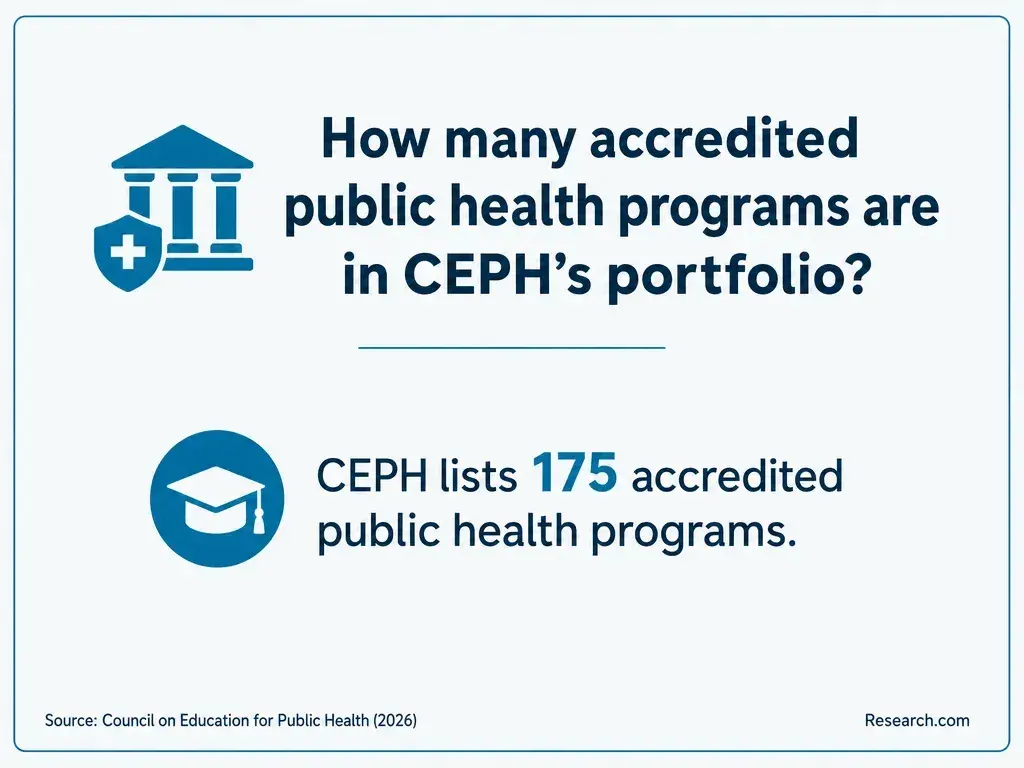
CEPH accreditation is a useful quality signal, but check its exact scope. An institution's general accreditation and CEPH accreditation are different, and a school's CEPH status does not establish that every degree it offers is covered. Use CEPH's current directory and the school's program information to confirm whether the particular bachelor's degree is included.
For coalition employment, an employer may value relevant projects and community experience more directly than accreditation status; another employer or graduate program may specify credential expectations. Compare those requirements before treating accreditation as the only selection criterion. Likewise, CEPH status does not settle an individual master's program's admission prerequisites. If graduate study is a possibility, investigate pathways into public health master's prerequisite completion with the programs you might actually apply to.
There is no single US professional license that universally authorizes community health coalition administration. Requirements attach to particular jobs and duties: an employer may prefer a health education credential, require training for a community health worker position, or expect experience managing grants. A public health BS does not itself award a professional certification or authorize clinical care.
CHES and CPH are distinct credentials with eligibility and examination rules set by their respective certifying bodies; neither should be assumed necessary for every coalition job. Check a target employer's posting and the certifier's current eligibility rules before paying for preparation. If you are considering a master's instead of a narrower credential or employer-supported training, compare public health master's fees and earning potential against the specific responsibilities you hope to gain. A larger credential is not automatically the better investment.
Either format can cover public health fundamentals. The deciding issue for coalition work is access to supervised local practice, not where lectures appear. An online student may build strong relationships through a nearby coalition, while a campus student may benefit from established community partners; neither arrangement is guaranteed.
Compare live-session times, group-project schedules, placement assistance, required campus visits, and whether faculty will approve a site near you. Working students should also ask whether evening coalition meetings and daytime placement hours can coexist with their jobs. Online delivery does not automatically make fieldwork asynchronous.
Keep degree levels separate when comparing online prices and flexibility. Online MPH affordability rankings concern graduate study, not the cost or placement support of an online BS. Choose the undergraduate format using its own course schedule, approved-site rules, and total charges.
A conventional full-time bachelor's plan is commonly built around four academic years and roughly 120 credits, but a student's actual timeline depends on transfer-credit application, major sequencing, course availability, and any field requirement. An accepted transfer course may count as an elective without satisfying a required public health course. Request a degree audit before relying on a completion estimate.
Calculate cost from the credits you still need, tuition and mandatory fees, books or technology, transportation to placements, and any earnings you would give up for fieldwork. Compare published public health undergraduate program affordability with your personalized degree audit; an attractive per-credit price can be offset by additional required credits or travel.
For someone already employed by a coalition, ask whether employer tuition assistance, selected undergraduate courses, or focused management training would address the gap more directly than completing another bachelor's degree. Confirm eligibility and funding terms with the employer and school before counting on either option.
What salary and job outlook can public health graduates expect?
There is no reliable national salary figure for "public health BS graduates" or a single occupational category covering coalition administrators. Pay depends on the job's duties, location, employer, funding, and your experience. For a relevant benchmark, the US Bureau of Labor Statistics Occupational Outlook Handbook reports wages and employment projections for occupations such as community health workers and health education specialists. Those occupation-wide figures are not starting salaries or guaranteed outcomes for BS graduates.
Use the benchmark that matches the work you plan to do, then compare local postings for coalition coordinator and manager positions. Note whether a salary is supported by a time-limited grant and whether the role includes benefits, supervisory authority, or advancement. These details are more useful for an entry-level decision than comparing a BS job with public health doctorate costs and career outcomes, which involve a different investment and experience level.
The practical next step is to collect several target job descriptions and mark which requirements you can already demonstrate. If the missing evidence is coalition operations, seek supervised responsibility; if it is population-health planning and evaluation, compare BS curricula and applied assignments before enrolling.
Other Things You Should Know About Public Health
Yes. A coalition can operate through a host organization, though partners should clarify who holds funds, signs agreements, maintains records, and makes decisions. Its legal and funding arrangements should fit the work it plans to undertake.
Partners and people affected by the issue should have meaningful input. An administrator can organize the process and present evidence but should not treat a needs assessment as permission to decide on a community's behalf.
Agree early on how decisions are made, how conflicts of interest are disclosed, and how unresolved issues are escalated. Document decisions and revisit the process when participation or trust changes.
Use a deliverable only with the host's permission. Remove confidential information and identifying details as required, and explain your own contribution without implying that a draft was adopted or that an activity achieved results it has not measured.
- The Landscape of US Undergraduate Public Health Education | nih.gov https://pmc.ncbi.nlm.nih.gov/articles/PMC6134569/
- A Handbook for Community Partnerships: Internship | High Tech High Graduate School of Education https://hthgse.edu/a-handbook-for-community-partnerships-internship/
- What Can You Do with a Public Health Degree? | Excelsior University https://www.excelsior.edu/article/what-can-i-do-with-a-public-health-degree/
- What Can You Do With a Public Health Degree? | American Military University https://www.amu.apus.edu/area-of-study/health-sciences/resources/what-can-you-do-with-a-public-health-degree-explore-careers/
- 1. Creating and Maintaining Coalitions and Partnerships | ku.edu https://ctb.ku.edu/en/creating-and-maintaining-coalitions-and-partnerships
- Career Guide: Community Health Worker | American College of Education https://ace.edu/student-success/career-guides/community-health-worker/
- Coalition Building, Partnerships, and Communications | gwu.edu https://ccr.publichealth.gwu.edu/tools-resources/coalition-communications
- Bachelor of Science in Public Health | Western Michigan University https://wmich.edu/publichealth/academics/undergraduate