2027 Evaluating an MPH Practicum in A Substance Use Prevention Coalition

Co-Founder and Chief Data Scientist
A substance use prevention coalition can give an MPH student meaningful community-based experience - or leave them attending meetings without a usable project. The difference matters when a practicum must satisfy academic requirements, respect community priorities, and produce work the coalition can use. This guide is for students comparing placements, including online MPH students arranging local fieldwork. It explains what coalition work involves, how to check supervision and deliverables, and which questions to resolve before accepting an offer.
Key Things You Should Know
- A strong coalition placement assigns the student a defined prevention project, a qualified supervisor, and work products the MPH program approves before fieldwork begins.
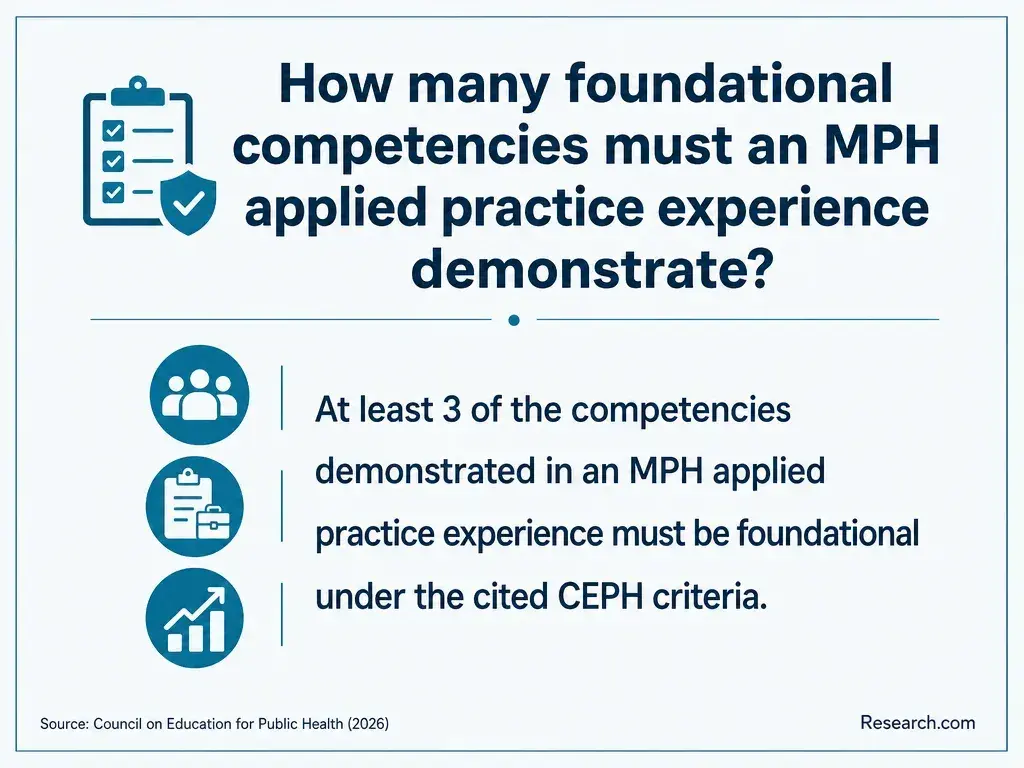
- Under CEPH's MPH applied practice framework, students demonstrate selected competencies through at least two work products; a school may impose additional requirements.
- Coalition access, permission to use data, school approval, and permission to share a portfolio sample are separate decisions - none should be assumed from an invitation to volunteer.
What Is an MPH Practicum in a Substance Use Prevention Coalition?
An MPH practicum - often called an applied practice experience - is supervised work in which a student applies public health competencies to an organization's real needs. A substance use prevention coalition brings together partners such as residents, schools, health departments, youth-serving organizations, and treatment providers to coordinate prevention efforts. Its focus is population-level prevention, not providing clinical treatment.
A suitable placement might help the coalition assess local priorities, plan an evidence-informed strategy, improve outreach, or evaluate implementation. The MPH's practice orientation is relevant here; students comparing different routes through public health master's study should not assume a research-oriented degree has the same fieldwork rules. Coalition willingness to host a student does not, by itself, make the placement eligible for MPH credit.
What Does a Substance Use Prevention Coalition Practicum Involve?
Coalition work usually combines partner coordination with a bounded project. A student may attend planning meetings, review a community assessment, help draft prevention messages, or examine whether an activity reached its intended audience. The student should have responsibility for producing and revising something useful - not merely observe meetings or handle unrelated clerical work.
Before agreeing, ask how decisions are made and whose priorities the project serves. A coalition may include organizations with different goals, while residents and people affected by substance use may have limited time or influence. The student's role is to listen, use respectful language, and avoid presenting a convenient partner's view as the community's consensus.
Students arriving from undergraduate study can bring communication or community-engagement experience, but a placement should still match their current skills and supervision needs. Someone reviewing public health BS programs and career preparation may find coalition volunteering valuable preparation; volunteering alone, however, is not an approved MPH practicum.
How Does CEPH Accreditation Shape MPH Practicum Requirements?
The Council on Education for Public Health (CEPH) sets applied practice expectations for MPH degrees within its accreditation scope. Its framework calls for competency-based practice and at least two work products demonstrating what the student did. The MPH program determines its own approval process, documentation, assessment, and any additional hour or supervision rules. Check that the specific MPH degree is covered by the accreditation claimed, rather than relying on the university's general accreditation or another degree's status.
Ask the practicum coordinator whether the proposed coalition, supervisor, activities, and products qualify before starting work. Also ask whether existing employment can count: a school may require duties distinct from a student's regular job. For a broader program comparison, CEPH-accredited MPH program selection should include the exact accreditation scope and each school's fieldwork policy, not accreditation status alone.
The best competency choices follow the proposed tasks. Coalition work can support community engagement, assessment of population needs, evidence-based program planning, health communication, and basic evaluation. A student who maps partners and revises an outreach plan can show different skills from one who designs indicators and interprets implementation data.
Methods matter at the level the project requires. For example, comparing event attendance across sites requires a clear definition of who was counted and recognition that attendance alone does not show reduced substance use. A student seeking deeper statistical training may separately consider biostatistics master's schedules for employed students; a coalition practicum is not a substitute for advanced analytic coursework. Agree with the faculty advisor on which competencies each planned product will actually demonstrate.
A useful project answers a decision the coalition expects to face during the placement. Possible paired products include a partner-informed outreach plan and message-testing protocol, or an evaluation plan and a reporting template. A needs-assessment brief could accompany a presentation tailored to coalition members. These are possible products, not claims about any coalition's available data or approval.
Scope the assignment around data access and time. An evaluation plan can define indicators and collection responsibilities without claiming that an intervention worked. If survey responses, school records, or other sensitive information are involved, confirm permissions, data security, and whether institutional review is needed before collection or analysis. Ask the partner what can be shared outside the coalition; a redacted portfolio version may require separate approval.
The deliverable should fit an MPH practice decision rather than imitate a dissertation. Students contemplating research careers can assess reviewing selectivity in public health doctoral study separately; admission prospects do not determine whether a coalition's immediate project is useful or ethical.
Start with the MPH fieldwork office's approved-site process and ask about existing coalition partners. A local health department's prevention staff or a state prevention network may be able to identify coalitions seeking project help. Approach a potential host with a brief description of your skills, available schedule, proposed project types, and school requirements - not a request for unrestricted access to its data.
Before treating interest from a coalition as an offer, establish who will supervise, what decision the work will support, and when the school must approve the agreement. If you are not yet admitted to an MPH program, separate that admissions decision from placement planning. Guidance on improving low-GPA MPH application prospects concerns entry to a degree; it cannot establish fieldwork eligibility at a particular school.
An online MPH may allow an approved local or remote coalition placement, but online classes do not make fieldwork automatically remote or self-paced. Coalition meetings may occur during working hours, and community events, school visits, or partner interviews may require travel. Confirm whether the school finds sites, permits student-identified sites, accepts remote supervision, and requires any campus visits.
Budget for unpaid hours, transportation, and possible changes to paid-work schedules as well as tuition. Students comparing online public health degrees for budget-conscious students should ask each MPH program about placement-related costs and scheduling; an advertised tuition rate does not capture those obligations. For a student employed by the proposed coalition, written approval of distinct practicum duties is especially important.
Coalitions value skills drawn from community organizing, health education, data analysis, grant support, and work with young people. An MPH can deepen planning and evaluation skills, but it is not universally required for prevention jobs. Entry-level coalition support or outreach roles may be accessible through relevant experience and targeted training; positions directing evaluation or complex programs may call for stronger methods skills and a record of responsibility.
Review actual job postings for the setting and state you want to enter. Some employers prefer prevention-specific credentials, and eligibility rules can vary; an MPH does not automatically confer certification or clinical licensure. If the goal is independent research rather than coalition practice, online PhD programs in public health by cost address a different training decision. A doctorate is not a routine prerequisite for helping a coalition implement or evaluate prevention activities.
A relevant practicum can supply evidence for applications to prevention coordinator, health education specialist, program associate, or evaluation assistant roles in nonprofits, health departments, and community organizations. Responsibilities differ: a coordinator may organize partners and activities, while an evaluation assistant may maintain indicators and prepare reports. Independent program leadership generally requires experience beyond one placement.
Use MPH-related occupations and earnings as occupational context, not as a salary forecast for coalition practicum graduates. Compare a posting's actual duties, required credential, location, funding source, and pay range. When applying, describe the decision your approved project supported and the products you made, without disclosing restricted coalition information or claiming an outcome you did not measure.
How Should Students Evaluate a Substance Use Prevention Practicum?
Choose the placement that can support an approved, feasible contribution - not simply the coalition with the most recognizable name. Use the following checks in a conversation with both the site supervisor and academic coordinator before signing an agreement.
- Project and authority: What decision needs support, who will review the student's work, and can the student do more than observe?
- Academic fit: Which competencies and work products will the school approve, and who provides feedback and assessment?
- Access and ethics: What data, partner contact, and permissions are available; what review is required; and what may be retained for a portfolio?
- Feasibility: When are meetings and events, which tasks require travel, and what costs or unpaid hours will the student bear?
If the answers remain vague, ask for a smaller, clearly supervised assignment or consider another site. For a reader still deciding whether to pursue an MPH at all, shorter undergraduate course calendars - such as those discussed in public health BS programs with shorter academic terms - do not resolve the separate question of whether a graduate-level coalition placement fits their goals. The immediate test is whether this particular project has school approval, partner support, and an achievable output.
Other Things You Should Know About Public Health
Possibly. Ask the host whether funding is available and the MPH program whether paid work is eligible. Do not assume a stipend exists or that payment changes the school's academic requirements.
Ownership and sharing depend on the host agreement and school policies. Clarify who may revise, publish, or reuse products before work begins, especially if they contain coalition data or partner contributions.
Follow the host's established safety and escalation procedures, including any applicable reporting duties. Agree on the student's role and supervisor contact in advance; a practicum student should not improvise clinical advice.
Sometimes, if the coalition and MPH program approve the task. Ask the host about its funding restrictions and policies, and distinguish permissible education or policy analysis from lobbying activities it may not authorize.
- Methods to Disseminate Research: A Primer - PMC - NIH https://pmc.ncbi.nlm.nih.gov/articles/PMC11286224/
- Principles and Best Practices for Protecting Participant Privacy | Grants & Funding https://grants.nih.gov/policy-and-compliance/policy-topics/sharing-policies/dms/privacy/best-practices
- SAMHSA Strategic Priorities https://www.samhsa.gov/about/strategic-priorities
- Drug and Alcohol Use - Healthy People 2030 | odphp.health.gov https://odphp.health.gov/healthypeople/objectives-and-data/browse-objectives/drug-and-alcohol-use
- Drug-Free Communities Program Successes | cdc.gov https://www.cdc.gov/overdose-prevention/php/drug-free-communities/program-success.html
- Federal Register, Volume 59 Issue 70 (Tuesday, April 12, 1994) | govinfo.gov https://www.govinfo.gov/content/pkg/FR-1994-04-12/html/94-8792.htm
- TCPS 2 (2022) - Chapter 5: Privacy and Confidentiality https://ethics.gc.ca/eng/tcps2-eptc2_2022_chapter5-chapitre5.html
- MPH Practicum - Washington University Bulletin - WashU https://bulletin.wustl.edu/publichealth/mph/practicum/
- Using effective community coalitions to prevent mental and behavioral disorders on a national scale - ScienceDirect https://www.sciencedirect.com/science/article/pii/S2212657024000047
- Coalition Self-Assessment Survey | NAM https://nam.edu/product/coalition-self-assessment-survey/