2027 MPH Epidemiology Prerequisites for Humanities Graduates

Co-Founder and Chief Data Scientist
A humanities degree does not rule out an MPH in epidemiology, but it may leave gaps in the statistics and quantitative reasoning the coursework demands. If you studied history, literature, languages, or philosophy, the important decision is not whether to earn another bachelor's degree. It is which requirements your target programs actually impose and how to demonstrate readiness without paying for unnecessary courses. This guide separates formal prerequisites from recommended preparation, then explains how to assess programs, costs, and career outcomes.
Key Things You Should Know
- A humanities major is not an automatic barrier to an MPH in epidemiology; required statistics, science, and methods coursework varies by program.
- Before applying, check whether each school requires a graded statistics course, accepts an alternative, or lets you finish a missing prerequisite before enrollment.
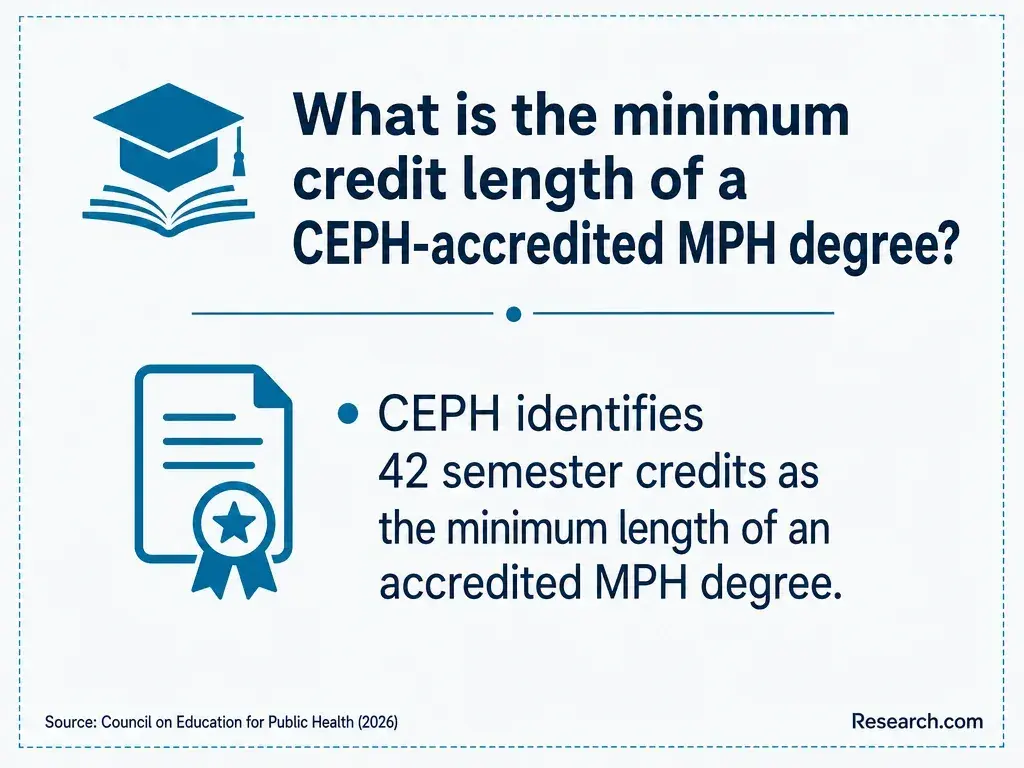
- For a CEPH-accredited MPH, expect at least 42 semester credits; compare the full degree and fieldwork commitment, not just the courses needed for admission.
What prerequisites do humanities graduates need for an MPH in epidemiology?
There is no universal prerequisite list for an MPH in epidemiology. Most programs require a bachelor's degree, but each school decides whether applicants must complete statistics, biology, calculus, research methods, or other courses before admission or enrollment. A course described as recommended is not the same as a formal condition of admission.
Statistics is the first subject to investigate. Epidemiology students work with rates, uncertainty, comparisons between groups, and statistical models. A humanities graduate may already have relevant preparation through a research methods course, economics, psychology, or a quantitative senior project; the receiving program decides whether that work meets its requirement. A public health bachelor's degree is not inherently necessary. Public health BS programs and career preparation follow a different pathway from graduate admissions and should not be treated as a prerequisite for an MPH.
The distinction below helps you read admissions pages accurately. Course titles alone may not establish equivalence, so ask for a review of your syllabus if a requirement is unclear.
| What a program says | What it means for your application |
| Required before applying | Confirm that your completed course meets the school's content, grade, credit, and recency rules. |
| Required before enrollment | Ask whether you may apply while the course is in progress and when a final grade is due. |
| Recommended preparation | Admission may still be possible, but you should assess whether you can manage the quantitative coursework. |
| Accepted alternative or waiver | Request the school's criteria; professional experience or informal study does not automatically qualify. |
Can humanities majors get into an MPH epidemiology program?
Yes. Programs can value the close reading, persuasive writing, historical context, language skills, and ethical reasoning developed in humanities study. Those abilities matter when interpreting evidence, communicating uncertainty, and working with communities. They do not, however, substitute for a required statistics course or prove that an applicant can analyze data.
To judge your chances, separate eligibility from competitiveness. Eligibility means meeting the published degree and prerequisite rules. Competitiveness may also depend on grades, evidence of quantitative learning, relevant work or service, recommendations, and a clear reason for studying epidemiology. A history graduate who has evaluated archival records or a linguistics graduate who has worked with datasets should explain the methods used and the limits of that experience rather than relabeling it as epidemiologic research.
Compare the actual requirements of several programs instead of assuming that a broadly accessible MPH has light epidemiology coursework. A guide to comparing accessible online public health master's options can help start a shortlist, but the concentration's admissions rules and course sequence should decide whether a program fits.
How can humanities graduates prepare for MPH epidemiology coursework?
Start with the skills you will use early in the degree: interpreting distributions and confidence intervals, understanding study design, working with spreadsheets or statistical software, and explaining what results do - and do not - show. Humanities strengths in interpretation and writing become more useful when paired with enough quantitative fluency to question a denominator, recognize a misleading comparison, or explain confounding.
A short preparation sequence avoids taking courses that a school will not recognize:
- Collect your transcripts and syllabi for statistics, mathematics, logic, economics, psychology, or research methods courses.
- Ask each target program which missing subjects are mandatory, which alternatives it accepts, and whether courses must carry a letter grade.
- Take the required credit-bearing course first; use introductory epidemiology and software practice to build confidence, not as presumed substitutes for it.
- Complete a small, documented analysis using appropriately public data, noting the question, measures, limitations, and what you did yourself.
An accelerated undergraduate course can be useful if it satisfies a stated prerequisite, but speed is not the same as preparation. Before choosing intensive online public health bachelor's classes, confirm that the specific course covers the required material and leaves enough time to practice statistics. You generally do not need to enroll in an entire second bachelor's program.
Check both the institution's recognized institutional accreditation and whether the exact MPH is within the scope of Council on Education for Public Health (CEPH) accreditation. An institution's accreditation does not establish that its public health degree is CEPH-accredited; likewise, an accredited school or unit may offer degrees that are not all covered in the same way. Confirm the status and scope in the CEPH directory and with the program before committing.
This matters particularly when comparing a professional MPH with a research-oriented MS. The degrees can have different curricula and accreditation arrangements even at the same university. Review different routes through public health master's study if your goal might be better served by research training than by the MPH's broader practice preparation. For either route, ask whether the epidemiology concentration is formally designated and which courses you can actually take.
An epidemiology-focused MPH typically combines public health foundations with study design, disease surveillance, biostatistics, data analysis, and interpretation of population-level evidence. Students may learn to compare disease rates across populations, evaluate potential sources of bias, and distinguish an observed association from a causal claim. Course depth, software, and elective options differ by school.
For a humanities graduate, the key curriculum question is where the quantitative sequence starts. An introductory biostatistics course may teach concepts from the ground up; a later regression or advanced epidemiologic methods course may assume fluency with those concepts. Read course descriptions and prerequisites in order, and ask how students with limited statistics backgrounds obtain support. Also check how the applied practice experience and final integrative work let you demonstrate epidemiology skills under supervision.
If your primary aim is to design independent research rather than work across public health practice settings, compare the MPH with a methods-intensive MS before contemplating a doctorate. Listings of online PhD programs in public health by cost concern a substantially different research commitment, not a substitute for missing introductory methods courses.
Online delivery can support rigorous epidemiology study, but the format alone cannot establish equivalent learning or career outcomes. Compare what students actually do: live or recorded methods instruction, access to instructors and statistical support, supervised analysis, group work, and help arranging an approved applied practice experience. Ask to see the course schedule, not just a claim that the degree is "flexible."
Remote study may save travel time while shifting more responsibility to the student to find a suitable field site and professional contacts. A campus program may offer easier in-person collaboration but require relocation or commuting. When comparing low-tuition online public health degree options, confirm that the listed price applies to the graduate epidemiology pathway and include fees, software, and any required travel. Neither a low price nor online access is evidence that the methods instruction meets your needs.
Expect to submit evidence of a completed bachelor's degree and the materials specified by each program, which may include transcripts, a statement of purpose, recommendations, a résumé, and proof of prerequisite coursework. GPA rules, entrance-test policies, interviews, deadlines, and application systems vary. Do not assume that a school uses SOPHAS or that a test is required or waived without checking its current instructions.
Your statement should connect your humanities training to a specific population-health question and show how you have addressed quantitative gaps. For example, describe a completed statistics course and what you learned from a research project; do not claim proficiency based solely on interest. If grades are a concern, guidance on explaining a low GPA in public health graduate admissions can help you present context, but only the target school can say how it weighs later coursework or an academic recovery.
Before submitting an application, email admissions with your transcript and a precise question: "Does this course satisfy your statistics prerequisite, and may I apply while any remaining course is in progress?" Save the answer and check whether the concentration has additional rules beyond the MPH-wide requirements.
CEPH's MPH criteria specify at least 42 semester credits. How long those credits take depends on course sequencing, full- or part-time enrollment, fieldwork, and any prerequisites you must finish first. Ask for a term-by-term plan that shows when required epidemiology and biostatistics courses run; a missing prerequisite can delay entry to a sequence even if it adds only one course.
Compare a written estimate of total tuition and mandatory fees rather than advertised per-credit tuition alone. Include prerequisite courses, books or software, travel, possible unpaid fieldwork, and earnings you would give up to attend. Ask whether aid applies to prerequisites taken before admission and whether the program helps students secure funded work or placements; neither benefit should be assumed.
A doctorate is not a cost-saving way around MPH preparation. Information on lower-cost epidemiology research training and aid is relevant if you later pursue doctoral research, but its funding and time commitments must be evaluated separately from an MPH budget.
Epidemiology graduates may pursue work in health departments, research organizations, health systems, and other settings that analyze population health. Early responsibilities can include cleaning surveillance data, reviewing literature, assisting with study protocols, and communicating findings. Employers may seek additional programming, clinical, subject-area, or research experience; an MPH alone does not qualify someone for every position titled "epidemiologist."
The US Bureau of Labor Statistics reported a $83,980 median annual wage for epidemiologists in May 2024 and projects employment to grow faster than the average for all occupations over 2024-2034. The wage describes people employed in that occupation across experience levels and settings - not the expected starting salary of a humanities graduate or a particular MPH program's alumni. For a broader explanation of why MPH degree salary expectations vary, compare actual job postings in your intended location and specialty.
If you have limited quantitative or health-sector experience, a supervised analyst, research assistant, or public health program role may be a more realistic first step than an independent study-lead position. Build a portfolio that shows sound analysis and clear writing without exposing restricted data.
Is certification or licensure required for epidemiologists?
There is no single US license required to work as an epidemiologist. Employers set qualifications for particular jobs, and specialized positions can have additional requirements. An MPH does not confer clinical licensure or automatically award a professional certification.
The Certified in Public Health credential is separate from the degree and has its own eligibility and examination rules. Check the credentialing organization's current criteria if a job posting requests it; do not assume that an epidemiology concentration makes certification mandatory. Similarly, an advanced degree is not a license. An online public health doctorate admissions guide addresses a different educational decision and should not be mistaken for a list of credentials required to enter epidemiology.
Other Things You Should Know About Public Health
Yes, if you explain the question, evidence, methods, and limitations clearly. It demonstrates research reasoning, but it does not automatically establish statistical proficiency.
It may help you learn, but a program may require transcripted, graded college credit. Ask admissions to assess the particular course before relying on it.
Possibly. The program must approve the site, supervision, learning objectives, and deliverables; holding a relevant job alone does not establish fieldwork credit.
Not necessarily. Check each program's rules and assess your target job. If you lack both quantitative preparation and exposure to public health work, a course plus a supervised project or volunteer role can help you make a more informed application.
- Core Academic Competencies for Master of Public Health Students: One Health Department Practitioner's Perspective - PMC https://pmc.ncbi.nlm.nih.gov/articles/PMC2509593/
- Graduate Admission Requirements | maryville.edu https://catalog.maryville.edu/content.php
- Academic Requirements | Office of Admissions & Financial Aid https://www.medadmissions.pitt.edu/admissions/you-apply/academic-requirements
- Master of Public Health | Department of Epidemiology https://epi.washington.edu/admissions/find-a-program/master-of-public-health/
- Epidemiology - MPH | Milken Institute School of Public Health https://publichealth.gwu.edu/programs/epidemiology-mph
- Master of Public Health - Epidemiology Concentration, (MPH) https://catalog.memphis.edu/preview_program.php
- MPH in Epidemiology | Rollins School of Public Health | Emory University https://sph.emory.edu/degrees-programs/mph/epidemiology
- Master of Public Health with a concentration in Epidemiology | UNT Health Fort Worth https://www.unthealth.edu/tcom/public-health/mph-in-epidemiology.html
- The Application Process | Columbia University Mailman School of Public Health https://www.publichealth.columbia.edu/become-student/how-apply/process
- Admission Requirements | School of Public Health https://www.publichealth.pitt.edu/admissions-aid/admission-requirements