2027 Public Health PhD Programs: Questions About Shared Supervision

Co-Founder and Chief Data Scientist
Two promising dissertation advisors can offer a public health PhD student stronger guidance or create conflicting expectations about methods, data, and deadlines. For research-oriented applicants, the important distinction is between a program that welcomes collaboration and one that formally supports shared supervision.
This guide explains how co-supervision works, what to ask before accepting an offer, and how to compare its benefits against funding, access, and progression risks. The goal is to help you choose a research environment where both mentors can contribute without leaving you to manage unresolved disagreements.
Key Things You Should Know
- Shared supervision usually involves two active mentors, but the graduate school may recognize only one as the official dissertation chair; confirm who has decision-making authority.
- Before enrolling, verify both advisors' availability, data permissions, funding commitments, meeting arrangements, and the process for resolving conflicting feedback.
- Two advisors are not automatically better than one. A strong primary mentor and a specialist committee member may be the safer arrangement when responsibilities cannot be defined.
What Is Shared Supervision in Public Health PhD Programs?
Shared supervision, also called co-supervision or co-advising, means that two faculty members take substantial, continuing responsibility for a doctoral student's research development. One might guide epidemiologic design while the other contributes expertise in community partnerships or health policy. The arrangement is most useful when the dissertation genuinely requires both perspectives.
It is not necessarily a formal university status. A program may permit two co-chairs, require one official chair with a second advisor, or allow an outside researcher to serve only as a committee member. Those distinctions affect approvals and accountability. Ask the graduate program which arrangement its handbook recognizes and whether both proposed mentors are eligible to serve.
Shared supervision is a research-fit decision, not a feature that every doctoral applicant needs. If you are comparing research training with practice-oriented leadership study, a public health doctoral degree comparison guide can help clarify which degree's work matches your goal before you assess advisors.
How Does Shared Supervision Work for a Public Health PhD Dissertation?
University rules govern committee appointments, proposal approval, candidacy, and the final defense. Within those rules, the student and mentors should agree early on who leads each part of the research.
For a dissertation using linked health records and interviews, for example, one advisor might oversee statistical design while the other guides qualitative sampling and interpretation. Neither role gives the student automatic access to records or participants.
Before committing, ask the proposed supervisors to discuss these working arrangements together:
- Decision authority: Who is the official chair, and whose approval is needed to change the research question or methods?
- Feedback: Will mentors review drafts jointly or in sequence, and who reconciles incompatible comments?
- Access and oversight: Who can authorize use of each dataset or partnership, and what institutional review, privacy, or data-use approvals may be required?
- Continuity: What happens if a mentor leaves, a grant ends, or the project changes?
A methods specialist need not always be a co-chair. If you primarily need additional quantitative training, comparing online biostatistics graduate programs may help you assess a different route; within a PhD, a course or committee member may address a narrower skills gap.
What Are the Benefits and Challenges of Co-Supervision?
The chief benefit is complementary expertise. Thoughtful co-supervision can improve the fit between a public health question, its methods, and the population or institution involved. It can also broaden scholarly feedback and professional connections. These gains are strongest when both mentors have time for the project and respect each other's roles.
The chief risk is divided accountability. Advisors may disagree about whether a project is ready for proposal review, which analyses belong in the dissertation, or how quickly drafts should move.
A student can lose time relaying messages between two busy faculty members. Joint meetings and a written division of responsibilities reduce that risk, but they do not replace a program policy for resolving disputes.
When finding public health doctorates that fit your background, treat an advertised opportunity to work across departments as a starting point. The more consequential question is whether the specific faculty members and graduate program can support the proposed arrangement through graduation.
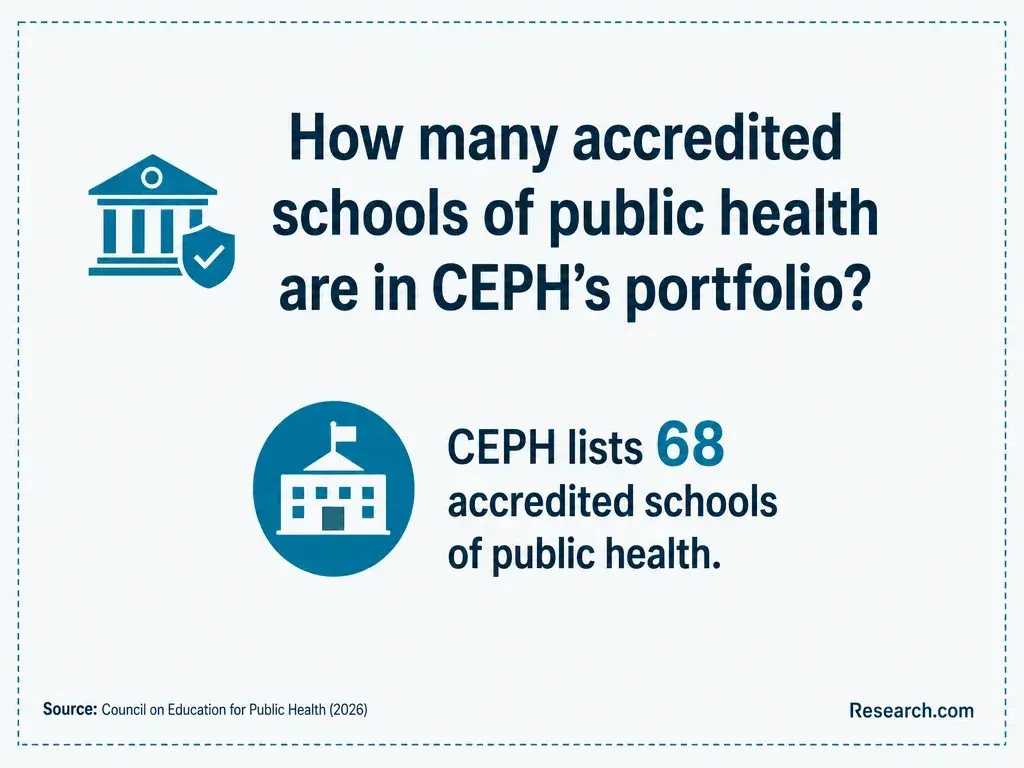
Check institutional accreditation first: it applies to the university awarding the degree. Then check whether the school or program has Council on Education for Public Health (CEPH) accreditation and, importantly, what that accreditation covers.
A university's public health school may be CEPH-accredited without every doctoral degree being included in its accredited scope. Neither form of accreditation establishes that a particular co-supervision arrangement is permitted.
For the supervision decision, the controlling documents are usually the current graduate-school rules and the PhD program's handbook. Request the policies on chair eligibility, external committee members, committee changes, and dissertation approvals for your expected entry term.
A description of CEPH-accredited distance learning MPH options concerns a different degree and should not be taken as evidence about a PhD's accreditation scope or advising rules.
Requirements vary by institution and research area. Programs may assess prior quantitative or qualitative methods preparation, research experience, academic writing, recommendations, and the match between an applicant's interests and available faculty.
An MPH, publication, GRE score, or advance commitment from an advisor is not a universal requirement. Eligibility to apply is also different from having the preparation and mentorship needed for a feasible dissertation.
If your proposed project needs two specialties, explain why each is necessary and show evidence that you can work across them. You might describe a prior analysis, thesis, community-engaged study, or research-assistant role, identifying your own contribution.
Ask admissions staff whether applicants may contact potential supervisors, whether both must agree before admission, and how advising assignments are made after enrollment.
Do not transfer assumptions from master's applications. MPH programs with no recommendation letter requirement, for example, do not establish the recommendation policy of a research PhD. Follow the requirements published for the specific doctoral program.
Coursework typically supports the dissertation through advanced research design, discipline-specific theory, analysis, research ethics, and scholarly communication. The balance depends on whether the PhD is housed in epidemiology, biostatistics, health policy, environmental health, or another field. Coursework does not substitute for supervised experience applying a method to suitable data.
For shared supervision, compare the proposed mentors' expertise with the training you can actually access. If one advisor expects causal inference methods and the other expects community-engaged qualitative work, ask which courses are required, which are available as electives, and when they are offered. A course plan can expose a project that is too broad for the available training or dissertation timeline.
Applicants still building foundational preparation can use a public health BS program selection guide to compare earlier-stage study, but a bachelor's curriculum is not a replacement for the advanced methods and original research expected in a PhD.
Employer Confidence in Online vs. In-Person Degree Skills, Global 2024

Time to completion depends on required coursework, exams, dissertation scope, data access, and the speed of review and revision. Co-supervision can help when mentors make timely, complementary decisions; it can slow progress when neither has clear authority. Ask the program for its published completion and funding policies rather than relying on an advertised minimum duration.
Evaluate the full funding package: tuition coverage, required fees, stipend, health coverage if offered, summer support, and teaching or research duties. Confirm which years are guaranteed, which depend on satisfactory progress or grant funding, and whether dissertation continuation carries charges. Also ask whether a change of chair or research project could affect assistantship support.
Figures for public health graduate tuition after institutional funding can illustrate why advertised tuition is not a net-cost estimate, but master's aid arrangements cannot be assumed to apply to a PhD. Compare doctoral offers using their written terms and your likely living and research expenses.
A public health PhD can support careers involving original research, advanced analysis, teaching, or research leadership in universities, government, health systems, and other organizations.
The relevant preparation depends on the work: a policy researcher needs different evidence of expertise from a biostatistician or community-engaged investigator. Co-supervision is valuable professionally when it helps produce rigorous, ethical work and meaningful collaboration, not simply because two faculty names appear on a committee.
There is no single reliable salary for "public health PhD graduates." The US Bureau of Labor Statistics reports wages for occupations, not degrees; an epidemiologist's occupation-wide median, for instance, would not predict a new graduate's offer or a faculty salary.
Compare current postings for your target role and location, including their methods, experience, and publication expectations, before estimating a return on doctoral study.
If your goal is an entry-level public health role rather than independent research, a PhD may be unnecessary. Affordable public health BS study options may be a more proportionate starting point for someone who has not yet completed undergraduate preparation.
How Can You Choose a Reputable Public Health PhD Program?
Start with a dissertation question narrow enough to reveal what supervision it needs. Then compare programs on faculty fit, formal advising rules, feasible data or partnership access, funding stability, and evidence that students receive timely guidance. Speak with current students if possible; ask how committee feedback, advisor absences, and research-plan changes are handled in practice.
Before accepting an offer, request the applicable handbook and written funding terms. Ask both prospective mentors to discuss the project together, including who would chair, what each would review, how often they would meet, and what happens if the research changes. If those answers remain vague, a single committed chair with specialist committee support may be preferable to nominal co-supervision.
An uneven academic record need not end the inquiry, but it makes evidence of current research readiness especially important. Guidance on public health graduate admission after academic setbacks can help frame a preparation plan; the PhD program must still judge whether your methods background and proposed supervision are sufficient for doctoral work.
Other Things You Should Know About Public Health Programs
Not necessarily. Graduate-school policy determines formal chair and committee authority. Ask the program to identify each person's official role rather than relying on the term "co-advisor."
Possibly, but eligibility varies. The researcher may qualify as an external committee member or informal mentor rather than a chair; the university must approve the role.
Discuss expected contributions and the applicable university or journal authorship standards early. Revisit the discussion as the work develops; supervision alone should not be treated as an automatic authorship agreement.
Ask for a joint meeting and document the agreed direction. If the disagreement persists, use the program's director-of-graduate-studies or committee-resolution process before it delays a formal milestone.
- Data ownership | ORI - The Office of Research Integrity https://ori.hhs.gov/content/Chapter-6-Data-Management-Practices-Data-ownership
- Full article: The more the merrier? PhD supervisors' perspectives in engaging in co-supervision | tandfonline.com https://www.tandfonline.com/doi/full/10.1080/14703297.2023.2258853
- View of PhD supervision in Public Health | nepjol.info https://www.nepjol.info/index.php/HPROSPECT/article/view/32735/28111
- Section 2: Supervision and Mentoring | utoronto.ca https://www.sgs.utoronto.ca/supports/supervision/supervision-guidelines/supervision-guidelines-for-faculty-section-2-supervision-and-mentoring/