2027 Choosing MPH Coursework for Health Communication Campaign Evaluation

Co-Founder and Chief Data Scientist
A health communication campaign can reach thousands of people without showing whether anyone understood its message or changed a behavior. If you want an MPH that prepares you to answer those questions, the concentration name alone is not enough.
This guide is for prospective students and early-career practitioners comparing coursework, evaluation methods, applied experience, and career options. It will help you identify a course sequence that fits your starting skills and determine whether a full MPH is worth the time and cost for your goal.
Key Things You Should Know
- Prioritize a sequence covering campaign planning, epidemiology or biostatistics, evaluation design, and an applied project; a health communication elective alone is insufficient preparation to evaluate impact.
- Look for measures beyond reach: message comprehension, intended behavior, and outcomes over a defined period. A before-and-after comparison by itself rarely proves a campaign caused change.
- Compare the exact MPH curriculum and CEPH accreditation scope, then confirm project access, supervision, scheduling, and total cost before enrolling.
What is health communication campaign evaluation in an MPH program?
Health communication campaign evaluation is the systematic assessment of how a population-focused message is developed, delivered, received, and associated with outcomes. An MPH approaches this work as a public health practice problem: Which community is the campaign intended to serve, what barriers affect its response, and what evidence would help a partner improve the effort?
Evaluation can examine process (whether intended audiences encountered the campaign), intermediate outcomes (such as comprehension or intentions), and longer-term outcomes (such as service use or behavior). These are different questions. Website impressions, for example, cannot establish that people understood a vaccination message, and a change in service use cannot automatically be attributed to that message.
Students entering from journalism, marketing, clinical care, or community outreach may already know how to develop or deliver messages. Their main gap may be evaluation design rather than communication itself. If admission requirements are an obstacle, comparing flexible public health master's entry routes can help identify options, but admissions flexibility does not establish that a curriculum teaches rigorous campaign evaluation.
Which MPH courses prepare students to evaluate health communication campaigns?
The strongest curriculum connects communication theory to measurement and supervised application. Course titles vary, so compare syllabi and assignments rather than assuming that every program with a health communication concentration provides the same depth.
| Course area | Contribution to campaign evaluation | What to check |
| Social and behavioral sciences or health communication | Connects audience research, message design, and plausible pathways to change. | Does coursework include formative research and message testing? |
| Epidemiology and biostatistics | Builds skills for defining populations, interpreting patterns, and assessing uncertainty. | Can students apply methods to a campaign-related question? |
| Program evaluation and research methods | Covers logic models, indicators, comparison strategies, surveys, interviews, and limitations. | Is evaluation design a substantial assignment rather than a brief overview? |
| Applied practice or integrative project | Provides an opportunity to produce a usable evaluation plan or analysis with oversight. | Are a suitable partner, supervisor, data access, and approvals feasible? |
A practical sequence is foundational statistics and population-health methods, followed by communication planning and evaluation design, then an applied project. Students aiming for complex quantitative analysis may need additional methods study; biostatistics master's format and scheduling comparisons provide context for a more specialized route, though a biostatistics degree is not a substitute for community-engaged communication training.
How does CEPH accreditation affect MPH health communication training?
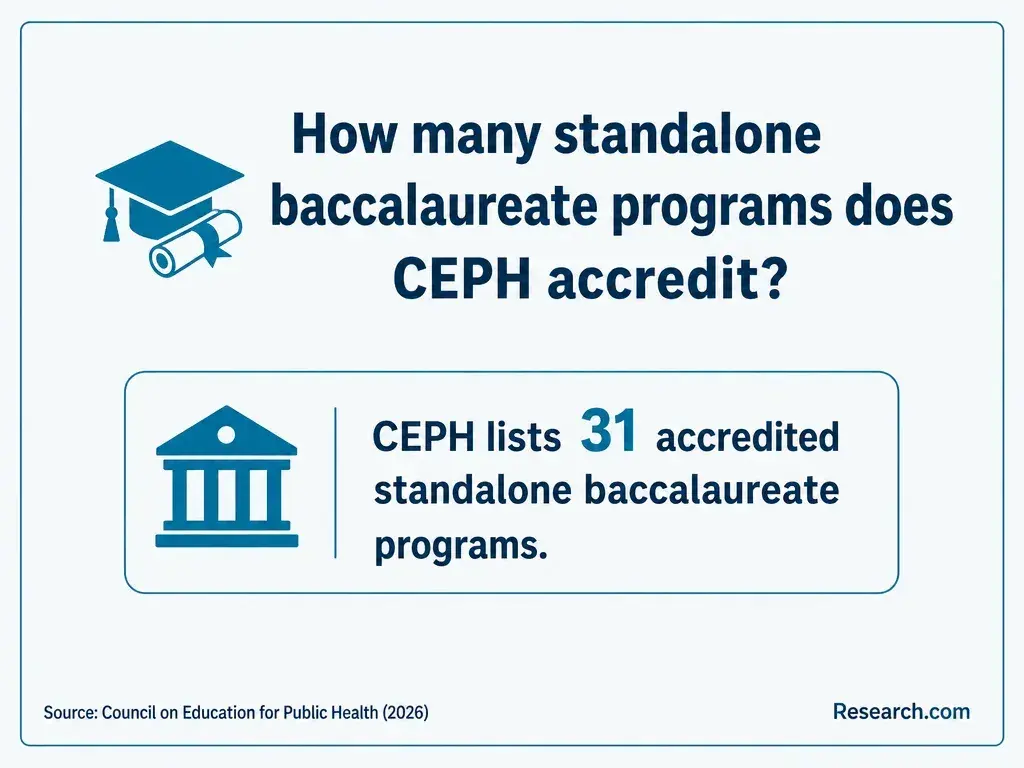
Accreditation by the Council on Education for Public Health (CEPH) provides assurance that an accredited public health school or program meets public health education standards. It does not certify that a particular health communication elective is available every term, that a concentration has extensive evaluation coursework, or that a graduate is professionally certified.
Check the CEPH directory for the exact school or program and confirm that the MPH you are considering falls within its accredited scope. Then inspect the current degree requirements, elective rotation, applied practice rules, and any formal concentration requirements for your entry term. Institutional accreditation and CEPH accreditation answer different questions; neither replaces a curriculum review.
Cost and speed matter, but they are separate tests of fit. Use public health degree affordability and completion planning to frame the financial comparison, then verify accreditation and evaluation-course availability directly rather than treating a short or inexpensive program as automatically equivalent.
Effective evaluators translate a campaign's purpose into a question that can be answered with available, ethically collected evidence. They should be able to work with community partners on message relevance, select indicators with clear denominators and timeframes, assess data quality, and explain what the findings do - and do not - show.
For example, a student evaluating a hypothetical screening-awareness campaign might distinguish the number of messages delivered from the share of eligible people who recall the message and the number who schedule a screening. Surveys could help assess comprehension; service data might describe subsequent use if access is authorized. Neither source alone would establish causation, because other outreach, changing availability, and differences between respondents and nonrespondents could influence the results.
Look for assignments that require a logic model, a measurement plan, an accessible reporting product, and a discussion of bias and privacy. If you already have communication experience and need only one missing method, supervised work or a targeted course may be more efficient than another degree. For an earlier-career learner considering undergraduate preparation instead, a public health BS program selection guide can help distinguish foundational study from MPH-level evaluation training.
Neither format is inherently better. The deciding factor is whether you can take the needed methods courses and complete a supervised, community-relevant evaluation project within your schedule. Online students may work with a local organization; campus-based students may benefit from nearby partners and in-person collaboration. Both still need permission to use partner data.
Before choosing a format, ask whether evaluation courses run regularly, whether classes or group meetings require live attendance, and whether the school helps students find qualified project supervisors. Also check travel, residency, and fieldwork expectations. An asynchronous lecture schedule does not make interviews, partner meetings, or campaign observations asynchronous.
If you are comparing access as well as delivery, comparing accessible online public health master's options can narrow a starting list. Apply the same course-and-project test to each option; ease of entry is not evidence of evaluation depth.
Requirements vary by school and may differ between admission to the MPH and selection of a concentration. Programs commonly review an applicant's prior degree, academic record, statement of purpose, recommendations, and relevant experience, but statistics prerequisites, tests, minimum grades, and application systems must be checked in each program's current instructions.
An applicant from communications or another non-public-health field should show transferable work - such as audience research, accessible writing, community partnership, or data reporting - while identifying any quantitative preparation gap. A statistics or introductory methods course can strengthen readiness when the target curriculum expects students to interpret campaign data. Ask whether a prerequisite must be finished before applying or merely before enrollment.
If grades are a concern, explaining a low GPA in public health graduate admissions is more useful than assuming either automatic rejection or an automatic waiver. Confirm the program's stated policy and provide concrete evidence of current academic and methods readiness.
Completion time depends on the required credits, course rotation, enrollment pace, and timing of applied work. A full-time path is generally shorter than a part-time path, but a required evaluation elective offered infrequently or a delayed partner agreement can extend either one. Request a term-by-term course map that includes the applied practice experience and integrative requirement.
Compare total expected cost, not an advertised tuition rate alone: include required credits, mandatory fees, books or software, travel or campus visits, and any income lost while completing fieldwork. Ask whether an existing job can host an approved project; employer permission and school approval are separate requirements. Funding may also depend on enrollment level and continued eligibility.
For a more realistic net-cost comparison, review comparing university scholarships for MPH study, then obtain written estimates and award conditions from each institution. Without a specific school's current charges and your aid offer, a reliable personal price cannot be stated.
Relevant work appears in health departments, community organizations, health systems, research teams, and agencies supporting public health clients. Titles vary, so evaluate job descriptions for the actual balance of message development, implementation, data collection, analysis, and reporting.
An early-career graduate might support surveys, monitor campaign delivery, prepare accessible summaries, or coordinate community feedback as a health education specialist, program evaluator, or communication specialist. Leading an evaluation portfolio or making advanced causal claims generally requires additional experience and methods expertise. A supervised project with a defensible evaluation question is stronger evidence of readiness than a concentration label alone.
If your goal is independent research rather than practice evaluation, investigate research-intensive training before committing to an MPH. An epidemiology doctoral tuition assistance guide may help frame the funding questions for that distinct, longer pathway; doctoral study is not necessary for most campaign implementation and evaluation roles.
There is no reliable single salary or growth rate for "MPH health communication campaign evaluation graduate." The closest federal occupational category depends on the job: the US Bureau of Labor Statistics tracks health education specialists, for example, but an evaluation analyst or communication specialist may be classified differently. Published occupation-wide medians are not starting salaries or outcomes for a particular MPH program.
For a useful comparison, identify several jobs you would actually pursue and check their duties, location, experience requirements, and current Bureau of Labor Statistics Occupational Outlook Handbook category. Compare that evidence with local postings and the school's clearly defined graduate-outcomes data, if available. MPH education and long-term earnings offers broader degree context, but it cannot replace an occupation- and location-specific estimate. Avoid financing a degree on the assumption that a particular salary increase will follow.
Which certifications and professional standards support health communication careers?
The Certified in Public Health (CPH) and Certified Health Education Specialist (CHES) credentials can signal relevant public health or health education knowledge, but neither is conferred automatically by an MPH. Eligibility is set by the National Board of Public Health Examiners for CPH and the National Commission for Health Education Credentialing for CHES and MCHES. Check their current education, coursework, examination, and experience rules before planning a degree around a credential.
For campaign evaluation, professional practice also means using accessible communication, representing communities respectfully, documenting methods honestly, and protecting participant information. Ask whether coursework assesses these responsibilities alongside technical analysis. If you are comparing an undergraduate health education route with an MPH, public health undergraduate tuition comparisons can inform the cost side of that decision; confirm credential eligibility from the certifying body rather than assuming either degree qualifies.
Other Things You Should Know About Public Health
Usually not. Platform metrics describe activity and possible exposure, but they rarely establish comprehension, population reach, or behavior change. Match each measure to the question it can actually answer.
Plan language access before collecting data. Test whether translated questions preserve the intended meaning, involve appropriate community reviewers, and report results without treating language groups as interchangeable.
No universal answer applies. The institution determines whether a project requires review, and a partner may impose additional permissions. Ask before collecting participant information or using restricted records.
Only within the permissions you received. Remove identifiable or confidential information, respect partner ownership, and label a proposed plan as a proposal rather than a completed evaluation.
- Federal Policy for the Protection of Human Subjects ('Common Rule') | hhs.gov https://www.hhs.gov/ohrp/regulations-and-policy/regulations/common-rule/index.html
- Causal Inference in Public Health - PMC - NIH https://pmc.ncbi.nlm.nih.gov/articles/PMC4079266/
- Framework for Program Evaluation in Public Health | cdc.gov https://www.cdc.gov/mmwr/preview/mmwrhtml/rr4811a1.htm
- CEPH Accreditation: Master of Public Health | northwestern.edu https://www.feinberg.northwestern.edu/sites/mph/about/ceph-accreditation.html
- MPH core competencies | ufl.edu https://phhp.ufl.edu/academics/masters-programs/mph/program-requirements/
- Health Communication " Academics | Boston University https://www.bu.edu/academics/met/courses/health-communication/
- Content Analysis Method and Examples | Columbia University Mailman School of Public Health https://www.publichealth.columbia.edu/research/population-health-methods/content-analysis
- Vulnerable Participants | Human Research Protection Program (HRPP) https://hrpp.research.virginia.edu/teams/irb-sbs/researcher-guide-irb-sbs/vulnerable-participants
- MPH in Population and Health Sciences Courses | umich.edu https://sph.umich.edu/research-education/courses/online-descriptions.php