2027 Public Health BS Programs With Required Fieldwork: Questions Before Enrolling

Co-Founder and Chief Data Scientist
A required field placement can be the most valuable part of a public health BS - and the hardest requirement to fit around work, commuting, or a transfer plan. For prospective and returning undergraduates, the crucial distinction is between a program that offers internships and one that requires an approved, supervised experience to graduate.
This guide explains what to ask about placements, accreditation, online study, costs, and career preparation so you can compare programs on what you will actually need to complete.
Key Things You Should Know
- Confirm that fieldwork is required for your exact BS degree, then obtain its current site-approval, supervision, scheduling, and assessment rules.
- Online classes do not necessarily mean remote or flexible fieldwork; ask who finds the site and whether your location or existing job qualifies.
- Compare the full cost of completing the degree, including any unpaid placement, travel, and credits that remain after an official transfer evaluation.
What are public health BS programs with required fieldwork?
These are Bachelor of Science programs in public health that make a supervised experience in a practice setting a condition of graduation. Schools may call it an internship, practicum, field experience, or community-based course. The label alone does not establish what students do: one requirement might involve program outreach at a health department, while another calls for a defined evaluation deliverable at a nonprofit.
Distinguish required fieldwork from an optional internship, a classroom capstone, or volunteer hours. Ask for the degree requirements applicable to your anticipated entry term and the fieldwork syllabus. If you are comparing public health undergraduate degree options online, check each school's actual degree name and whether its experiential requirement is mandatory; similar-sounding programs can have different graduation rules.
A strong fit is a program whose approved sites and projects let you practice the work you want to pursue, not simply one that advertises employer connections. A student interested in community health outreach, for example, needs different tasks and supervision from a student seeking introductory data or evaluation experience.
Why does accreditation matter for public health bachelor's programs?
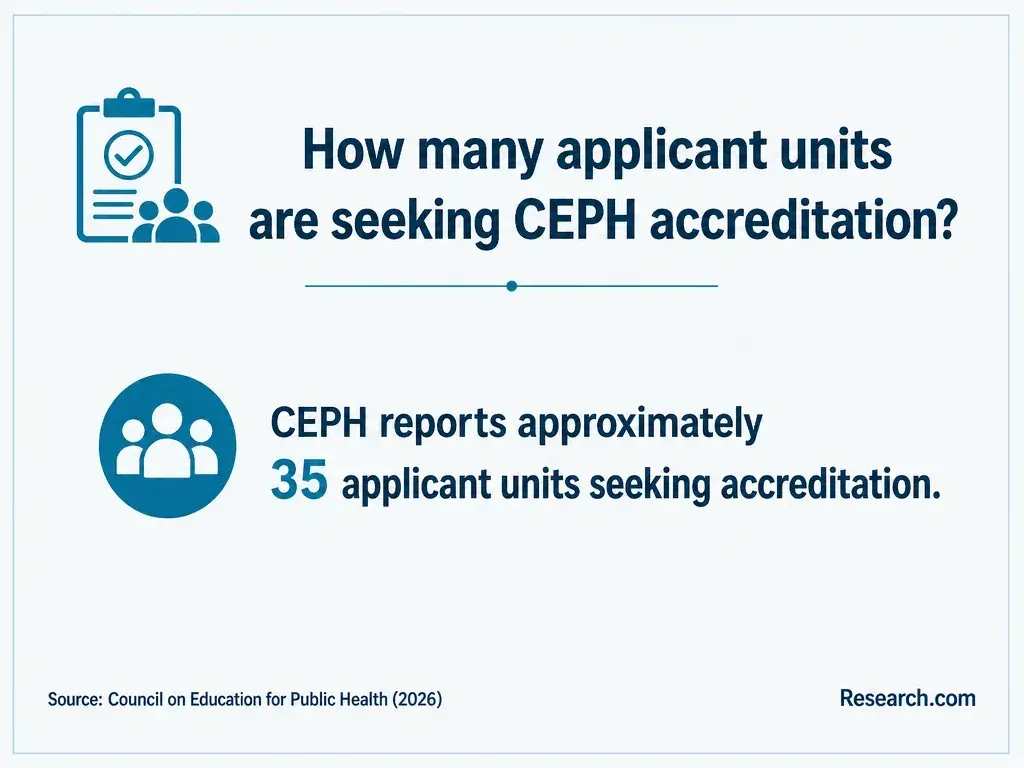
Check the institution's accreditation and the scope of any public health-specific accreditation separately. The Council on Education for Public Health (CEPH) accredits eligible public health schools and programs, but a university's CEPH-accredited unit does not automatically mean every degree it offers is covered. Confirm the exact BS degree and academic unit against current CEPH and school records; ask the school to clarify any ambiguity.
Accreditation is not a substitute for inspecting the placement. It does not tell you whether a suitable site is available near home, whether the internship is paid, or whether a supervisor can support your intended work. It also says nothing about how selective admission is: even when reviewing selectivity in public health doctoral study later in your education, admission difficulty and accreditation remain separate questions.
Ask whether the school's fieldwork policies, grievance process, and degree requirements apply to your specific program and entry term. That is more useful than relying on a general university accreditation statement or an undated program brochure.
What fieldwork requirements should students expect in public health programs?
Requirements vary by institution. Before accepting an offer, request the current handbook or syllabus and clarify the following with the fieldwork coordinator; a willing host organization alone cannot approve academic credit.
- Site and tasks: Which organizations qualify, and must the work involve population-health practice rather than observation or routine office duties?
- Placement responsibility: Does the school secure sites, provide leads, or require students to find and propose their own?
- Timing and supervision: When can fieldwork begin, what schedule is expected, and who provides site supervision and faculty assessment?
- Approval and evidence: What agreements, learning objectives, evaluations, and final deliverables are required before credit is awarded?
- Practical constraints: Are remote work, an existing job, paid placements, accommodations, travel, or placements outside the school's region permitted?
Ask for examples of approved types of work, not promises of a particular placement. A proposed dashboard or outreach plan may also require permission to access organizational data. Student status does not automatically authorize use of identifiable health information, publication of a partner's materials, or human-subjects research.
Keep undergraduate requirements distinct from those in online public health doctorate pathways: a doctoral applied project is not interchangeable with a BS internship. The requirement that matters is the one attached to your degree.
Public health BS coursework commonly introduces population health, epidemiology, statistics, social and structural influences on health, health communication, policy, and program planning. The depth and sequence differ. A BS may emphasize quantitative and science courses, but its title does not prove that it offers advanced statistical training or a particular concentration.
For a fieldwork-focused comparison, trace how coursework prepares you for the placement. Can you learn basic data interpretation before helping with an evaluation? Will you study ethical community engagement before conducting outreach? Does a required methods course come before, rather than after, the field term? An introductory course supports supervised work; it does not by itself qualify a student to lead research or make clinical decisions.
If your eventual goal is specialist analysis, compare the undergraduate methods sequence with later career-compatible online biostatistics study. That helps you identify preparation gaps without expecting a generalist BS placement to provide graduate-level technical depth.
They can be, provided the school permits an approved placement where you live and its schedule fits your obligations. Online coursework may be asynchronous while fieldwork requires weekday site hours, live supervision meetings, or a campus visit. Ask separately about each obligation; "online" describes course delivery, not necessarily the location or timing of practice.
For working students and caregivers, the decisive questions are whether you can propose a local site, complete work in predictable blocks, and reduce course load during the placement term. If you plan to use your current employer, obtain written confirmation of the rules before counting on it: some programs require duties distinct from your regular job, a different supervisor, or a newly approved project.
Compressed-term online public health BS pathways may shorten classroom terms without shortening the time needed to arrange a site. Check when placement applications open and whether the required course runs in the term you expect.
Schools may admit students directly to a public health major or require admission to the university first and a later application to the major. Review the applicable prerequisites, minimum academic standards, and deadlines; do not assume that eligibility for the university guarantees a place in the BS or its fieldwork course.
Transfer and returning students should request a written degree audit showing which prior courses satisfy general education, major, prerequisite, and residency requirements. Accepted credits are not necessarily credits that replace required courses. Ask the department who approves substitutions and whether a prerequisite sequence could delay fieldwork. Keep course descriptions and syllabi available if the evaluator requests them.
If you are considering graduate study instead of another undergraduate degree, exploring less selective MPH study pathways addresses a different admissions decision. For the BS, prioritize the school's official major-admission and placement-eligibility rules.
Completion time depends on remaining degree requirements, course availability, enrollment pace, and the term in which fieldwork can be taken. For a transfer student, an official degree audit is more informative than an advertised completion estimate. Ask whether prerequisites, minimum credits earned at the institution, or a placement offered only in certain terms affect your schedule.
Build a total-cost estimate rather than comparing tuition alone. The following categories show where a fieldwork requirement can change an otherwise affordable plan.
| Cost category | What to confirm |
| Tuition and required fees | Charges for your residency status, course load, and fieldwork term |
| Placement expenses | Travel, parking, screening, equipment, or other site requirements |
| Income and scheduling | Whether the placement is paid and whether its hours displace paid work |
| Time to finish | Remaining courses and terms after the school's official credit evaluation |
Compare that estimate with aid eligibility and any employer support confirmed for your circumstances. Guides to online public health degrees balancing cost and time can help identify options, but verify each program's current charges and placement expenses directly.
A BS plus relevant fieldwork can support applications for entry-level community health, outreach, program support, health education, and research-support positions, depending on the employer's requirements. Responsibilities may include preparing educational materials, coordinating activities, maintaining program records, or assisting with data collection under supervision. A placement is most useful when its tasks produce evidence of those abilities and a supervisor can describe your contributions.
Do not treat every public health title as a bachelor's-entry role. Epidemiologist and advanced analyst positions commonly call for additional education or specialized experience; clinical work has separate licensing rules. Before choosing a placement, review actual job postings in your target location and compare their tasks and requirements with what the site will let you do.
For some goals, work experience or targeted training may be more direct than another degree. If graduate study is under consideration, an online public health master's value guide can frame the later cost decision, but it does not replace evidence that your target jobs require a master's.
There is no single reliable salary for "public health BS graduates." Pay depends on the occupation, location, employer, experience, and duties - not just the major or whether fieldwork was required. The U.S. Bureau of Labor Statistics Occupational Outlook Handbook reports wages and employment projections for defined occupations, such as health education specialists and community health workers. Its occupation-wide medians are not starting salaries or outcomes for a particular BS program.
For a useful earnings comparison, identify jobs for which you meet the stated entry requirements, then compare local postings with the BLS occupation's duties, typical entry education, wage reference year, and projection period. This avoids using higher-paid specialist or management roles to justify the cost of an undergraduate program. Figures for MPH-related occupations and earnings likewise describe different roles and should not be presented as expected BS outcomes.
What certifications or graduate degrees can advance a public health career?
Choose a next credential after identifying a job's actual requirements and the skills you lack. An MPH may fit broader professional public health practice; a specialized MS may better fit intensive research or quantitative work. Practice-focused DrPH and research-focused PhD programs address later, different goals. None is an automatic promotion from a BS or a replacement for relevant experience.
Professional credentials also have separate eligibility rules. The Certified in Public Health (CPH) credential and health education credentials such as CHES or MCHES are not conferred automatically with a public health degree. Check the administering organization's current education, coursework, examination, and experience requirements before choosing classes around a credential.
For an early-career student, the best immediate next step may be to use fieldwork to test a role, build supervised evidence of skills, and ask what additional preparation employers value. If doctoral study eventually becomes relevant, online public health doctorate investment planning is a separate decision involving cost, experience, and career purpose, not a necessary expense for most bachelor's-level openings.
Other Things You Should Know About Public Health
Possibly, but contact your academic coordinator before changing sites. Ask how completed work will be assessed and what new approval or agreement is required.
Ask the program in advance about backup sites, deadline extensions, and whether a cancellation could postpone graduation. Do not assume an alternative site will be available immediately.
Usually only with appropriate permission and careful removal of confidential information. Ask both the site and your instructor what you may share; a description of your methods and responsibilities may be safer than the original deliverable.
It is experience you can describe accurately on a résumé, but employers decide how they count internships toward their hiring requirements. State whether it was a placement and explain the work you actually performed.
- The HIPAA Privacy Rule | hhs.gov https://www.hhs.gov/hipaa/for-professionals/privacy/index.html
- Bachelor's Degree Full-Time Opportunities | cdc.gov https://www.cdc.gov/fellowships/php/opportunities/applying-for-bachelors-degree-opportunities.html
- A narrative review of the CEPH-accredited bachelor's public health programs' curricula in the United States | nih.gov https://pmc.ncbi.nlm.nih.gov/articles/PMC11371682/
- student evaluation of the fieldwork experience (sefwe) | usa.edu https://my.usa.edu/ICS/Portlets/ICS/Portlet.Resources/ViewHandler.ashx
- Bachelor of Science in Public Health | sfsu.edu https://publichealth.sfsu.edu/bs-public-health
- Field Placement FAQ's | Social Work at Providence College https://social-work.providence.edu/field-placement/faq/
- Public Health Major Jobs & Career Resources | Towson University https://www.towson.edu/careercenter/planning-resources/major/healthsci.html
- Online Student Placement Process | asu.edu https://clinicalpartnerships.asu.edu/online-student-placement-process
- Bachelor of Science in Public Health | Western Michigan University https://wmich.edu/publichealth/academics/undergraduate
- Best Practices | Field Study - UC Irvine https://fieldstudy.soceco.uci.edu/pages/best-practices