2027 From Local Government Administrative Assistant to Public Health: Planning a Bachelor's Pathway

Co-Founder and Chief Data Scientist
Local government administrative work can put you close to the budgets, services, and residents that shape public health - but proximity is not the same as preparation for a public health role. If you are considering a bachelor's degree, the decision is whether it will help you move into the work you want without repeating coursework or leaving a viable government career path behind. This guide connects your existing skills to realistic roles, explains what to check in a degree program, and identifies when internal experience or targeted training may be the better next step.
Key Things You Should Know
- Start with a target job: program support may be reachable through your current experience, while health education or data-focused roles usually require additional, demonstrable skills.
- Ask for a degree audit before enrolling; credits a university accepts may not satisfy the public health major, statistics prerequisite, or graduation requirements.
- Compare the full cost and schedule of a degree - including fieldwork - against internal transfers, employer-supported study, and shorter training. A bachelor's degree does not guarantee a public health job or promotion.
What Is a Public Health Bachelor's Degree?
A public health bachelor's degree studies health across populations rather than diagnosing or treating individual patients. Programs commonly address prevention, disease patterns, health communication, policy, and the conditions that affect communities.
A BA, BS, or related community health degree may emphasize different amounts of science, statistics, and applied work; the degree name alone does not establish what you will learn.
For a local government administrative assistant, the strongest fit is a program that connects population-health concepts to work you can demonstrate: explaining a service clearly to residents, tracking program activity, supporting outreach, or interpreting basic data.
Compare the actual curriculum and fieldwork arrangements when reviewing public health BS programs and career preparation. A bachelor's degree is not clinical training and does not confer a professional license.
How Can an Administrative Assistant Transition Into Public Health?
Your starting point is operational knowledge. Scheduling public meetings, processing purchasing requests, maintaining records, responding to residents, and following government procedures can transfer to health department program support.
The gap depends on the destination: a program assistant may need public health terminology and reporting skills, while a health education role also calls for audience-appropriate communication and program planning.
A staged transition lets you test that gap before committing to a degree:
- Review actual vacancies in your city, county, and nearby health agencies; separate duties you already perform from duties requiring new coursework, certification, or experience.
- Ask a supervisor or human resources office about approved cross-department assignments, tuition assistance, and the qualifications used for internal postings.
- Build supervised evidence of a new skill, such as helping maintain an outreach schedule, improving an accessible service handout, or summarizing nonconfidential program activity.
- Choose a bachelor's program only after confirming that its courses and experience opportunities address the remaining hiring requirements.
Protect resident information when building examples for a résumé or portfolio. If a later master's degree becomes relevant, conditional public health master's eligibility is a separate question; it is not a reason to rush past the undergraduate preparation your target job requires.
What Public Health Bachelor's Degree Requirements Should You Expect?
Expect general education, public health major courses, and a school's graduation requirements. Some programs add a statistics prerequisite, a capstone, or supervised fieldwork. If you have prior college credit, the pivotal distinction is between credit accepted by the university and credit applied to a specific requirement.
A written evaluation should resolve the following categories before you estimate your remaining time or cost:
| Requirement category | What an accepted prior course may still leave unresolved |
| General education | A course may count as an elective rather than satisfy a required writing, math, or science area. |
| Major or prerequisite | The department may require a particular statistics topic, laboratory component, grade, or approved equivalency. |
| Graduation | Minimum upper-division or in-residence study and the required course sequence may still apply. |
Send transcripts and, for uncertain matches, course descriptions or syllabi to the transfer-credit office; request a major-specific degree audit from the public health department or its adviser.
The receiving institution has final authority. If earlier grades concern you, public health master's admissions with a low GPA addresses a different, later admissions decision - not whether undergraduate credits satisfy this bachelor's degree.
Online study can reduce commuting while you remain employed, but it may still involve scheduled discussions, group work, exams, or fieldwork during agency business hours. Campus study may provide more immediate access to faculty and local partners, though travel and fixed class times can conflict with a government workday. Neither format eliminates the need to confirm when required courses are offered.
Ask each program whether required classes are asynchronous, whether any campus visits are mandatory, who finds and approves field sites, and whether a placement can occur at your current agency.
A supervisor's willingness to host you is not the same as academic approval. If you later compare online graduate study, use an online public health master's accreditation guide for that separate degree decision; do not assume its accreditation or scheduling arrangements apply to a bachelor's program.
Typical subjects include introductory epidemiology, biostatistics or statistics, environmental health, health policy, social and behavioral health, and program planning. For an administrative assistant, the useful test is what each course enables you to do.
Statistics should help you read a service report accurately; policy should help you understand governmental authority and funding; communication should help you adapt information for residents without overstating evidence.
Check whether an applied course lets you produce an approved, nonconfidential work sample, such as an outreach plan or evaluation outline. An introductory epidemiology course builds literacy; it does not qualify you to lead advanced research.
If your long-term goal is research-intensive work, graduate study may eventually matter, and epidemiology doctorate scholarships and grants belong to that much later funding decision - not your immediate bachelor's course selection.
Requirements depend on whether you apply as a first-year student, a university transfer, or a student entering a separately admitted major. Schools may request transcripts and evidence of completed general education or prerequisites; some also set a minimum grade or GPA for major entry. Admission to the university does not necessarily mean admission to the public health major.
Ask admissions which applicant category fits your record, then ask the major adviser when you may begin required courses. If you hold an associate degree - particularly an applied degree - request an individual evaluation rather than assuming it satisfies a transfer pathway. Graduate admissions rules are different: online MPH admissions flexibility comparisons should not be used to predict bachelor's admission.
A conventional full-time bachelor's path takes about four academic years, but your remaining time depends on credits that apply, course sequencing, enrollment pace, and any required fieldwork. An assistant keeping a full-time job may prefer fewer courses per term; that can protect income while extending tuition, fee, and completion commitments.
Compare written estimates of remaining required credits, tuition and mandatory fees, books, travel, and possible unpaid placement hours. Then ask your employer whether education assistance covers this degree, what approval or grade conditions apply, and whether reimbursement would affect your plans to change departments.
Low-tuition online public health degree options can provide comparison candidates, but an advertised tuition rate is not your total cost. A school-specific degree audit and aid estimate are more useful than a generic completion promise.
A bachelor's degree may strengthen an application for public health program coordination, outreach support, or health education work, but job descriptions - not the degree title - determine eligibility. Your government experience may be especially valuable where the role involves procurement, scheduling, public records procedures, or coordination across departments.
These distinctions help keep your first target realistic:
| Role type | Typical work | Key qualification distinction |
| Program or administrative assistant | Schedules activities, maintains records, supports budgets and reporting | Relevant government experience may matter as much as a public health major. |
| Community health worker | Connects residents with services and supports community outreach | Training, language skills, and any applicable state requirements vary by position. |
| Health education specialist | Plans, delivers, and assesses health information or education activities | Employers commonly seek relevant bachelor's-level preparation and practical communication skills. |
| Epidemiologist | Investigates population-level health patterns using data | Typically requires graduate-level preparation; a bachelor's alone is generally not the direct route. |
Seek supervised work that fills the gap in your chosen row rather than collecting unrelated credentials. A doctorate is not needed for the entry-level roles described here; less selective online public health doctoral options concern a substantially different, later career decision.
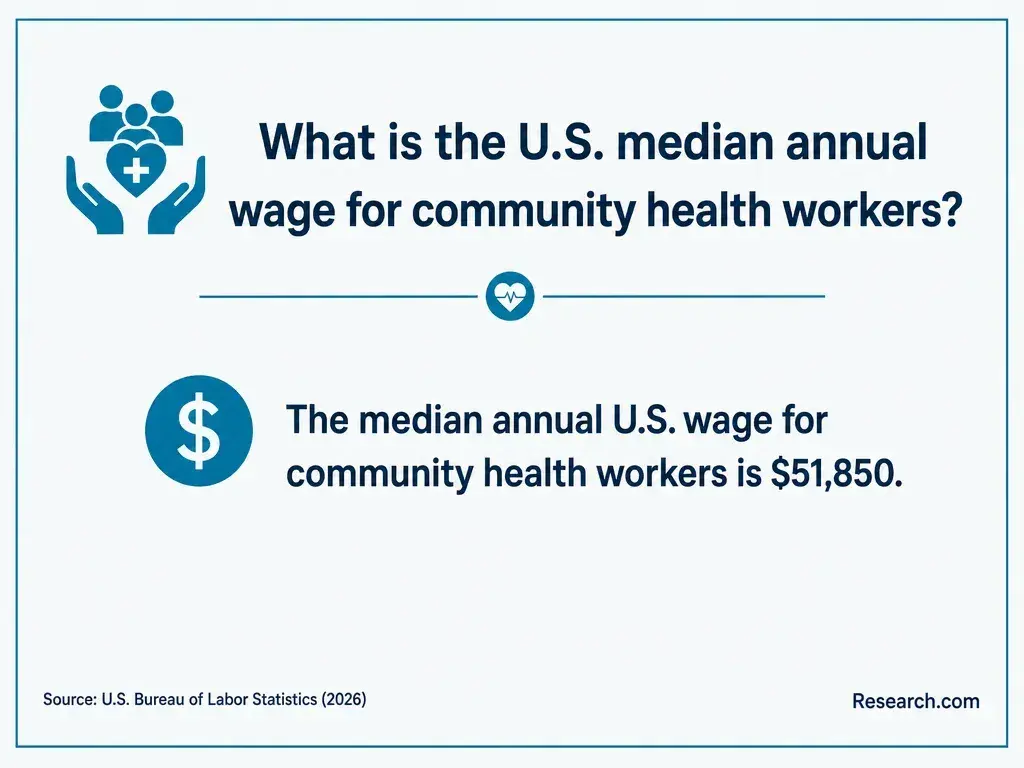
There is no single salary or employment outlook for "a public health graduate." Pay depends on the occupation, location, employer, classification, and experience. A local government vacancy's posted pay range and civil-service rules are more relevant to your near-term decision than an occupation-wide median, which includes workers at many career stages and employers.
For a defensible comparison, match your target posting to the corresponding occupation in the U.S. Bureau of Labor Statistics Occupational Outlook Handbook - such as health education specialist or community health worker - and check its wage reference year and projection period.
Do not use an epidemiologist's pay or growth figures to forecast the return on an entry-level program-support job. Before paying for additional schooling based on an expected raise, compare actual local vacancies, promotion rules, and total education cost. An online public health master's value guide is relevant only if a later target role calls for graduate preparation.
Which Accreditations and Certifications Matter in Public Health?
First, confirm that the university has recognized institutional accreditation; this matters for academic quality review and may affect transfer and aid decisions. Then check whether the exact public health school, unit, or program - and your intended degree - is within the scope of Council on Education for Public Health (CEPH) accreditation.
Institutional accreditation and CEPH accreditation are different, and accreditation of a school's MPH does not automatically establish coverage of its bachelor's degree.
Credentials such as Certified in Public Health (CPH) and Certified Health Education Specialist (CHES) have their own eligibility and examination rules. A bachelor's degree does not award either automatically, and many administrative or program-support jobs do not require them.
Verify a target employer's requirements and the certifying body's current rules before budgeting for an exam. Likewise, budget-friendly online public health PhD options concern research training, not a certification or a prerequisite for moving from local government administration into public health practice.
Other Things You Should Know About Public Health
Yes, if the posted minimum qualifications allow it. Look closely at program-support and administrative openings, and describe your government procedures, resident service, and reporting experience in the terms used by the posting.
Possibly, but the answer depends on your employer's classification, bargaining agreement, and benefits rules. Ask human resources for a written explanation before accepting a transfer or leaving your current position.
Do not assume so. Agency access for your job is not permission for academic use. Obtain the required employer and instructor approvals, and use public or appropriately authorized data when possible.
It can, especially if it offers supervised outreach, communication, or program-support tasks. Choose work that builds a skill named in your target job postings, and confirm separately whether a school would accept it for academic fieldwork.
- Accreditation in the U.S. | ed.gov http://www.ed.gov/laws-and-policy/higher-education-laws-and-policy/college-accreditation/accreditation-in-the-us
- The Role of Primary Care in Improving Population Health - PMC https://pmc.ncbi.nlm.nih.gov/articles/PMC10126984/
- Department of Health | Public Health and Environmental Laboratories | Outreach to Students | Civil Service Commission https://www.nj.gov/health/phel/student-outreach
- Credentialing in Local Public Health | mass.gov https://careersinlocalhealth.mass.gov/your-career/credentialing-local-public-health
- Types of Financial Aid: Grants, Work-Study, and Loans | studentaid.gov https://studentaid.gov/understand-aid/types
- Your financial path to graduation | consumerfinance.gov https://www.consumerfinance.gov/paying-for-college/your-financial-path-to-graduation/
- Exploring the Benefits and Value of Public Health Department Internships for Environmental Health Students | cdc.gov https://stacks.cdc.gov/view/cdc/107366
- HRTP: A Public Health Internship Program | NYC Health https://www.nyc.gov/site/doh/about/employment/hrtp-internship.page
- How to Get College Credit for Work Experience | post.edu https://post.edu/blog/pla-101-can-a-prior-learning-assessment-get-me-college-credit-for-work-experience/
- Requirements | jhu.edu https://publichealth.jhu.edu/academics/mph/requirements