2027 Does a Public Health BS Prepare You for Migrant Health Program Support?

Co-Founder and Chief Data Scientist
A public health BS can prepare you to support health programs serving migrant communities, but coursework alone will not make you ready for every role. Programs need staff who can coordinate services, communicate respectfully, protect sensitive information, and work within community partnerships.
This guide is for students considering the degree and early-career applicants weighing their next step. It explains where a BS is useful, where supervised experience or another qualification matters more, and what to check before committing time and money to a program.
Key Things You Should Know
- A public health BS can build relevant skills in community engagement, health communication, data handling, and program evaluation, particularly when paired with supervised fieldwork.
- Outreach and program-assistant roles may have different entry requirements from clinical, licensed social-work, epidemiology, and program-management positions.
- A bachelor's degree commonly takes about four years of full-time study from the start, but transfer credits, field placement, total cost, and local employer requirements determine whether it is the best route for you.
What does a public health BS teach about migrant health program support?
It provides a population-health foundation, not a specialist credential in migrant health. In the US, "migrant health" often includes services for migrant and seasonal agricultural workers and their families; other organizations may serve people who migrate for different reasons. The population, eligibility rules, and service model depend on the organization. Do not assume that "migrant," "immigrant," and "refugee" describe the same people or programs.
Relevant bachelor's coursework can help a student identify barriers to care, plan outreach, interpret basic community-health data, and assess whether a service is reaching its intended population. Those skills matter when a program must coordinate with clinics, community organizations, and the people it serves. A degree does not, by itself, teach the local languages, establish community trust, or authorize clinical advice.
Students interested in advanced policy, research, or management work can later compare public health master's degree types explained. For initial program support, however, a relevant BS plus practical experience may be more directly useful than planning immediately for graduate school.
What careers can you pursue supporting migrant health programs with a public health BS?
Search by duties as well as titles. A federally funded health center, local nonprofit, health department, or outreach contractor may use different titles for similar work. The distinctions below show where a BS can be competitive and where additional qualifications usually matter.
| Role | Typical contribution | What to check in the job posting |
| Program or outreach assistant | Schedules activities, maintains records, prepares materials, and coordinates partners | Required experience, travel, schedule, and data-system skills |
| Community health worker or outreach worker | Builds relationships, shares approved information, and helps people navigate services | Community experience, language requirements, training, and any state-specific rules |
| Health education specialist | Develops and assesses education activities | Degree requirements, education experience, and preferred credentials |
| Program manager, epidemiologist, or clinician | Leads operations, performs specialized analysis, or delivers regulated care | Experience, graduate education, or professional license required for the particular position |
A graduate may be ready to assist with outreach plans or reporting under supervision; managing a grant, directing a surveillance study, or diagnosing patients is a different level of responsibility. After substantial practice experience, leadership-focused online doctoral public health entry pathways may be worth examining, but a doctorate is not a requirement for entry-level migrant health support.
What education and training are required for migrant health program jobs?
There is no single degree or training rule for all migrant health program jobs. Employers set qualifications for support positions; states and credentialing bodies may set additional rules for particular occupations. Some outreach jobs prioritize trusted community experience and provide job-specific training. Others require a bachelor's degree, experience with health records, or demonstrated language proficiency.
Before applying, match the posting to the work you would actually do. The following sequence helps separate a degree requirement from skills you can develop more directly:
- Identify whether the job is outreach, administration, education, analysis, management, or regulated care; read its required qualifications rather than relying on its title.
- Document relevant experience, such as community partnership work, scheduling, interpretation coordination, privacy-conscious recordkeeping, or program reporting.
- Seek supervised training for gaps in referral procedures, confidentiality, safe field practice, and the organization's service area.
If a position truly calls for graduate-level preparation, compare the specific admissions rules before applying. Online public health master's no-letter application paths address one possible application constraint, not the question of whether a master's degree is necessary for the job.
Course names vary, so compare what students practice and produce - not just the catalog titles. For program support, the strongest combination is community-health learning, basic evidence skills, and an approved opportunity to apply both.
| Course area | Useful preparation | Limit of classroom learning |
| Community health and social determinants | Examining how work, housing, transportation, and access to services shape health | Cannot substitute for listening to a particular community |
| Health communication | Developing accessible messages and checking whether materials fit their audience | Does not establish fluency or qualify a student as a medical interpreter |
| Epidemiology and introductory statistics | Reading rates, identifying denominators, and interpreting basic program indicators | Does not establish specialist analytic competence |
| Program planning and evaluation | Defining activities, outputs, and feasible measures of reach | Does not grant access to patient records or permission to publish results |
Look for an internship or project with appropriate supervision, community-partner approval, and clear privacy expectations. Students who later want deeper quantitative work can examine biostatistics graduate study while working; that specialization is usually unnecessary for an initial outreach or coordination role.
They can be, if the program makes applied experience feasible. Online lectures may fit around employment, but live classes, group projects, exams, and fieldwork may still have fixed hours. Migrant health outreach can also involve travel and schedules shaped by a community's work patterns. An online degree cannot replace learning how a local organization operates.
Ask whether the school helps approve local placements, who supervises students, whether remote projects qualify, and how students handle confidential information. If you need a shorter academic schedule, compare public health bachelor's pacing and course length with the actual hours available for fieldwork; faster courses do not necessarily make a placement easier to schedule.
A bachelor's degree commonly takes about four years of full-time study when starting without college credit. Part-time enrollment, prerequisites, course availability, and an internship can change that timeline. Transfer students need a written degree audit: credits accepted by a university may not satisfy its public health major or residency requirements.
There is no dependable single price for a public health BS. Compare these components using each school's published charges and your likely enrollment plan:
- Tuition and mandatory fees for the credits you still need, including any higher charges for online or out-of-state enrollment.
- Books, technology, transportation, and possible unpaid fieldwork time.
- Available grants, scholarships, employer support, and borrowing - without assuming an award until it is confirmed.
Use the same remaining-credit and fieldwork assumptions when comparing low-tuition online public health degree options. A lower advertised tuition rate will not necessarily mean a lower total cost if more credits or travel are required.
Requirements depend on whether you are entering college, transferring, or applying separately to a public health major. A university may admit a student before the student has met the major's statistics, science, GPA, or prerequisite rules. Check the school's current catalog and ask for a degree audit before relying on a projected graduation date.
If you have previous coursework, submit official transcripts and request confirmation of which credits count toward general education, prerequisites, the major, and graduation. If you have not started college, focus first on the institution's admission requirements and the sequence needed to enter the major. Graduate admissions are a separate decision: finding online MPH programs that fit your profile is relevant later only if your target role calls for graduate study.
No general professional license is awarded or required simply because you earn a public health BS. A specific job may have different rules. Clinical care requires the applicable professional license; a community health worker position may involve state-specific certification or employer training. Health education credentials have their own eligibility and examination rules, which should be checked with the certifying organization rather than inferred from the degree name.
Do not buy additional education to solve a credential requirement you have not verified. Even much later, when comparing advanced degrees, online doctoral public health tuition and duration are education-planning considerations - not substitutes for a license required by a regulated role.
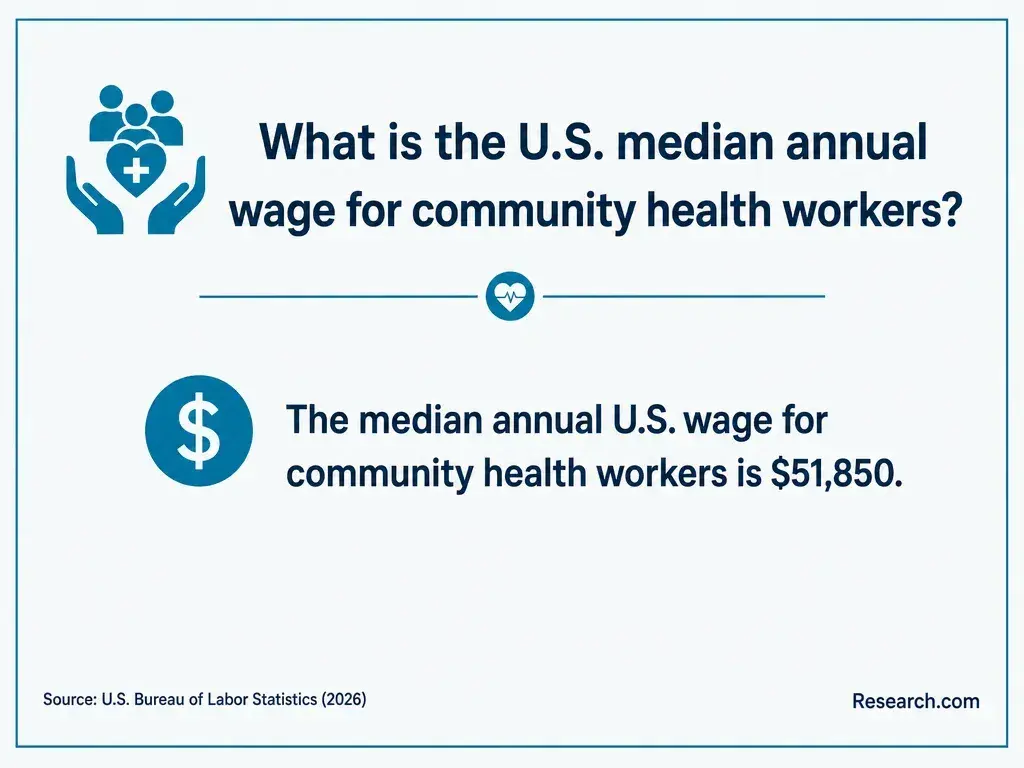
There is no single "migrant health professional" wage: outreach workers, health education specialists, analysts, and clinicians belong to different occupations. The US Bureau of Labor Statistics publishes occupation-wide pay and employment projections for roles such as community health worker and health education specialist. Those figures can help you compare job categories, but they are not starting salaries for public health BS graduates or pay estimates for one migrant health employer.
For a useful local comparison, review current postings for the exact title and location, noting required experience, travel, seasonal hours, benefits, and whether the work is grant-funded. If you are considering graduate education for a different role, average earnings after an MPH provide a separate comparison; do not treat a graduate-degree salary discussion as the likely return on a BS.
How do you choose an accredited public health BS program?
First, verify the university's institutional accreditation with the accreditor or the US Department of Education. Then check any claimed Council on Education for Public Health accreditation against CEPH's listing for the exact school, unit, or standalone program; institutional accreditation does not establish that a particular public health BS is within CEPH's accredited scope.
For this career goal, a strong choice also offers relevant community-health coursework, accessible advising, and a realistic route to supervised work with an appropriate organization. Ask the program how placements are approved, whether a student can work with a local migrant-serving partner, and what happens if that placement is unavailable. Compare those answers alongside the written degree audit and total cost, not accreditation status alone.
Budget separately for any later graduate degree. Lists of online MPH programs by tuition affordability may help if graduate study becomes necessary, but they should not outweigh the BS program's fit for the entry-level work you want now.
Other Things You Should Know About Public Health
No. The terms describe different circumstances, and organizations define whom they serve according to their mission and program rules. Use the language a community and service organization prefer rather than assuming a person's immigration status.
Usually only with the organization's permission. Remove identifiable information and follow its rules for sharing materials; a class assignment does not automatically authorize public release.
Do not collect sensitive information on your own initiative. Follow the organization's approved procedures, collect only information needed for your assigned task, and refer eligibility questions to trained staff.
Yes, if the organization has an appropriate role and supervision. Volunteering can show you the realities of outreach and coordination without committing immediately to a degree, but it does not automatically count as academic fieldwork.
- Community-Based Healthcare for Migrants and Refugees - PMC https://pmc.ncbi.nlm.nih.gov/articles/PMC7349376/
- Barriers to Immigrants' Access to Health and Human Services Programs | ASPE https://aspe.hhs.gov/reports/barriers-immigrants-access-health-human-services-programs-0
- Competencies for Public Health Professionals | cdc.gov https://www.cdc.gov/infrastructure/training-professional-development/competencies-for-public-health-professionals.html
- Chapter 7 - Privacy and Confidentiality https://www.uscis.gov/policy-manual/volume-1-part-a-chapter-7
- Refugee and migrant health - Global https://www.who.int/health-topics/refugee-and-migrant-health
- Health Insurance Portability and Accountability Act (HIPAA) Compliance - StatPearls - NCBI Bookshelf https://www.ncbi.nlm.nih.gov/books/NBK500019/
- What Can You Do With a Public Health Degree? Career Paths Explained | The College of Westchester https://www.cw.edu/blog/what-can-you-do-with-a-public-health-degree/
- How to Become a Public Health Professional | West Coast University https://westcoastuniversity.edu/about/career-guides/how-to-become-a-public-health-professional
- Community Health Worker Job Guide | MSU Denver https://www.msudenver.edu/innovative-lifelong-learning/blog/community-health-worker-jobs/
- What Can You Do With a Public Health Degree? | Goodwin College of Professional Studies https://drexel.edu/dornsife/students/career-services/what-can-you-do-with-a-public-health-degree/