2027 Best Short Certificate Programs for Single Parents

Co-Founder and Chief Data Scientist
Choosing training while raising a child means balancing class time, childcare, cost, and a realistic job outcome. Short certificate programs can build job-specific skills in months rather than years, but their value varies widely by field and state. The U.S. Bureau of Labor Statistics projects healthcare support occupations to grow faster than average from 2024 to 2034. This guide helps single parents compare flexible certificate paths, verify program quality, understand total costs, and choose training that fits both family responsibilities and career goals.
Key Things You Should Know
- For the fastest route to work, prioritize certificates tied to a specific entry-level role, required employer skill, or state-approved license pathway; a vague "career certificate" may have limited hiring value.
- Flexible programs are not always fully online: healthcare, skilled trades, and legal-support training may require labs, clinical rotations, internships, or proctored exams during fixed hours.
- As of 2024, average published tuition and fees at public two-year colleges were about $4,050 annually, but books, tools, exams, uniforms, transportation, and childcare can materially change the total budget.
Top 10 Best Short Certificate Programs for Single Parents
Popular Trade School Programs
Trade certificates suit parents who prefer practical, job-focused learning. Common choices include HVAC technician, welding, electrical helper, plumbing, CDL, and automotive service certificates. Many run from a few weeks to about one year and combine classroom instruction with shop time. HVAC and electrical work often require an apprenticeship and state or local licensing after training; a certificate alone is usually the first step. Evening cohorts can help with scheduling, but hands-on labs are commonly fixed. Ask whether tools, safety gear, testing fees, and supervised work experience are included before enrolling.
Healthcare Programs
Criminal Justice / Law Programs
Short legal and criminal justice programs may cover paralegal support, legal transcription, court reporting foundations, security, corrections, or criminal justice administration. A legal studies certificate can support administrative work in law offices, but it does not authorize someone to practice law. Paralegal jobs often favor applicants with an associate or bachelor's degree plus paralegal education, especially in competitive markets. Security roles may require state licensing, fingerprinting, or background checks. Parents seeking predictable remote work may find legal billing, records, or compliance support more flexible than programs requiring field placements or academy-style schedules.
Arts & Design Programs
What types of short certificate programs work best for single parents' schedules and needs?
This comparison highlights the schedule trade-offs that matter most when selecting a credential.
| Program type | Typical format | Best fit | Key limitation |
| Administrative or technology certificate | Often asynchronous online | Parents needing evening or nap-time study | Requires self-direction and reliable computer access |
| Healthcare clinical certificate | Online coursework plus in-person clinicals | Parents with dependable backup childcare | Clinical shifts may be assigned rather than chosen |
| Skilled-trade certificate | Campus labs, evening, or hybrid | Parents seeking hands-on career entry | Labs and commute can be difficult to reschedule |
| Industry professional certificate | Self-paced online or scheduled cohort | Career changers targeting digital roles | May not carry academic credit or aid eligibility |
For broad career exploration, compare these options with best degrees to get online when a longer credential could produce better access to the roles you want. Choose a short program when it teaches a clearly requested skill; consider an associate degree when employers, licensure rules, or advancement paths consistently require more education.
Programs generally work best when they offer recorded lessons, a realistic part-time track, transparent attendance policies, and a pause-or-return policy. Avoid accelerated formats that compress a full-time workload into fewer weeks unless you have dependable childcare and enough study time.
How long do these certificate programs take and what do they typically cost?
Short certificates range from brief noncredit workforce courses lasting a few weeks to credit-bearing college certificates that take roughly six months to one year part time. The advertised duration is only useful if it reflects the schedule you can actually maintain. Clinical, lab, apprenticeship, and externship hours can lengthen the practical timeline.
Costs depend on provider type, residency, required equipment, and whether the program includes external exam fees. The following ranges are planning estimates rather than universal prices; request a written total-cost sheet from each school.
| Credential format | Typical time commitment | Common cost considerations | Funding considerations |
| Noncredit workforce certificate | Weeks to several months | Tuition, materials, examination fees | May not qualify for federal student aid |
| Community-college credit certificate | About 6-12 months part time | Per-credit tuition, books, supplies, campus fees | May qualify for aid if the program and student are eligible |
| Healthcare certificate | Several months to about one year | Uniforms, vaccinations, background checks, clinical travel | Workforce grants may be available locally |
| Trade certificate | Several weeks to about one year | Tools, protective equipment, licensing or testing costs | Employer sponsorship or apprenticeship pay may help |
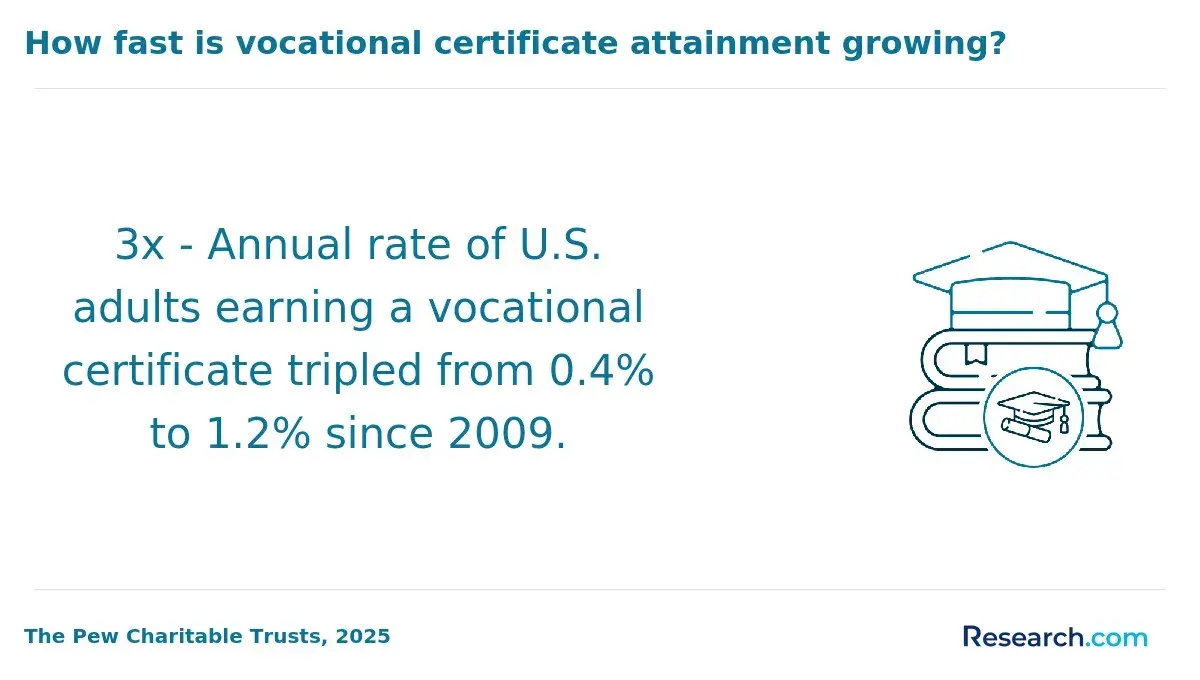
College Board reported average published tuition and fees of about $4,050 for public two-year colleges in 2024-25. That figure is a useful baseline, not a program quote: short technical programs can cost less or more depending on equipment and clinical requirements. If a one-year certificate does not meet your career goal, an online associates degree may be worth comparing for longer-term advancement.
Before enrolling, calculate your full budget: tuition, supplies, required tests, transportation, lost work hours, internet service, and childcare. Ask the financial-aid office whether the specific certificate is eligible for federal aid, state workforce funding, institutional grants, payment plans, or emergency assistance.
Which online short certificate programs are most flexible and reputable for single parents?
The most reputable flexible online programs are typically offered by accredited community colleges, public universities, established nonprofit institutions, or recognized industry providers. "Reputable" does not mean every program is right for every goal: a noncredit professional certificate can be useful for digital skills, while a credit-bearing college certificate may be better for financial-aid eligibility and future degree progression.
Look for an online format that matches the kind of learning and career outcome you need.
| Option | What it usually provides | When it makes sense | What to verify |
| Accredited college certificate | Academic or career coursework, often for credit | You may continue to an associate or bachelor's degree | Credit transfer rules and programmatic approval where needed |
| University professional certificate | Focused continuing education or career skills | You need a defined skill set and employer-recognized provider | Whether it is credit-bearing and its job relevance |
| Industry certificate program | Preparation for vendor or professional certification | You are entering IT, project support, or digital work | Exam alignment, current curriculum, and employer demand |
| Private career school | Short, structured occupational training | The school meets a local labor-market or licensing need | State authorization, outcomes disclosures, and refund terms |
Parents seeking mission-driven online institutions can also compare non profit colleges. For healthcare, trades, and any regulated occupation, do not rely on general institutional reputation alone; confirm that the exact program meets the clinical, board, or licensing requirements in your state.
A major red flag is a provider that promises a job, license, or high salary without identifying the employer requirements, required exam, or state approval. Another is a course platform that issues a completion badge but provides no evidence that employers recognize it.
How can single parents verify a certificate program's accreditation and institutional quality?
Accreditation and authorization answer different questions. Institutional accreditation evaluates a college or school as an organization. Programmatic accreditation evaluates certain professional programs, particularly in fields such as nursing, medical assisting, and allied health. State authorization or licensing may govern whether a career school can operate. A private training provider may have neither institutional accreditation nor a need for it, but it should still be transparent about its credential and industry standing.
Use these checks before you apply or make a payment.
- Search the institution in the U.S. Department of Education's Database of Accredited Postsecondary Institutions and Programs and confirm that the accreditor is recognized.
- For regulated healthcare or trade pathways, contact the relevant state licensing board and ask whether the exact program meets education requirements.
- Request the program's current curriculum, completion requirements, total cost, refund policy, and any published outcomes data in writing.
- Confirm whether credits are academic credits, whether they can transfer, and whether another college decides transfer acceptance.
- Ask local employers or job postings whether the certificate, related professional certification, or degree is commonly requested.
Do not assume that a school's institutional accreditation automatically approves every specialized program for licensure. Likewise, a school may be legitimate but offer nontransferable continuing-education coursework. Match the quality check to your purpose: licensing, employment skills, academic credit, or career advancement.
What admission requirements and prior education do short certificate programs usually expect?
Admission requirements are determined by the credential type and provider. Many short noncredit courses have open enrollment and may only require identity verification, payment, and basic technology access. Credit-bearing college certificates generally require an application and high school completion or an equivalent credential, although placement rules vary. Competitive healthcare programs may add prerequisite courses, immunizations, drug screening, background checks, CPR training, entrance testing, or minimum grades.
The requirements below can help you plan without assuming that every short program uses traditional college admissions.
| Program category | Common entry expectations | Possible additional requirements |
| Noncredit online certificate | Basic computer access and payment | Prior knowledge for advanced courses |
| College career certificate | Application and high school diploma or equivalent | Placement, residency documentation, prerequisite courses |
| Healthcare certificate | College or school application | Health records, screening, clinical clearance, background check |
| Trade or transportation training | Age and identity requirements | Physical ability standards, driving record, drug testing, permits |
If you have prior college credits, military training, work experience, or a previous credential, ask whether the school offers credit for prior learning. Do not count on transfer credit until the receiving institution evaluates it in writing. If your longer-term goal requires a bachelor's degree, compare prerequisites and workload with an easiest bachelor's degree option rather than choosing a certificate solely because it appears faster.
What careers and entry-level job roles can these short certificate programs lead to?
Short certificate programs can support entry-level work, but the outcome depends on local hiring, prior experience, employer preferences, and whether the role requires a license or separate certification. The strongest programs teach tasks visible in job descriptions and include career support, supervised practice, or a portfolio where appropriate.
This table separates common entry points from roles that usually require additional education, experience, or credentialing.
| Certificate focus | Potential entry-level roles | Typical next step |
| Medical assisting | Medical assistant, clinical support staff | National certification where preferred and workplace experience |
| Billing and coding | Patient accounts representative, billing clerk | Professional coding certification and specialty experience |
| IT support | Help desk technician, desktop support assistant | Vendor certification, troubleshooting experience, portfolio |
| HVAC or electrical fundamentals | Installer helper, maintenance trainee | Apprenticeship, supervised hours, local licensing |
| Legal support | Legal assistant, records clerk, intake coordinator | Paralegal education or specialized legal experience |
| Digital design | Production artist, content assistant, junior freelance work | Stronger portfolio and software specialization |
Read at least 15 local job postings before selecting a program. Note whether employers ask for a certificate, a named certification, specific software, a degree, experience, or a license. This prevents a common mistake: enrolling in a program that teaches an interesting subject but does not match actual hiring filters.
What salary ranges and earning growth can graduates of short certificate programs expect?
Salary should be used as labor-market context, not as a promise attached to a certificate. Pay varies by state, metro area, employer, shift, union status, experience, and credentials. Entry-level pay can be below an occupation's median, while advancement may require additional training or licensure.
These Bureau of Labor Statistics May 2024 median annual wage figures illustrate the range across occupations commonly associated with short-term training pathways.
| Occupation | 2024 median annual wage | Certificate-alone limitation |
| Medical assistants | $44,200 | Employers may prefer certification; state rules vary |
| Dental assistants | $47,300 | Some states require specific education or expanded-function credentials |
| Heating, air conditioning, and refrigeration mechanics and installers | $59,810 | Training is commonly followed by apprenticeship and required refrigerant certification |
| Paralegals and legal assistants | $61,010 | Many employers prefer an associate or bachelor's degree plus paralegal preparation |
| Graphic designers | $61,300 | Portfolio quality and experience strongly affect access to work |
BLS projected medical assistant employment to grow 15% from 2024 to 2034, much faster than average. That supports demand in the occupation, but it does not remove the need to compare local openings, required clinical access, commute time, and wage offers. For a family budget, compare expected starting pay against total training costs and the number of unpaid clinical or lab hours required.
Are there licensing or professional certification steps after completing a short certificate program?
Completing a certificate program and earning a professional certification or license are separate events. A school certificate shows that you completed its curriculum. A professional certification is awarded by a certifying organization after meeting its eligibility rules, often including an exam. A license is permission from a government authority to practice or perform regulated work.
These common examples show why parents should confirm the post-program step before enrolling.
| Pathway | Possible post-program requirement | Why it matters |
| Medical assisting | Optional or employer-preferred national certification exam | Eligibility rules may require an approved education program |
| Pharmacy technician | State registration and/or national certification | Requirements differ by state and employer |
| HVAC | EPA Section 608 certification for refrigerant work | Federal rules apply to technicians handling regulated refrigerants |
| Commercial driving | Commercial driver's license and applicable endorsements | Training is not a substitute for state testing and eligibility rules |
| Security work | State license, registration, or training requirement | Rules may include fingerprinting and background review |
Ask the provider for the exact name of the exam, regulator, or license involved; the current eligibility rules; pass-rate information if available; and every additional cost. Do not enroll based on a statement that a program is "license ready" unless the state board confirms the claim for your location.
How can single parents compare schools and choose the best short certificate program for them?
Start with the job you want, not the course title. The best program is one you can finish without creating an unmanageable childcare, commuting, or debt burden - and one that meets the actual education requirement for your intended role. Compare at least three programs using the same questions so marketing language does not drive the decision.
A practical selection process can reduce expensive mismatches.
- Find local job postings for your target role and write down the education, license, software, schedule, and experience requirements that recur.
- Confirm whether the program is credit-bearing, noncredit, or preparation for a separate professional certification exam.
- Request a complete written cost estimate that includes tuition, fees, books, equipment, exams, uniforms, background checks, transportation, and clinical or lab travel.
- Map mandatory meeting times against work, school pickup, custody arrangements, and backup childcare before applying.
- Verify institutional accreditation, program approval, state authorization, and licensing alignment when applicable.
- Ask about withdrawal, leave-of-absence, make-up, and refund policies in case a family emergency interrupts study.
- Compare career services, employer partnerships, clinical placement support, and whether credits can apply toward a later degree.
Be cautious of high-pressure enrollment calls, unclear refund terms, claims of guaranteed placement, and schools that will not identify their accreditor or total charges. The most affordable advertised tuition is not necessarily the lowest-cost choice if the program has hidden fees, inflexible attendance, or weak relevance to local employers.
Other Things You Should Know About
Yes, especially in administrative, IT, design, and business-support fields. Confirm whether the program is truly asynchronous and whether it includes fixed live classes, proctored exams, labs, internships, or clinical shifts.
Some credit-bearing programs at eligible schools may qualify for federal or state aid, but many noncredit and third-party programs do not. Ask the financial-aid office about the exact program, not just the institution.
The fastest useful option depends on local job requirements. Billing support, customer service technology, nursing assistant training, phlebotomy, CDL training, and IT support can be relatively short, but each has different scheduling, licensing, and hiring considerations.
Choose a certificate when it matches a specific entry-level requirement and you need a shorter, lower-cost path. Choose an associate degree when job postings, licensure rules, or advancement opportunities regularly require broader education or when you want more transferable academic credit.
References
- LibGuides: Hybrid Learning for Non-Traditional Student Success: Home https://acaweb.org/c.php
- Affordable Childcare for Single Parents: Where to Start https://singleparent411.org/affordable-childcare-for-single-parents/
- 2025's Best Online Graduate Certificate Programs in the U.S. https://www.onlinemastersdegrees.org/graduate-certificate-programs/
- Pursuing Flexible Education as a Single Mom https://blackstone.edu/pursuing-flexible-education-as-a-single-mom/
- What You Should Know About Short-Term Certification Programs https://www.learnhowtobecome.org/career-resource-center/short-term-certifications/
- Empowering Single Parents: A Guide to Grants and Scholarships for Financial Aid https://www.centralbank.net/learning-center/empowering-single-parents-a-guide-to-grants-and-scholarships-for-financial-aid/
- Study: Modest earnings gains from short-term training https://www.ccdaily.com/2025/11/study-modest-earnings-gains-from-short-term-training/
- 10 Scholarships for Single Moms [2023] | Outlier https://articles.outlier.org/scholarships-for-single-moms
- Online Parent Education and Family Stabilization Course https://courseforparents.com/
- Flexible Childcare Options for Working Parents in San Antonio | CoPlay Cove https://www.coplaycove.com/post/what-do-working-parents-do-when-they-don-t-need-full-time-daycare-flexible-childcare-options-in-san