Choosing an online counseling master's in Indianapolis means choosing a career path, not just a school: a degree designed for school counseling may not meet the requirements for clinical mental health licensure. This guide compares program fit, fieldwork, cost, Indiana credentials, and career prospects. It also features a 2027 Best Online Master's in Counseling Degree Programs Ranking in Indianapolis, created by the Research.com team of data scientists to help students make an informed choice about which counseling programs are worth considering.
Key findings about online Counseling degrees in Indianapolis
Start with the credential: Indiana school counselor licensing and clinical mental health counselor licensing have different requirements. An online format does not make either pathway automatic.
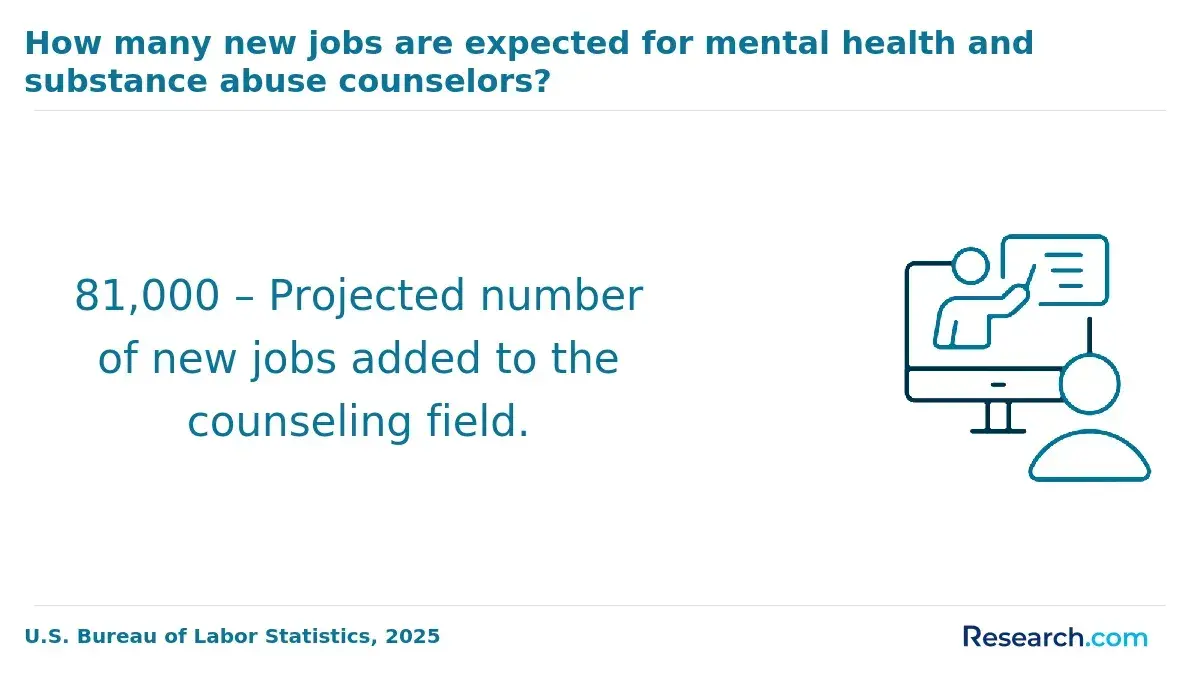
The U.S. Bureau of Labor Statistics reports a May 2025 national median wage of $59,350 for the occupation covering mental health and substance use counselors, with 18% projected employment growth from 2025 to 2035. These are occupational figures, not Indianapolis graduate outcomes.
The comparable national median for school and career counselors and advisors is $64,330, with 3% projected growth from 2025 to 2035 (U.S. Bureau of Labor Statistics). Compare both the career fit and the required local field placement before comparing tuition.
What can I expect from an online Counseling degree in Indianapolis?
An online counseling master's usually combines remote coursework with supervised, in-person work with clients or students. Courses address counseling theory, ethics, assessment, and culturally responsive practice; practica and internships test those skills in a real setting. "Online" therefore describes much of the instruction, not the entire path to graduation or licensure.
The choice that matters most is school counseling versus clinical mental health counseling. School counseling prepares students for work within K-12 schools and the Indiana Department of Education's school counselor credential requirements. Clinical mental health counseling focuses on assessment and treatment in settings such as clinics and community agencies and must be evaluated against Indiana's Licensed Mental Health Counselor requirements (Indiana Department of Education; Indiana Professional Licensing Agency). If your goal is private clinical practice, do not assume a school counseling degree supplies that pathway.
Indianapolis can make in-person training more accessible because prospective sites include school systems, health care organizations, and community mental health providers. Availability is not guaranteed: ask each program who secures a placement, whether it approves sites near your home, and what happens if a site cannot provide the required supervision.
Where can I work with an online Counseling degree in Indianapolis?
Work settings depend on the degree and credential. School counseling graduates may seek positions in Indianapolis-area public, charter, or private schools once they meet applicable Indiana requirements. Clinical mental health graduates may pursue supervised or licensed roles in community mental health centers, hospitals, outpatient practices, and substance use treatment organizations. Indianapolis's mix of schools and health care providers gives students settings to investigate for both placements and future work, but employers set their own hiring standards.
A master's alone does not authorize independent clinical practice. The Indiana Professional Licensing Agency oversees mental health counselor licensing, while the Indiana Department of Education handles school counselor licensing. If you might move, compare the intended program with the rules in the state where you expect to work; an Indiana-oriented placement or curriculum does not establish eligibility everywhere.
Pay depends on occupation, credential, employer, and experience - not simply on holding a counseling master's. The table uses U.S. Bureau of Labor Statistics national occupational medians for May 2025 and national employment projections for 2025-2035. Neither measure is an Indianapolis starting salary or a forecast for an individual graduate.
Career direction
National median annual wage, May 2025
Projected U.S. job growth, 2025-2035
Mental health or addiction counseling
$59,350
18%
School and career counseling
$64,330
3%
Marriage and family therapy
$66,940
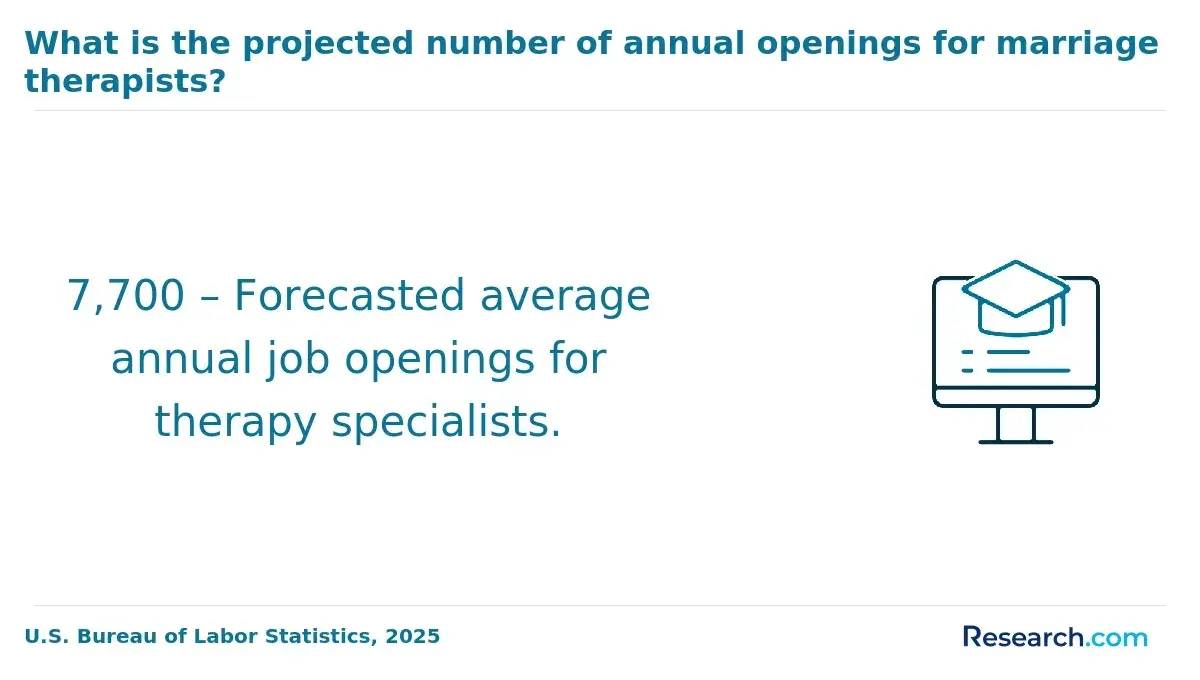
14%
Rehabilitation counseling
$46,850
2%
The faster projected growth in mental health and addiction counseling may make that pathway attractive, but it does not mean every Indianapolis opening pays the national median. Marriage and family therapy is also a distinct occupation with its own licensure requirements; do not treat its wage as the expected payoff from any counseling degree. For a personal return-on-investment estimate, compare likely local job offers with your current pay and the full cost and time required to obtain the credential (U.S. Bureau of Labor Statistics).
The clearest difference among the Indianapolis options is the career each curriculum serves. These program-level features are more useful than a university-wide reputation when deciding whether a degree fits your intended credential; confirm current credits, delivery, and placement rules directly before applying.
Indiana University-Indianapolis, Counseling and Counselor Education: The IU Indianapolis program presents counseling preparation through its education school rather than as a school-counseling-only online offering. That makes its specific degree pathway and delivery arrangement the first questions for applicants seeking clinical practice: verify that the track you choose meets Indiana's educational requirements and that required courses can actually be completed remotely (Indiana University Indianapolis School of Education).
Butler University, online school counseling: Butler explicitly markets this master's as an online school counseling program. That clear occupational focus suits applicants committed to K-12 work more than those seeking the educational route to clinical mental health licensure; ask how Butler coordinates school-based placements in the Indianapolis area (Butler University).
Butler University, school counseling course sequence: Butler publishes a separate course-level description for the online program, allowing applicants to inspect how counseling instruction and supervised school practice fit together rather than judging delivery by the word "online" alone. Use that sequence to check scheduling and prerequisites against your job and a prospective placement site (Butler University).
These distinctions concern published program design, not verified comparative placement or licensure-pass outcomes. A prospective student should request current program-specific results before using outcomes to break a close tie.
Plan on roughly two to three years for full-time study and often longer if you attend part time. The actual timeline depends on credit requirements, how frequently required courses run, prerequisites, and whether you can complete supervised fieldwork while employed. A school counseling placement tied to the academic calendar may constrain an otherwise flexible online schedule.
An accelerated option is useful only if its course load and placement hours fit your life; a shorter advertised timeline is not necessarily a shorter route to licensure. If speed is your priority, compare the fastest counseling programs, then request a term-by-term plan showing the earliest realistic graduation date for your enrollment status.
Both formats can require face-to-face supervised experience. The practical distinction is where you attend classes and how much responsibility you have for arranging fieldwork. The comparison below helps working Indianapolis residents identify the constraint most likely to affect completion.
Consideration
Online study
On-campus study
Class attendance
Remote coursework; scheduled live sessions or visits may still apply
Regular travel to campus
Field experience
In person at an approved site, often near the student
In person through approved sites; campus proximity may ease coordination
Best fit
Students who need classroom flexibility and can secure local supervision
Students who prefer in-person instruction and campus contact
Do not choose online study solely to avoid commuting: a placement may require travel during school or clinic hours. Ask whether an online student can use Indianapolis-area sites and whether any campus visits, synchronous meetings, or technology requirements add costs.
There is no dependable single Indianapolis average that describes the total price of these distinct counseling pathways. A national graduate tuition average would also obscure differences in program length, residency pricing, and required fieldwork. For a usable estimate, multiply each school's current per-credit graduate rate by its required credits, then add mandatory fees, books, travel to placements, and any campus-visit costs. Use the school's published price for your entry year rather than a general university tuition figure (National Center for Education Statistics, IPEDS; institution tuition schedules).
Compare net cost to completion, not just the first term's bill. A lower per-credit price can lose its advantage if it requires more credits or prevents you from working during fieldwork. The most affordable counseling programs offer a useful shortlist, but request a written total-cost estimate and check whether Indiana residency changes the rate.
Start by checking a program's eligibility for federal aid, then submit the FAFSA and review the school's graduate aid offer. Federal Direct Unsubsidized Loans, institutional scholarships, assistantships, employer tuition assistance, and eligible placement-related support may reduce the amount you must cover yourself; eligibility and availability vary by student and program (Federal Student Aid; individual institutions).
Federal borrowing rules are especially important for a 2027 entrant. Graduate PLUS is generally unavailable to new graduate borrowers beginning July 1, 2026; limited transition provisions may apply to eligible continuing students. Do not build a financing plan around that loan without confirming your individual status and current limits with the school's financial aid office (Federal Student Aid). If an employer will contribute, ask whether supervised fieldwork affects the hours you must work to keep that benefit.
View the chart data as a table
Median wage by U.S. state - Mental Health Counselors (BLS OEWS, May 2025) (Source: BLS)
State
Value
AK
80,770
AL
47,310
AR
51,580
AZ
65,300
CA
59,250
CO
62,390
CT
63,590
DC
60,450
DE
56,020
FL
56,790
GA
58,960
HI
60,090
IA
60,880
ID
63,360
IL
60,730
IN
53,760
KS
59,470
KY
54,190
LA
37,910
MA
59,890
MD
59,530
ME
59,970
MI
61,690
MN
58,780
MO
56,910
MS
46,990
MT
59,000
NC
55,490
ND
68,630
NE
63,770
NH
54,840
NJ
62,820
NM
74,100
NV
57,210
NY
59,450
OH
58,360
OK
59,350
OR
74,590
PA
52,010
PR
46,790
RI
65,120
SC
52,370
SD
53,650
TN
49,580
TX
62,630
UT
63,890
VA
59,880
VT
61,810
WA
68,910
WI
62,220
WV
49,430
WY
62,980
Expect to need a bachelor's degree from an appropriately accredited institution. Programs may also request transcripts, references, a statement of purpose, an interview, or relevant preparation in psychology or education; exact rules belong to each admissions office (Indiana University Indianapolis School of Education; Butler University).
Admission is not the same as placement or eventual licensure eligibility. Ask whether field sites require background checks, immunization records, or other clearances, and disclose any concern about professional licensing to the appropriate Indiana authority before paying a deposit. Applicants comparing admission routes can review the easiest counseling programs, but should not mistake less restrictive entry criteria for fewer graduation or credential requirements.
Common subjects include counseling theories, helping skills, ethics, assessment, human development, research, and supervised practicum and internship. Their application differs by pathway: school counseling coursework addresses student development, school systems, and collaboration with families and educators; clinical mental health coursework places greater emphasis on diagnosis, treatment planning, and clinical practice (Indiana University Indianapolis School of Education; Butler University).
Read the actual course sequence, not only the course titles. A required class offered infrequently can delay fieldwork, and a course that looks clinically relevant may not meet an Indiana licensing board's specific educational standard. Request a curriculum-to-credential explanation from the program if your goal is licensure.
The most consequential specialization choice is the credential track: school counseling or clinical mental health counseling. Some programs may also offer electives concerning addiction, children and adolescents, or related populations, but an elective is not a separate license. Confirm whether a named concentration changes the degree requirements, supervised placement, or state eligibility before treating it as a career pathway.
Students primarily interested in couples and families should also examine marriage and family therapy degrees rather than assuming a general counseling master's meets that occupation's requirements. Likewise, someone whose goal is school counseling should prioritize school-specific training and placements over a clinical curriculum with only occasional work involving children (Indiana Professional Licensing Agency; Indiana Department of Education).
Choose the program that provides a verifiable route to your intended work at a cost and pace you can sustain. A ranking helps identify options, but program fit depends on Indiana credential rules, fieldwork logistics, and your finances - not institution type alone.
Use these checks when speaking with admissions and program staff:
Name the intended credential. Ask the program to identify the exact Indiana school counseling or mental health counseling requirements its degree is designed to address, including any exam and post-degree supervision.
Verify accreditation separately. Check institutional accreditation and whether the specific counseling program holds any programmatic accreditation you need; do not infer programmatic status from the university's status (U.S. Department of Education; CACREP).
Test the placement plan. Ask who finds and approves Indianapolis-area sites, what supervision is required, and whether employed students can complete fieldwork on their available schedule.
Calculate net cost and time. Obtain the full credit-and-fee estimate, aid offer, likely borrowing, and a realistic completion plan that includes any earnings you may forgo during placement.
Request relevant outcomes. Ask for current program-specific completion, licensure exam, and employment results, along with their reporting periods and sample sizes.
For value comparisons, the most valuable counseling programs can help focus your search. A sound personal return-on-investment calculation still needs your baseline earnings, expected post-degree earnings, aid and debt, completion probability, time to credential, and the period over which you expect to recover the investment.
View the chart data as a table
Best score by program (Source: Research.com)
Category
Value
Butler University
92.41
Butler University
92.63
Indiana University-India
92.73
A school counseling master's can support a path toward K-12 school counselor positions once Indiana's education credential requirements are met. A clinical mental health counseling master's can support a path from supervised practice toward mental health counselor licensure and, later, positions with greater clinical autonomy. Addiction-focused work may be another direction, subject to the qualifications for the role and employer (Indiana Department of Education; Indiana Professional Licensing Agency).
The degree is a better investment if you want counseling to be your primary occupation and can complete its supervised requirements. If your goal is a nonclinical student-support or human services role that does not require counselor licensure, compare that job's actual hiring requirements before committing to a licensure-oriented master's. A shorter credential may be more appropriate, but it will not substitute for a qualifying counseling degree where one is required.
View the chart data as a table
Wage range - Mental Health Counselors in Indiana (BLS OEWS, May 2025) (Source: BLS)
Category
Value
10th percentile
37,580
25th percentile
42,210
Median
53,760
75th percentile
66,340
90th percentile
83,200
National projections indicate different demand conditions across counseling occupations: the U.S. Bureau of Labor Statistics projects 18% growth for the occupation covering mental health and substance use counselors from 2025 to 2035, versus 3% for school and career counselors and advisors. That contrast is worth considering when choosing a track, but national growth does not establish the number of openings in Indianapolis or your likelihood of receiving an offer.
Local opportunity is shaped by school hiring cycles, provider vacancies, credential status, and the supervised experience a role requires. Review current Indianapolis-area postings for your target title before enrolling: note the specified Indiana credential, setting, schedule, and experience level. If most attractive roles require full licensure, include the time and cost of reaching that stage - not just graduation - in your career plan.
2027 Best Online Master's in Counseling Degree Programs Ranking in Indianapolis
Investing in graduate education is an important decision. Research.com created this ranking to help readers compare programs using consistent evidence rather than relying on reputation alone. Its team checks program information against education databases and accounts for differences in available measures so the ranking is a starting point for further investigation, not a substitute for confirming current requirements with a school.
The Best ranking first combines program completion (40%), employment or doctoral admission (20%), applicable licensure exam pass rates (20%), applicable CACREP programmatic accreditation (16%), and federal Title IV eligibility (4%). Shares are adjusted when a measure does not apply. Program cost then contributes about 7% of the final score. The method applies to both online and on-campus programs; rankings named for another dimension, such as affordability, order programs by that dimension.
The ranking draws on these sources to assess programs and cross-check institutional information:
IPEDS database - institutional reporting on enrollment, completions, and costs.
Peterson's database - program and institution information used in comparisons.
Readers can use the ranking to narrow their options, then verify a shortlisted program's delivery format, placement support, and eligibility for their intended Indiana credential. More detail on Research.com's approach is available on its methodology page.
# 1 position
Indiana University-Indianapolis
Master
School Counseling (M.S.Ed.)
Delivery mode: hybrid
92.73
/ 100
Final score
Program length
Average completion: about 3 years (full-time)
Specialization
School Counseling
Required credits
60 semester credits
GPA range
3.00 - 4.00
Application deadline
Summer: March 1 (admits for Summer and Fall terms only, no Spring admission)
Application process
direct
Additional requirements
Personal goal statement (max 3 double-spaced pages), two signed professional letters of recommendation, unofficial transcripts (WES ICAP evaluation for non-U.S. degrees), resume; English proficiency for non-native speakers (e.g., TOEFL 79+ iBT).
Accreditation
Accredited by the Council for Accreditation of Counseling and Related Educational Programs (CACREP), with institutional accreditation from the Higher Learning Commission (HLC).
Indiana University-Indianapolis earned a Research.com Counseling Program Score of 92.73/100. The program is CACREP-accredited, valid through 2030-03-31.
# 2 position
Butler University
Master
Master of Science in School Counseling
Delivery mode: online
92.63
/ 100
Final score
Program length
three years (eight semesters)
Specialization
School Counseling
Required credits
60 semester credits
GPA range
3.00 - 4.00
Application deadline
rolling
Application process
direct
GRE
no
Prerequisites
Bachelor's degree from a regionally accredited four-year college or university; cumulative undergraduate GPA of at least 3.0; no prerequisite coursework required.
Additional requirements
Official transcripts from all colleges/universities attended, two letters of recommendation, a personal statement, and an interview. No GRE/GMAT required. No application fee.
Accreditation
Accredited by the Council for Accreditation of Counseling and Related Educational Programs (CACREP), with institutional accreditation from the Higher Learning Commission (HLC).
Butler University earned a Research.com Counseling Program Score of 92.63/100. The program is CACREP-accredited, valid through 2030-10-31.
# 3 position
Butler University
Master
M.S. in School Counseling – Dual Licensure (Mental Health Counseling) Track
Delivery mode: online
92.41
/ 100
Final score
Specialization
School Counseling
Required credits
66 semester credits
GPA range
3.00 - 4.00
Application deadline
rolling
Application process
direct
GRE
no
Prerequisites
Same as base MS in School Counseling admission requirements; dual-licensure track selected via elective coursework.
Additional requirements
Same as base MS in School Counseling program (transcripts, two letters of recommendation, personal statement, interview); careful elective planning required for dual licensure.
Accreditation
Accredited by the Council for Accreditation of Counseling and Related Educational Programs (CACREP), with institutional accreditation from the Higher Learning Commission (HLC).
Butler University earned a Research.com Counseling Program Score of 92.41/100. The program is CACREP-accredited, valid through 2030-10-31.
Frequently asked questions about online Counseling degree in Indianapolis
Can I complete an online counseling master's without going to a placement site?
Generally, no. Counseling programs include supervised in-person practica or internships. Ask whether a school approves sites near Indianapolis and whether it helps students find them.
Will an online school counseling degree qualify me to become a mental health counselor?
Do not assume so. Indiana school counselor credentials and mental health counselor licenses have different requirements. Ask the program and the relevant Indiana authority to confirm the pathway before enrolling (Indiana Department of Education; Indiana Professional Licensing Agency).
Do I need a counseling bachelor's degree to apply?
Not necessarily. A bachelor's degree is the usual starting point, but prerequisite coursework and admission criteria vary. Check the requirements of each program you are considering.
Does graduating from a counseling master's make me licensed?
No. Graduation, supervised experience, examinations, and state approval are distinct steps. The steps that apply depend on the Indiana credential you seek (Indiana Professional Licensing Agency; Indiana Department of Education).
Is a lower-priced program always the better value?
No. Compare total cost after aid, time away from paid work, completion prospects, placement support, and whether the degree fits your intended credential. A degree that does not qualify you for your target path can be costly even at a lower tuition rate.
See What Experts Have To Say About Studying Counseling