Finishing a counseling degree quickly matters only if the program also fits your budget, schedule, and Ohio licensure plans. This guide is for prospective students and working professionals comparing online master's options. It explains clinical training, costs, career prospects, and the questions to ask before enrolling. It will also feature the 2027 Fastest Online Clinical Mental Health Counseling Degree Programs Ranking in Ohio, created by the Research.com team of data scientists to help students make an informed choice about which programs are worth considering.
Key findings about online Clinical Mental Health Counseling degrees in Ohio
Speed has a clinical-training limit: CACREP's 2024 standards specify at least 100 hours of supervised practicum and 600 hours of supervised internship for accredited entry-level counseling programs. Ask whether placements are available near your Ohio home and fit your work schedule.
Licensure needs a separate check: An online degree does not itself grant an Ohio counseling license. Confirm the curriculum, supervision, and examination pathway with the Ohio Counselor, Social Worker, and Marriage and Family Therapist Board.
Demand is promising, not guaranteed: The U.S. Bureau of Labor Statistics reports a May 2025 national median wage of $59,350 for the relevant mental health and addiction counseling occupation and projects 18% employment growth from 2025 to 2035. Neither figure predicts an individual graduate's Ohio earnings or hiring prospects.
What can I expect from an online Clinical Mental Health Counseling degree in Ohio?
Expect a graduate counseling program - not a fully remote route into clinical practice. Online coursework typically covers assessment, diagnosis, ethics, treatment planning, and counseling methods, while supervised practicum and internship involve working with clients at approved sites. Live classes, residencies, and placement rules differ by school; "online" describes course delivery, not necessarily every degree requirement.
This path fits someone seeking clinical counseling work who can commit to supervised client contact. If your goal is school counseling, social work, or independent practice in another state, compare the credential required for that specific role before choosing a clinical mental health curriculum. Ohio's Counselor, Social Worker, and Marriage and Family Therapist Board sets state licensing requirements; a university's admissions approval is not a board determination of eligibility.
Where can I work with an online Clinical Mental Health Counseling degree in Ohio?
Clinical mental health counselors may work in community behavioral health agencies, hospitals, outpatient clinics, residential programs, or private practices, depending on their license and employer requirements. Substance-use treatment is another possible setting when the role and credentials align. These settings differ substantially in schedules, supervision, and the kinds of clients served, according to the U.S. Bureau of Labor Statistics.
For an Ohio student, placement geography can shape the first job search. A program with an approved site near home may be more workable than a faster-looking program that expects travel or daytime hours you cannot accommodate. Ask schools which Ohio sites they currently approve, who secures placements, and whether graduates seeking work in your preferred setting receive relevant clinical experience.
The U.S. Bureau of Labor Statistics reports a $59,350 national median annual wage in May 2025 for the occupation encompassing substance abuse, behavioral disorder, and mental health counselors. That is a benchmark for an occupation, not a starting salary for newly licensed Ohio graduates. Pay can differ by employer, experience, location, and whether a position requires independent clinical licensure.
Use that benchmark cautiously when estimating return on investment. Compare your likely post-degree role with your current earnings, then account for tuition, borrowing, reduced work hours during internship, and the time needed to meet licensing requirements. A higher eventual wage may not offset a substantially more expensive or difficult-to-complete program on your preferred timeline.
The most useful comparison is not which school sounds most flexible; it is whether the program's published structure matches your intended license and available time. The following program-specific distinctions are starting points for checking current catalogs, delivery formats, and placement policies directly with each school. No unverified completion-time or outcome figure should determine your choice.
Capital University: Its program information is presented through an academic bulletin, making the catalog's degree requirements the key document to scrutinize rather than relying on a general recruitment description. This is especially useful for applicants comparing required coursework and asking how often each course is offered in an accelerated sequence (Capital University academic bulletin).
John Carroll University: Its clinical mental health counseling program explicitly identifies an online option, a meaningful distinction for applicants who cannot routinely commute for classes. Confirm which sessions, if any, require attendance at set times or in person, and whether the school can approve placements near your Ohio residence (John Carroll University program page).
Heidelberg University: Its published offering is a Master of Arts in Counseling. Applicants should establish which clinical mental health pathway and delivery arrangement they would actually enter before comparing its timeline with programs advertised specifically as online clinical mental health degrees (Heidelberg University program page).
Winebrenner Theological Seminary: Its degree is explicitly titled a Master of Arts in Clinical Counseling and is offered in a seminary setting. Students interested in that environment should compare the degree's clinical coursework, Ohio licensing alignment, and required attendance with secular university options rather than treating the institution's name as evidence of a different license (Winebrenner Theological Seminary program page).
A full-time clinical mental health counseling master's commonly takes about two to three years; part-time study can take longer. The practical timeline depends on course sequencing, start dates, placement availability, and whether your internship can fit around paid work. Treat a school's shortest advertised timeline as a scenario to verify, not the time every student will finish.
CACREP's 2024 standards require at least 100 supervised practicum hours and 600 supervised internship hours in accredited entry-level counseling programs. Those experiences explain why compressing online classes does not necessarily compress the whole degree. Ask for a term-by-term plan showing when clinical work begins, how placements are approved, and what happens if a required course or site is unavailable.
Online and campus programs can teach comparable counseling competencies, but their logistics differ. Online delivery may eliminate a regular classroom commute; it does not eliminate supervised client contact, scheduled skills practice, or possible campus visits. A campus option may make local faculty contact and established placement relationships easier to access, but it can be less workable for someone employed outside commuting distance.
Choose by testing the format against your weekly schedule: Are classes live or asynchronous? How are counseling skills assessed? Who finds and approves your internship site? If you plan to live outside Ohio during enrollment, ask whether the school can place students there and whether the curriculum supports that state's licensing rules. Neither delivery format automatically makes a degree faster or more licensure-ready.
There is no single reliable Ohio-wide price for the specific combination of online and clinical mental health counseling programs. Published graduate tuition averages can be useful background, but they do not capture each program's required credits, fees, and clinical expenses. For this decision, obtain a current program-level estimate rather than treating an institution-wide average as your expected bill (National Center for Education Statistics; institutional tuition schedules).
Compare total required tuition, mandatory online and technology fees, books, travel or residency costs, and expenses associated with securing a placement. Check whether an Ohio public university charges different resident and nonresident graduate rates and whether its online program has a separate rate. The most affordable clinical mental health counseling programs are worth comparing, but the lowest sticker price is not necessarily the lowest cost to finish.
Start with the FAFSA and the school's financial aid office. An eligible graduate student may be considered for federal Direct Unsubsidized Loans; scholarships, assistantships, employer tuition support, and school-specific grants depend on the institution and the student's circumstances. Federal aid also depends on institutional eligibility and enrollment rules, not simply on whether classes are online (Federal Student Aid).
Check current federal loan rules before assuming a funding gap can be covered. Graduate PLUS availability has changed for students beginning graduate study under new federal rules; limited transitional eligibility may apply to some existing borrowers. Ask the aid office to identify the rules for your enrollment date and circumstances, then request an aid offer for the full program rather than its first term (Federal Student Aid). Compare the resulting debt and expected completion time with the most valuable clinical mental health counseling programs.
View the chart data as a table
Program length by program (Source: Research.com)
Category
Value
Capital University
24
John Carroll University
24
Heidelberg University
24
Winebrenner Theological
36
Programs generally require a bachelor's degree and commonly request transcripts, a statement of purpose, recommendations, and an interview; psychology or statistics preparation varies by school (institutional admissions pages). A counseling master's is typically an entry path for applicants without a prior counseling license, but admission standards and prerequisite courses are program-specific.
Before applying, separate three questions: whether you meet admissions criteria, whether the curriculum is designed for your intended Ohio license, and whether you can complete its clinical requirements where you live. If you need to strengthen an application, compare actual prerequisite and admissions policies rather than assuming an "easy" admission route also offers an easy path to licensure. The easiest clinical mental health counseling programs can help start that comparison, but confirm requirements with each school.
Expect coursework in counseling theory, helping skills, ethics, human development, assessment, diagnosis, group counseling, research, and multicultural counseling, alongside supervised clinical training (CACREP standards). Substance-use counseling, crisis response, and family-focused work may appear as required courses or electives. Course titles alone do not show how much practice you will get using a skill.
Compare syllabi and training sequences: When do students first practice counseling with feedback? How are telehealth ethics and crisis procedures taught? Does assessment coursework match the populations you hope to serve? Telehealth matters because online learning and online client care are different competencies; ask how the program prepares students for each within applicable professional and state rules.
Possible emphases include addiction, trauma, child and adolescent counseling, or couples and family work, but their availability and requirements vary by program. An elective or concentration can deepen preparation for a client population; it does not automatically confer a separate credential. Verify the exact course sequence and whether a suitable supervised placement is available for your interest.
If your goal is specifically to be a school counselor, compare school counseling programs rather than assuming a clinical mental health concentration meets school credentialing rules. Likewise, someone focused on marriage and family therapy should check the education and licensing route for that profession. Specialization is most valuable when the curriculum, placement, and intended license point toward the same job (Ohio Counselor, Social Worker, and Marriage and Family Therapist Board; relevant credentialing authorities).
Build a shortlist around your intended license and the time you can realistically devote to clinical work. Accreditation, completion speed, and price answer different questions; none substitutes for checking the others. Use the best clinical mental health counseling programs as one comparison tool, then request written answers to the checks below.
Verify the pathway: Ask how the curriculum meets current Ohio board education rules, whether the specific program holds CACREP accreditation, and which steps remain after graduation. Check accreditation with CACREP and licensure requirements with the Ohio board.
Test the promised timeline: Request the course rotation and a sample plan for your intended start term, including practicum, internship, live meetings, and any campus visits.
Price completion, not admission: Request required credits, a full-program tuition and fee estimate, likely placement-related costs, and the school's policy on transfer credit.
Examine evidence: Ask for recent program-level completion, licensing-exam, and employment outcomes with their reporting periods. Be wary of institution-wide figures presented as counseling-program results.
A common mistake is choosing the shortest advertised schedule before confirming placement capacity. Another is treating CACREP accreditation, federal aid eligibility, and Ohio licensure approval as interchangeable. They serve different purposes; obtain documentation for each issue relevant to your goal.
View the chart data as a table
Median wage by U.S. state - Mental Health Counselors (BLS OEWS, May 2025) (Source: BLS)
State
Value
AK
80,770
AL
47,310
AR
51,580
AZ
65,300
CA
59,250
CO
62,390
CT
63,590
DC
60,450
DE
56,020
FL
56,790
GA
58,960
HI
60,090
IA
60,880
ID
63,360
IL
60,730
IN
53,760
KS
59,470
KY
54,190
LA
37,910
MA
59,890
MD
59,530
ME
59,970
MI
61,690
MN
58,780
MO
56,910
MS
46,990
MT
59,000
NC
55,490
ND
68,630
NE
63,770
NH
54,840
NJ
62,820
NM
74,100
NV
57,210
NY
59,450
OH
58,360
OK
59,350
OR
74,590
PA
52,010
PR
46,790
RI
65,120
SC
52,370
SD
53,650
TN
49,580
TX
62,630
UT
63,890
VA
59,880
VT
61,810
WA
68,910
WI
62,220
WV
49,430
WY
62,980
A common progression is graduate training, supervised practice under the appropriate credential, and application for the license required for the intended scope of work. Ohio distinguishes counseling credentials and sets requirements for education, examinations, and supervised experience; completing a master's degree alone does not authorize independent clinical practice (Ohio Counselor, Social Worker, and Marriage and Family Therapist Board).
Potential directions include community mental health counseling, outpatient behavioral health, substance-use services, and, after meeting applicable requirements, more independent clinical roles. Compare job postings for your preferred setting before enrolling: an employer may require a particular Ohio license or experience with a specific population. If you want a nonclinical support role rather than a licensed counseling career, a shorter or less expensive educational path may fit better.
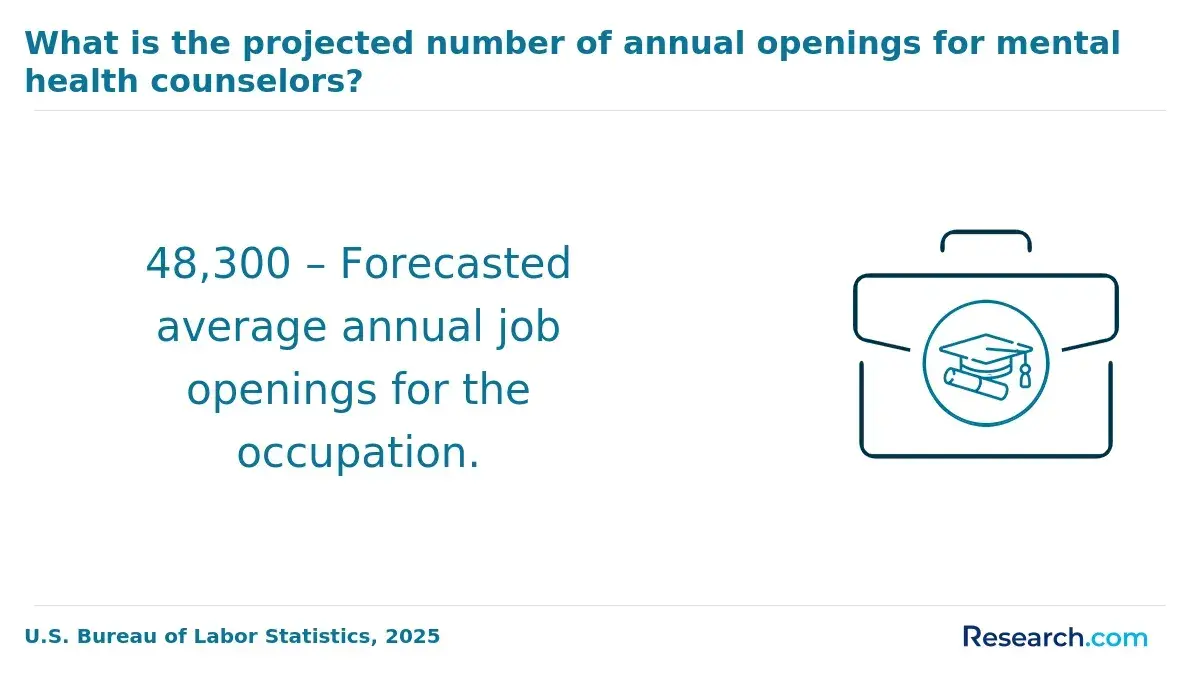
The U.S. Bureau of Labor Statistics projects 18% national employment growth from 2025 to 2035 for substance abuse, behavioral disorder, and mental health counselors. That projection indicates broad occupational demand, but it is not an Ohio hiring forecast or a guarantee of a job in a particular city. Local opportunities depend on employers, funding, the populations served, and the credentials required.
For a more useful Ohio-specific test, review current openings in the area where you could work and note their license, schedule, and experience requirements. Then ask prospective programs whether their placements and supervision arrangements help students build relevant experience there. This connects a national growth trend to the actual market you plan to enter instead of assuming demand is uniform across the state.
2027 Fastest Online Clinical Mental Health Counseling Degree Programs Ranking in Ohio
Investing in a counseling degree is a consequential decision, especially when a shorter advertised timeline could conceal clinical-placement or licensure complications. Research.com evaluates counseling programs using graduate outcomes, licensure exam results where applicable, accreditation, federal aid eligibility, and cost. Its team reviews multiple education datasets to make the rankings more credible and useful for comparison.
The ranking draws on these data sources:
IPEDS database: Institutional reporting on programs, enrollment, completion, and prices.
Peterson's database: Program and institution information used to compare available options.
For the Best ranking, Research.com first combines program completion (40%), employment or doctoral admission (20%), licensure exam pass rate where applicable (20%), CACREP accreditation (16%), and institutional Title IV eligibility (4%). It renormalizes these shares when a measure does not apply, then incorporates program cost as approximately 7% of the final score. Online and campus programs use the same approach; other rankings emphasize the dimension named in their titles. A fastest-program ranking should be a starting point for checking each school's current, individually achievable completion schedule - not a promise that every student can finish on that timeline. See Research.com's methodology for more detail.
# 1 position
Capital University
Master
Master of Arts in Clinical Mental Health Counseling
Delivery mode: hybrid
78.30
/ 100
Final score
Program length
two years (full-time)
Specialization
Clinical Mental Health Counseling
Required credits
64 semester credits
GPA range
3.00 - 4.00
Program completion rate
100% (2024-25)
Employment or doctoral admission
100% (2024-25)
Licensure exam pass rate
96.4% (2024-25)
Application deadline
Priority Deadline: December 1; Final Deadline: March 15
Class size
31
Application process
direct
Prerequisites
Bachelor's degree or recognized equivalent from an accredited institution, with a satisfactory GPA, usually a minimum of 3.0 (B); applicants below 3.0 are reviewed individually and, if admitted, placed on a probationary period.
Additional requirements
Online application; statement of intent; three professional references; resume or CV; official transcripts from all institutions; signed Statement of Assurance of Good Moral Character; in-person interview if invited. Fall admission only.
Accreditation
Accredited by the Council for Accreditation of Counseling and Related Educational Programs (CACREP), with institutional accreditation from the Higher Learning Commission (HLC).
Capital University earned a Research.com Completion Speed Score of 78.3/100, supported by 2-year completion pathway and 64 semester credits. The program is CACREP-accredited, valid through 2031-10-31.
# 2 position
John Carroll University
Master
M.A. in Clinical Mental Health Counseling (Online)
Delivery mode: hybrid
78.30
/ 100
Final score
Program length
2 Years / six semesters
Specialization
Clinical Mental Health Counseling
GPA range
3.00 - 4.00
Employment or doctoral admission
100% (2024-25)
Licensure exam pass rate
97% (2024-25)
Application deadline
rolling (priority date Aug 1 for Fall start)
Application process
direct
GRE
no
Prerequisites
An undergraduate degree in a recognized area from an accredited institution; undergraduate cumulative GPA of at least 3.0.
Additional requirements
Official transcripts from all colleges/universities attended; Resume/CV; Two letters of recommendation; Statement of purpose (400-600 words); Faculty Interview. Program requirement: two on-campus weekend residencies (University Heights, OH).
Accreditation
Accredited by the Council for Accreditation of Counseling and Related Educational Programs (CACREP), with institutional accreditation from the Higher Learning Commission (HLC).
John Carroll University earned a Research.com Completion Speed Score of 78.3/100, supported by 2-year completion pathway and 97% licensure exam pass rate. The program is CACREP-accredited, valid through 2029-10-31.
# 3 position
Heidelberg University
Master
Master of Arts in Counseling
Delivery mode: hybrid
78.30
/ 100
Final score
Program length
approximately 2 calendar years
Specialization
Clinical Mental Health Counseling
Required credits
60 semester credits
GPA range
3.00 - 4.00
Application deadline
rolling
Application process
direct
GRE
no
Prerequisites
Minimum GPA of 3.0 on a 4.0 scale.
Additional requirements
Graduate application, transcripts, two recommendation letters, a 2–3-page personal statement of professional goals, and Ohio BCI and FBI background checks. Admission is conditional; a faculty interview after nine credits is required.
Accreditation
Accredited by the Council for Accreditation of Counseling and Related Educational Programs (CACREP), with institutional accreditation from the Higher Learning Commission (HLC).
Heidelberg University earned a Research.com Completion Speed Score of 78.3/100, supported by 2-year completion pathway and 60 semester credits. The program is CACREP-accredited, valid through 2028-03-31.
An accredited Bachelor of Arts or Science degree or its equivalent is required for admission to the master's program.
Additional requirements
Completed application form, application fee, transcripts, undergraduate cumulative GPA of 3.0, interview with the program director and/or other MACC faculty, and a current resume (older catalog also cites three letters of recommendation).
Accreditation
Accredited by the Council for Accreditation of Counseling and Related Educational Programs (CACREP), with institutional accreditation from the Higher Learning Commission (HLC) and the Commission on Accrediting of the Association of Theological Schools (ATS).
Winebrenner Theological Seminary earned a Research.com Completion Speed Score of 52.2/100, supported by 3-year completion pathway and 64 semester credits. The program is CACREP-accredited, valid through 2027-03-31.
Frequently asked questions about online Clinical Mental Health Counseling degree in Ohio
Can I complete the entire degree from home?
Usually not. Coursework may be online, but supervised practicum and internship require approved clinical experience. Some programs also schedule live sessions or in-person visits; confirm every attendance requirement before applying.
Will an online counseling master's qualify me for an Ohio license?
Not automatically. Ask the program how its curriculum aligns with current Ohio board requirements, then confirm the education, examination, and supervised-experience steps with the Ohio Counselor, Social Worker, and Marriage and Family Therapist Board.
Is a CACREP-accredited program required?
Do not assume accreditation and licensure rules are identical. CACREP accreditation is a program-level quality designation; Ohio's board determines licensing eligibility. Check the board's current education rules and the accreditation status of the specific program and campus or delivery option you are considering.
Can previous graduate credits shorten the degree?
Possibly. Schools set transfer-credit limits and decide whether previous courses match required counseling content. Ask for a written evaluation; clinical training and course sequencing may still determine your earliest graduation date.
Is the fastest program the best investment?
Only if its curriculum supports your license goal, its placements are workable, and its total cost fits your budget. Compare debt, forgone earnings, completion likelihood, and the time until you can pursue your intended role - not advertised duration alone.