Choosing a counseling master's program means comparing more than reputation: the degree must fit your budget, schedule, clinical training needs, and path to Minnesota licensure. This guide explains those trade-offs for future therapists and professionals changing careers. It also features the 2027 Most Popular Clinical Mental Health Counseling Degree Programs Ranking in Minnesota, created by the Research.com team of data scientists to help students make an informed choice about programs worth considering. You'll learn how to compare programs and judge whether the investment fits your goals.
Key findings about Clinical Mental Health Counseling degrees in Minnesota
A clinical mental health counseling master's is the relevant degree path for many aspiring Minnesota professional counselors, but graduation does not itself confer a license; confirm curriculum and supervised-training requirements with the Minnesota Board of Behavioral Health and Therapy.
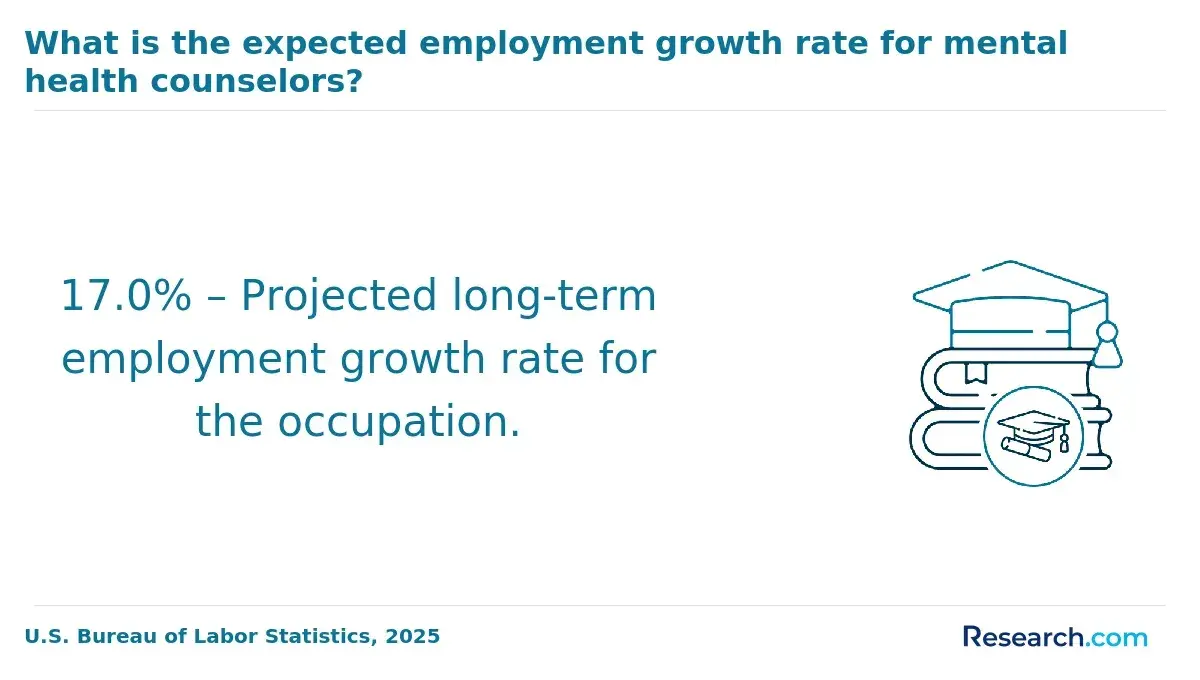
The U.S. median annual wage for the BLS occupation covering mental health counselors was $59,350 in May 2025; projected national employment growth is 18% from 2025 to 2035. Neither figure predicts an individual graduate's earnings or a Minnesota job offer.
Plan on roughly 2-3 years of full-time graduate study, with additional time for post-degree supervised experience. Compare total tuition, field-placement logistics, and time away from work - not popularity alone.
What can I expect from a Clinical Mental Health Counseling degree in Minnesota?
A clinical mental health counseling degree is usually a graduate program preparing students to assess concerns, develop treatment plans, provide counseling, and practice ethically under supervision. It is a fit for people seeking a counseling career in community agencies, health settings, or private practice - not for someone who only needs an introductory mental health credential.
In Minnesota, the crucial distinction is between earning a degree and qualifying for a license. The Minnesota Board of Behavioral Health and Therapy regulates licensed professional counselors and licensed professional clinical counselors. Before enrolling, ask a program which license its curriculum is designed to support, how it documents required coursework and field experience, and what graduates must complete after the degree (Minnesota Board of Behavioral Health and Therapy).
Program titles can obscure meaningful differences. A counseling track aimed at school employment is not interchangeable with clinical mental health counseling; a short certificate generally does not replace a qualifying master's. If you want to prescribe medication or practice in another regulated profession, investigate that profession's education route instead.
Where can I work with a Clinical Mental Health Counseling degree in Minnesota?
Potential settings include community mental health agencies, outpatient clinics, hospitals, integrated-care practices, substance-use treatment organizations, and, after meeting applicable requirements, private practice. Job duties and eligibility depend on the employer, license, and supervision available; a new graduate should not assume every independent-practice role is immediately open.
Location affects the training decision. Programs in the Twin Cities can be practical for students seeking placements near a large metropolitan network of providers, while studying in Mankato, Winona, or St. Cloud may better fit someone intending to build a career in that part of the state. Ask where recent students actually completed placements rather than assuming a campus location guarantees a nearby site.
The U.S. Bureau of Labor Statistics reports a $59,350 national median annual wage in May 2025 for substance abuse, behavioral disorder, and mental health counselors, the occupational grouping relevant to clinical mental health counseling. This is an occupation-wide midpoint, not a starting salary, a Minnesota-specific figure, or a return attributable to any particular master's program (U.S. Bureau of Labor Statistics, Occupational Outlook Handbook).
When evaluating earnings, compare jobs at the license level you can realistically hold immediately after graduation with those available after supervised experience. Ask employers about salary or reimbursement arrangements, supervision costs, and benefits. A higher advertised private-practice rate may not translate into higher take-home pay after expenses and unpaid administrative time.
The clearest differences among these Minnesota options concern degree framing, institutional setting, and where students may want to establish clinical connections. Published program descriptions are a starting point, not proof of placement availability or licensure eligibility; request current requirements and outcomes directly before choosing.
Minnesota State University, Mankato: Its mental health counseling MS sits within Counseling and Student Personnel, making the specific mental health track - not the department name - the curriculum to inspect. This is a useful comparison for students considering Mankato who want to distinguish clinical preparation from other counseling-related paths (Minnesota State University, Mankato).
Bethany Lutheran College: Bethany offers a graduate program explicitly titled Clinical Mental Health Counseling within a private college setting. Students comparing it with nearby Minnesota State University, Mankato should focus on the two programs' current total charges, clinical-placement arrangements, and educational approach rather than assuming proximity makes their costs or requirements alike (Bethany Lutheran College).
Winona State University: Its named clinical mental health counseling program gives students interested in southeastern Minnesota a public-university option to examine. For someone hoping to remain in that area, the decisive follow-up is whether suitable local practicum and internship sites are available during the terms they need them (Winona State University).
Bethel University: Bethel places graduate counseling within a private, faith-based university. Applicants should review the program's clinical curriculum and training policies alongside its institutional approach, especially if they want to know how that environment fits their professional goals and responsibilities to clients (Bethel University).
St. Cloud State University: Its dedicated clinical mental health counseling program offers a public-university option in central Minnesota. Students planning to work outside the Twin Cities can usefully ask how the program arranges and supervises placements in the communities where they intend to practice (St. Cloud State University).
University of Minnesota-Twin Cities: The master's is housed in counselor education within the Department of Educational Psychology. That departmental setting may appeal to applicants interested in the relationship between counseling preparation and educational psychology; confirm the precise master's track and its clinical licensure alignment rather than relying on the university name (University of Minnesota-Twin Cities).
These distinctions help narrow a shortlist, but they are not a substitute for like-for-like evidence. Request each program's current credit requirements, total tuition, accreditation status, fieldwork handbook, and published graduate outcomes before deciding that one offers a stronger fit.
Full-time clinical mental health counseling master's study commonly takes about 2-3 years; part-time enrollment takes longer. The actual schedule depends on required credits, course sequencing, and when practicum and internship placements are offered. A program advertised as flexible is not necessarily faster if clinical courses must be taken in order.
Licensure planning extends beyond graduation. Minnesota's licensing board sets requirements for examinations and supervised experience that differ by credential, so ask the school for a term-by-term degree plan and ask the board what remains afterward (Minnesota Board of Behavioral Health and Therapy). Working adults should also check whether a required placement can coexist with their paid-work hours.
Online coursework can reduce commuting and help students keep a job; campus study may make scheduled face-to-face classes and local faculty contact easier. Neither format removes the need to arrange required clinical training. Compare the whole program, including any residencies, synchronous meetings, placement travel, and on-site supervision - not just where lectures occur.
For a Minnesota resident considering an out-of-state online school, the central question is whether its curriculum and fieldwork can meet Minnesota's requirements for the intended license. Obtain a written explanation from the program and verify requirements with the Minnesota Board of Behavioral Health and Therapy before paying a deposit. A general statement that an online degree "prepares students for licensure" is not state-specific confirmation.
There is no single reliable statewide price for this particular degree: published tuition may be charged per credit, per term, or by residency status, and advertised rates may exclude fees. A broad graduate-school average would not accurately represent the cost of a clinical counseling program. Use each school's current graduate tuition schedule and required credits to build a comparable estimate (National Center for Education Statistics, IPEDS; institutional tuition schedules).
Compare total expected cost to completion: tuition, mandatory fees, books, travel or residency expenses, and the earnings you may give up during fieldwork. At a public university, verify whether you qualify for the quoted resident rate; at either a public or private nonprofit university, subtract grants or assistantship support only if the award is available to you. The most affordable clinical mental health counseling programs can help start a price comparison, but your net cost may differ from a listed price.
Eligible graduate students may be able to use federal Direct Unsubsidized Loans; schools may also offer scholarships, assistantships, or employer-linked tuition support. Federal aid eligibility depends on the student and program, and borrowing increases the eventual cost through interest (Federal Student Aid). Complete the FAFSA and ask each financial aid office for a graduate-specific award estimate rather than using undergraduate aid examples.
Minnesota's state aid programs have their own eligibility rules, and not every grant advertised to residents covers graduate study. Check the Minnesota Office of Higher Education and the school before counting a state award in your budget. For each offer, separate funds you do not repay from loans, then compare likely borrowing with the work schedule and earnings available during and after training. The most valuable clinical mental health counseling programs offer another comparison point, not a personal return-on-investment calculation.
View the chart data as a table
Graduates (2024-25) distribution across ranked programs (Source: Research.com)
Category
Value
10–14
1
15–19
3
20–24
1
25–29
0
30–34
0
35–39
0
40–44
1
Applicants generally need a bachelor's degree and the application materials specified by the individual graduate program. Schools may also request transcripts, recommendations, a statement of purpose, an interview, or particular preparatory coursework; requirements and deadlines vary (institutional admissions offices). A psychology major is not automatically required, but a career changer should ask whether missing prerequisites must be completed before admission.
Check eligibility at two levels. First, confirm that you meet the school's admissions rules. Second, ask whether its degree plan covers the education and supervised-training components for your intended Minnesota license (Minnesota Board of Behavioral Health and Therapy). Admission to a graduate program and eventual eligibility for professional licensure are different decisions.
Expect study in counseling theories and techniques, assessment and diagnosis, ethics, research, multicultural counseling, and supervised clinical practice. Programs can differ in how they teach trauma, group work, substance-use concerns, and treatment across age groups. Compare course descriptions with the populations and settings where you hope to work, not just with a program's title.
Fieldwork deserves special attention because it tests whether the curriculum is workable in your location and schedule. Ask who finds placements, which sites are approved, when hours must be completed, and how supervision is documented for Minnesota licensing purposes. An appealing elective will not compensate for a clinical sequence you cannot complete.
Depending on the school, students may be able to emphasize trauma, addiction, child and adolescent counseling, or particular treatment approaches through electives and placements. An emphasis is not necessarily a separate credential or authorization to practice beyond the scope of a license. Compare the actual courses, supervisors, and available sites before treating a specialization label as an advantage.
If your goal is school counseling or marriage and family therapy, compare the degree and license designed for that profession rather than assuming a clinical mental health concentration is interchangeable. That distinction can prevent paying for coursework that does not fit the job you ultimately want (Minnesota Board of Behavioral Health and Therapy; relevant Minnesota licensing authorities).
Start with your intended job and license, then compare only programs that can plausibly support that route. The best clinical mental health counseling programs can broaden your shortlist, but your decision should rest on verifiable program details and your circumstances.
Ask each school the same questions so differences are easier to spot:
Which Minnesota license does this curriculum target, and how does the school document required coursework and fieldwork?
What is the program's current accreditation status, and can the school identify the accrediting body and the specific program covered?
What will I pay through graduation after confirmed aid, including fees, travel, and any placement-related costs?
Who secures clinical placements, where have recent students trained, and can I complete them near where I live?
What are the current completion and graduate-outcome figures, what period do they cover, and how were they measured?
Verify programmatic accreditation with the Council for Accreditation of Counseling and Related Educational Programs (CACREP) when a school claims it, and confirm institutional accreditation separately. Do not assume either accreditation or graduation automatically grants a Minnesota license (CACREP; Minnesota Board of Behavioral Health and Therapy). For return on investment, weigh net cost, debt, completion likelihood, time out of the workforce, your current earnings, realistic post-degree earnings, and how long you expect to work in the field. A less expensive or faster program is a poor bargain if its clinical requirements do not fit your goal.
View the chart data as a table
Median wage by U.S. state - Mental Health Counselors (BLS OEWS, May 2025) (Source: BLS)
State
Value
AK
80,770
AL
47,310
AR
51,580
AZ
65,300
CA
59,250
CO
62,390
CT
63,590
DC
60,450
DE
56,020
FL
56,790
GA
58,960
HI
60,090
IA
60,880
ID
63,360
IL
60,730
IN
53,760
KS
59,470
KY
54,190
LA
37,910
MA
59,890
MD
59,530
ME
59,970
MI
61,690
MN
58,780
MO
56,910
MS
46,990
MT
59,000
NC
55,490
ND
68,630
NE
63,770
NH
54,840
NJ
62,820
NM
74,100
NV
57,210
NY
59,450
OH
58,360
OK
59,350
OR
74,590
PA
52,010
PR
46,790
RI
65,120
SC
52,370
SD
53,650
TN
49,580
TX
62,630
UT
63,890
VA
59,880
VT
61,810
WA
68,910
WI
62,220
WV
49,430
WY
62,980
A common path begins with supervised counseling work and progresses toward the Minnesota professional license appropriate to the role. Experience and additional training may support work with particular client populations, clinical supervision where permitted, or independent practice after applicable requirements are met (Minnesota Board of Behavioral Health and Therapy).
The degree makes most sense if you want sustained client-facing counseling and can commit to graduate study plus supervised experience. If you primarily want a school-based role, compare school counseling preparation; if you want to enter the behavioral health workforce sooner without pursuing counselor licensure, examine roles with different education requirements. Match the credential to the work rather than choosing the most familiar job title.
View the chart data as a table
Wage range - Mental Health Counselors in Minnesota (BLS OEWS, May 2025) (Source: BLS)
Category
Value
10th percentile
45,250
25th percentile
48,910
Median
58,780
75th percentile
65,430
90th percentile
77,320
The U.S. Bureau of Labor Statistics projects 18% employment growth from 2025 to 2035 for substance abuse, behavioral disorder, and mental health counselors. That national projection suggests sustained demand across the occupation, but it does not measure openings in a particular Minnesota county or guarantee that a new graduate will secure a preferred clinical role (U.S. Bureau of Labor Statistics, Employment Projections).
For a local reality check, review postings in the Minnesota communities where you would accept work. Separate positions open to supervised, pre-licensure clinicians from those requiring an independent license, and note whether employers provide supervision. This matters especially if your placement location could become your first professional network: a program with workable training sites may offer more practical value than one whose campus is convenient but whose placements are not.
2027 Most Popular Clinical Mental Health Counseling Degree Programs Ranking in Minnesota
Investing in graduate education is a consequential decision. Research.com's team uses multiple education datasets and checks program information to make its counseling rankings more credible and useful. The most-popular ranking helps readers identify programs attracting attention; popularity alone does not establish affordability, licensure fit, or superior career outcomes.
The ranking draws on these data sources:
IPEDS database, for institution-reported education data.
Research.com's broader counseling methodology also considers completion, employment or doctoral admission, applicable licensure-exam results, CACREP accreditation, federal Title IV eligibility, and cost. Its Best ranking gives the greatest weight to graduate outcomes and accreditation, then a smaller weight to cost; other rankings order programs by the dimension named. Use this popularity ranking to build a shortlist, then verify each program's current curriculum, price, and Minnesota licensure alignment. See Research.com's methodology for more detail.
# 1 position
Minnesota State University-Mankato
Master
Counseling and Student Personnel (MS) - Mental Health Counseling
Delivery mode: campus
43.00
/ 100
Final score
Program length
2 years
Specialization
Clinical Mental Health Counseling
Required credits
60 semester credits
GPA range
2.75 - 4.00
Program completion rate
100% (2024-25)
Employment or doctoral admission
100% (2024-25)
Application deadline
Rolling admissions for Summer/Fall start, with priority given to applications received by January 15
Application process
direct
GRE
no
Prerequisites
Abnormal Psychology or its equivalent, completed prior to or during the first year of admission
Additional requirements
Bachelor's degree from an accredited university (2.75+ GPA competitive); three letters of recommendation (one from an instructor or academic advisor); personal statement answering prompt questions; resume
Accreditation
Accredited by the Council for Accreditation of Counseling and Related Educational Programs (CACREP), with institutional accreditation from the Higher Learning Commission (HLC).
Minnesota State University-Mankato earned a Research.com Student Interest Score of 43.0/100, supported by 21 graduates (2024-25) and 100% program completion rate. The program is CACREP-accredited, valid through 2033-10-31.
# 2 position
Bethany Lutheran College
Master
Master of Arts in Clinical Mental Health Counseling
Delivery mode: hybrid
41.70
/ 100
Final score
Program length
two years (three-year option available)
Specialization
Clinical Mental Health Counseling
Required credits
60 semester credits
Program completion rate
93%
Employment or doctoral admission
79% (2025)
Application deadline
Priority Fall Cohort or Summer Jumpstart: February 28/29; Standard Fall Cohort: May 15; Rolling if Available: June 30
Application process
direct
Prerequisites
An undergraduate degree in any field is accepted; a psychology degree is not required.
Accreditation
Accredited by the Council for Accreditation of Counseling and Related Educational Programs (CACREP), with institutional accreditation from the Higher Learning Commission (HLC).
Bethany Lutheran College earned a Research.com Student Interest Score of 41.7/100, supported by 19 graduates (2024-25) and 93% program completion rate. The program is CACREP-accredited, valid through 2034-04-30.
# 3 position
Winona State University
Master
Clinical Mental Health Counseling
Delivery mode: campus
41.00
/ 100
Final score
Program length
2-year, 3-year, or 4-year program plan options
Specialization
Clinical Mental Health Counseling
Required credits
60 semester credits
GPA range
3.00 - 4.00
Program completion rate
81.4% (2024-25)
Employment or doctoral admission
94% (2023-24)
Licensure exam pass rate
100% (2024-25)
Application deadline
Fall priority screening: Graduate Studies November 15; Counselor Education December 1. Spring screening for fall entry: March 1 for both applications.
Application process
GradCAS
GRE
no
Prerequisites
Cumulative GPA of 3.0 or higher (2.5-2.99 reviewed case-by-case, probationary admission); applicants with lower GPAs are eligible only for graduate non-degree seeking status.
Additional requirements
GradCAS application; current resume; 2–5 professional references completing rating forms; five personal statement responses; signed Statement of Understanding; in-person individual/group interview if selected.
Accreditation
Accredited by the Council for Accreditation of Counseling and Related Educational Programs (CACREP), with institutional accreditation from the Higher Learning Commission (HLC).
Winona State University earned a Research.com Student Interest Score of 41.0/100, supported by 18 graduates (2024-25) and 81.4% program completion rate. The program is CACREP-accredited, valid through 2034-04-30.
# 4 position
Bethel University
Master
M.A. in Counseling
Delivery mode: campus
39.40
/ 100
Final score
Program length
As few as 33 months
Specialization
Clinical Mental Health Counseling
Required credits
60 semester credits
GPA range
3.00 - 4.00
Program completion rate
100% (2024-25)
Employment or doctoral admission
100% (2024-25)
Application deadline
Fall 2027: January 1, 2027
Application process
direct
GRE
no
Prerequisites
Baccalaureate degree from a regionally accredited institution or internationally recognized equivalent; 9 semester credits in behavioral/social sciences; minimum GPA of 3.0 on a 4.0 scale.
Additional requirements
Online application, official transcripts, resume, statement of purpose, three professional and one personal reference forms, and interview by invitation. Criminal background check after acceptance.
Accreditation
Accredited by the Council for Accreditation of Counseling and Related Educational Programs (CACREP), with institutional accreditation from the Higher Learning Commission (HLC).
Bethel University earned a Research.com Student Interest Score of 39.4/100, supported by 16 graduates (2024-25) and 100% program completion rate. The program is CACREP-accredited, valid through 2031-10-31.
# 5 position
St. Cloud State University
Master
Clinical Mental Health Counseling M.S.
Delivery mode: campus
37.70
/ 100
Final score
Program length
3 years
Specialization
Clinical Mental Health Counseling
Required credits
61 semester credits
Program completion rate
100% (2024-25)
Employment or doctoral admission
100% (2024-25)
Application deadline
Fall: December 15 (Priority); February 1 (Final)
Class size
18
Application process
GradCAS (Liaison)
Prerequisites
No specific undergraduate major required.
Additional requirements
Graduate School application materials, one letter of professional recommendation, group interview, letter of intent, resume
Accreditation
Accredited by the Council for Accreditation of Counseling and Related Educational Programs (CACREP), with institutional accreditation from the Higher Learning Commission (HLC).
St. Cloud State University earned a Research.com Student Interest Score of 37.7/100, supported by 14 graduates (2024-25) and 100% program completion rate. The program is CACREP-accredited, valid through 2032-10-31.
# 6 position
University of Minnesota-Twin Cities
Master
M.A. in Counselor Education – Clinical Mental Health Counseling
Delivery mode: campus
52.00
/ 100
Final score
Program length
5 semesters full-time, including summer
Specialization
Clinical Mental Health Counseling
Required credits
60 semester credits
GPA range
3.00 - 4.00
Program completion rate
100% (2024)
Application deadline
January 15
Application process
direct (UMN Graduate School application)
GRE
no
Additional requirements
Graduate application and fee, transcripts, TOEFL/IELTS/MELAB for non-native speakers, personal statement, resume/CV, course abstract (if applicable), three letters of recommendation, DOVE statement.
Accreditation
Accredited by the Council for Accreditation of Counseling and Related Educational Programs (CACREP), with institutional accreditation from the Higher Learning Commission (HLC).
University of Minnesota-Twin Cities earned a Research.com Student Interest Score of 52.0/100, with 100% program completion rate among the verified supporting factors. The program is CACREP-accredited, valid through 2032-10-31.
Frequently asked questions about Clinical Mental Health Counseling degree in Minnesota
Do I need a master's degree to become a licensed clinical counselor in Minnesota?
Graduate education is part of Minnesota's professional clinical counselor licensing pathway, along with other board requirements. Check the exact degree, coursework, examination, and supervised-experience rules for your intended credential with the Minnesota Board of Behavioral Health and Therapy before enrolling.
Is CACREP accreditation required for every Minnesota counseling applicant?
Do not assume that a program's CACREP status alone determines your eligibility. Verify the board's current education rules for your intended license and ask the school to explain how its specific curriculum meets them (Minnesota Board of Behavioral Health and Therapy; CACREP).
Can I complete a Minnesota counseling degree online?
Some coursework may be available online, but clinical training still requires an approved setting and supervision. Confirm any in-person requirements, placement support, and Minnesota licensure alignment with the program before applying.
How long until I can practice independently?
A full-time master's commonly takes about 2-3 years, followed by whatever examination and supervised experience the intended Minnesota license requires. Ask the licensing board about your pathway; degree completion is not the same as independent-practice authorization.
Does a more popular program lead to better pay?
Not necessarily. Popularity does not establish individual earnings, placement quality, or licensure success. Compare verified outcomes and net cost, then assess likely pay for jobs at the license level you expect to hold.