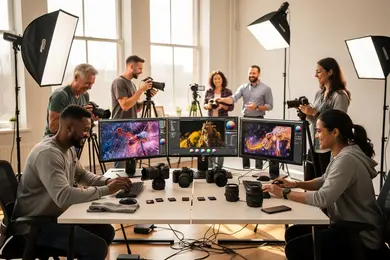
2027 Online Digital Photography Degrees With Camera and Lighting Coursework

Co-Founder and Chief Data Scientist
Choosing an online digital photography degree is harder than comparing camera brands: you need to judge accreditation, studio access, portfolio support, cost, and career fit. The U.S. Bureau of Labor Statistics reported a May 2024 median wage of about $42,500 for photographers, showing that skill, specialization, and business strategy matter.
This guide is for students, career changers, working creatives, and military-affiliated learners who want flexible training in camera technique, lighting, editing, and visual storytelling before investing in a degree.
Key Things You Should Know
- Accredited online photography degrees commonly combine camera operation, studio lighting, digital editing, visual communication, portfolio development, and business coursework rather than focusing only on taking better pictures.
- Cost varies widely: College Board's 2024 pricing data lists average published tuition and fees at about $4,050 for public two-year colleges, $11,610 for in-state public four-year colleges, and $43,350 for private nonprofit four-year colleges.
- BLS employment projections show photographer roles growing modestly from 2024 to 2034, so students should choose programs that build marketable skills in lighting, post-production, branding, video, and client-based portfolio work.
What is an online digital photography degree with camera and lighting coursework?
An online digital photography degree is a college program that teaches students to plan, capture, edit, and present photographic work using digital cameras, lighting equipment, image-editing software, and professional production workflows. The "camera and lighting coursework" part is important because it signals that the program is not limited to art history or visual theory; students practice exposure, lens choice, composition, studio lighting, location lighting, color control, and image output.
These programs are typically offered at the associate, bachelor's, and sometimes master's levels. Associate degrees can support entry-level creative work or transfer into a bachelor's program. Bachelor's degrees usually go deeper into portfolio development, professional critique, creative direction, branding, and business practices. Graduate programs are more specialized and may suit photographers pursuing teaching, fine art, advanced commercial practice, or leadership in creative production.
The right fit depends on the student's goal. A degree may be worth considering if the learner wants structured feedback, a credential, a broad visual arts foundation, and a portfolio reviewed by faculty. A certificate, workshop series, or self-directed path may be more practical for someone who already has a degree, needs only one skill such as lighting or editing, or wants to test the field before committing to a longer program.
The table below compares common photography education paths so readers can match the credential to their goal before looking at schools.
| Path | Best fit | Typical focus | Main trade-off |
| Certificate or nondegree coursework | Beginners, hobbyists, or working creatives adding one skill | Camera basics, lighting, software, or portfolio refresh | Fast and targeted, but may not carry the same academic weight as a degree |
| Associate degree | Students seeking lower-cost entry or transfer preparation | Foundational photography, digital imaging, general education | Shorter and often cheaper, but less time for advanced portfolio development |
| Bachelor's degree | Students pursuing commercial, editorial, fine art, or creative industry roles | Lighting, visual storytelling, critique, art history, business, portfolio | Broader training, but higher total cost and longer completion time |
| Master's degree | Advanced practitioners, educators, or fine-art photographers | Conceptual practice, research, exhibition, teaching preparation | Specialized credential, but usually unnecessary for many entry-level photo jobs |
How do online digital photography programs compare with campus-based options?
Online and campus-based photography degrees can cover the same creative fundamentals, but they deliver practice, critique, equipment access, and networking differently. The best format is not automatically the one with the lowest tuition or the most flexible schedule; it is the one that gives the student enough hands-on production experience for the work they want to do.
Online programs usually work well for students who already have access to a camera, a computer, editing software, and a workable shooting environment. Assignments may ask students to photograph products, portraits, interiors, events, or documentary subjects in their own communities and submit files for critique. Campus programs can be stronger for students who need dedicated studios, lighting labs, darkrooms, equipment checkout, and in-person collaboration.
The comparison below shows the practical differences that matter most when choosing between formats.
| Factor | Online digital photography degree | Campus-based photography degree |
| Schedule | Often better for working adults, caregivers, military students, and students far from campus | Better for students who want a fixed weekly studio routine |
| Lighting practice | Depends on at-home gear, local rentals, school kits, or improvised setups | Often includes access to studio strobes, modifiers, seamless backdrops, and lighting labs |
| Feedback | Usually delivered through video critique, annotated files, discussion boards, and live sessions | Often delivered through in-person critiques and studio reviews |
| Networking | Requires more intentional outreach to local clients, online communities, and faculty | May offer easier peer collaboration, campus exhibitions, and local industry events |
| Cost control | Can reduce relocation and commuting costs, but equipment costs still matter | May include higher living or transportation costs, but campus gear access can offset purchases |
Students comparing online degrees across fields should also notice how hands-on requirements differ by discipline. For example, an online animal science bachelor degree may require labs, field experiences, or local placements, while photography programs usually rely on project-based image production, critique, and portfolio evidence.
Choose online if flexibility is essential and you can create or access shooting conditions outside campus. Choose campus if you need intensive studio access, in-person critique, or access to expensive shared equipment. A hybrid option can be ideal when a program offers online academics plus short residencies, campus studio weekends, or local internship opportunities.
Which accredited schools offer online digital photography degrees in the United States?
Several U.S. institutions offer online photography-related degrees, but availability, program titles, delivery formats, and admissions policies can change. Students should confirm current details directly with the school, verify institutional accreditation, and review whether the curriculum includes the specific camera, lighting, editing, and portfolio work they need.
The table below lists examples of accredited U.S. schools with online photography or closely related digital photography degree options. It is not a ranking; it is a starting point for comparison.
| School | Example online photography-related option | Institutional accreditation | What to verify before applying |
| Southern New Hampshire University | BA in Digital Photography | New England Commission of Higher Education | Portfolio expectations, software requirements, transfer credit policies, and course sequence |
| Arizona State University | Online art or digital photography-related bachelor's study through ASU Online offerings | Higher Learning Commission | Whether the current catalog option is photography-specific and how studio work is completed remotely |
| Academy of Art University | Online photography degrees at undergraduate and graduate levels | WASC Senior College and University Commission | Total cost, equipment requirements, critique format, and graduation outcomes |
| Savannah College of Art and Design | Online photography degrees through SCADnow offerings | Southern Association of Colleges and Schools Commission on Colleges | Residency expectations, portfolio development, equipment access, and professional networking support |
| Dakota College at Bottineau | Photography-related associate study with online delivery options | Higher Learning Commission | Transferability to a bachelor's program and how technical photo assignments are supported |
Accreditation matters because it affects credit transfer, federal financial aid eligibility, and employer confidence. Institutional accreditation is the baseline. Programmatic accreditation is less common in photography than in fields such as nursing, teaching, or engineering, so students should focus on institutional accreditation, faculty qualifications, student work, portfolio support, and transparent costs.
Before shortlisting a school, look beyond the program name. "Digital photography," "photography," "visual arts," "graphic design with photography electives," and "digital media" can lead to different outcomes. A student who wants studio portrait or product photography should not choose a program that offers only one introductory photography elective inside a broader design degree.
What camera, lighting, and studio courses are typically included in the curriculum?
Digital photography programs usually combine technical execution, visual theory, critique, software skills, and professional practice. Camera and lighting courses are central because they teach students to control the image before editing instead of relying entirely on post-production.
Students should review course descriptions carefully because two programs with similar titles can differ substantially. A strong curriculum usually includes the following categories of coursework:
- Camera fundamentals: manual exposure, aperture, shutter speed, ISO, metering, autofocus systems, lenses, focal length, depth of field, and file formats.
- Digital imaging and workflow: RAW processing, color management, non-destructive editing, retouching, image archiving, output preparation, and software-based workflow.
- Studio lighting: strobes, continuous lights, light meters, key and fill light, modifiers, reflectors, flags, backgrounds, and controlled studio setups.
- Location lighting: portable flash, ambient-light balancing, mixed color temperatures, environmental portrait lighting, and practical problem-solving in uncontrolled spaces.
- Portrait and product photography: posing, subject direction, styling, tabletop lighting, reflective surfaces, texture, scale, and client-oriented image requirements.
- Visual storytelling: sequencing, documentary methods, editorial planning, narrative structure, visual ethics, and image selection.
- Portfolio and professional practice: artist statements, brand identity, client communication, pricing concepts, contracts, copyright basics, website presentation, and career planning.
Many programs also include art history, design principles, typography, motion media, video production, or digital marketing electives. These courses can be valuable because photographers increasingly work in mixed-media environments where still images, short-form video, social content, and brand storytelling overlap.
A useful way to evaluate a curriculum is to ask whether assignments simulate real production constraints. Strong projects require students to plan shoots, control light, meet a visual brief, revise after critique, and present finished work for a defined audience. Weak programs may overemphasize software tutorials without enough original shooting, critique, or portfolio development.
What admission requirements and portfolio expectations do online photography programs have?
Admission requirements depend on degree level and selectivity. Many associate and bachelor's programs are accessible to first-time college students, while more selective art schools may ask for creative samples, statements of purpose, or prior college work. Graduate programs usually expect a stronger portfolio and a clearer creative direction.
Most online photography programs ask applicants to provide academic and identity materials first. The following items are commonly required, although each school sets its own policies:
- High school diploma, GED, or official college transcripts for transfer applicants.
- Application form and any required application fee or fee waiver request.
- Proof of English proficiency for applicants whose prior education was not in English.
- Personal statement, creative statement, or short essay explaining educational and career goals.
- Portfolio or sample images for programs that use creative review in admissions or placement.
- Technology readiness, including access to a camera, computer, reliable internet, and required editing software.
Portfolio expectations vary more than many applicants expect. Some programs use portfolios mainly to award credit, place students into the right course level, or evaluate scholarship eligibility. Others use portfolios as a major admissions factor. Beginning students should not assume they need a polished commercial portfolio, but they should submit work that shows intentional composition, control of light, curiosity, and willingness to revise.
Applicants can strengthen a beginner portfolio by following a practical sequence before applying:
- Review the school's exact portfolio instructions, including image count, file size, subject restrictions, and statement requirements.
- Select images that show variety, such as portrait, still life, documentary, landscape, and controlled-light experiments.
- Remove repetitive images, even if they are technically strong, because reviewers want range and decision-making.
- Write concise descriptions that explain the goal of the image, the lighting approach, and any revision process.
- Ask a teacher, working photographer, or admissions counselor to review the portfolio before submission.
Common mistakes include submitting only social-media favorites, over-editing images to hide technical weaknesses, ignoring file instructions, or choosing a program without understanding its creative emphasis. A portfolio should show potential and seriousness, not just expensive equipment.
How long do online digital photography degrees take, and what do they cost?
Program length depends on credential level, transfer credit, course load, and whether the student studies full time or part time. An associate degree commonly takes about two years of full-time study, while a bachelor's degree generally takes about four years for first-time students. Transfer students with prior credits may finish faster, especially if the school accepts general education, studio art, or digital media coursework.
Cost should be evaluated as total cost of attendance, not tuition alone. College Board's 2024 pricing report lists average published tuition and fees of about $4,050 at public two-year colleges, $11,610 for in-state students at public four-year colleges, and $43,350 at private nonprofit four-year colleges for the 2024-25 academic year. Online students may avoid room and board relocation costs, but they still need to budget for equipment, software, books, fees, and portfolio production.
The table below summarizes cost categories students should compare before enrolling.
| Cost category | What it may include | Why it matters |
| Tuition and required fees | Per-credit tuition, technology fees, online course fees, graduation fees | This is the largest visible cost, but not always the full cost |
| Camera and lens gear | Camera body, lenses, memory cards, batteries, tripod, storage drives | Some programs allow starter gear; others expect more advanced equipment |
| Lighting equipment | Speedlights, strobes, continuous lights, modifiers, stands, reflectors | Lighting courses may require controlled setups outside campus |
| Software and computing | Editing software, calibrated monitor, computer upgrades, backup storage | Digital workflow can be limited by underpowered hardware |
| Portfolio and production | Website, prints, exhibition materials, model fees, props, travel to shoots | Career readiness often depends on polished presentation |
Students comparing creative graduate programs may find it useful to study cost breakdowns from adjacent online fields, such as MS in digital marketing degree cost tuition fees, because the same principles apply: compare tuition, fees, time to completion, employer value, and realistic earning potential rather than choosing on sticker price alone.
To control costs, ask schools about transfer credits, credit for prior learning, equipment loan programs, used gear policies, military or employer tuition benefits, institutional scholarships, and whether software is included through a student license. The cheapest program is not always the best value if it lacks serious critique, portfolio support, or industry-relevant assignments.
What careers can graduates of online digital photography programs pursue?
Graduates of online digital photography programs may pursue creative roles in commercial photography, portraiture, product imaging, media production, digital content, visual marketing, and fine art. A degree can support the path, but the portfolio usually carries the most weight with clients and creative employers.
The table below connects common career directions with the type of work students should prepare to show in a portfolio.
| Career direction | Typical responsibilities | Portfolio evidence that helps |
| Portrait photographer | Photograph individuals, families, graduates, professionals, or performers | Consistent skin tones, posing skill, lighting control, client-ready galleries |
| Commercial or product photographer | Create images for brands, catalogs, ecommerce, packaging, or advertising | Clean product lighting, texture control, reflective-surface handling, visual consistency |
| Editorial or documentary photographer | Cover people, places, events, communities, or visual stories | Strong sequencing, captions, ethical storytelling, environmental portraits |
| Digital content creator | Produce still images and short-form visual assets for web, social, and campaigns | Brand-aware image sets, motion clips, platform-ready crops, fast turnaround work |
| Photo editor or retoucher | Select, edit, correct, retouch, and prepare images for publication or clients | Before-and-after edits, color consistency, natural retouching, organized workflow |
| Studio assistant or digital tech | Support photographers on set, manage files, test lighting, and handle equipment | Technical reliability, tethered capture experience, lighting diagrams, production notes |
Some graduates are self-employed, while others work for studios, agencies, media companies, retailers, universities, museums, hospitals, real estate firms, or in-house marketing teams. Self-employment can provide creative freedom, but it also requires pricing, contracts, client acquisition, bookkeeping, insurance, and consistent delivery.
A smart career plan starts before graduation. Students should build a focused portfolio, assist established photographers, document lighting setups, learn basic business practices, and create a simple website that shows a clear specialty. Employers and clients rarely hire based on a transcript alone; they want proof that the photographer can solve real visual problems reliably.
What salary ranges and earning potential exist for digital photography professionals?
Photography earning potential varies widely because the field includes salaried jobs, freelance contracts, studio ownership, seasonal work, licensing, retouching, assisting, and hybrid content roles. The BLS reported a May 2024 national median annual wage of about $42,500 for photographers, but that figure does not capture every revenue model or specialization.
The table below gives salary context for photography and adjacent creative roles using national median wage information reported by federal labor data. Readers should treat these figures as benchmarks, not promises.
| Role category | Approximate national median wage context | How to interpret it |
| Photographers | About $42,500 | Represents the broad occupation, including varied industries and experience levels |
| Graphic designers | About $61,000 | Relevant for photographers who combine images with layout, branding, and visual design |
| Film and video editors and camera operators | About $70,000 | Relevant for photographers who add motion, editing, and production skills |
| Art directors | Above $110,000 | Usually requires substantial experience, leadership ability, and a strong creative portfolio |
Several factors influence income more than the degree title alone. Location, specialization, client base, portfolio quality, business skills, speed, reliability, and ability to work across still photography, video, and digital campaigns can all affect earnings. Commercial product, corporate, event, and specialized technical photography may pay differently from fine-art or early-stage freelance work.
Students should evaluate return on investment conservatively. A photography degree may be a better investment when it helps the student build a portfolio, gain critique, access internships, develop business skills, and avoid years of trial-and-error. It may be a weaker investment if the student takes on high debt without a clear specialty, paid work strategy, or transferable creative skills.
How is the job outlook for digital photographers and related creative roles?
The job outlook for photographers is competitive but not stagnant. BLS employment projections for 2024 to 2034 show modest growth for photographers, with openings also shaped by retirements, career changes, and freelance demand. The key takeaway is that students should not rely on the degree alone; they need a portfolio and a flexible skill set.
Several trends are shaping photography work. Smartphones and computational photography have raised expectations for quick, polished images. Generative AI has changed parts of concept development, retouching, background creation, and visual experimentation. At the same time, clients still need original images of real people, products, places, events, and branded experiences.
Students who want to stay competitive should build skills that remain useful as tools change. These include:
- Controlled lighting, because original capture quality still separates professional work from casual image-making.
- Ethical editing and transparency, especially when images are used in journalism, documentary, healthcare, education, or public communications.
- Video and motion basics, because many clients now expect short-form content alongside still images.
- Digital asset management, including file naming, backups, metadata, and delivery workflows.
- Client communication, project planning, estimating, and revision management.
For students who are more interested in building or managing the technology behind machine learning and creative automation, online AI degree programs may be a more direct route than a photography degree. For photography students, the practical goal is not to ignore AI but to understand where it helps and where authentic capture, lighting judgment, and client trust still matter.
How can students choose a reputable online digital photography program?
Choosing a reputable online digital photography program requires more than scanning tuition and course titles. The strongest programs align accreditation, curriculum, faculty feedback, equipment expectations, portfolio development, and career support with the student's goal.
Use the following steps to compare programs in a practical order:
- Verify institutional accreditation through recognized accreditation databases or the school's accreditor listing.
- Read the full curriculum and confirm that camera, lighting, editing, critique, portfolio, and professional practice courses are required rather than optional.
- Ask how online lighting assignments work, including whether students need to buy equipment, rent locally, or use recommended starter kits.
- Review student portfolios, exhibitions, or capstone examples to judge the level of work the program helps students produce.
- Compare total cost, including tuition, fees, software, gear, computer requirements, and portfolio expenses.
- Ask about transfer credits, military benefits, employer tuition assistance, scholarships, and part-time pacing.
- Confirm career support, including internship guidance, portfolio reviews, alumni networking, and freelance business preparation.
Military-affiliated learners should pay special attention to transfer credit, deployment flexibility, tuition assistance rules, and veteran support services. A dedicated guide to an online photography degree for military veterans can help compare benefits and support structures before enrolling.
Red flags include unclear accreditation, pressure-heavy admissions calls, vague equipment requirements, no faculty critique process, limited student work samples, poor transfer transparency, and promises of specific earnings. Photography outcomes depend heavily on portfolio quality, market conditions, business execution, and specialization, so reputable schools should describe support honestly rather than guaranteeing results.
A good final test is simple: after reading the catalog and speaking with admissions, can you explain exactly what you will learn, what equipment you need, how much the program will cost, what portfolio pieces you will produce, and how the school will support your next career step? If not, keep asking questions or compare another program.
Other Things You Should Know About Digital Photography
Not always. Some beginner courses accept an entry-level DSLR or mirrorless camera with manual controls. However, students should confirm exact camera, lens, lighting, computer, and software requirements before enrolling because advanced courses may require more capable equipment.
Some schools include student access to editing software, while others expect students to purchase or subscribe on their own. Ask whether software is bundled into fees, discounted through the school, or required as a separate expense.
In 2027, most online digital photography degree programs do not provide camera equipment. Students are typically required to own a DSLR or mirrorless camera with manual controls. Personal investment in such equipment ensures students match program coursework demands focused on camera handling and lighting techniques.
Most programs require JPEG and RAW submissions, with full-resolution originals kept for critiques and portfolio review. Common class standards include 300 ppi for print work and sRGB color space for web delivery. Many instructors also ask for clearly labeled files and metadata embedded in each image.
References
- Best Online Photography Courses For Beginners? (2022 Review) https://howtotakegoodphotos.com/best-online-photography-courses/
- Current Issue https://www.thehighereducationreview.com/jobs-and-careers/news/best-online-photography-schools-nid-1203.html
- Which one is more beneficial online photography courses or offline photography courses? https://www.careers360.com/question-which-one-is-more-beneficial-online-photography-courses-or-offline-photography-courses
- The Photography Institute https://www.thephotographyinstitute.com/us/en/blog-salary
- Lighting Curriculum - Filmskills Academic https://www.filmskills-academic.com/lighting-curriculum/
- Photography | OCADU https://admissions.ocadu.ca/program/photography
- College Certificate vs Online Photography School | Cameraderie https://cameraderie.org/threads/college-certificate-vs-online-photography-school.56322/
- Photographers: Salary, career path, job outlook, education and more - RaiseMe https://www.raise.me/careers/media-and-communication/photographers/
- Top 10 Career Options After a Photography Course | SSVAP Pne https://www.ssvap.edu.in/blog/top-10-career-options-after-completing-a-photography-course
- Cinematography: Introduction to Lighting and Camera Work https://www.tlu.ee/en/tuitions/cinematography-introduction-lighting-and-camera-work