2027 AI Master's Degrees in New York: Best Options

Co-Founder and Chief Data Scientist
Transitioning into the field of artificial intelligence can be daunting for professionals with unrelated undergraduate degrees seeking advanced expertise. Many face challenges locating accredited programs in New York that offer flexibility while maintaining rigorous academic standards. Navigating options without clear guidance wastes time and resources, delaying career shifts into this rapidly evolving industry. This article highlights the best 2027 AI master's degrees in New York that cater to diverse backgrounds and emphasize practical skills. It aims to help readers identify programs combining flexibility, accreditation, and industry relevance to facilitate a successful pivot into artificial intelligence careers.
Key Things You Should Know
- New York offers diverse AI master's programs with strong industry ties, including Columbia University and NYU, emphasizing machine learning, data science, and ethical AI deployment.
- These programs typically require 30-36 credits and blend theoretical foundations with practical labs, preparing graduates for roles in tech, finance, and healthcare.
- Job growth for AI-related roles is projected at over 35% through 2030 in New York, driven by high demand in startups and corporate innovation hubs.
What are the best AI master's degree programs offered by universities in New York?
New York hosts some of the best AI master's degree programs in New York universities, led by Columbia University and New York University (NYU). Columbia's Master of Science in Computer Science with a specialization in machine learning and AI combines rigorous coursework with cutting-edge research opportunities. Students have direct access to faculty involved in pioneering AI projects funded by the National Science Foundation and major tech companies. NYU's Master of Science in Data Science offers an AI concentration featuring deep learning, natural language processing, and computer vision. Its link to the Courant Institute of Mathematical Sciences ensures a strong foundation in applied mathematics, crucial for AI innovation.
Rensselaer Polytechnic Institute (RPI) also offers a highly respected Master of Science in Artificial Intelligence program that emphasizes robotics and cognitive systems alongside traditional machine learning topics. The program's strong industry partnerships facilitate valuable internships with leading AI firms in New York's growing tech sector. These top New York universities offering master's in artificial intelligence provide students with varied strengths: Columbia focuses on theoretical grounding and research, NYU suits those interested in data-driven AI applications, and RPI prioritizes robotics and practical AI integration.
Tuition ranges from $30,000 to over $60,000 per year, reflecting program prestige and resources. According to the New York State Department of Labor, AI-related occupations are projected to grow at 22% through 2030, signaling robust demand for graduates. Applicants should review graduation rates, faculty-to-student ratios, and AI subfields to align with career goals. Hands-on experience and access to research centers significantly enhance employability in the competitive New York tech market, and for those looking to accelerate their studies, a one year computer science degree can be an efficient option.
What are the admission requirements and prerequisites for AI master's programs in New York?
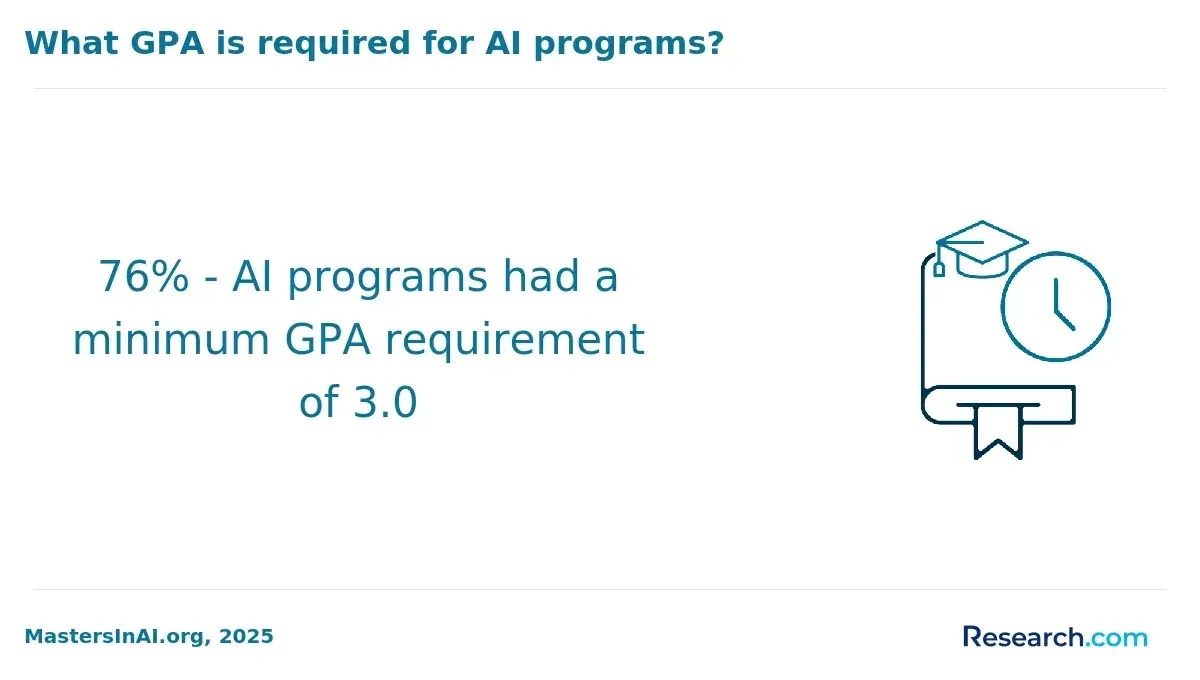
Admission requirements for AI master's programs in New York generally include a bachelor's degree in computer science, engineering, mathematics, or a related field. Applicants are expected to have completed coursework in programming, algorithms, data structures, linear algebra, and probability. For instance, New York University's program requires proficiency in Python or Java alongside foundational courses in calculus and statistics. Many programs also request GRE scores, though some have made this optional; competitive quantitative scores usually surpass the 75th percentile.
Prerequisites for pursuing an AI master's degree in New York involve submitting two or three letters of recommendation from academic or professional sources familiar with the applicant's technical skills. A statement of purpose outlining research interests and career goals is mandatory, emphasizing alignment with AI study. Relevant work experience in software development, data analysis, or machine learning can enhance applications, but is not always required.
Some programs offer conditional admission to candidates with non-traditional backgrounds if prerequisite courses in programming or mathematics are completed. International students must submit TOEFL or IELTS scores to demonstrate English proficiency. Admission committees increasingly value demonstrated skills through AI-related projects, coding competitions, or publications. According to the National Center for Education Statistics, a 74% increase in AI-related master's enrollment between 2020 and 2023 has intensified competition.
Prospective students should ensure a strong technical foundation and practical experience to boost admissions prospects. Exploring the data science master US ranking can also aid in choosing the right program within the region.
How do online and campus-based AI master's degrees in New York compare in format and flexibility?
Online AI master's degrees in New York offer greater format flexibility than campus-based options, allowing learners to balance studies with work or personal life. These programs often use asynchronous lectures, giving students access to coursework at any time. For example, Columbia University provides online AI master's degrees with part-time options, enabling completion over two to three years instead of a fixed two-year on-campus schedule.
By contrast, campus-based programs require physical attendance for lectures, labs, and seminars, typically full-time, offering hands-on experiences with advanced equipment and direct faculty interaction. This rigid schedule benefits those who prefer a traditional academic environment and want on-site networking opportunities. This comparison of New York AI master's degree delivery methods highlights distinct advantages of each format.
Students considering online programs must evaluate their self-discipline and time management skills, as these formats rely heavily on independent study. Campus programs, while less flexible, foster structured learning and immediate peer collaboration. Financial factors also differ: online degrees may reduce commuting and relocation costs, though tuition tends to be comparable. Many New York AI programs require prerequisites like a bachelor's in computer science or math and proficiency in programming languages such as Python. Admission data shows about 65% of AI master's students in New York choose part-time or online formats to maintain employment during their studies. Additionally, those interested in related fields might explore options such as a game art degree online.
Ultimately, online programs excel in accessibility and adaptability, fitting for working professionals and remote learners. Campus-based degrees deliver immersive, resource-rich experiences favored by recent graduates aiming for deep academic engagement. Candidates should align their choice with their learning style, career stage, and personal schedule. Choosing between online vs campus-based AI master's programs in New York flexibility and format can greatly impact student success.
What is the typical curriculum and coursework structure in New York AI master's programs?
The typical curriculum for AI master's programs in New York combines core theoretical foundations with applied coursework and hands-on projects. Students usually begin with advanced mathematics such as linear algebra, probability, and statistics, essential for machine learning algorithms and data modeling. Core topics include machine learning, natural language processing, computer vision, and robotics, often supported by programming in Python or R. This coursework structure of New York AI master's degrees usually spans 30 to 36 credit hours, blending lectures, labs, and research components.
Coursework also covers data structures, algorithms, and optimization techniques to build a strong computational background. Many programs offer electives allowing specialization in ethical AI, deep learning, reinforcement learning, or AI applications in healthcare and finance. Several institutions emphasize experiential learning through capstone projects, internships, or industry collaborations to help students apply AI theories practically and improve job readiness.
Admission is competitive, with average GRE quantitative scores for computer science and AI master's programs around 163 out of 170; top-tier programs often require scores above 165. Prospective students should carefully review course offerings and prerequisites to ensure alignment with career goals and adequate preparation in quantitative skills. For those considering further education, it's helpful to compare options such as the cheapest online phd in cyber security as part of broader career planning.
How long do AI master's degrees take to complete, and what is the average cost in New York?
AI master's degrees in New York typically require 18 to 24 months to complete, with full-time students finishing in roughly two years. Part-time and online students often take up to three years, thanks to scheduling flexibility. Traditional campus programs, such as those at Columbia or NYU, usually require 30 to 36 credits over four semesters. In contrast, online options allow students to learn at their own pace, benefiting working professionals who need more flexible timelines.
Tuition costs vary widely, generally ranging from $30,000 to over $60,000. Public universities tend to offer more affordable rates near $30,000, while private institutions in New York City often exceed $50,000. Additional fees for technology, labs, and administration can add several thousand dollars. Onsite programs also involve living expenses and material costs that students should factor into their budgets.
Online AI master's degrees can be more cost-effective by eliminating commuting, housing, and campus fees. However, campus programs provide valuable access to research labs, networking opportunities, and direct mentorship, which may justify higher expenses for some.
According to data from the New York State Education Department, flexibility remains a key factor: online programs frequently use asynchronous classes that help students balance full-time work, while campus-based courses follow stricter schedules. This difference impacts both program length and overall cost.
What career roles and job titles are available to AI master's graduates in New York?
Graduates with a master's degree in artificial intelligence in New York can access diverse career opportunities across the region's growing tech and finance sectors. Popular roles include AI engineer, machine learning specialist, data scientist, and natural language processing engineer. Many also work as computer vision engineers or robotics specialists, especially in companies dedicated to automation and advanced manufacturing. AI research and development positions are common within universities and tech startups seeking innovation.
AI consultants and solutions architects apply AI to optimize business processes in finance, healthcare, and media industries. Growing demand for AI project and product managers reflects the need for leadership that blends technical expertise with strategic vision as organizations integrate AI into daily workflows.
The finance sector hires graduates for quantitative analyst and algorithmic trader roles, using AI to improve predictive analytics. Healthcare employers increasingly seek AI professionals for bioinformatics and medical imaging analysis, demonstrating the degree's broad applicability.
Online master's degree enrollment shows a 13% year-over-year increase, with STEM fields accounting for 31% of such graduate education (National Student Clearinghouse Research Center, 2024). This rise highlights expanding access to STEM education and growing competition for AI roles.
Graduates should focus on in-demand skills like applied machine learning, data engineering, and AI ethics. Networking within New York's AI hubs and obtaining certifications in emerging technologies can enhance career prospects and advancement.
What is the salary potential and job outlook for AI master's degree holders in New York?
Master's degree holders in artificial intelligence in New York benefit from attractive salaries and ample job opportunities due to the state's dynamic tech environment. The U.S. Bureau of Labor Statistics reports a median annual wage near $131,490 for computer and information research scientists nationally, many of whom specialize in AI. In New York, salaries are typically higher because of living costs and strong demand across finance, healthcare, and technology sectors. Entry-level graduates usually earn between $90,000 and $110,000, while experienced professionals can see salaries from $140,000 to $180,000.
The New York State Department of Labor forecasts a 23% growth in computer and information research jobs from 2022 to 2032, well above average. This growth is driven by AI's expanding role in cybersecurity, natural language processing, and autonomous systems. Mastery of tools like TensorFlow or PyTorch enhances employability.
AI roles range from research scientist and machine learning engineer to AI product manager and data scientist. Employers value master's programs that emphasize hands-on projects, internships, and experience with real datasets. Practical skills and networking within New York's vibrant AI communities and tech meetups further improve career prospects.
Which AI master's programs in New York are regionally and nationally accredited?
Several master's programs in artificial intelligence based in New York hold respected regional and national accreditation, which guarantees recognized standards and broad acceptance in academia and the professional world. Key regionally accredited schools include Columbia University, New York University (NYU), and the State University of New York (SUNY) system. Columbia's Master of Science in Artificial Intelligence and NYU's Master of Science in Data Science with an AI specialization are accredited by the Middle States Commission on Higher Education, the official regional accreditor for New York. SUNY's AI-related degrees also maintain regional accreditation across campuses.
National accreditation often supports regional credentials, especially for STEM-focused programs. For example, ABET (Accreditation Board for Engineering and Technology) accreditation may apply to programs with strong engineering or technology components, enhancing program credibility. While many AI-specific degrees are still evolving, related computer science and data science programs include essential courses in machine learning and deep learning. The ACM Computing Curricula 2024 Report states 89% of AI master's programs integrate these courses, up from 64% in 2021, demonstrating a curricular shift toward industry standards.
Prospective students should verify accreditation via authoritative sources like the U.S. Department of Education's Database of Accredited Postsecondary Institutions and Programs. Reviewing a program's curriculum and faculty expertise is also crucial to ensure alignment with current industry demands, focusing on key AI elements such as neural networks and advanced algorithms.
What professional certifications or credentials complement an AI master's degree in New York?
Professional certifications greatly enhance the value of an AI master's degree in New York by validating specialized skills and improving job competitiveness. The Certified Artificial Intelligence Practitioner (CAIP) stands out for its focus on practical AI deployment and ethics, catering to graduates seeking leadership roles in AI-driven projects. Meanwhile, the TensorFlow Developer Certificate highlights proficiency in building AI models with TensorFlow, a leading open-source framework, which is especially beneficial for those pursuing machine learning engineering positions.
Complementing AI degrees, Data Science certifications such as the Certified Data Scientist from the Data Science Council of America (DASCA) expand expertise in data analytics and handling, essential for AI applications across sectors. Cloud computing certifications from AWS, Microsoft Azure, and Google Cloud-for example, the AWS Certified Machine Learning - Specialty-equip professionals to deploy AI models in scalable environments, a crucial skill within New York's dynamic tech landscape.
AI master's programs in New York usually take 18 to 24 months and cost between $40,000 and $70,000 based on recent academic data. Adding certifications may extend study time but can increase salaries by 10-20%, making the investment worthwhile. Leading institutions like NYU and Columbia often recommend combining formal degrees with professional credentials to optimize career growth in AI.
How should prospective students evaluate and choose a reputable AI master's program in New York?
Prospective students should carefully evaluate a program's curriculum to ensure it covers essential AI topics such as machine learning, natural language processing, robotics, and ethics. Programs offering hands-on projects, internships, or industry partnerships provide valuable practical experience that enhances career readiness. Reviewing faculty expertise and their research contributions also helps gauge program quality.
Cost varies widely, with master's programs in New York State typically ranging from $58,000 to $120,000 for total attendance. Private universities average around $95,000 for two years. It's important to weigh the return on investment, including services like career support and alumni outcomes, since higher costs don't always equate to better opportunities.
Accreditation and reputation affect employer recognition. Confirming regional accreditation and endorsements from relevant professional bodies helps ensure a program's credibility. Graduation rates and job placement statistics provide further insight into student success.
Flexibility in course delivery-such as part-time, evening, or online formats-benefits working professionals. Specialized tracks in fields like deep learning or AI ethics allow tailoring education to specific career goals. Networking opportunities through career fairs, seminars, and local tech hubs foster professional growth and direct industry connections, a key advantage of programs in New York.
Other Things You Should Know About Artificial Intelligence
Many New York AI master’s programs do not require the GRE, and several state that it is optional or waived for applicants with strong academic records. When the GRE is required, programs usually ask for recent scores submitted with transcripts, recommendation letters, and a statement of purpose.
International students must demonstrate English language proficiency, typically via tests like TOEFL or IELTS. Most New York AI master's programs require a TOEFL score of at least 90 or an IELTS score of 6.5, although specific requirements may vary by institution.
AI master's programs in New York in 2027 include courses on AI ethics, covering topics such as bias in algorithms, transparent decision-making, and privacy concerns. These courses aim to equip students with skills to responsibly address the ethical implications of AI technologies.
In 2027, AI master's programs in New York offer specializations in fields like natural language processing, robotics, and machine learning. Notably, some programs feature an AI and finance master’s program, integrating finance-specific AI skills to meet industry needs.
References
- Top 10 Careers You Can Pursue With an Online Master’s in AI https://www.ucumberlands.edu/blog/careers-you-can-pursue-with-an-online-masters-in-ai
- Artificial Intelligence Certificate Programs - MastersInAI.org https://www.mastersinai.org/degrees/ai-certificate-programs/
- Choosing a master’s degree: data science or artificial intelligence | edX https://www.edx.org/resources/choosing-a-masters-degree-data-science-or-artificial-intelligence
- The Best AI & Machine Learning Certifications for 2024 | New York Computer Help https://www.newyorkcomputerhelp.com/the-best-ai-machine-learning-certifications-for-2024/
- M.S. in Artificial Intelligence (AI) | Yeshiva University https://www.yu.edu/katz/ai
- Finding Your Dream Master's Program in AI | Towards Data Science https://towardsdatascience.com/finding-your-dream-masters-program-in-ai-17f525c89151/
- 3 Best Artificial Intelligence (Ai) courses In New York 2026 https://www.hotcoursesabroad.com/study/training-degrees/new-york/artificial-intelligence-ai-courses/loc/49/cgory/cb.31-4/sin/ct/programs.html
- New York City, US's best Artificial Intelligence (AI) colleges [Rankings] https://edurank.org/cs/ai/new-york/
- How to Find the Best Online MS in AI | University of Bridgeport https://www.bridgeport.edu/news/best-online-ms-ai-degree/
- 11 Best AI Certifications in 2025 to Deepen Your Technical Knowledge | DigitalOcean https://www.digitalocean.com/resources/articles/ai-certifications