
2027 What Is the Average Cost of a Master’s Degree?

Co-Founder and Chief Data Scientist
Deciding whether to earn a master’s degree is partly an academic choice and partly a financial one. Graduate school can deepen your expertise, help you qualify for specialized or leadership roles, and improve long-term career mobility, but the cost of a master’s degree can also create debt that takes years to repay. In 2024, 864,457 college graduates earned master's degrees, and projections show that there will be around 1,000,460 master’s degree recipients by 2031–2032 (Hanson, 2025; Statista, 2025). This guide explains what master’s programs usually cost, why prices vary, how online and accelerated options compare, what financial aid can reduce your bill, and how to evaluate whether the degree is likely to be worth it for your goals.
How much does a master’s degree cost? Quick answer
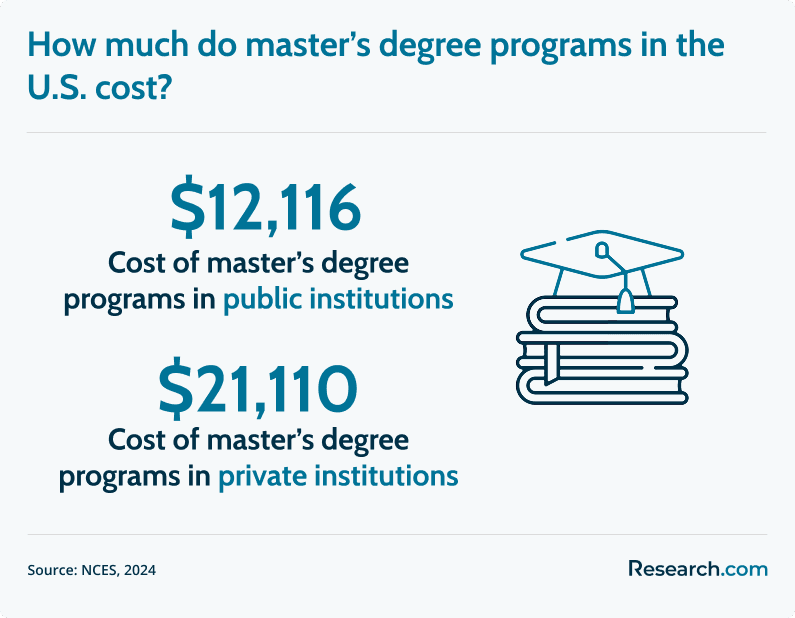
The cost of a master’s degree depends on the institution, program, residency status, enrollment pace, delivery format, and available aid. According to National Center for Education Statistics data, the average tuition and fees for graduate students in 2024-25 were $12,116 in public institutions and $21,110 in private institutions. Those figures do not necessarily include books, technology, transportation, housing, lost income, professional fees, or loan interest, so students should calculate total cost of attendance rather than tuition alone.
What are the main benefits of earning a master’s degree?
- Deeper field expertise: A master’s program can help you build advanced knowledge in a focused discipline and compete for roles that require specialized training.
- Stronger earning potential: Graduates with master’s degrees often earn more, at around $1,840 each week.
- More advancement options: Some management, clinical, research, technical, and education roles either require a graduate credential or strongly prefer one.
Affordable Quick Online Master’s Degree Programs with High Acceptance Rates
If your goal is to reduce master’s degree costs, program choice matters as much as school choice. Some fields lead to regulated careers with strict licensure requirements, while others are more flexible and employer-driven. The options below are commonly pursued online and may appeal to students looking for a balance of career relevance, accessibility, and cost control.
Nursing
A master’s degree in nursing is designed for registered nurses who want advanced clinical, administrative, or specialized practice preparation. Coursework commonly covers advanced assessment, pharmacology, healthcare policy, leadership, and evidence-based care. Depending on the track, graduates may pursue roles such as nurse practitioner, nurse anesthetist, nurse educator, or nurse leader, but students should verify state licensure and clinical placement requirements before enrolling.
Computer Science
A master’s in computer science can help students move into advanced software, data, cybersecurity, systems, or artificial intelligence roles. Programs typically emphasize algorithms, programming, software engineering, data analytics, cybersecurity, and emerging technologies. This path is often best for learners who already have technical foundations or are willing to complete prerequisite coursework before beginning graduate-level study.
Healthcare Administration
Healthcare administration programs prepare students for management responsibilities in hospitals, clinics, health systems, insurance organizations, and public health settings. Courses often focus on healthcare finance, operations, policy, compliance, workforce management, and strategic planning. This option may be a better fit for students who want to lead systems and teams rather than provide direct clinical care.
Management
A master’s in management builds broad leadership, operations, project management, organizational behavior, and strategy skills. Graduates may apply the credential in areas such as consulting, business analysis, risk management, banking, operations, or project leadership. It can be useful for early- or mid-career professionals who want management training without the broader structure of an MBA.
Management Information Systems
A master’s in management information systems connects business strategy with technology implementation. Students study information systems design, enterprise data management, business processes, problem-solving, and IT leadership. Common career directions include systems analyst, IT manager, network administrator, computer technician, and technology operations roles.
Special Education
A special education master’s degree is built for educators who want advanced preparation in inclusive instruction, behavior support, special education law, assessment, and services for students with diverse learning needs. Graduates may pursue special education teaching, instructional coordination, or behavior-focused roles. Because education licensure rules vary, applicants should confirm whether the program meets their state’s requirements.
Economics
A master’s in economics develops graduate-level skills in quantitative analysis, economic theory, policy evaluation, consulting, and research. Students may study econometrics, statistics, accounting, public economics, and government policies related to economics. Career paths can include business consulting, financial analysis, financial planning, actuarial work, and policy-related roles.
Social Work
A master’s in social work prepares students for advanced practice with individuals, families, communities, and organizations. Programs often include counseling, advocacy, social justice, program management, communication, and problem-solving. Graduates may work as clinical social workers, child welfare specialists, victim advocates, or social services managers, but clinical licensure requirements should be checked carefully before enrollment.
Accounting
A master’s in accounting strengthens preparation in auditing, financial reporting, taxation, forensic accounting, fraud examination, accounting systems, and management communication. Many students use this degree to prepare for CPA eligibility or auditing roles. Because CPA requirements vary by jurisdiction, students should confirm whether a program’s credits align with the rules where they plan to practice.
Business Administration
An MBA gives students broad training in business leadership, strategy, finance, marketing, operations, human resources, and entrepreneurship. Graduates may pursue roles such as consultant, brand manager, HR manager, executive leader, chief officer, or business owner. The MBA is often most valuable when the curriculum, network, and career services match the student’s target industry.
- Average tuition costs for master’s degree programs
- Factors that cause tuition differences across universities
- How residency status changes graduate school costs
- Financial aid options for master’s students
- How often graduate students use loans
- Part-time versus full-time master’s degree costs
- Online versus on-campus master’s program costs
- Unexpected costs to include in your budget
- Pros and cons of joint degree programs for cost efficiency
- Open-enrollment online colleges and affordable master’s options
- Qualitative factors that affect degree value
- How to evaluate master’s degree ROI
- Ways to lower the cost of graduate school
- Whether a master’s degree remains competitive in a changing job market
- Employer benefits and tax incentives
- How long repayment may take
- Accelerated associate degrees as a stepping stone
- Traditional and alternative master’s formats
- Doctoral degrees as an alternative path
- Accelerated online bachelor’s degrees and early cost savings
- Alternative financing options
- How accelerated master’s programs reduce time and costs
What are the average tuition costs for master’s degree programs?
National Center for Education Statistics data show that the average tuition and fees for graduate students in 2024-25 were $12,116 in public institutions and $21,110 in private institutions. These averages are useful starting points, but they do not tell you what a specific program will cost after fees, course materials, technology requirements, transportation, housing, aid, and loan interest are included.
Students asking “How much does a master’s degree cost?” should compare the full cost of attendance across multiple schools rather than looking only at advertised tuition. Reputation, program type, residency classification, delivery format, and enrollment pace can all change the final price.
What factors influence variations in tuition costs across universities?
Graduate tuition varies because institutions price programs differently and because students do not all pay under the same conditions. The biggest cost drivers usually include the following:
- Institution type: Private universities often charge more than public institutions because their funding models depend heavily on tuition, donations, and endowments.
- Residency and location: Public institutions commonly charge lower rates to in-state or in-district students, while out-of-state and international students may face higher tuition.
- Program delivery: Online options at some of the most affordable online colleges may reduce commuting, relocation, and campus-related expenses, although online programs can still include technology or distance-learning fees.
- Degree type and specialization: Professional and specialized graduate degrees can cost more because they may require experienced faculty, clinical or technical resources, intensive advising, or specialized coursework. For instance, the estimated cost of an MA degree in 2024 was $71,140, and an MS cost $61,380 (Hanson, 2024).
The chart below uses College Board data to compare graduate degree costs by institution type.
How does residency status impact the overall cost of a master’s degree?
Residency status can make a large difference at public universities. In-state students often receive lower tuition because state funding helps support public higher education for residents. Out-of-state, out-of-district, and international students may pay more for the same program.
Before applying, check how each school defines residency, how long you must live in the state to qualify, whether online students receive a separate tuition rate, and whether reciprocity agreements with nearby states can reduce the out-of-state charge. Residency rules are school- and state-specific, so do not assume that moving shortly before enrollment will automatically lower your bill.
What types of financial aid are available for master’s degree students?
Graduate students may combine several funding sources to reduce out-of-pocket costs. The best strategy is usually to maximize aid that does not require repayment before using loans.
| Funding option | How it can help | What to check before relying on it |
| Scholarships | May reduce tuition based on merit, financial need, talent, identity, field of study, employer affiliation, or community involvement. | Deadlines, renewal rules, minimum GPA requirements, and whether the award applies to graduate students. |
| Grants | Often need-based and may come from government agencies, schools, or private organizations. | Eligibility limits, enrollment requirements, and repayment rules if you withdraw. |
| Student loans | Can cover tuition and related costs when other aid is not enough. | Interest rate, origination fees, repayment plan, borrowing limit, and total debt at graduation. |
| Assistantships | May provide tuition support, a stipend, or both in exchange for teaching, research, or administrative work. | Weekly work expectations, academic workload, renewal conditions, and whether the award covers fees. |
| Fellowships | Can support full-time study or research, often in competitive academic or professional fields. | Required deliverables, service expectations, duration, and whether outside employment is allowed. |
| Work-study programs | Allow eligible students to earn income while enrolled. | Job availability, hourly workload, and whether earnings are enough to meaningfully offset costs. |
How common is it for master’s students to take on student loans?
Borrowing is common in graduate education. From 2024 to 2025, 61% of funding for graduate students accounted for federal loans, the largest share among other types of student aid (Ma et al., 2025). The average cost of federal loans that each student received in 2024–2025 was $17,710.
Federal loans can make a master’s degree more accessible, whether you choose a standard-priced program or one of the most affordable master’s degrees for teachers. They may be attractive because they do not require the same credit profile as many private loans and can offer flexible repayment options. Still, borrowing should come after scholarships, grants, employer aid, assistantships, and realistic budgeting, because interest can increase the total cost long after graduation.
How do tuition costs differ for part-time and full-time master’s students?
Part-time students are often billed by the credit hour, which means they pay for fewer courses in a given term. Full-time students may pay a flat semester rate that covers a defined course load, depending on the school’s tuition structure.
| Enrollment choice | Best fit | Cost advantage | Cost risk |
| Part-time enrollment | Working professionals, caregivers, and students who need schedule flexibility. | Lower term-by-term payments and the ability to keep earning income while studying. | Longer completion time can expose students to tuition increases and extended fees. |
| Full-time enrollment | Students who can prioritize school and want to finish faster. | May reduce time in school and limit the number of terms that include fees. | Higher upfront payments and possible income loss if the student stops working. |
How do the costs of online and on-campus master’s programs compare?
Online master’s programs are not automatically cheaper, but they can reduce certain expenses. Students may avoid relocation, commuting, parking, and some campus-based costs, and working adults may be able to keep their jobs while enrolled. For example, a cheap online business degree may help students limit costs tied to transportation or physical learning materials.
On the other hand, online programs may charge technology fees, require specific software or equipment, or include short in-person residencies. When comparing formats, ask for a full cost breakdown rather than assuming the online option is the lowest-priced choice.
What are some unexpected costs associated with pursuing a master’s degree?
Tuition is only one part of graduate school budgeting. Depending on the program, students may also need to plan for the following:
- Textbooks, journals, subscriptions, and study materials
- Technology, software, hardware, and secure internet access
- Application, enrollment, graduation, testing, or professional association fees
- Housing, meals, and campus living costs
- Transportation, parking, public transit, or travel to residencies
- Conference, workshop, practicum, or convention expenses
- Uniforms, lab supplies, clinical materials, or professional attire
- Emergency funds, childcare, personal expenses, or reduced work hours
These expenses vary by discipline and delivery format. Even if you are comparing lower-cost options such as the cheapest online criminal justice degree, ask each school for a detailed estimate of required and optional costs before deciding.
What are the pros and cons of joint degree programs for cost efficiency?
Joint degree programs allow students to complete two credentials through an integrated plan of study. Examples include a JD/MBA, which combines law and business, or an MD/MPH, which combines medical training and public health preparation. These programs may take less time than completing both degrees separately, but they are still more demanding and usually more expensive than a single master’s degree.
| Potential advantage | Potential drawback |
| Students can build interdisciplinary expertise that may fit roles at the intersection of two fields. | The workload can be intense because students must satisfy requirements from both programs. |
| Integrated scheduling may reduce total completion time compared with earning two degrees one after the other. | Total tuition is still higher than most single-degree pathways. |
| Students may gain access to two professional networks and broader career services. | Course sequencing, advising, and scheduling can become complicated. |
| The combination may strengthen marketability in fields that value cross-functional skills. | Students may have less room for electives or deep specialization within each field. |
A joint degree makes the most sense when both credentials are directly tied to your career plan. If your goal is to earn an advanced credential quickly, a shorter alternative such as one year masters programs online may provide a simpler and less expensive route.
Can online colleges with open enrollment offer affordable master’s degrees?
Some online colleges with open enrollment reduce admissions barriers and make graduate study more accessible for working adults. They may also lower application-related friction by simplifying prerequisites or admissions steps. However, open enrollment should not be confused with guaranteed quality or guaranteed affordability.
Before choosing this route, compare accreditation, faculty qualifications, student support, transfer policies, technology services, course structure, and total program cost. Reviews of online colleges with open enrollment can help you identify programs that combine flexible admissions with credible academic standards.
What qualitative factors influence the true value of a master’s degree?
Financial return matters, but it is not the only measure of value. A lower-cost program may not be a good investment if it lacks recognized accreditation, weakens licensure eligibility, offers limited advising, or has little connection to employers. A more expensive program may be worth considering if it provides strong faculty mentorship, relevant experiential learning, career services, alumni networks, and employer recognition in your field.
When comparing options, review accreditation status, curriculum relevance, faculty experience, placement support, alumni outcomes, internship or clinical access, and employer partnerships. Students comparing online options can also review the best online masters degrees to understand how program quality and flexibility can vary.
How can students evaluate the ROI of their master’s degree?
A simple way to estimate return on investment is to subtract your total attendance cost of a master’s degree from your projected 20-year earnings, divide the result by your attendance cost, and multiply it by 100. This formula is only a starting point, because your actual outcome depends on your field, location, experience, employer, debt level, and career choices.
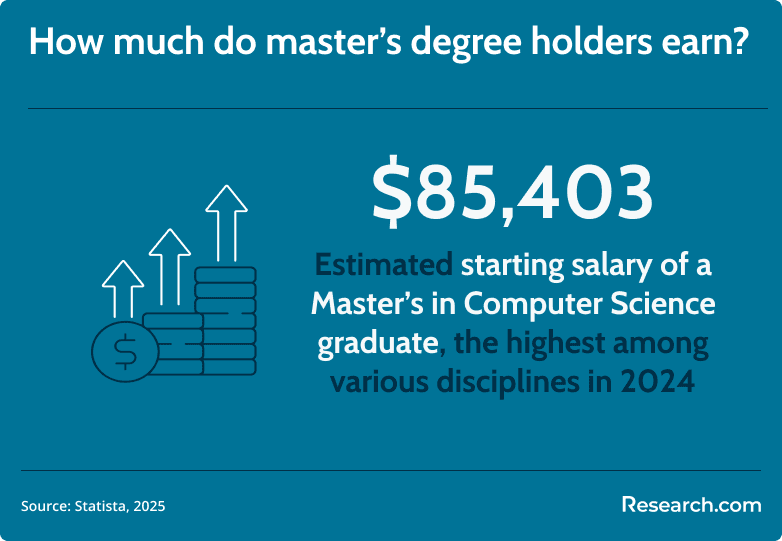
Fields requiring specialized knowledge often produce stronger financial returns. For example, nursing, engineer, and computer science can yield an ROI above $500,000, while law and medicine degrees have an ROI beyond $1 million (Cooper, n.d.). Statista (2025) data also show that master’s graduates in the following fields have the highest starting incomes:
- Computer science: $85,403
- Engineering: $83,628
- Math and sciences: $83,380
- Business: $75,303
When weighing ROI, look beyond salary. Consider job stability, advancement speed, licensure requirements, industry demand, job satisfaction, schedule flexibility, professional network, and whether the credential is truly required for the roles you want. Researching the majors that make the most money can provide context, but no salary outcome is guaranteed.
What are some ways to cut down the costs of master’s degrees?
Lowering graduate school costs requires planning before you apply. Use the checklist below to reduce avoidable expenses and limit unnecessary borrowing.
- Apply for scholarships and grants first: Prioritize funding that does not need to be repaid before turning to loans.
- Ask about employer tuition reimbursement: If you are working, find out whether your employer covers part of tuition for job-related programs.
- Consider work-study or campus employment: Paid roles can provide income and sometimes relevant experience.
- Look for teaching or research assistantships: Assistantships may reduce tuition, provide a stipend, or add field-specific experience.
- Use part-time enrollment strategically: Taking fewer credits can help you keep working, although a longer timeline may increase total costs if tuition rises.
- Compare accelerated formats: Faster programs may reduce the number of terms you pay for. Students interested in social work, for example, can compare one year MSW programs.
Some students also benefit from working before graduate school. Full-time work can help you build savings, clarify career goals, strengthen your application, and identify employers that may help pay for future education.
Will a Master’s Degree Stay a Competitive Asset in a Changing Job Market?
A master’s degree is most likely to remain useful when the program keeps pace with employer expectations. In many fields, students should look for curricula that incorporate current tools, applied projects, data literacy, emerging technologies, communication skills, and industry partnerships. The value of the credential depends not only on the degree title but also on whether the program helps graduates adapt as job requirements change.
Before enrolling, ask how often the curriculum is reviewed, whether faculty have current field experience, how employers are involved, and what alumni career paths look like over time. A program that teaches outdated methods may deliver weaker value even if its tuition appears affordable.
Can employer benefits and tax incentives lower the overall cost of a master’s degree?
Employer tuition assistance and tax-related education benefits can reduce the amount students pay out of pocket. Some employers reimburse tuition after a course is completed, while others pay schools directly or support job-related credentials only. Tax benefits such as the Lifetime Learning Credit may be available for qualifying educational expenditures.
Students should confirm eligibility rules, annual limits, grade requirements, repayment obligations if they leave their employer, and whether benefits apply to fees or only tuition. If graduate school is not immediately necessary, a lower-cost undergraduate route such as the cheapest fastest bachelor's degree may also be part of a broader cost-saving plan.
How long does it take to pay off a master’s degree?
Repayment time depends on how much you borrow, the interest rate, your income, and the repayment plan you choose. Most borrowers take 10 to 20 years to repay their student loans. Some pay them faster by making larger payments, while others extend repayment beyond 20 years through income-driven plans.
The main repayment factors include:
- Loan amount: Larger balances usually take longer to pay down.
- Income: Higher earnings can make faster repayment possible.
- Interest rate: Fixed and variable rates affect total cost differently.
- Repayment plan: Standard 10-year plans are common, while income-based and extended plans can lengthen the timeline.
Borrowers working in qualifying public service roles may consider Public Service Loan Forgiveness (PSLF). Before relying on forgiveness, confirm that your employer, loan type, repayment plan, and payment history meet program rules.
Is an Accelerated Associate Degree a Cost-Effective Stepping Stone?
An accelerated associate degree can be a lower-cost starting point for students who are still building toward a bachelor’s degree and eventually a master’s degree. By completing early college credits more quickly, students may enter the workforce sooner, transfer credits into a bachelor’s program, and reduce the total cost of their education pathway.
This option is most relevant for students who have not yet completed undergraduate requirements. To learn more about short associate pathways, review Can I get an associate's degree in 6 months?.
Comparing Traditional and Alternative Master’s Degree Programs to Reduce Costs
Graduate programs come in several formats, and the cheapest option is not always the best one. The right format depends on your schedule, learning style, career urgency, and need for clinical, lab, internship, or networking access.
| Program format | When it may make sense | Cost consideration |
| Traditional on-campus | You need campus labs, face-to-face networking, clinical access, or structured in-person learning. | May involve commuting, housing, parking, and campus fees. |
| Online | You need flexibility, want to keep working, or cannot relocate. | Can reduce travel and housing costs, but may include technology fees. |
| Hybrid | You want online flexibility with occasional in-person experiences. | May require travel for residencies or campus sessions. |
| Competency-based | You already know parts of the material and can progress independently. | May lower costs if you complete requirements quickly. |
| Accelerated | You have a clear goal and can handle an intensive schedule. | Can reduce time in school but may limit your ability to work full time. |
Students who want a faster graduate path can compare formats such as online, competency-based, and accelerated options. Some easiest master’s degree programs may have lighter prerequisites or more flexible structures, but students should still verify academic quality and employer relevance.
Is Pursuing a Doctoral Degree a Cost-Effective Alternative?
A doctoral degree is not usually a direct substitute for a master’s degree. It may be appropriate for students pursuing advanced research, university teaching, high-level clinical practice, or specialized professional expertise. However, doctoral programs often require more time, more intensive research or practice requirements, and a stronger long-term commitment.
Students comparing master’s and doctoral routes should consider funding availability, program length, career requirements, opportunity cost, and whether a doctorate is necessary for the target role. For more information on efficient doctoral pathways, see accredited online PhD programs.
Can an accelerated online bachelor's degree provide early cost-saving benefits?
An accelerated online bachelor's degree can reduce the total time spent before graduate school by helping students complete undergraduate requirements faster. That may allow earlier workforce entry, earlier eligibility for employer tuition assistance, and quicker access to graduate-level opportunities.
This strategy is most useful for students who have not yet earned a bachelor’s degree. If you are planning a long-term education pathway, compare accelerated online bachelor degree options before committing to a traditional timeline.
Can alternative financing options reduce the financial burden of a master’s degree?
Beyond scholarships, grants, assistantships, and loans, some students consider alternative financing models such as income share agreements or employer-sponsored repayment programs. Income share agreements typically require graduates to repay a fixed percentage of future income for a set period, while employer-based repayment may tie support to continued employment or performance requirements.
These options can reduce upfront costs, but the terms matter. Review repayment caps, income thresholds, total repayment limits, eligibility rules, and what happens if your income changes. Students seeking faster completion may also compare fast track degree programs as part of a broader cost-reduction strategy.
How Accelerated Programs Cut Time and Costs for Master’s Degrees
Accelerated master’s programs compress the graduate timeline, which can lower costs when students pay for fewer terms, reduce time away from full-time work, or finish before additional tuition increases occur. They can be efficient, but they are not ideal for every student.
What are accelerated master’s programs?
Accelerated master’s programs shorten the usual graduate school schedule, typically allowing students to finish within 12 to 18 months instead of the usual two years. They often use condensed terms, heavier course loads, year-round study, or structured sequencing.
How accelerated programs can save money
- Fewer terms of tuition and fees: A shorter schedule may reduce the number of semesters or terms you pay for.
- Lower living and commuting costs: On-campus students may spend less on housing, meals, transportation, and parking if they finish sooner.
- Reduced opportunity cost: Graduating earlier may allow students to return to full-time work or pursue promotions sooner.
Fields where accelerated master’s degrees are common
Accelerated options are often found in business, healthcare, education, social work, and other professionally oriented fields. For example, accelerated MBA and healthcare administration programs may appeal to professionals seeking quicker leadership preparation.
Who should consider an accelerated master’s program?
- Students with a specific career goal and a clear reason for needing the credential quickly.
- Professionals who already have relevant experience and can manage intensive coursework.
- Learners who want to lower total time in school without sacrificing accreditation or program quality.
Who should be cautious about accelerated programs?
- Students who need to work full time and cannot manage a compressed academic schedule.
- Learners entering a new field who need more time for prerequisites, internships, or networking.
- Students in licensure fields where speed should not come at the expense of required clinical, practicum, or supervised hours.
If speed and affordability are both priorities, compare affordable masters degrees that match your career target, accreditation needs, budget, and schedule capacity.
Common mistakes to avoid when comparing master’s degree costs
| Mistake | Why it can be costly | Better approach |
| Choosing a program based on tuition alone | Fees, books, travel, technology, and lost income can change the real cost. | Compare total cost of attendance and net price after aid. |
| Ignoring accreditation | Unrecognized programs may limit licensure, transfer credit, employer acceptance, or financial aid eligibility. | Verify institutional and programmatic accreditation before applying. |
| Assuming online always means cheaper | Some online programs charge comparable tuition or additional technology fees. | Ask for a full online cost breakdown, including residency or campus visit requirements. |
| Borrowing the maximum available | Higher debt can reduce the financial benefit of the degree. | Borrow only what is needed after grants, scholarships, employer aid, and savings. |
| Overlooking licensure rules | A program may not meet requirements in the state where you plan to work. | Confirm licensure alignment directly with the school and state licensing board. |
| Relying only on rankings | A highly ranked program may not fit your budget, schedule, or career objective. | Use rankings as one input alongside cost, outcomes, support, curriculum, and employer relevance. |
Questions to ask before enrolling in a master’s program
- What is the total cost of attendance, including fees, books, technology, travel, and required residencies?
- How much aid do graduate students in this program typically receive, and what aid does not require repayment?
- Is the program accredited by the appropriate institutional and programmatic accreditor?
- Does the curriculum meet licensure or certification requirements in the state where I plan to work?
- Can I transfer credits, test out of prerequisites, or use prior graduate coursework?
- What are the completion rates, career support services, and alumni employment outcomes?
- How will the schedule affect my ability to work and earn income while enrolled?
- What loan amount would I need, and what would monthly repayment look like after graduation?
Key Insights
- The average tuition and fees for graduate students in 2024-25 were $12,116 in public institutions and $21,110 in private institutions, but tuition alone does not show the full cost of a master’s degree.
- Residency status, program type, institution type, enrollment pace, and online versus campus delivery can all change what you actually pay.
- Graduate borrowing is common: from 2024 to 2025, 61% of funding for graduate students accounted for federal loans, and the average cost of federal loans that each student received in 2024–2025 was $17,710.
- A lower-cost program is not automatically the best value. Accreditation, licensure alignment, employer recognition, faculty expertise, and career support matter.
- ROI is strongest when the degree is clearly tied to a career goal, required for advancement, or connected to specialized fields with strong earning potential.
- Students can reduce costs through scholarships, grants, assistantships, employer reimbursement, part-time work, transfer credits, online formats, and accelerated programs.
- Before enrolling, calculate total cost, expected debt, repayment timeline, and realistic career outcomes—not just the advertised tuition or program ranking.
References
- Hanson, M. (2024, November 23). Average Cost of a Master’s Degree. Education Data Initiative. https://educationdata.org/average-cost-of-a-masters-degree
- Hanson, M. (2025, January 14). Education Attainment Statistics. Education Data Initiative. https://educationdata.org/education-attainment-statistics
- Ma, J., Pender, M., & Hu, X. (2025). Trends in College Pricing and Student Aid 2025. https://research.collegeboard.org/media/pdf/Trends-in-College-Pricing-and-Student-Aid-2025-final_1.pdf
- National Center for Education Statistics. (2024). Student Charges: What is the average amount of tuition and required fees for graduate students at public postsecondary institutions operating on an academic year calendar system? Trend Generator. https://nces.ed.gov/ipeds/trendgenerator/app/answer/13/207
- National Center for Education Statistics. (2024). Student Charges: What is the average amount of tuition and required fees for full-time graduate students at private postsecondary institutions operating on an academic year calendar system? Trend Generator. https://nces.ed.gov/ipeds/trendgenerator/app/answer/13/208
- Statista. (2025, December 12). Number of Master's degree recipients in the United States from 1879/80 to 2031/32. https://www.statista.com/statistics/238236/masters-degree-recipients-in-the-us
- Statista. (2025, November 28). Projected starting salaries for master’s degree graduates in the United States in 2024, by discipline. https://www.statista.com/statistics/635512/average-salary-of-graduates-in-the-us-by-discipline
- U.S. Bureau of Labor Statistics. (2025, May). Education pays, 2024. https://www.bls.gov/careeroutlook/2025/data-on-display/education-pays.htm
Other things you should know about the cost of master’s degrees
File the 2027–28 FAFSA online at StudentAid.gov using your FSA ID, then list the schools you want to receive your aid record. Federal Direct Unsubsidized Loans and Grad PLUS loans are the main U.S. federal options for master’s students.
In 2027, the average cost of a master's degree for international students ranges from $20,000 to $50,000 annually at public universities, and can exceed $60,000 at private institutions. The exact cost depends on factors such as the university, field of study, and location.
The location affects costs significantly due to variances in tuition fees, living expenses, and state funding. For example, a master's program in a major city may cost more due to higher living expenses compared to a rural area in 2027.


