
2027 Most Affordable Online PhD in Nursing (DNP) Programs

Co-Founder and Chief Data Scientist
Working nurses often consider a doctoral degree when they want to move beyond bedside practice into research, teaching, policy, advanced clinical leadership, or executive decision-making. An online PhD in nursing can make that goal more realistic because it allows licensed nurses to complete advanced doctoral study while continuing to work. The bigger question is not simply whether an online format is convenient. You need to know whether the degree matches your career goal, whether the program is accredited, how much it will cost, how long it may take, and whether a PhD or a Doctor of Nursing Practice is the better fit.
This guide explains what to expect from an online PhD in nursing, how it compares with campus-based study, what costs and aid options to review, which career paths may open after graduation, and how to evaluate programs without relying only on rankings. It also clarifies when a practice-focused DNP may be a stronger choice than a research-focused PhD.
Quick answer: Is an online PhD in nursing a good option?
An online PhD in nursing can be a strong choice for experienced nurses who want to conduct research, teach at the college level, influence healthcare policy, or lead evidence-based improvements in care delivery. It is usually best for nurses who are comfortable with independent study, scholarly writing, statistics, research design, and long-term dissertation work. Nurses whose main goal is advanced clinical practice may be better served by a DNP or another practice-oriented pathway.
What are the main benefits of earning an online PhD in nursing?
- Flexible study for working nurses: Online coursework can make doctoral education more manageable for nurses balancing employment, family responsibilities, clinical schedules, and professional commitments.
- Potentially shorter completion windows in some programs: Many online PhD programs in nursing can be completed in 2 to 3 years, though timelines vary by program structure, transfer credits, dissertation progress, and full-time or part-time enrollment.
- Access to expanding leadership and advanced nursing roles: Graduates may pursue careers in research, higher education, administration, policy, and specialized clinical leadership. Nurse practitioners are projected to see 45% job growth from 2022 to 2032, while medical and health services managers are projected to grow by 28% over the same period.
What can I expect from an online PhD in nursing?
An online PhD in nursing is a doctoral research degree designed to prepare nurses to generate new knowledge, evaluate evidence, teach future nurses, and shape healthcare systems. Unlike many clinical graduate programs, the PhD emphasizes scholarship. Students usually study nursing theory, research methods, statistics, healthcare policy, ethics, leadership, and dissertation development.
Most programs combine online coursework with faculty mentoring, virtual seminars, independent research, and a dissertation. Some programs may include residencies, intensives, practicum experiences, or in-person requirements, so “online” does not always mean fully remote. Before applying, nurses should confirm whether campus visits, clinical hours, research meetings, or local site placements are required.
| Program feature | What it usually means for students | Why it matters |
| Research-focused curriculum | Students learn to design studies, analyze data, review literature, and develop evidence-based recommendations. | This prepares graduates for academic, research, policy, and systems-level roles. |
| Dissertation requirement | Students complete an original scholarly project under faculty supervision. | Dissertation progress is often the biggest factor affecting completion time. |
| Online delivery | Courses may be asynchronous, synchronous, or a mix of both. | The format affects schedule flexibility, work-life balance, and interaction with faculty. |
| Faculty mentorship | Students work with faculty whose research interests align with their goals. | A poor mentor fit can slow research progress and reduce program value. |
| Possible residencies | Some programs require short campus visits, clinical experiences, or research intensives. | These requirements can add travel costs and scheduling constraints. |
Where can I work with an online PhD in nursing?
Graduates with an online PhD in nursing commonly work in healthcare organizations, universities, research centers, public agencies, consulting firms, and leadership offices. The best workplace depends on whether your doctoral work focuses on education, clinical research, health systems, policy, population health, informatics, or leadership.
Common settings include:
- Hospitals and healthcare systems: Graduates may work as nursing directors, clinical research coordinators, quality improvement leaders, evidence-based practice specialists, or healthcare administrators.
- Universities and colleges: PhD-prepared nurses may pursue faculty, curriculum leadership, or academic research roles. There are over 64,000 jobs for postsecondary nursing instructors.
- Research institutions: Some graduates work as medical scientists or clinical research professionals. Medical scientists are projected to see 10% job growth from 2022 to 2032.
Opportunities are often stronger in states with large healthcare and higher education sectors, including California, New York, and Texas.
How much can I make with an online PhD in nursing?
Salary after an online PhD in nursing depends on the role, employer, location, credentials, experience, and whether the position is clinical, academic, administrative, or research-based. A doctorate can improve access to senior positions, but it does not guarantee a specific salary.
- Advanced practice and specialized roles can be among the highest-paying options. Certified Nurse Anesthetists (CRNA) earn about $239,911 per year.
- Clinical Nurse Specialists and Health Services Administrators often report salaries above $100,000 per year.
- Nurse Educators and Health Policy Consultants have reported average salaries of about $81,350 and $82,500 per year, respectively.
- Senior executives can earn substantially more. Chief Nursing Officers can earn about $246,000 per year.
The strongest financial return usually comes when the doctoral degree is connected to a specific career plan, such as a faculty appointment, executive leadership role, funded research agenda, or high-level systems position.
- 2027 affordable online doctoral nursing programs to compare
- How long does an online PhD in nursing take?
- Online PhD in nursing vs. on-campus study
- Average cost of an online PhD in nursing
- Financial aid options for online doctoral nursing students
- Common admission requirements
- Courses in an online PhD in nursing
- Specializations in online doctoral nursing programs
- How to choose the right online PhD in nursing program
- Career paths after an online PhD in nursing
- Job market outlook for doctoral nursing graduates
- How doctoral nursing study can help address healthcare disparities
- DNP programs as an alternative to the PhD
- Why faculty expertise and mentorship matter
- Accreditation and quality standards
- Global healthcare challenges and doctoral nursing research
- How to succeed in an online PhD in nursing program
- How doctoral nursing graduates can influence healthcare policy
- Is an online PhD in nursing worth it?
- Technology trends in online doctoral nursing education
- How RNs can move toward an online PhD in nursing
- Common challenges in online PhD programs and how to manage them
2027 affordable online doctoral nursing programs to compare
The programs below are useful for nurses comparing affordable online doctoral nursing options. Important note: several programs listed here are Doctor of Nursing Practice programs rather than research PhD programs. That distinction matters. A PhD is usually designed for research and academic careers, while a DNP is generally designed for advanced clinical practice and healthcare leadership. If you are still deciding between pathways, compare these options with a BSN to DNP online program to understand how practice-focused doctoral tracks differ.
How do we rank schools?
Research.com rankings are developed through structured research and data review. To understand the ranking process in more detail, review our ranking methodology. Data sources include:
- IPEDS database
- Peterson’s database
- Distance Learning Licensed Data Set, College Scorecard database
- National Center for Education Statistics
1. Arkansas State University
Arkansas State University offers a Doctor of Nursing Practice program focused on nurse education. The part-time, 100% online format is built for working nurses who need flexibility. Students can attend live sessions at different times and select their course load by semester. The curriculum combines broader doctoral nursing study with education-focused coursework. Applicants must hold an MSN and a nursing license.
- Program Length: 1 to 2 years
- Tracks/Concentrations: Nursing Education
- Tuition: $456 per credit hour
- Required Credits to Graduate: 36-44
- Accreditation: Accreditation Commission for Education in Nursing
2. Texas A & M University-Corpus Christi
Texas A&M provides a Doctor of Nursing Practice program that can be completed online and part-time. The Corpus Christi-based program is intended for nurses who already hold a master’s degree in nursing. Students choose either a nurse practitioner track or an executive leadership track, and both options culminate in a DNP final project.
- Program Length: 2 to 3 years
- Tracks/Concentrations: Nurse Practitioner (NP), Executive Leadership (ExL)
- Tuition: $271/credit in-state | $592/credit out-of-state
- Required Credits to Graduate: 40
- Accreditation: Commission on Collegiate Nursing Education
3. University of North Carolina Wilmington
The University of North Carolina at Wilmington offers a Doctor of Nursing Practice program with a flexible structure. Although the program is connected to campus, much of the coursework is delivered online, while some classes and clinical hours must be completed in person. Students may choose psychiatric, family, nurse executive leadership, and post-APRN concentrations. Completion time ranges from five to 14 semesters depending on concentration and pacing.
- Program Length: 5-14 semesters
- Tracks/Concentrations: Adult-Gerontology Primary Care Nurse Practitioner Concentration, Family Nurse Practitioner Concentration, Nurse Executive Leadership Concentration, Post Aprn Concentration, Psychiatric Mental Health Nurse Practitioner Concentration
- Tuition: $384.19/credit in-state | $1,227.30/credit out-of-state
- Required Credits to Graduate: 33-70
- Accreditation: Commission on Collegiate Nursing Education
4. New Mexico State University-Main Campus
New Mexico State University offers a Doctor of Nursing Practice with concentrations in family nurse practice, psychiatric mental health nurse practice, and population health leadership. Coursework is largely online, but students attend a two-day on-campus orientation in the first year and a week-long clinical boot camp in the third year. Clinical training must be completed in person at a local healthcare site, and the program requires 1,000 supervised hours.
- Program Length: 2-3 years
- Tracks/Concentrations: Family Nurse Practitioner, Psychiatric Mental Health Nurse Practitioner, Nurse Anesthesiology
- Tuition: $394.46/credit in-state | $1,107.96/credit out of state
- Required Credits to Graduate: 74
- Accreditation: Commission on Collegiate Nursing Education
5. Northwestern Oklahoma State University
Northwestern Oklahoma State University offers a BSN to DNP option for nurses who hold a bachelor’s degree. The classroom portion is fully online, while students also complete two week-long summer residencies at a nearby hospital. Full-time students can finish in three years, and part-time students can finish in four years. Nurses who already hold a master’s degree may qualify for the accelerated advanced placement option and graduate in less than three years.
- Program Length: 3 years
- Tracks/Concentrations: Family Nurse Practitioner
- Tuition: $388.50/credit in-state | 642.50/credit out-of-state
- Required Credits to Graduate: 73
- Accreditation: Commission on Collegiate Nursing Education
Affordable online doctoral programs can help nurses continue their education without leaving the workforce. Students comparing healthcare-related online degrees may also want to review low-cost online nutrition and dietetics degree options if their interests extend beyond nursing.
What graduates often value in online doctoral nursing programs
- The online format made it possible to keep working and remain present for family responsibilities while completing doctoral coursework. Flexible scheduling and remote access to resources helped support steady progress without giving up academic quality. -Cherry
- Online doctoral study opened the door to collaboration with nurses and healthcare professionals from different locations. The format made research materials, faculty interaction, and peer discussion accessible without relocating. -Lee
- The strongest part of the experience was the combination of flexibility and faculty support. Being able to move through demanding research work with guidance helped build confidence for leadership and patient care improvement. -Jasmine
Key findings
- Nurse practitioners are projected to see 45% job growth from 2022 to 2032, according to the Bureau of Labor Statistics, which supports strong demand for advanced nursing expertise.
- Online PhD in nursing costs can vary significantly, ranging from as low as $20,000 to as high as $120,000. Arkansas State University, for example, charges $456 per credit hour.
- Healthcare workforce shortages continue to increase the need for nurses prepared for specialized, leadership, research, and education roles.
- Nurse practitioners have a median annual salary of $120,680, while Chief Nursing Officers can earn around $239,871, showing that doctoral-level nursing pathways can lead to high-earning roles.
- Financial aid is widely used in U.S. higher education. Around 83.8% of students in the U.S. receive some form of financial aid, including loans, scholarships, and grants.
- Career options for graduates may include Clinical Nurse Specialist roles with an estimated salary of $112,267 and Certified Nurse Anesthetist roles earning around $202,470 per year.
How long does it take to complete an online PhD in nursing?
An online PhD in nursing commonly takes 1 to 3 years to complete, depending on the school, enrollment pace, dissertation progress, transfer credits, and program requirements. Nurses researching faster nursing education pathways should pay close attention to whether a program is truly a PhD or a DNP, because the timeline and final requirements may differ.
Arkansas State University lists a 1 to 2 year completion window. Texas A&M University-Corpus Christi offers nurse practitioner and executive leadership tracks that take 2 to 3 years. New Mexico State University also lists a 2 to 3 year timeline, while Northwestern Oklahoma State University can take up to 3 years for full-time students. The University of North Carolina at Wilmington offers a broader range of five to 14 semesters, depending on concentration.
| School | Listed program length | Best for students who need |
| Arkansas State University | 1 to 2 years | A shorter, part-time doctoral nursing education pathway |
| Texas A & M University-Corpus Christi | 2 to 3 years | NP or executive leadership options with online flexibility |
| University of North Carolina Wilmington | 5-14 semesters | Multiple concentration choices and flexible pacing |
| New Mexico State University-Main Campus | 2-3 years | Mostly online study with required in-person components |
| Northwestern Oklahoma State University | 3 years | A BSN to DNP route with full-time completion |
How does an online PhD in nursing compare to an on-campus program?
An online PhD in nursing can be respected by employers when it is offered by a legitimate, accredited institution and meets the same academic standards as campus-based doctoral study. The delivery format matters less than accreditation, faculty quality, research support, curriculum rigor, graduate outcomes, and whether the program fits your professional goal.
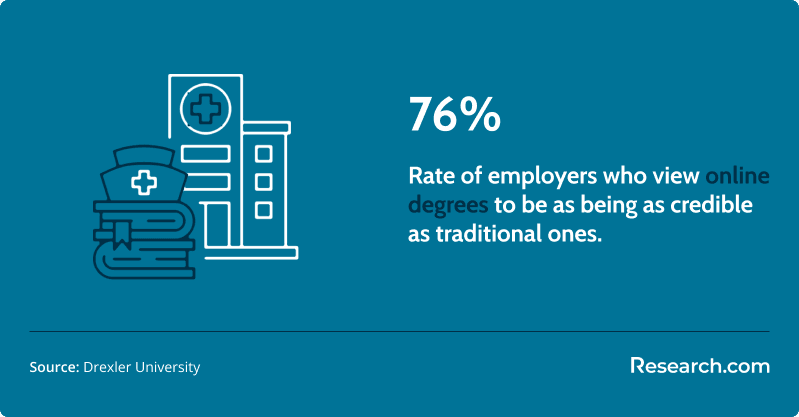
Online programs, including online MSN to DNP programs, can reduce commuting time and make graduate study more accessible for working nurses. However, online students must be disciplined, comfortable with digital learning, and proactive about faculty communication. The Sloan Consortium Study shown below reports that 76% of academic leaders believe online degrees are equivalent to on-campus ones.
| Factor | Online PhD in nursing | On-campus PhD in nursing |
| Schedule | Often more flexible, especially with asynchronous coursework | Usually more structured and tied to campus schedules |
| Networking | Requires intentional participation in virtual events, research groups, and conferences | More informal interaction through campus offices, labs, and seminars |
| Costs | May reduce commuting or relocation costs, but tuition varies widely | May involve relocation, parking, housing, or commuting expenses |
| Research support | Depends heavily on virtual mentoring, library access, and faculty availability | May offer easier access to labs, campus resources, and in-person mentorship |
| Best fit | Working nurses who need flexibility and have strong self-management skills | Students who prefer face-to-face learning and campus-based research culture |
What is the average cost of an online PhD in nursing?
The total cost of an online PhD in nursing can range from as low as $20,000 to as high as $120,000, depending on tuition, required credits, residency expenses, fees, and whether the student pays in-state or out-of-state rates. At Johns Hopkins University, the cost is approximately $1,939 per credit hour.
The most affordable online nursing programs can cost much less per credit. Arkansas State University charges $456 per credit hour. Texas A&M University-Corpus Christi lists $271 per credit hour for in-state students and $592 for out-of-state students. The University of North Carolina Wilmington charges $384.19 per credit hour for in-state students and $1,227.30 for out-of-state students, which is still below the Johns Hopkins University per-credit example listed above.
Cost factors to compare before enrolling
| Cost item | What to check | Why it affects affordability |
| Tuition per credit | Compare in-state, out-of-state, and online rates. | A low per-credit rate can still become expensive if the program requires many credits. |
| Required credits | Confirm the exact number of credits needed to graduate. | Programs with more credits may cost more even if the rate is lower. |
| Residency or campus visits | Ask whether travel, lodging, meals, or time off work are required. | Short residencies can add meaningful costs. |
| Clinical or research expenses | Check site placement fees, background checks, software, and research materials. | These costs are often not obvious in tuition estimates. |
| Lost work time | Estimate whether you will reduce shifts or move to part-time employment. | Opportunity cost can be larger than program fees for some nurses. |
What are the financial aid options for students enrolling in an online PhD in nursing?
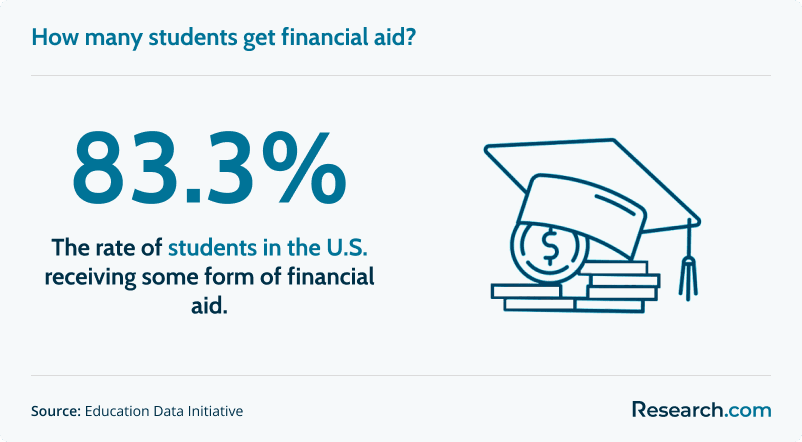
Online PhD in nursing students may be able to use federal loans, scholarships, grants, employer tuition benefits, assistantships, and private loans. According to the Education Data Initiative, around 83.8% of students in the U.S. receive some type of financial aid. The federal government alone loans $45.3 billion annually to 44.4% of all postsecondary students, including graduate and professional students.
Common funding options include:
- Federal Financial Aid: Graduate students can complete the FAFSA to determine eligibility for federal loan programs and other aid options.
- Scholarships: Nursing students may qualify for awards such as the Health Resources and Services Administration (HRSA) Nurse Corps Scholarship Program, Nurses Educational Funds Scholarships, and other scholarship options for online nursing students. Scholarships do not need to be repaid.
- Grants: Grants are often based on need, academic merit, research interest, or service commitments and generally do not require repayment.
- Employer Tuition Assistance: Hospitals, health systems, universities, and government employers may offer tuition reimbursement for nurses pursuing advanced degrees.
- Private Loans: Private lenders may provide education loans, but these often carry different terms and may have higher interest rates than federal options.
Before borrowing, compare your expected career path with the program’s total cost. A PhD can be valuable, but debt should match a realistic plan for salary growth, promotion, academic appointment, or research funding.
What are the prerequisites for enrolling in an online PhD in nursing?
Admission requirements vary, but most online PhD in nursing programs expect applicants to show graduate-level preparation, active nursing credentials, professional experience, and readiness for doctoral research. Common requirements include:
- Master’s Degree: Many programs require a Master of Science in Nursing (MSN) or a closely related graduate degree from an accredited institution.
- Nursing License: Applicants are usually expected to hold a current, active registered nurse (RN) license.
- GPA Requirement: Programs commonly set a minimum GPA, often around 3.0 or higher.
- Professional Experience: Many schools prefer applicants with relevant nursing experience, often including several years of clinical practice.
- Letters of Recommendation: Applicants typically submit two to three recommendations from academic, clinical, or professional references.
- Statement of Purpose: A strong essay should explain your research interests, career goals, faculty fit, and reason for pursuing doctoral study.
- Technical Requirements: Online students need reliable internet, an updated computer, required software, and the ability to use digital learning platforms.
Nurses without a traditional BSN may still have bridge options. If you are asking whether a nurse can earn a master’s in nursing without a BSN, the answer is yes in some cases through RN-to-MSN pathways. Nurses who first need bachelor’s-level preparation can also compare accessible online RN to BSN programs.
What courses are typically in an online PhD in nursing?
An online PhD in nursing usually includes research, theory, leadership, health systems, and ethics coursework. The exact curriculum depends on the school and specialization, but many programs include courses such as:
- Advanced Nursing Theory: Reviews major nursing frameworks and how theory guides research, education, and practice.
- Research Methods: Covers qualitative and quantitative methods, study design, evidence appraisal, and data collection.
- Healthcare Policy: Examines how policy decisions affect care delivery, nursing practice, access, leadership, and outcomes.
- Ethics in Nursing: Explores ethical issues in advanced practice, scholarship, human subjects research, and healthcare systems.
- Leadership in Nursing: Builds skills for leading organizations, teams, academic programs, and evidence-based initiatives.
- Advanced Pathophysiology: Provides deeper study of disease processes and their effects on patient care.
- Clinical Practicum: Applies advanced learning in supervised settings when required by the program or specialization.
What types of specializations are available in online PhDs in nursing?
Specialization options vary by school. Some are research-focused PhD concentrations, while others are DNP or advanced practice tracks. Students should confirm whether a concentration leads to licensure, certification eligibility, academic preparation, or research expertise.
- Nursing Education: Focuses on curriculum design, teaching methods, assessment, and preparation for academic or clinical educator roles. Example: Arkansas State University.
- Nurse Practitioner (NP): Prepares nurses for primary or specialty care roles, often focused on a defined population. Example: Texas A&M University-Corpus Christi.
- Executive Leadership: Develops skills for healthcare administration, organizational strategy, and policy influence. Example: Texas A&M University-Corpus Christi.
- Family Nurse Practitioner: Centers on care for patients across the lifespan. Example: University of North Carolina Wilmington.
- Psychiatric Mental Health Nurse Practitioner: Focuses on mental health assessment, diagnosis, and treatment. Example: University of North Carolina Wilmington.
- Population Health Leadership: Emphasizes community health, health systems, policy, and population-level outcomes. Example: New Mexico State University.
| Goal | Better-fit specialization | Decision note |
| Teach nursing students | Nursing Education | Look for faculty teaching experience, curriculum courses, and academic mentoring. |
| Provide advanced clinical care | Nurse Practitioner, Family Nurse Practitioner, Psychiatric Mental Health Nurse Practitioner | Confirm certification and state licensure requirements before enrolling. |
| Lead healthcare organizations | Executive Leadership | Review coursework in finance, quality improvement, health systems, and leadership. |
| Improve community outcomes | Population Health Leadership | Look for training in data analysis, health equity, and policy. |
| Build a research career | Research-focused PhD concentration | Prioritize faculty research alignment and dissertation support. |
How to Choose the Best Online PhD in Nursing Program Program
The best online PhD in nursing program is not always the cheapest, fastest, or highest ranked. It is the program that aligns with your career goal, research interests, schedule, budget, licensure needs, and preferred level of faculty support. Use rankings as a starting point, not the final decision.
- Accreditation: Confirm institutional accreditation and nursing program accreditation from recognized bodies such as the Commission on Collegiate Nursing Education (CCNE), when applicable.
- Specializations: Choose a program that supports your intended path, such as nursing education, research, nurse practitioner preparation, or executive leadership.
- Flexibility: Review whether courses are asynchronous, synchronous, part-time, full-time, cohort-based, or self-paced.
- Cost: Compare tuition, fees, required credits, travel, technology, books, and lost work time.
- Support Services: Ask about academic advising, dissertation coaching, library access, writing support, statistical consulting, career services, and technical help.
Students preparing for graduate nursing study may benefit from reviewing what to expect when starting nursing school, especially if they need a refresher on academic workload, clinical expectations, and financial planning. Nurses who want a shorter route should also examine whether schools offer accelerated degree formats.
Questions to ask before applying
| Question | Why it matters |
| Is this a PhD, DNP, or another doctoral nursing degree? | The degree type affects research preparation, career options, certification eligibility, and dissertation or project requirements. |
| Who could supervise my dissertation or doctoral project? | Faculty alignment is critical for research progress and professional mentoring. |
| Are there any required campus visits? | Residencies can affect travel costs, time off work, and family scheduling. |
| Does the program meet licensure requirements in my state? | This is essential for advanced practice tracks. |
| What are recent graduate outcomes? | Career placement, completion rates, and alumni roles help indicate practical program value. |
What career paths are available for graduates of online PhD in nursing?
Graduates of online PhD in nursing programs may move into academic, clinical leadership, research, administration, and policy roles. Salaries vary by employer, state, experience, credentials, and responsibilities. Reported annual salary estimates include:
- Nurse Practitioner: Provides primary and specialty care. Estimated salary: $120,680.
- Clinical Nurse Specialist: Works to improve patient outcomes, care standards, and nursing practice. Estimated salary: $112,267.
- Nurse Educator: Teaches and mentors nursing students in colleges, universities, or clinical education settings. Estimated salary: $86,774.
- Certified Nurse Anesthetist (CRNA): Provides anesthesia care before, during, and after procedures. Estimated salary: $$239,911. If this path interests you, review how to prepare for CRNA school.
- Certified Nurse Midwife: Provides prenatal, childbirth, postpartum, and women’s health care. Estimated salary: $118,200.
- Health Services Administrator: Manages departments, facilities, budgets, operations, and staff. Estimated salary: $112,409.
- Clinical Research Scientist: Designs or conducts studies to improve healthcare practice and outcomes. Estimated salary: $95,000.
- Health Policy Consultant: Advises organizations or policymakers on healthcare rules, systems, and reforms. Estimated salary: $95,000.
- Chief Nursing Officer (CNO): Leads nursing strategy, staffing, quality, and patient care standards. Estimated salary: $260,660.
The chart below provides a visual salary comparison.
If a PhD in nursing does not fit your timeline, budget, or career plan, other nursing specialties may offer strong earning potential with less doctoral-level research. Cosmetic nursing is one example; compare aesthetic nurse salary by state before deciding whether that route fits your goals.
What is the job market for graduates with an online PhD in nursing?
The job market for doctoral-prepared nurses is shaped by demand for advanced clinical care, healthcare leadership, education, research, and system improvement. Nurse practitioners are projected to grow by 45% from 2022 to 2032, according to the Bureau of Labor Statistics. That growth is tied to preventive care needs and rising healthcare demand from an aging population.
Medical and health services managers, a category that includes roles such as Health Services Administrator, are projected to grow by 28% over the same period. Medical scientists, including clinical research scientists, are projected to grow by 10%, reflecting ongoing demand for healthcare research and medical advancement.
Workforce shortages also support demand for advanced nursing expertise. Reports from Oracle and CNN have highlighted shortages across the U.S. healthcare workforce, which increases the importance of nurses who can teach, lead, conduct research, improve systems, and support advanced care delivery.
How can an online PhD in nursing prepare you for addressing healthcare disparities?
Healthcare disparities affect access, quality, outcomes, and trust across communities. An online PhD in nursing can prepare nurses to study these problems systematically and design evidence-based responses. This work often combines research, policy, community engagement, data analysis, and leadership.
- Community-focused research: Students can learn to investigate barriers faced by underserved populations and use findings to improve care access and outcomes.
- Policy advocacy: Doctoral study can build the skills needed to evaluate policies and recommend changes that improve equity.
- Cultural competency: Programs may help nurses deliver and teach care that respects patient backgrounds, values, and lived experiences.
- Health equity leadership: Graduates may lead initiatives that improve resource allocation, community health programs, and system-level accountability.
- Interdisciplinary collaboration: Complex disparities often require nurses to work with physicians, public health professionals, social workers, educators, policymakers, and community organizations.
- Data analysis: Doctoral training helps nurses identify patterns in outcomes, access, quality, and risk across patient groups.
- Education and mentorship: PhD-prepared nurses can train future nurses to prioritize equity, evidence, and ethical care.
Doctor of Nursing Practice (DNP) Programs as an Alternative Path
A DNP may be a better option than a PhD for nurses who want advanced clinical practice, executive leadership, or direct application of evidence in healthcare settings. The PhD is usually research-intensive and often leads to academic or scholarly careers. The DNP focuses more on practice improvement, patient outcomes, clinical leadership, and healthcare administration.
DNP programs may offer concentrations such as Family Nurse Practitioner, Psychiatric Mental Health, and Executive Leadership. If you want a practice-focused doctorate, compare the most affordable online DNP programs and verify whether each program meets your state’s licensure and certification requirements.
| Degree | Main focus | Best for | Typical final requirement |
| PhD in Nursing | Research, scholarship, theory, and knowledge generation | Nurses aiming for research, faculty, policy, or academic leadership roles | Dissertation |
| DNP | Advanced practice, clinical leadership, and applying evidence to improve outcomes | Nurses pursuing NP, executive, systems leadership, or practice improvement roles | DNP project |
How do faculty expertise and mentorship opportunities influence an online PhD in nursing program?
Faculty fit is one of the most important quality indicators in an online PhD in nursing program. Strong mentors help students refine research questions, select methods, publish scholarship, navigate dissertation milestones, and connect with professional networks. A program may look attractive on cost or flexibility, but if no faculty member works in your area of interest, the degree may be harder to complete and less useful professionally.
Prospective students should review faculty publications, funded projects, clinical specialties, policy work, and dissertation supervision experience. Students who value a diverse academic community may also want to compare resources connected to the top HBCU nursing schools.
How do accreditation and quality standards impact an online PhD in nursing program?
Accreditation helps verify that a nursing program and institution meet recognized standards for curriculum, faculty qualifications, student support, academic integrity, and outcomes. It also affects transfer credit, employer acceptance, financial aid eligibility, and—in some cases—licensure or certification pathways.
Do not assume that every online nursing doctorate has the same credibility. Review institutional accreditation, nursing-specific accreditation, faculty credentials, graduate outcomes, completion rates, student support, and state authorization. Students comparing admission accessibility should still avoid sacrificing quality; reviewing the easiest nursing schools to get into can be helpful only if accreditation and outcomes are also considered.
How can an online PhD in nursing address global healthcare challenges?
Global healthcare challenges require nurses who can analyze systems, adapt evidence to different settings, and consider cultural, economic, and policy differences. Online doctoral study can expose students to international case studies, cross-cultural research questions, virtual collaboration, and population-level problem solving.
Graduates may contribute to global health by studying care access, workforce shortages, maternal health, chronic disease management, infectious disease response, and health system design. Nurses who prefer a practice-focused route may compare these goals with an accelerated DNP program online.
How to succeed in an online PhD in nursing program
Online doctoral nursing programs require independence, organization, academic discipline, and consistent communication. Flexibility is helpful, but it also means students must create structure for reading, coursework, research, writing, and faculty meetings. Nurses who prefer a faster clinical specialization should also compare accessible nurse practitioner specialty programs.
Build a realistic weekly schedule
Doctoral coursework and dissertation research are difficult to manage without protected study time. Treat academic work like a recurring professional commitment.
- Block dedicated study periods: Set weekly time for readings, assignments, research tasks, and meetings with faculty.
- Plan around clinical work: If you work shifts, map deadlines against your schedule before each term begins.
Create a research organization system early
The dissertation process involves extensive reading, notes, drafts, revisions, data, and citations. Disorganization can slow progress quickly.
- Use citation tools: Zotero or Mendeley can help track sources, notes, and bibliographies.
- Write in smaller sections: Break articles, proposals, and dissertation chapters into manageable tasks instead of waiting for long uninterrupted writing time.
Participate actively in the online learning community
Online students can build strong professional relationships, but they usually need to be intentional about it.
- Engage in discussions: Use forums, webinars, and virtual meetings to exchange ideas and stay visible.
- Connect with alumni: Alumni can provide practical insight into dissertation management, faculty expectations, job searches, and career transitions.
Ask for support before problems grow
Doctoral students sometimes wait too long to request help. Early support can prevent delays and reduce stress.
- Use academic resources: Writing centers, library consultations, statistics support, and faculty office hours can improve performance.
- Protect mental health: Doctoral work can be demanding, so use counseling, peer support, or wellness resources when available.
Stay connected to nursing practice and scholarship
Even in a research-focused program, connection to the nursing profession keeps doctoral work relevant.
- Attend conferences: Virtual and hybrid conferences can help students present research and build professional visibility.
- Join professional organizations: Groups such as the American Nurses Association (ANA) can help nurses follow policy, practice, and workforce trends.
How can an online PhD in nursing influence healthcare policy?
An online PhD in nursing can prepare graduates to influence policy through research, evidence evaluation, health systems analysis, and leadership. Coursework in evidence-based practice, biostatistics, policy, and health systems can help nurses translate findings into recommendations for healthcare organizations, public agencies, and professional associations.
Nurses do not need to wait until the doctoral level to build momentum. Those still completing earlier nursing credentials can explore fast track RN to BSN online programs as one step toward advanced education and policy-oriented work.
Is an online PhD in nursing worth the investment?
An online PhD in nursing is most likely to be worth it when the degree is directly tied to a career goal that requires or strongly values doctoral research preparation. Examples include tenure-track faculty roles, research leadership, policy analysis, health systems innovation, and senior nursing leadership. It may be less worthwhile if your primary goal is direct clinical practice and a DNP or advanced practice certification would get you there more efficiently.
When calculating value, compare tuition, fees, time to completion, lost income, potential promotions, salary expectations, employer tuition support, and your willingness to complete a dissertation. Nurses who are still building toward graduate credentials may also review an ASN to MSN bridge program as an alternative progression route.
Who should consider an online PhD in nursing?
- Nurses who want to teach in higher education or lead academic nursing programs.
- Nurses interested in original research, publications, grants, or evidence generation.
- Healthcare leaders who want stronger research and policy credentials.
- Experienced nurses who can manage independent online study and long-term writing projects.
Who may be better served by another path?
- Nurses whose main goal is advanced clinical practice rather than research.
- Students who need extensive in-person structure and face-to-face accountability.
- Nurses who cannot commit time to dissertation work.
- Applicants who have not confirmed whether the program meets state licensure or certification requirements.
How do emerging technologies facilitate an online PhD in nursing education?
Online doctoral nursing programs increasingly use digital tools to support research, collaboration, simulation, and faculty interaction. Students may use secure video meetings, digital libraries, virtual research groups, data analysis tools, online discussion platforms, and research management software. These tools can make advanced study possible for nurses who cannot relocate or attend campus full time.
Technology does not replace mentorship or program quality. The best online programs combine strong digital systems with accessible faculty, research support, and clear academic expectations. Nurses comparing online clinical routes can also evaluate affordable online FNP programs.
How can RNs transition smoothly to an online PhD in nursing?
RNs can prepare for online doctoral study by mapping their current credentials against admission requirements, strengthening research and writing skills, identifying faculty mentors, and choosing bridge programs when needed. The transition is easier when nurses plan each step instead of applying only because a program looks convenient.
RNs who still need bachelor’s-level preparation can explore accessible RN to BSN online programs. After that, many nurses complete MSN-level preparation before moving into doctoral research. Mentorship, professional networking, and early exposure to scholarly writing can also make the transition smoother.
Navigating and Overcoming Challenges in Online PhD Programs
Online PhD programs in nursing can be flexible, but they are not easy. Students must manage technology, time, isolation, resource access, writing demands, and dissertation momentum. Planning for these challenges before enrollment can improve persistence.
- Technical problems: Use a reliable internet connection, maintain backup access, learn the learning platform early, and contact IT support before deadlines become urgent.
- Self-motivation and time management: Build a weekly routine for coursework, research, writing, and rest. Use digital calendars and deadline reminders.
- Limited face-to-face interaction: Attend virtual office hours, join online study groups, participate in discussion forums, and connect with classmates outside required meetings.
- Access to resources: Make full use of online libraries, journals, databases, writing centers, and virtual research support. Ask whether local library agreements are available.
- Practical experience: Use virtual simulations, case studies, remote research opportunities, local partnerships, shadowing, or volunteer experiences when appropriate.
If a nursing PhD feels too intensive or does not align with your goals, compare other doctoral options, including the easiest PhD to get, while still evaluating quality, outcomes, and career relevance.
Common mistakes to avoid when choosing an online PhD in nursing
| Mistake | Why it can hurt you | Better approach |
| Confusing a PhD with a DNP | You may choose a research degree when you need clinical preparation, or a practice doctorate when you want an academic research career. | Start with your career goal, then choose the degree type. |
| Choosing only by tuition | The cheapest program may lack the faculty fit, support, or specialization you need. | Compare total cost, faculty, outcomes, accreditation, and structure. |
| Ignoring accreditation | Accreditation can affect financial aid, employer recognition, transfer credits, and licensure pathways. | Verify institutional and programmatic accreditation before applying. |
| Assuming “online” means no campus visits | Residencies, intensives, or clinical requirements may add travel and scheduling burdens. | Ask for a written list of all in-person requirements. |
| Overlooking dissertation support | Poor support can delay graduation and increase costs. | Ask about faculty mentoring, milestone timelines, writing support, and completion outcomes. |
| Expecting salary guarantees | A doctorate may improve access to roles, but earnings depend on job type, market, experience, and credentials. | Research salaries for your target role and region before borrowing. |
References
- Bureau of Labor Statistics. (2023, April 25). Postsecondary nursing instructors and teachers.
- Bureau of Labor Statistics. (2024, April 17). Medical and health services managers outlook.
- Bureau of Labor Statistics. (2024, April 17). Medical scientists outlook.
- Bureau of Labor Statistics. (2024, April 17). Nurse anesthetists, nurse midwives, and nurse practitioners outlook.
- Bureau of Labor Statistics. (2024, April 17). Nurse anesthetists, nurse midwives, and nurse practitioners: Occupational outlook handbook details.
- Duquesne University. (2022, January 11). Online degree vs. on campus: Why earn your DNP online? | Duquesne University.
- Drexel University Online. (2024). Online degree vs on-campus degrees. Drexel University Online.
- Howard, J. (2023, May 16). Concern grows around US health-care workforce shortage: "We don't have enough doctors." CNN.
- Is a PhD in nursing right for you? | Wilkes University Online. (2021, May 21). Wilkes University.
- Oracle. (2023, January 17). The shortage of US healthcare workers in 2023.
- Salary.com. (2024). Certified nurse anesthetist salary.
- Salary.com. (2024). Certified nurse midwife salary.
- Salary.com. (2024). Chief nursing officer salary.
- Salary.com. (2024). Clinical nurse specialist salary.
- Salary.com. (2024). Health policy consultant salary.
- Salary.com. (2024). Health services administrator salary.
- Salary.com. (2024). Nurse educator salary.
- Salary.com. (2024). Nurse practitioner salary.
- Salary.com. (2024). Clinical research scientist salary.
Key Insights
- An online PhD in nursing is best for nurses who want research, teaching, policy, or scholarly leadership roles; nurses focused on advanced clinical practice should compare DNP options carefully.
- Program credibility depends on accreditation, faculty expertise, dissertation support, and graduate outcomes—not simply whether the courses are online.
- Completion time can vary widely. Programs listed here range from 1 to 2 years, 2 to 3 years, 3 years, and five to 14 semesters depending on school and track.
- Costs can range from $20,000 to $120,000, so students should compare total program cost, not just tuition per credit.
- Strong job outlook exists in several advanced nursing areas, including 45% projected growth for nurse practitioners and 28% projected growth for medical and health services managers from 2022 to 2032.
- The most important application question is fit: choose a program only after confirming the degree type, accreditation, faculty mentor match, state requirements, in-person obligations, and realistic return on investment.
Other Things You Should Know About Online PhD in Nursing
The average duration for affordable online PhD in Nursing (DNP) programs in 2027 typically ranges from 3 to 5 years. This time frame can vary based on the program structure, credit requirements, and the student's pace of study.
Many affordable online DNP programs offer various financial aid options, including scholarships, grants, and federal student loans. Additionally, students might access tuition reimbursement programs through their employer or specialized nursing scholarships to ease their financial burden.
Yes. Most online DNP programs require an active, unencumbered RN license before admission, and some track-specific options also require APRN certification. Applicants usually need a BSN or MSN, official transcripts, and proof of licensure in the state where the clinical practicum will occur.


