2027 What Is a Neonatal Nurse?

Co-Founder and Chief Data Scientist
Choosing neonatal nursing means choosing one of the most specialized paths in registered nursing. Neonatal nurses care for newborns during the first weeks of life, including premature infants, babies with infections or breathing problems, and newborns recovering from surgery or other serious conditions. For families, these nurses are often the professionals who explain what is happening, provide reassurance, and help parents participate in care during a frightening time.
This guide explains what neonatal nurses do, where they work, how to enter the field, which degrees and certifications matter, what the salary and job outlook data show, and how to decide whether this career fits your goals. It also covers advancement routes such as neonatal nurse practitioner roles, online and bridge nursing programs, financial aid considerations, and common mistakes to avoid before investing in additional education.
Key Insights
- Neonatal nurses are RNs who care for newborns during the first month of life, with roles ranging from routine newborn care to high-acuity NICU practice.
- You can begin through an ADN or BSN, but many hospitals prefer BSN-prepared nurses for competitive neonatal and NICU positions.
- NICU care levels matter: Level I focuses on healthy newborns, while Level III and Level IV units involve critically ill infants, advanced equipment, surgery, and intensive monitoring.
- Advanced practice as a neonatal nurse practitioner requires graduate education, national certification, and compliance with state practice rules.
- The average annual salary for neonatal nurses is reported as $71,497 as of September 2023, while broader RN and nurse practitioner salary benchmarks differ by role and source.
- Certifications such as RNC-NIC, CCRN Neonatal, and NNP certification can support advancement, but they must match your experience level and career target.
- Before choosing a program, verify accreditation, clinical placement support, certification alignment, state authorization, and total cost—not just tuition or program speed.
- Neonatal nursing is best for nurses who can combine technical precision, calm decision-making, compassion, and resilience in emotionally demanding settings.
Quick answer: Is neonatal nursing a good career path?
Neonatal nursing can be a strong career choice for registered nurses who want highly specialized clinical work, close teamwork, and meaningful patient and family care. You can enter the field after becoming an RN through an ADN or BSN pathway, although many hospitals prefer or require a BSN. Advanced roles, such as neonatal nurse practitioner, require graduate education, national certification, and state authorization to practice.
- Neonatal nursing is best suited for nurses who can work carefully under pressure, communicate compassionately with families, and manage emotionally intense situations.
- Entry into neonatal nursing typically begins with RN licensure, followed by clinical experience in newborn, nursery, postpartum, pediatric, or NICU-related settings.
- Specialty certifications such as CCRN Neonatal or RNC-NIC can strengthen your qualifications after you gain the required experience.
- Neonatal nurse role overview
- Work settings and NICU care levels
- Types of neonatal nursing roles
- Is neonatal nursing worth it?
- Skills needed for neonatal care
- Steps to become a neonatal nurse
- Neonatal nurse salary
- Advanced education for neonatal nurses
- Education pathways for neonatal specialization
- How long the pathway takes
- Transitioning into advanced neonatal roles
- Job outlook for neonatal nurses
- Common challenges in neonatal nursing
- Becoming a neonatal nurse as a non-nurse
- Using clinical residency to build NICU readiness
- Additional education that may support neonatal careers
- Dual degrees for neonatal nursing leadership
- Accelerated advanced nursing degrees
- Post-master's NP programs and neonatal practice
- Financial aid for neonatal nursing education
- Certification options for neonatal nurses
What is a neonatal nurse?
A neonatal nurse is a registered nurse who provides care to newborns during the neonatal period, which covers the first month of life. Some neonatal nurses care for healthy infants after delivery, while others work with babies who are premature, medically fragile, recovering from procedures, or experiencing complications that require close monitoring.
The role is different from general pediatric nursing because newborns have distinct clinical needs. A change in breathing, temperature, feeding tolerance, oxygen saturation, or weight can quickly become important. Neonatal nurses must notice small changes, document them accurately, communicate with the care team, and respond quickly when an infant’s condition shifts.
Where do neonatal nurses work?
Most neonatal nurses work in hospitals, especially maternity units, newborn nurseries, labor and delivery departments, neonatal step-down units, and neonatal intensive care units. Some also work in community health, home health, critical care transport, flight nursing, trauma-related services, or specialized cardiac and surgical units that treat newborns.
Hospitals use different levels of newborn care depending on the infant’s condition. Understanding these levels can help you decide what kind of neonatal environment fits your skills and career goals.
| Newborn care level | Who is treated there | What neonatal nurses typically do |
| Level I | Healthy newborns who need routine care after birth. | Support feeding, monitor basic newborn transition, help with screening, and educate parents before discharge. |
| Level II NICU | Infants born at 32 weeks gestation and above, or full-term newborns who need closer observation. | Track vital signs, weight, feeding, temperature, fluid status, IV fluids, medications, and changes that require escalation. |
| Level III NICU | Infants born earlier than 32 weeks of gestation, infants weighing under 1,500 grams, and critically ill newborns of any gestational age. | Care for high-acuity infants, manage ventilators and other specialized equipment, monitor babies before and after procedures, and respond to emergencies. |
| Level IV NICU | Newborns with the most complex conditions, including major surgical needs such as congenital heart defects. | Provide intensive monitoring, prepare babies for major surgery, support post-operative recovery, and work closely with surgical and specialty teams. |
In community or in-home roles, neonatal nurses may focus more on discharge follow-up, parent coaching, feeding support, weight checks, medication teaching, and monitoring high-risk infants after they leave the hospital.
What are the key responsibilities of a neonatal nurse?
Neonatal nurse responsibilities vary by unit, employer, state scope of practice, and the infant’s condition. In general, the work combines detailed assessment, technical care, family education, and constant communication with physicians, nurse practitioners, respiratory therapists, lactation consultants, pharmacists, social workers, and other clinicians.
- Monitor premature, ill, or recovering newborns for changes in breathing, temperature, oxygen levels, weight, feeding tolerance, and overall stability.
- Perform or assist with newborn assessments and screening procedures, including hearing and vision-related checks when assigned.
- Administer special feedings, including tube feedings, and track intake, output, and growth patterns.
- Use NICU equipment such as incubators, radiant warmers, infant ventilators, monitors, infusion pumps, and oxygen delivery systems.
- Start or manage IV lines according to training, unit policy, and scope of practice.
- Administer medications, verify dosages carefully, and document responses or adverse changes.
- Prepare infants and families for transfer, surgery, discharge, or follow-up care.
- Teach parents safe care techniques, feeding expectations, warning signs, and what to ask the care team.
A Level II NICU nurse may spend much of a shift monitoring feeding, weight, fluids, and vital signs. A Level III nurse often works with ventilators, surgical recovery, and unstable patients. A Level IV nurse may care for newborns before and after complex operations, requiring advanced clinical judgment and close coordination with specialists.
What are the types of neonatal nurses?
“Neonatal nurse” is often used broadly, but the field includes several roles with different education levels, responsibilities, and advancement options. The right path depends on whether you want bedside RN practice, surgical care, transport, leadership, or advanced practice authority.
1. Neonatal nurse
A neonatal nurse is an RN who works with newborns shortly after birth. These nurses may work in newborn nurseries, postpartum units, labor and delivery, neonatal step-down settings, or other hospital units that serve infants. Entry typically requires completion of an associate or bachelor’s nursing program, such as online or campus-based nursing degree programs, followed by RN licensure.
Common duties include newborn assessments, screening support, feeding assistance, parent education, and implementing care plans created by the clinical team. Hospital neonatal nurses often work long shifts, including nights, weekends, and holidays.
2. NICU nurse
A NICU nurse is an RN who works in a neonatal intensive care unit. NICU patients may be premature, critically ill, recovering from surgery, or experiencing complications that require constant monitoring. These roles usually require strong assessment skills, comfort with technology, and experience caring for medically complex newborns.
3. Pediatric surgical nurse with neonatal experience
Pediatric surgical nurses care for children undergoing procedures, and some specialize in newborn surgical care. In neonatal settings, they may help prepare infants for surgery, monitor them during the perioperative period, assist surgical teams according to role and facility policy, and support recovery after the procedure.
4. Neonatal nurse practitioner
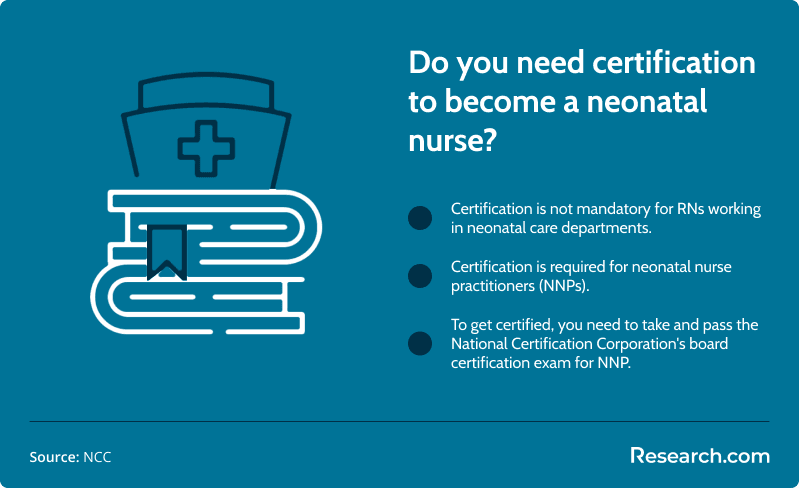
A Neonatal Nurse Practitioner, or NNP, is an advanced practice registered nurse who manages high-risk newborns and infants. NNPs may assess patients, order and interpret diagnostic tests, prescribe medications where allowed, participate in delivery room resuscitation, and perform advanced NICU procedures under applicable regulations and clinical protocols. To become an NNP, nurses need graduate education in neonatal care and must pass the appropriate national certification exam.
What makes neonatal nursing a good career?
Neonatal nursing is meaningful, but it is not easy. The work can be emotionally heavy, technically demanding, and physically tiring. It may involve caring for critically ill infants, supporting parents during frightening moments, and coping with loss. For the right person, however, the combination of specialized clinical work and family-centered care can make the profession deeply fulfilling.
| Potential advantage | Why it matters | Important reality check |
| Specialized patient care | You work with newborns who need precise, developmentally appropriate care during a vulnerable stage of life. | The margin for error is small, so careful practice and strong documentation are essential. |
| Strong clinical learning curve | NICU practice builds skills in monitoring, medication safety, respiratory support, feeding, and emergency response. | New nurses may need time, mentorship, and structured orientation before feeling confident. |
| Team-based practice | Neonatal care depends on collaboration with physicians, APRNs, therapists, pharmacists, lactation professionals, and families. | Communication problems can affect care quality, so teamwork is not optional. |
| Advancement options | Experienced nurses can pursue NICU certification, charge nurse roles, transport, education, management, MSN, DNP, or NNP pathways. | Advanced practice and leadership roles require additional education, experience, certification, and often significant cost. |
| Meaningful family impact | Neonatal nurses support parents during one of the most stressful periods of their lives. | Emotional boundaries and self-care are necessary for long-term sustainability. |
This career may be a good fit if you enjoy detailed assessment, fast-changing clinical situations, family education, and collaborative care. It may not be ideal if you prefer predictable routines, minimal emotional intensity, or limited exposure to high-acuity patients.
Neonatal nursing also offers advancement routes for nurses entering from different starting points. For example, licensed practical nurses who want RN-level neonatal roles may consider online LPN to BSN pathways if they need a bachelor’s route into registered nursing. After building neonatal experience, nurses who want advanced practice can pursue graduate preparation and eventually qualify for neonatal nurse practitioner roles.
What skills and qualities does a neonatal nurse need?
Neonatal nurses need more than an interest in caring for babies. They must combine technical competence with patience, emotional control, and clear communication. Because newborns cannot explain symptoms, nurses must rely on careful observation, clinical judgment, data trends, and team communication.
- Technical nursing skills: Neonatal nurses use specialized equipment, administer medications, monitor vital signs, assist with respiratory support, and perform procedures appropriate to their training and scope.
- Critical thinking: Small clinical changes can be significant in newborns, so nurses must recognize patterns, escalate concerns, and respond quickly during emergencies.
- Medication precision: Neonatal medication dosing requires close attention because infants are small and medically fragile.
- Communication: Nurses must explain care plans to families in understandable language while also giving concise, accurate updates to clinicians.
- Family-centered care: Parents may feel frightened, guilty, confused, or overwhelmed. Neonatal nurses help them participate safely in care when possible.
- Documentation: Accurate charting of assessments, interventions, feeding, medications, and patient response is a core safety responsibility.
- Emotional resilience: NICU work can involve emergencies, setbacks, and loss. Nurses need healthy coping strategies and supportive teams.
- Attention to detail: Equipment settings, IV rates, feeding schedules, and assessment findings must be checked carefully.
- Collaboration: Neonatal care is interdisciplinary, so nurses must work effectively with professionals across specialties.
How to Become a Neonatal Nurse
The pathway to neonatal nursing starts with becoming a registered nurse. From there, you build newborn or NICU experience, pursue relevant certifications, and decide whether you want to remain in bedside practice or move into advanced practice, education, leadership, or transport.
- Earn an accredited nursing degree. Complete an ADN or BSN program that prepares you for RN licensure. The minimum academic route is typically an Associate Degree in Nursing, but many employers prefer a Bachelor of Science in Nursing. Students comparing options can start with a broader guide to the nursing major.
- Pass the NCLEX-RN. After graduation, you must pass the National Council Licensure Examination for Registered Nurses to become licensed as an RN.
- Apply for neonatal-related roles. Look for positions in newborn nursery, postpartum, labor and delivery, pediatric, step-down neonatal, or NICU units. Some hospitals hire new graduates into NICU residency programs, while others prefer prior RN experience.
- Develop NICU-specific competencies. Build confidence with feeding support, thermoregulation, oxygenation, neonatal assessment, infection prevention, medication safety, family education, and emergency response.
- Consider specialty certification. The CCRN Neonatal credential is designed for RNs and APRNs who care for acutely or critically ill newborns. Certification is not always required, but it can demonstrate specialty competence.
- Plan for advancement if desired. If your goal is NNP practice, leadership, education, or advanced clinical authority, compare MSN, DNP, bridge, and post-master’s options carefully.
LPNs generally do not qualify for RN-level neonatal nurse roles without becoming registered nurses first. LPNs who want to move into neonatal RN practice can explore online LPN to RN programs as one possible transition route.
For CCRN Neonatal eligibility, nurses need an unencumbered RN or APRN license and either two years of RN or APRN experience with 1,750 hours of direct acute or critical care for newborn patients, or five years of RN or APRN experience with at least 2,000 hours caring for acutely or critically ill newborns.
How much do neonatal nurses in the United States make?
The average annual salary for neonatal nurses in the United States is $71,497 as of September 2023, equal to an average hourly rate of $34.37. Reported salaries range from $41,000 to $122,000, depending on factors such as location, employer, education, experience, shift differentials, and level of specialization.
For comparison, the mean annual wage for registered nurses overall is $89,010. Nurse practitioners, a category that includes NNPs, earn an average of $124,680 per year, or $59.94 per hour. These figures should not be treated as guarantees because actual pay depends heavily on region, facility type, credentials, overtime, union agreements, and role responsibilities.
According to Zippia, the highest-paying states for neonatal nurses are Washington, California, and Pennsylvania.
| Role or category | Salary figure stated | How to interpret it |
| Neonatal nurse | $71,497 average annual salary as of September 2023 | A specialty-specific estimate that may vary widely by market and source. |
| Registered nurses overall | $89,010 mean annual wage | A broad RN benchmark that includes many practice areas, not only neonatal care. |
| Nurse practitioners overall | $124,680 average annual salary, or $59.94 per hour | A broader APRN category that includes neonatal nurse practitioners but is not limited to them. |
What does advanced education mean for neonatal nurses?
Advanced education allows neonatal nurses to move beyond RN bedside roles into advanced practice, leadership, quality improvement, education, administration, or specialized clinical positions. The most common graduate route for advanced neonatal practice is an MSN or DNP with neonatal nurse practitioner preparation.
Neonatal Nurse Practitioners are APRNs who care for high-risk newborns, including premature infants and babies with infections, cardiac abnormalities, respiratory complications, or other serious conditions. To practice as an NNP, nurses must complete the required graduate education and pass the National Certification Corporation exam for neonatal nurse practitioners.
An MSN can prepare nurses for advanced clinical responsibilities, while a DNP may support higher-level clinical leadership, systems improvement, and administrative roles. DNP-prepared NNPs may work in direct care and may also hold leadership positions such as NICU management or broader hospital service oversight, depending on experience, employer requirements, and state regulations.
Advanced neonatal practice may include attending high-risk deliveries, evaluating diagnostic and clinical data, performing advanced assessments, managing critically ill and intermediate-care neonates, educating caregivers, and carrying out advanced procedures such as delivery room resuscitation, lumbar puncture, intubation and non-invasive respiratory management, umbilical line placement and suturing, and pleural needle aspiration when allowed by role and clinical policy.
Working nurses who want graduate preparation can compare flexible routes such as the best RN to MSN programs, but they should confirm clinical placement requirements, state authorization, accreditation, and whether the program prepares graduates for the exact credential they need.
What are the educational pathways to specialize in neonatal care?
Your best education pathway depends on your current credentials, timeline, budget, and target role. A nurse who wants to work as a neonatal RN may not need the same degree as someone planning to become an NNP, nurse educator, manager, or DNP-prepared clinical leader.
| Pathway | Typical purpose | Timeframe stated | Best fit |
| ADN to RN | Entry into registered nursing and possible neonatal RN employment. | Two years | Students who want the shortest standard RN academic route and are willing to build experience after licensure. |
| BSN to RN | Broader nursing preparation and stronger alignment with hospitals that prefer bachelor’s-prepared nurses. | Four years | Students targeting competitive hospital or NICU roles. |
| RN to BSN | Bachelor’s completion for licensed RNs. | Varies by program | ADN-prepared RNs who want stronger employment or advancement options. |
| RN to MSN or ADN to MSN | Graduate-level progression without following a traditional BSN-first sequence. | Bridge routes vary; ADN to NP bridge programs may take two to three years. | Experienced RNs who want advanced roles and meet admission requirements. |
| MSN with neonatal focus | Preparation for NNP certification and advanced practice responsibilities. | At least two more years after RN preparation, as stated. | Neonatal nurses seeking APRN practice. |
| DNP | Advanced clinical leadership, systems practice, and doctoral-level nursing preparation. | Varies by program | Nurses who want the highest practice-focused nursing credential for leadership or advanced practice. |
Online and hybrid programs can make continued education more realistic for working nurses, but neonatal students should read the fine print. Clinical requirements are usually in person, and online coursework does not remove the need for supervised practice. If affordability is a major concern, comparing low-cost RN to MSN online options can help you narrow choices before applying.
How long does it take to become a neonatal nurse?
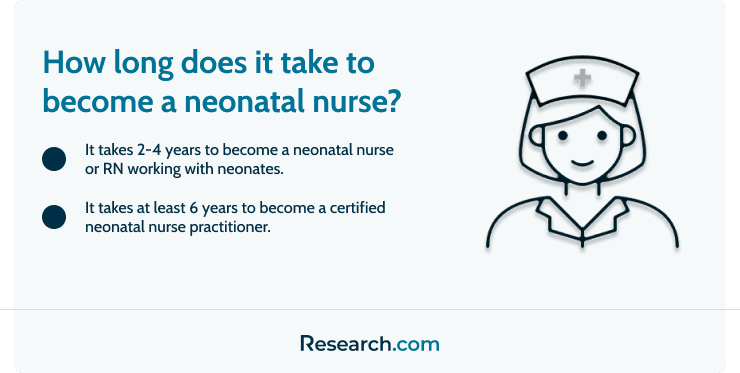
You can become eligible for entry-level neonatal RN roles in two to four years, depending on whether you complete an ADN or BSN before passing the NCLEX-RN. An ADN can prepare you for RN licensure in two years, while a BSN generally takes four years.
After RN licensure, nurses who want CCRN Neonatal certification need the required neonatal acute or critical care experience and hours. The eligibility options include two years of RN or APRN experience with 1,750 hours of direct acute or critical care for newborn patients, or five years of RN or APRN experience with at least 2,000 hours caring for acutely or critically ill newborns.
Becoming an NNP takes longer because it requires graduate education. An MSN route adds at least two more years. Some ADN to NP bridge programs allow qualified nurses to move from associate-level preparation toward graduate practice in just two to three years, but admission requirements, clinical hours, and state eligibility should be checked carefully.
How Can I Transition to Advanced Neonatal Nursing Roles?
Moving from bedside neonatal nursing into advanced practice or leadership requires more than simply accumulating years of experience. Start by identifying the role you actually want: NNP, charge nurse, nurse educator, clinical specialist, transport nurse, unit manager, quality improvement leader, or DNP-prepared executive. Each option has different education, certification, and experience expectations.
- Build a strong clinical base. Seek exposure to higher-acuity patients, complex feeding cases, respiratory support, family education, and interdisciplinary rounds.
- Ask for structured feedback. Preceptors, charge nurses, NNPs, and nurse managers can identify gaps before you apply for advanced programs.
- Pursue relevant certification. Specialty certification can demonstrate commitment and may support advancement discussions.
- Compare graduate pathways. Nurses with a BSN who want APRN preparation can review options such as a BSN to nurse practitioner pathway.
- Confirm licensure and certification alignment. Do not enroll in a program until you verify that it supports your intended state and role.
What is the job outlook for neonatal nurses?
The outlook for neonatal nurses is tied to broader RN and nurse practitioner demand, hospital staffing needs, the availability of NICU services, and the continued need for specialized care for premature and medically complex newborns. Technology also allows care teams to manage highly fragile infants, which can increase the need for nurses who understand advanced neonatal equipment and protocols.
Employment of RNs overall is projected to grow 5% to 8% from 2022 to 2032, with projected job openings of 193,100 each year over that 10-year period, according to O*NET OnLine 2022. Nurse practitioner employment overall is projected to grow 9% or higher from 2022 to 2032, with projected job openings of 26,300 each year over the same period, according to O*NET OnLine.
The National Certification Corporation also reported growing NNP certification interest across recent years, with 348 NNP candidates applying for certification in 2020, 471 candidates in 2021, and 435 candidates in 2022.
For job seekers, the strongest opportunities often go to nurses who can show relevant clinical experience, specialty training, strong references, comfort with high-acuity care, and willingness to work shifts that hospitals need to staff.
What are the common challenges neonatal nurses face in their careers?
Neonatal nursing is rewarding, but the work can be difficult to sustain without support, realistic expectations, and healthy boundaries. Before choosing this specialty, consider the challenges as seriously as the benefits.
- Emotional strain: Nurses may care for infants with severe complications, uncertain outcomes, or end-of-life needs. Supporting families through those moments can be exhausting.
- Physical demands: Long shifts, constant movement, alarms, repositioning, and procedural support can contribute to fatigue.
- High patient acuity: NICU nurses manage fragile patients who may require ventilators, IV therapy, specialized feedings, and rapid intervention.
- Pressure to make quick judgments: Changes in newborn status can be subtle, so nurses must respond to data trends and clinical signs without delay.
- Complex family communication: Parents need honest explanations, emotional support, and practical teaching, often while they are scared or overwhelmed.
- Shift work and burnout risk: Nights, weekends, holidays, and overtime can affect sleep, family life, and long-term well-being.
Strong orientation, mentorship, peer support, continuing education, debriefing after difficult cases, and personal self-care practices can help neonatal nurses remain effective and resilient.
Can I become a neonatal nurse if I am not currently a nurse?
Yes. If you are not already a nurse, your first goal is to become eligible for RN licensure. Students without a nursing background can pursue an ADN or BSN, while those who already hold a bachelor’s degree in another field may qualify for accelerated nursing pathways. Program names and formats vary, so compare admissions requirements, clinical placement expectations, accreditation, NCLEX preparation, and total cost.
If you are exploring entry routes, Research.com’s guide to online nursing programs for non-nurses can help you compare possible starting points. Remember that online coursework does not mean clinical training is optional; nursing licensure requires supervised hands-on experience.
How Can Clinical Residency Programs Bridge the Gap Between Theory and Practice in Neonatal Nursing?
Clinical residency programs can help new nurses move from classroom learning into real neonatal practice. A strong residency typically combines supervised patient care, preceptor guidance, simulation, skills checkoffs, case discussions, feedback, and gradual exposure to more complex assignments.
For neonatal nursing, residency can be especially useful because NICU care involves specialized equipment, fragile patients, and fast-changing clinical scenarios that are difficult to master through coursework alone. Nurses should ask hospitals how long the residency lasts, how preceptors are assigned, what competencies must be completed, whether new graduates can enter the NICU directly, and how the unit supports nurses after orientation.
Students still choosing a school can also compare admissions options through resources such as nursing schools with higher acceptance rates, but acceptance rate should never be the only deciding factor. Accreditation, NCLEX preparation, clinical quality, and neonatal placement opportunities matter more for career readiness.
What Other Educational Opportunities Can Enhance My Career as a Neonatal Nurse?
Neonatal nurses can strengthen their practice through continuing education in lactation support, developmental care, respiratory care, pharmacology, infection prevention, bereavement support, quality improvement, simulation, and family communication. The best choice depends on the role you want next.
Some nurses also explore related imaging or diagnostic fields to better understand procedures used in infant care. For example, students interested in ultrasound-related knowledge may review accelerated sonography programs. This type of education is not a substitute for neonatal nursing preparation, but it may broaden understanding for nurses working closely with diagnostic teams.
Can dual degree programs expand my leadership opportunities in neonatal nursing?
Dual degree programs may be useful for neonatal nurses who want leadership roles that combine clinical knowledge with budgeting, staffing, operations, and strategy. A combined MSN and MBA can prepare nurses to understand both patient care and healthcare administration, which may be valuable for nurse managers, directors, service-line leaders, or quality improvement professionals.
These programs are not necessary for every neonatal nurse. They make the most sense if you are intentionally moving away from full-time bedside care toward management or organizational leadership. Nurses comparing this route can review online MSN MBA programs and should evaluate tuition, workload, accreditation, clinical requirements, and employer tuition assistance.
Are accelerated advanced nursing degree programs right for my career?
Accelerated advanced nursing programs can shorten the time needed to earn a graduate or doctoral credential, but they are not automatically easier. Condensed programs often require heavier course loads, strict sequencing, and excellent time management. They may be a good fit for nurses with strong clinical experience, clear career goals, and reliable support at work and home.
If your goal is advanced neonatal practice, leadership, or doctoral-level preparation, compare program outcomes, clinical placement support, certification alignment, and total cost before choosing speed. Nurses considering a faster doctoral route can explore accelerated MSN to DNP programs as one possible option.
How can post-master's acute care NP online programs enhance my neonatal practice?
Post-master's programs can help nurses who already hold graduate nursing credentials expand their clinical preparation or shift into a new specialty area. For neonatal nurses, the value depends on whether the certificate aligns with the population, setting, certification exam, and state practice requirements relevant to their goals.
Online coursework may offer flexibility, but clinical practice requirements are still a major consideration. Before enrolling, ask whether the program supports neonatal or acute care goals, how clinical placements are arranged, and whether graduates qualify for the certification you intend to pursue. Nurses comparing certificate routes may review post-master's acute care NP online programs while confirming fit with neonatal practice needs.
What financial aid options are available for advancing my neonatal nursing education?
Advanced nursing education can be expensive, especially for nurses pursuing BSN completion, MSN, DNP, or post-master’s certificates while working. The best strategy is to compare the full cost of attendance, not only tuition. Fees, books, clinical travel, background checks, uniforms, technology charges, and reduced work hours can all affect affordability.
- Employer tuition assistance: Many hospitals offer reimbursement or tuition benefits, sometimes in exchange for a work commitment.
- Scholarships and grants: Nursing schools, hospitals, professional associations, and foundations may offer awards for nursing students or practicing nurses.
- Federal student aid: Eligible students should complete the FAFSA and compare loan terms carefully before borrowing.
- Payment plans: Some schools allow tuition to be divided across the term.
- Affordable program comparison: Lower-cost options may reduce debt, but students should still verify accreditation and outcomes.
RNs seeking a flexible bachelor’s completion route can compare options such as the easiest RN-to-BSN programs to get into, but “easy to enter” should not replace careful review of quality, accreditation, clinical expectations, and employer recognition.
What are the certification options for neonatal nurses?
Certification can help neonatal nurses demonstrate specialty knowledge, prepare for advancement, and show commitment to high-acuity newborn care. Requirements differ by credential, so always confirm eligibility with the certifying organization before paying for an exam or review course.
| Certification | Who it is for | How it may support a neonatal career |
| Neonatal Intensive Care Nursing (RNC-NIC) | RNs focused on NICU nursing. | Shows specialized knowledge in caring for critically ill newborns. |
| Certified Pediatric Nurse (CPN) | Nurses who want a broader pediatric credential. | May be useful for nurses whose work includes infants and children beyond the neonatal period. |
| Critical Care Registered Nurse (CCRN) – Neonatal | Experienced nurses caring for acutely or critically ill newborns. | Can strengthen qualifications for high-acuity NICU practice and advanced clinical opportunities. |
| Neonatal Nurse Practitioner certification | Graduate-prepared nurses seeking NNP practice. | Required for nurses who want to practice as board-certified neonatal nurse practitioners. |
Certification is most valuable when it matches your actual role. A nurse working in a Level I nursery may need different professional development than a nurse in a Level IV NICU or an NNP managing critically ill infants. If you are comparing flexible education options beyond neonatal-specific programs, you may also encounter unrelated nursing certificate guides such as affordable online PMHNP certificate programs; use those only when they match your intended specialty.
How to choose the right neonatal nursing program or pathway
Before enrolling in any nursing program, compare it against your career goal. A program that is good for RN entry may not prepare you for NNP certification, and a general NP program may not qualify you for neonatal advanced practice. Use the questions below to avoid costly mismatches.
- Is the program accredited? Accreditation affects licensure eligibility, transfer credit, employer recognition, and graduate school admission.
- Does the program meet your state’s licensing rules? Online programs may not be authorized in every state.
- Does it prepare you for the credential you want? NNP programs should align with neonatal nurse practitioner certification requirements.
- How are clinical placements handled? Ask whether the school finds placements or expects students to secure them independently.
- What neonatal experience is available? For entry-level students, clinical exposure to maternity, newborn, pediatric, or NICU settings can be valuable.
- What is the total cost? Include tuition, fees, travel, supplies, exams, and lost income from reduced work hours.
- What support exists for working nurses? Consider part-time options, online coursework, faculty availability, and schedule flexibility.
Common mistakes to avoid
| Mistake | Why it can hurt you | Better approach |
| Choosing a program without checking accreditation. | You may face licensure, transfer, certification, or employer recognition problems. | Verify accreditation and state approval before applying. |
| Assuming every online program fits neonatal career goals. | Some programs are general nursing programs and may not prepare you for NICU or NNP roles. | Match the curriculum, clinicals, and certification outcomes to your target role. |
| Focusing only on tuition. | Fees, clinical travel, reduced work hours, and exam costs can change affordability. | Calculate the full cost of attendance and compare financial aid options. |
| Expecting certification to replace experience. | Specialty credentials usually require relevant clinical practice and do not substitute for competence. | Build strong bedside skills first, then pursue certification when eligible. |
| Assuming salary outcomes are guaranteed. | Pay varies by state, hospital, shift, experience, union status, and role. | Research local job postings and talk with nurses in your target market. |
| Ignoring emotional fit. | NICU work can involve grief, emergencies, and family distress. | Shadow if possible, ask about unit culture, and evaluate your coping strategies honestly. |
References:
- United States Bureau of Labor Statistics. (2023, April 25). Occupational Employment and Wages, May 2022 | 29-1141 Registered Nurses. BLS.
- United States Bureau of Labor Statistics. (2023, April 25). Occupational Employment and Wages, May 2022 | 29-1171 Nurse Practitioners. BLS.
- O*NET OnLine. (2023). Registered Nurses 29-1141.00. O.NET OnLine.
- O*NET OnLine. (2023). Nurse Practitioners 29-1171.00. O.NET OnLine.
- National Certification Corporation. (2022). Exam Results 2017 to 2022. NCC.
Other Things You Should Know About Neonatal Nurses
Neonatal nurses must pass the NCLEX-RN after completing an approved nursing program. After licensure, optional specialty certification through the RNC-NIC exam from the National Certification Corporation can strengthen credentials for NICU practice. Some employers also require Basic Life Support and Neonatal Resuscitation Program training.
To become a neonatal nurse in 2027, candidates typically need a Bachelor of Science in Nursing (BSN). After obtaining their degree, they must pass the NCLEX-RN exam to be licensed as a Registered Nurse (RN). Additional clinical training in neonatal care or certifications, such as the Neonatal Resuscitation Program (NRP), may also be required.
Becoming a neonatal nurse in 2027 typically takes about four years. This includes obtaining a Bachelor of Science in Nursing (BSN), which generally requires four years of study, followed by obtaining licensure and potentially completing additional certifications in neonatal care.