2027 How to Become a Nurse in Indiana

Co-Founder and Chief Data Scientist
Becoming a nurse in Indiana requires choosing the right license level, completing an approved nursing program, passing the correct NCLEX exam, and applying through the Indiana Board of Nursing. The decision matters because your starting credential, program type, and long-term education plan can affect how quickly you enter the workforce, what responsibilities you can take on, and whether you can later move into advanced practice. This guide explains the Indiana nursing pathway for future LPNs, RNs, APRNs, nurse practitioners, nurse midwives, and nurses considering online or bridge programs.
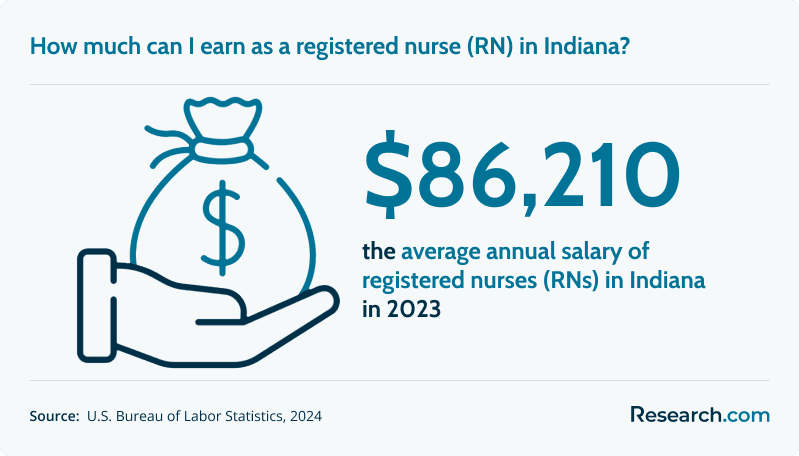
Indiana had around 68,850 registered nurses (RNs) in 2023, with an average annual salary of $82,700. The state’s nursing labor market remains important for students because registered nurse employment is projected to grow 5.4% through 2032, with around 4,090 job openings annually. Below, you will learn how licensure works, which education options make sense for different goals, what mistakes to avoid, and how to compare nursing programs before enrolling.
Quick Answer: How Do You Become a Nurse in Indiana?
To become a nurse in Indiana, you generally need to complete a state-approved nursing education program, pass the appropriate NCLEX exam, complete the required background check and fingerprinting process, and apply for licensure through the Indiana Professional Licensing Agency and Indiana Board of Nursing. LPN candidates usually complete a practical nursing program and take the NCLEX-PN. RN candidates complete either an Associate Degree in Nursing (ADN) or Bachelor of Science in Nursing (BSN) program and take the NCLEX-RN. Advanced practice roles require graduate education, national certification, and additional state recognition.
Key Facts About Nursing Careers in Indiana
- In 2023, there were around 68,850 registered nurses (RNs) in Indiana.
- According to the Indiana Center for Nursing, the state is projected to need an additional 20,000 nurses by 2025.
- The average salary for registered nurses in Indiana was approximately $82,700 per year in 2023.
- The employment outlook for nurses in Indiana is promising, with the Bureau of Labor Statistics projecting a 7% growth in nursing jobs over the next decade.
- Indiana offers several entry points into nursing, including Licensed Practical Nurse (LPN), Associate Degree in Nursing (ADN), and Bachelor of Science in Nursing (BSN) pathways.
- What are the steps to becoming a nurse in Indiana?
- What are the educational requirements for becoming a nurse in Indiana?
- What types of nurses can legally practice in Indiana?
- What are the licensing requirements for nurses in Indiana?
- What types of nursing licenses are available in Indiana?
- Can a Compact nurse practice in Indiana?
- Can you practice as a nurse without a license in Indiana?
- What options are available for LPN programs in Indiana?
- Can expanding your healthcare career to pharmacy improve your options in Indiana?
- Is an online accelerated pathway right for advanced practice in Indiana?
- What are the nurse practitioner education requirements in Indiana?
- What should you consider when choosing a nursing education program in Indiana?
- How can nursing professionals explore alternative healthcare roles in Indiana?
- What are the career pathways for LVNs in Indiana?
- Is enrolling in online nursing programs a strategic career move in Indiana?
- What can nurses do to stay current with evolving licensure standards in Indiana?
- Which nursing education programs in Indiana best prepare you for a successful career?
- How can I specialize as a nurse midwife in Indiana?
- What is the state of nursing in Indiana?
- What is the job outlook for nursing in Indiana?
- How Indiana supports professional development for nurses
What are the steps to becoming a nurse in Indiana?
The Indiana nursing pathway is straightforward, but the best route depends on the role you want. Someone who wants to enter the workforce quickly may choose an LPN program. Someone aiming for broader responsibilities, hospital roles, leadership, or graduate school may be better served by an RN pathway, especially a BSN.
| Step | What you need to do | Why it matters |
| 1. Choose a nursing role | Decide whether you want to become an LPN, RN, APRN, nurse practitioner, nurse midwife, or another nursing professional. | Your goal determines the program length, NCLEX exam, clinical training, and license application process. |
| 2. Meet admissions requirements | Complete high school or a GED and satisfy any science, math, GPA, entrance exam, background check, immunization, or prerequisite requirements set by the school. | Nursing programs are selective, and missing prerequisites can delay admission. |
| 3. Complete an approved program | Finish a practical nursing program for LPN licensure, an ADN or BSN for RN licensure, or graduate education for advanced practice. | Indiana requires formal nursing education before licensure. |
| 4. Pass the NCLEX | Take the NCLEX-PN for LPN licensure or the NCLEX-RN for RN licensure. | Passing the exam is required before you can receive a nursing license. |
| 5. Apply for Indiana licensure | Submit the application, required documents, fees, and criminal background check materials through the state licensing process. | Education and exam completion alone do not authorize independent nursing practice. |
| 6. Keep your license active | Track renewal deadlines, continuing education expectations, and updates from the Indiana Board of Nursing. | Failure to renew or meet state requirements can interrupt your ability to work legally. |
If you are exploring practical nursing first, review whether an online or hybrid option can meet clinical requirements before assuming it will work for you. Students comparing entry-level practical nursing routes can also research options to become an LPN online.
In 2023, there were around 68,850 registered nurses (RNs) in Indiana, earning around $82,700 per year on average.
What are the educational requirements for becoming a nurse in Indiana?
Indiana’s nursing education requirements vary by license level. The main question is whether you want the fastest entry into bedside care, the broadest RN employment options, or a long-term path into advanced practice.
| Goal | Typical education route | Best fit | Trade-off to consider |
| Licensed Practical Nurse | One-year diploma program | Students who want a shorter route into direct patient care under supervision | Scope of practice and advancement options are more limited than RN roles. |
| Registered Nurse through ADN | Two-year Associate Degree in Nursing | Students who want to become RNs more quickly and may later complete a BSN | Some employers may prefer or require a BSN for certain roles. |
| Registered Nurse through BSN | Four-year Bachelor of Science in Nursing | Students targeting hospitals, leadership, public health, specialty units, or graduate study | It usually requires more time before initial licensure than an ADN. |
| Advanced Practice Nurse | Master of Science in Nursing | RNs who want advanced clinical responsibilities, specialization, or national certification | Graduate school requires additional time, clinical hours, and cost planning. |
| Doctorally prepared nurse | Ph.D. or DNP | Nurses interested in research, advanced practice leadership, systems improvement, or academic roles | The Ph.D. and DNP serve different purposes, so choose based on research versus practice goals. |
For LPNs, the standard education route is a one-year diploma program focused on foundational nursing care, medication administration, patient monitoring, and clinical skills. For RNs, the two common entry points are the ADN and BSN. The ADN can help you qualify for RN licensure sooner, while the BSN provides a broader undergraduate education that may support long-term mobility.
Students planning to become advanced practice nurses, including nurse practitioners and clinical nurse specialists, usually need an MSN. Graduate coursework often includes advanced health assessment, pharmacology, pathophysiology, evidence-based practice, and specialty clinical preparation. If you are comparing family nurse practitioner certifications, it is useful to understand what the difference is between FNP-C and FNP-BC.
Nurses who want doctoral preparation can pursue either a Ph.D. or a DNP. A Ph.D. is generally associated with research and scholarship, while a DNP is practice-focused. Experienced nurses who need a flexible route may compare the shortest DNP programs online, but they should still verify accreditation, clinical placement expectations, and state authorization.
- Accreditation should be a non-negotiable requirement. Indiana nursing students should confirm that their program is properly approved and accredited by recognized organizations such as NLNAC or CCNE when applicable.
- Clinical placement matters as much as online convenience. A program that fits your schedule is not enough if it cannot provide required supervised clinical experience.
- Your first credential should support your next credential. If you plan to move from LPN to RN, RN to BSN, or RN to advanced practice, ask how credits transfer before enrolling.
What types of nurses can legally practice in Indiana?
Indiana recognizes several nursing roles, each with its own training, licensing, and scope of practice. Before choosing a program, make sure the credential matches the type of care you want to provide.
- Registered Nurses (RNs): RNs complete an accredited nursing program, usually an ADN or BSN, and pass the NCLEX-RN. As of 2022, the Indiana State Board of Nursing reported over 100,000 licensed RNs in the state. RNs assess patients, coordinate care, administer treatments, educate patients, and often supervise other care team members.
- Licensed Practical Nurses (LPNs): LPNs complete a state-approved practical nursing program and pass the NCLEX-PN. The Indiana Board of Nursing reported approximately 20,000 LPNs in the state. LPNs provide direct care, monitor patients, administer certain medications, and work under the supervision of RNs or physicians.
- Advanced Practice Registered Nurses (APRNs): APRNs include nurse practitioners, clinical nurse specialists, nurse anesthetists, and nurse midwives. Indiana had over 8,000 licensed APRNs, reflecting the growing role of advanced nursing practice. APRNs generally need graduate education and national certification in their specialty.
- Certified Nursing Assistants (CNAs): CNAs are not licensed nurses, but they are important members of the care team. They complete state-approved training and a competency exam to provide basic patient support.
A student who wants the fastest route into hands-on care may start as a CNA or LPN. A student who wants broader clinical judgment, specialty practice, or eventual graduate study may start with an ADN or BSN. Nurses planning advanced practice can later compare flexible doctoral options, including easiest DNP program choices, while remembering that “easy” should never replace proper accreditation and clinical quality.
Bridge programs may also help nurses move upward. For example, an LPN may later pursue an RN credential through options such as 6 month LPN to RN program online pathways, but students should verify whether the timeline, clinical requirements, and state approval fit their situation.
In 2023, nurse anesthetists were the highest-earning nurses in the state with an average yearly salary of $207,180. See the chart below for more salary information.
What are the licensing requirements for nurses in Indiana?
Indiana nursing licensure is controlled by state rules and administered through the Indiana Professional Licensing Agency and Indiana Board of Nursing. The exact documents and fees may vary by application type, but the core requirements are consistent: approved education, examination, background screening, and state application approval.
- Graduate from the required nursing program. LPN candidates complete practical nursing education. RN candidates complete an ADN or BSN program. Advanced practice candidates complete graduate-level nursing education for their specialty.
- Apply for authorization and take the NCLEX. LPN candidates take the NCLEX-PN, and RN candidates take the NCLEX-RN.
- Complete the criminal background check. Indiana requires fingerprinting and background review, including checks through the Indiana State Police and the FBI.
- Submit the state licensure application. Candidates must provide required information, documents, and fees through the appropriate state process.
- Wait for license approval before practicing. Passing a program or exam does not by itself give you permission to practice as a nurse.
Applicants should budget for more than tuition. Licensing expenses can include application fees, NCLEX registration, background checks, fingerprinting, exam preparation resources, uniforms, immunizations, supplies, and transportation to clinical sites. These costs can total several hundred dollars, so students should ask schools for a full cost breakdown before enrolling.
What types of nursing licenses are available in Indiana?
Indiana nursing credentials differ by scope of practice, education level, and supervision requirements. Understanding these differences can prevent costly mistakes, such as enrolling in a program that does not lead to the license you actually need.
| Credential or license | Education level described | Typical scope | Best for |
| Licensed Practical Nurse (LPN) | One-year training program | Basic nursing care, patient monitoring, medication support, and daily care assistance under supervision | Students seeking a shorter entry route into nursing care |
| Registered Nurse (RN) | ADN or BSN | Patient assessment, care planning, clinical coordination, education, treatments, and broader nursing judgment | Students who want a wider range of nursing roles and advancement options |
| Nurse Midwife | Advanced nursing education, typically a master's degree, plus certification | Prenatal, delivery, postnatal, reproductive, and women’s health care | RNs interested in maternity and reproductive health specialization |
| Advanced Practice Registered Nurse (APRN) | Master’s degree or higher | Advanced assessment, diagnosis, prescribing authority, specialty care, and patient management | Experienced nurses pursuing nurse practitioner, clinical specialist, nurse anesthetist, or nurse midwife roles |
| Nurse Licensure Compact (NLC) | Applies to eligible RNs and LPNs | Practice across participating Compact states under one multistate license | Nurses who may work across state lines or relocate among Compact states |
Some nurses also add related healthcare credentials to broaden their work options. For example, a nurse interested in prevention, wellness, food systems, or patient education may compare affordable online nutrition degree programs. Before adding any credential, consider whether it supports your intended role, employer expectations, and licensure goals.
In 2023, there were around 68,850 RNs, 13,580 LPNs, and 6,740 NPs in the state. See the chart below for the employment levels of the most common nursing occupations.
Can a Compact nurse practice in Indiana?
Yes. Indiana participates in the Nurse Licensure Compact, so an eligible nurse with a Compact license from another participating state can practice in Indiana without obtaining a separate Indiana license. This is especially useful for nurses who live near state borders, accept travel assignments, relocate, or provide care across state lines.
Compact practice is not a free pass to ignore Indiana rules. A Compact nurse practicing in Indiana must understand Indiana’s nursing regulations, scope of practice expectations, employer requirements, and any setting-specific policies. If your primary state of residence changes, your licensing obligations may also change.
- Good fit: Nurses who need cross-state mobility and hold a valid multistate license.
- Use caution: Nurses moving permanently to Indiana should confirm whether they must update their primary state of residence and license status.
- Practical step: Verify Compact status and state requirements before accepting a job or travel contract in Indiana.
Can you practice as a nurse without a license in Indiana?
No. You cannot legally practice as a nurse in Indiana without the appropriate license. Nursing licensure protects patients by confirming that a person has completed required education, passed the required exam, and met state screening requirements.
- Legal risk: Unlicensed nursing practice can result in penalties and may affect future eligibility for healthcare employment.
- Patient safety risk: Nursing involves clinical judgment, medication knowledge, documentation, and escalation of care. Unqualified practice can harm patients.
- Career risk: Employers, licensing boards, and credentialing bodies take unlicensed practice seriously.
Students may work in support roles while in school if the role is allowed by law and employer policy, but they should not represent themselves as licensed nurses or perform duties outside their authorized role. If you are unsure whether a task is permitted, ask the employer, program director, or licensing authority before doing it.
What options are available for LPN programs in Indiana?
LPN programs in Indiana are designed for students who want a shorter path into nursing care. When comparing programs, look beyond the headline length. The most important questions are whether the program is state-approved, whether clinical placements are available, how NCLEX-PN preparation is handled, and whether credits can later apply toward an RN bridge program.
Students who need flexibility can compare campus, hybrid, and online-supported options. However, practical nursing cannot be completed through coursework alone; hands-on clinical training is central to licensure preparation. If you are ready to compare schools, Research.com’s guide to online LPN programs in Indiana can help you identify programs that fit your schedule and career goals.
Can expanding your healthcare career to pharmacy improve your options in Indiana?
Some nurses and healthcare professionals consider pharmacy-related education because medication safety, patient counseling, and interprofessional care are major parts of healthcare delivery. This does not mean every nurse should become a pharmacist. It may make sense if you are interested in medication therapy, clinical pharmacy collaboration, healthcare systems, or a major career pivot.
Before choosing this route, compare the time, prerequisites, licensure requirements, and opportunity cost against nursing advancement options such as BSN completion, MSN study, or APRN certification. If pharmacy is a serious goal, review the pathway for how to become a pharmacist in Indiana.
Is an online accelerated pathway right for advanced practice in Indiana?
Online accelerated nurse practitioner programs can appeal to working RNs who want to move into advanced practice without leaving employment. The right program can reduce scheduling friction, but acceleration is not automatically better. Advanced practice education must still include rigorous graduate coursework, supervised clinical preparation, and alignment with Indiana licensure expectations.
Accelerated online pathways may be appropriate if you already have strong nursing experience, reliable time for intensive study, access to approved clinical sites, and a clear specialty goal. They may be a poor fit if you need extensive academic support, cannot reduce work hours when clinical rotations begin, or have not confirmed state authorization. Compare options carefully through accelerated nurse practitioner programs online.
What are the nurse practitioner education requirements in Indiana?
Nurse practitioner preparation in Indiana generally requires graduate-level nursing education, advanced clinical coursework, supervised practice experiences, and national certification in the NP specialty. Coursework commonly includes advanced health assessment, pharmacology, pathophysiology, evidence-based practice, and population-focused clinical care.
The most important decision is specialty fit. Family nurse practitioner, adult-gerontology, psychiatric-mental health, pediatric, women’s health, and acute care tracks prepare nurses for different patient populations and practice settings. Students should confirm that the program’s clinical placements, faculty expertise, and certification preparation match their intended role. For a detailed pathway, see the guide to nurse practitioner education requirements in Indiana.
What should you consider when choosing a nursing education program in Indiana?
Choosing a nursing school should be treated like a career investment, not just an admissions decision. A lower tuition price or convenient schedule can become expensive if the program lacks proper approval, has weak clinical placements, or does not support licensure.
| Question to ask | Why it matters | Warning sign |
| Is the program approved for Indiana nursing licensure? | Graduation must lead to eligibility for the correct NCLEX or advanced credential process. | The school gives vague answers about licensure eligibility. |
| Is the program properly accredited? | Accreditation can affect transfer credits, graduate admission, employer confidence, and financial aid eligibility. | The school emphasizes speed but avoids naming recognized accrediting bodies. |
| Where do clinical rotations happen? | Nursing education requires supervised patient care experience. | Students must find all clinical sites alone with little support. |
| What are the full costs? | Books, fees, uniforms, testing, transportation, background checks, and supplies can add up. | The school only advertises tuition and does not provide a full cost estimate. |
| How well does the program prepare students for the NCLEX? | Licensure depends on passing the correct exam. | The school does not provide clear exam preparation support. |
| Can credits transfer into future nursing degrees? | Bridge pathways matter if you plan to move from LPN to RN, ADN to BSN, or MSN to DNP. | Transfer policies are unclear or highly restrictive. |
For advanced practice students, a streamlined route can be useful, but it should still meet licensure, accreditation, clinical, and certification standards. If you are comparing lower-friction graduate options, review the easiest nurse practitioner program choices with a careful eye toward quality and state requirements.
How can nursing professionals explore alternative healthcare roles in Indiana?
Not every nursing professional wants to remain in direct bedside care forever. Some nurses move into education, case management, quality improvement, informatics, administration, public health, compliance, or revenue-cycle roles. These options may be attractive for nurses who want to use clinical knowledge while changing pace, schedule, or responsibilities.
Medical billing and coding is one example of a healthcare-adjacent role where clinical familiarity can be useful, especially for documentation accuracy, coding context, and compliance awareness. If you are considering this shift, compare salary expectations, certification requirements, remote-work possibilities, and the degree of patient interaction before leaving clinical nursing. Research.com explains the transition in its guide on how to become a medical biller and coder in Indiana.
What are the career pathways for LVNs in Indiana?
The term Licensed Vocational Nurse is commonly associated with some states, while Indiana uses Licensed Practical Nurse. If you are researching LVN pathways in Indiana, make sure you are comparing the correct state terminology and licensing process. In practical terms, the Indiana pathway aligns with practical nursing education, NCLEX-PN preparation, and LPN licensure.
An LVN or LPN background can support several next steps: gaining experience in long-term care or clinics, completing specialty certificates, entering an LPN-to-RN bridge program, or eventually earning a BSN. If you are transferring credentials from another state or trying to understand terminology, use the guide on how to become an LVN in Indiana as a starting point and confirm current Indiana Board of Nursing requirements.
Is enrolling in online nursing programs a strategic career move in Indiana?
Online nursing programs can be a strong option for Indiana students who need flexibility, especially working adults, parents, rural students, and licensed nurses returning for a higher credential. The key distinction is that “online” usually refers to coursework delivery, not the elimination of clinical training.
| Online nursing may work well if... | It may not work well if... |
| You are self-directed and can manage deadlines without frequent in-person reminders. | You need daily face-to-face structure to stay on track. |
| The program is approved, accredited, and transparent about clinical placements. | The school cannot explain how Indiana clinical requirements are completed. |
| You already hold a nursing license and are completing a bridge or advancement degree. | You are seeking initial licensure and assume all requirements can be completed remotely. |
| Your employer may support tuition, scheduling, or clinical access. | Your work schedule leaves no room for labs, simulations, or supervised clinical hours. |
Students should compare program approval, accreditation, clinical support, cost, transfer credit, faculty access, and licensure alignment. To begin comparing flexible options, review the best online nursing programs in Indiana.
What can nurses do to stay current with evolving licensure standards in Indiana?
Nursing rules, renewal procedures, scope-of-practice expectations, and continuing education requirements can change. Indiana nurses should not rely on memory or informal advice from coworkers when license status is at stake.
- Check updates from the Indiana Board of Nursing and Indiana Professional Licensing Agency.
- Keep copies of license renewal confirmations, continuing education records, certifications, and background check documents when applicable.
- Verify requirements before changing roles, adding a multistate practice arrangement, or moving into advanced practice.
- Use employer education departments and professional associations for policy updates, but confirm legal requirements with official licensing sources.
- Review the requirements for nursing licensure in Indiana before renewal deadlines or career changes.
Which nursing education programs in Indiana best prepare you for a successful career?
The strongest nursing programs are not always the fastest or cheapest. The best fit is a program that prepares you for licensure, provides reliable clinical training, supports exam readiness, and aligns with your intended work setting. For example, a student targeting hospital RN roles may prioritize BSN pathways and acute-care clinical exposure, while a student seeking a quick entry into care may prioritize a practical nursing program with strong NCLEX-PN preparation.
When comparing schools, ask about accreditation, state approval, clinical partners, faculty qualifications, graduation support, NCLEX preparation, transfer agreements, and total program cost. If you want a starting list of strong options, review Research.com’s guide to the best nursing schools in Indiana.
How can I specialize as a nurse midwife in Indiana?
Nurse midwifery is an advanced nursing specialty focused on reproductive health, prenatal care, birth, postpartum care, and related women’s health services. In Indiana, the route generally begins with RN preparation and clinical experience, followed by graduate-level midwifery education, supervised specialty training, certification, and state-recognized advanced practice authorization.
This path is best for nurses who want a long-term commitment to maternal, newborn, and reproductive health. It is not simply a short specialization added to basic nursing education. Prospective students should compare program accreditation, clinical placement access, certification outcomes, and whether the curriculum supports Indiana practice requirements. For a full pathway, see how to become a nurse midwife in Indiana.
What is the state of nursing in Indiana?
Nursing in Indiana is shaped by demand for healthcare services, a mix of urban and rural care settings, affordability considerations, staffing pressure, and continued need for professional development. For students, the main takeaway is that opportunity exists, but preparation quality matters.
Nursing demand and staffing pressure
Indiana continues to need nurses across hospitals, long-term care facilities, outpatient centers, community health organizations, and other care settings. The cited Indiana Center for Nursing projection that the state would need an additional 20,000 nurses by 2025 highlights the scale of workforce concern. Students should view this as a reason to prepare seriously, not as a guarantee of employment in any preferred specialty or location.
Cost of living and salary considerations
Indiana is often viewed as more affordable than many states, which can help early-career nurses manage expenses and student debt. Still, affordability should be evaluated alongside wages, commuting costs, shift differentials, benefits, tuition debt, and local job availability.
Where nurses work
Hospitals, long-term care facilities, outpatient clinics, telehealth services, and community health organizations all employ nurses. This range gives nurses room to choose work environments that fit their interests, whether they prefer acute care, primary care, rehabilitation, elder care, public health, or virtual care support.
Job satisfaction and workplace realities
Nursing can be meaningful and stable, but it can also be physically and emotionally demanding. Staffing shortages, shift work, documentation burdens, and high patient acuity can affect job satisfaction. Before accepting a role, ask about staffing ratios, onboarding, preceptor support, scheduling practices, safety policies, and turnover.
Regulation and professional standards
The Indiana Board of Nursing plays an important role in licensing, practice standards, and regulatory decisions. Nurses should treat licensure compliance as an ongoing professional responsibility, not a one-time step after graduation.
What is the job outlook for nursing in Indiana?
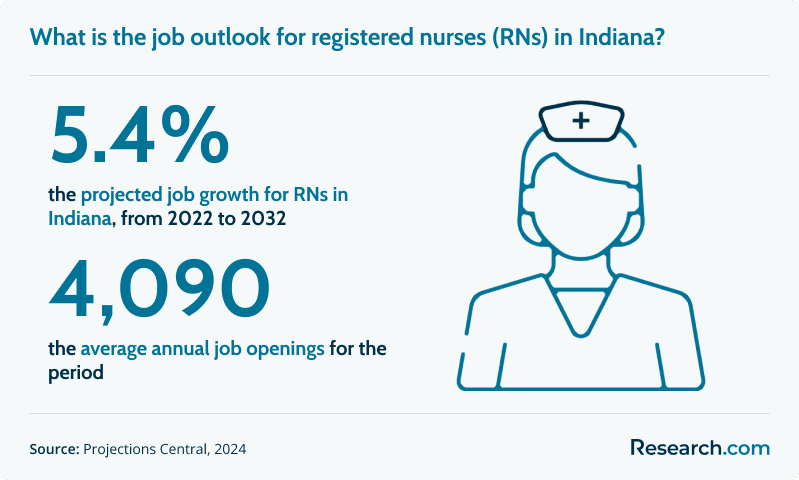
The nursing job outlook in Indiana is positive based on the cited projection data. The U.S. Bureau of Labor Statistics projects a 5.4% increase in employment for registered nurses from 2022 to 2032, with around 4,090 new RN jobs annually during the same period. Demand is influenced by population needs, retirements, chronic disease management, hospital staffing, long-term care, outpatient services, and expanded care models.
RNs who want to improve long-term mobility may consider specialty experience, BSN completion, certifications, leadership training, or graduate nursing education. Because nurse practitioners are in demand nationally, some Indiana RNs may compare affordable online RN to FNP programs if family practice aligns with their career goals.
| Career move | When it may help | What to verify first |
| Earn a BSN after an ADN | You want broader RN opportunities, leadership eligibility, or graduate school preparation. | Transfer credit policy, employer tuition support, and program accreditation. |
| Add a specialty certification | You want to strengthen your profile in a focused area such as critical care, pediatrics, oncology, or case management. | Eligibility requirements and whether employers value the credential. |
| Move into nurse practitioner education | You want advanced clinical responsibility and a defined patient population focus. | Specialty fit, clinical placements, certification preparation, and Indiana practice requirements. |
| Explore non-bedside healthcare roles | You want to use healthcare knowledge in administration, coding, education, informatics, or quality roles. | Required credentials, pay expectations, and whether the role matches your preferred work style. |
How Indiana supports professional development for nurses
Professional development is essential for Indiana nurses who want to maintain competence, renew credentials, move into specialty roles, or prepare for leadership. Development can include continuing education, employer training, graduate programs, certifications, mentorship, and professional association involvement.
Many healthcare employers partner with colleges, universities, and training providers to offer continuing education opportunities. These may include workshops, webinars, simulations, policy updates, clinical refreshers, and specialty education. Continuing education can help nurses stay current with evidence-based practice, technology, documentation expectations, and patient safety standards.
Professional organizations such as the Indiana State Nurses Association can also support career growth through networking, advocacy updates, leadership opportunities, and professional resources. Membership is not mandatory for every nurse, but it can be useful for nurses who want to understand legislative changes and connect with peers across the state.
Indiana also encourages career advancement through education and workforce initiatives. The Workforce Ready Grant is one example mentioned in the context of supporting eligible training and education. Nurses interested in graduate study should also compare employer tuition assistance, scholarships, loan repayment possibilities, and part-time study options.
Nurses planning advanced practice can review the best NP programs in Indiana to compare educational routes that may support higher-level clinical roles and expanded patient care responsibilities.
Common mistakes to avoid when becoming a nurse in Indiana
| Mistake | Why it can hurt you | Better approach |
| Choosing a school without confirming approval and accreditation | You may face licensure, transfer, financial aid, or employer-recognition problems. | Verify state approval and recognized accreditation before applying. |
| Focusing only on tuition | Fees, supplies, transportation, exams, and lost work time can change the real cost. | Ask for a full cost estimate and compare financial aid carefully. |
| Assuming online means fully remote | Nursing programs still require labs, simulations, and clinical practice. | Confirm exactly where and how clinical hours are completed. |
| Ignoring NCLEX preparation | Graduation does not matter professionally if you cannot pass the licensing exam. | Ask about exam support, practice testing, remediation, and faculty advising. |
| Picking the shortest program without checking career fit | A fast credential may not support your preferred role or advancement path. | Map your first license to your five-year career goal. |
| Assuming salary outcomes are guaranteed | Pay varies by employer, region, shift, specialty, experience, and credential. | Use salary data as a benchmark, not a promise. |
Questions to ask before enrolling in an Indiana nursing program
- Is this program approved for the exact Indiana nursing license I want?
- What accrediting body recognizes the program?
- What percentage of coursework is online, and what must be completed in person?
- Who arranges clinical placements, and where do students usually train?
- What are the total costs beyond tuition?
- How does the school support NCLEX preparation?
- Can credits transfer into BSN, MSN, or DNP programs later?
- Does the program meet requirements for students who live outside Indiana or plan to move?
- What student support is available for working adults?
- What happens if I fail a course, need to pause enrollment, or cannot complete a clinical rotation on schedule?
Related Articles for Nearby States
- 2027 How to Become a Nurse in Ohio
- 2027 How to Become a Nurse in Illinois
- 2027 How to Become a Nurse in Kentucky
- 2027 How to Become a Nurse in Michigan
- 2027 How to Become a Nurse in Wisconsin
- 2027 How to Become a Nurse in Missouri
- 2027 How to Become a Nurse in Tennessee
- 2027 How to Become a Nurse in Iowa
- 2027 How to Become a Nurse in West Virginia
- 2027 How to Become a Nurse in Minnesota
References:
- nursejournal.org (27 Sep 2023). Become RN nurse Indiana + requirements & licensing. nursejournal.org
- ivytech.edu (n.d.). Ivy Tech Community College. ivytech.edu
- in.gov (15 Feb 2024). Nursing Board. in.gov
- U.S. Bureau of Labor Statistics. (2023, December 27). Occupational outlook handbook - Registered nurses. Retrieved February 16, 2024, from BLS.
Key Insights
- Indiana nursing licensure requires approved education, the correct NCLEX exam, background screening, and formal state approval before practice.
- The fastest entry route is usually LPN education, while ADN and BSN pathways prepare students for RN licensure and broader career options.
- In 2023, Indiana had around 68,850 RNs, and registered nurses earned around $82,700 per year on average.
- The cited RN employment projection for Indiana shows 5.4% growth from 2022 to 2032 and around 4,090 annual openings.
- Online and accelerated nursing programs can be useful, but only if they are properly approved, accredited, and clear about clinical placement requirements.
- Students should compare programs by licensure eligibility, accreditation, clinical quality, total cost, NCLEX support, and transfer pathways rather than choosing by speed or tuition alone.
- Advanced roles such as nurse practitioner, nurse midwife, nurse anesthetist, and clinical nurse specialist require graduate education and specialty certification beyond entry-level RN preparation.
Other Things You Need to Know About Nursing in Indiana
To become a nurse in Indiana in 2027, earn a nursing degree (ADN or BSN), pass the NCLEX-RN exam, and apply for an Indiana nursing license. Stay updated on state-specific requirements and consider joining professional nursing organizations for ongoing education and networking.
When considering a career in nursing in Indiana, many prospective students wonder if an accelerated nursing program is a viable option. Accelerated nursing programs, typically designed for individuals who already hold a bachelor's degree in another field, offer a fast-tracked path to becoming a registered nurse (RN).
- Viability: Indiana has several accredited accelerated nursing programs, allowing students to complete their nursing education in as little as 12 to 18 months. This option is particularly appealing to those eager to enter the workforce quickly. According to the Indiana State Board of Nursing, the demand for RNs is projected to grow by 12% from 2018 to 2028, indicating a strong job market for graduates.
- Competency: While accelerated programs are rigorous, they are designed to ensure that graduates meet the same competencies as traditional nursing students. The curriculum is intensive, covering essential nursing skills and knowledge in a condensed timeframe. Graduates from these programs often perform well on the NCLEX-RN exam, which is required for licensure. In Indiana, the pass rate for first-time test-takers from accelerated programs is comparable to that of traditional programs, reflecting their effectiveness in preparing competent nurses.
- Return on Investment (ROI): The financial implications of an accelerated nursing program can be significant. While tuition costs may be higher due to the condensed nature of the program, the potential for quicker entry into the workforce can lead to a faster return on investment. According to the Bureau of Labor Statistics, the median annual wage for RNs in Indiana is approximately $65,000, which can offset educational expenses relatively quickly.
In summary, an accelerated nursing program can be a highly advisable route for those looking to practice as a nurse in Indiana, offering a viable, competency-focused, and potentially lucrative pathway into the nursing profession.
To prepare for a nursing career in Indiana in 2027, focus on completing an accredited nursing program, gaining practical experience through internships or clinical rotations, and preparing for the NCLEX-RN exam. Utilize study resources such as NCLEX review courses and consider joining professional networks like the Indiana State Nurses Association for support and guidance.