2027 BCBA Program Comparison Worksheet: Features to Review Before Applying

Co-Founder and Chief Data Scientist
Choosing a BCBA program is a high-stakes education decision because the wrong fit can add cost, delay certification, or leave you scrambling to arrange supervised fieldwork. Prospective students often compare programs while working full time, changing careers from another undergraduate major, or trying to meet certification requirements without relocating.
This guide explains how to evaluate BCBA programs with the factors that matter most: certification eligibility, accreditation or verification status, online versus campus delivery, coursework, admissions criteria, time to completion, cost, career options, salary outlook, and job demand. Use it to narrow your choices, ask better questions of admissions teams, and avoid programs that look convenient but do not fully support your path to becoming a Board Certified Behavior Analyst.
Key Things You Should Know
- Programs vary significantly in supervision hours required for BCBA eligibility, with the Behavior Analyst Certification Board mandating 1000 to 1500 hours depending on the credential pathway.
- Accreditation by the Association for Behavior Analysis International's Verified Course Sequence ensures curriculum alignment with BACB standards, a key factor in program quality and certification success.
- Tuition ranges widely; recent data show average total costs between $15,000 and $35,000, affecting accessibility and student debt, particularly in private versus public institutions.
What is a BCBA certification and who needs it?
BCBA certification is a professional credential for practitioners who use Applied Behavior Analysis to assess behavior, design intervention plans, evaluate outcomes, and supervise behavior-analytic services. It is most commonly associated with autism and developmental disability services, but BCBAs also work in schools, clinics, hospitals, residential programs, community agencies, and private practice.
The credential is especially important for professionals who want to lead or supervise ABA services rather than only assist with implementation. Clinicians, educators, therapists, case supervisors, and career changers may pursue BCBA certification when their roles require independent behavior assessment, treatment planning, data-based decision-making, or supervision of other staff.
Certification requires more than completing a degree. Candidates must complete graduate-level ABA coursework, supervised experience, and pass the BCBA exam. The exam is demanding: only 54% of first-time test takers passed, according to the BACB's Annual Data Report cited by certifyndaba.com. That pass-rate context matters because program quality, supervision quality, and exam preparation can directly affect how quickly a student reaches certification.
BCBA certification may also affect employability. Employers and insurance-funded ABA providers often prefer or require the credential for roles involving treatment oversight, clinical supervision, and billable ABA services. Before enrolling, compare program curriculum, fieldwork support, faculty experience, and exam outcomes—not just tuition and convenience.
If affordability is a major concern, reviewing BCBA college programs online can help you identify lower-cost pathways that still support certification preparation.
What are BCBA education requirements for certification?
BCBA education requirements generally include a qualifying graduate degree, behavior-analytic coursework, supervised fieldwork, and successful completion of the BCBA exam. Candidates commonly earn a master's degree in behavior analysis, psychology, education, or a related field from an approved institution, then complete coursework covering ethics, assessment, intervention, measurement, research methods, and core behavior-analytic principles.
The supervised experience requirement is a separate and critical part of the pathway. Applicants usually complete between 1,500 and 2,000 hours, depending on the supervision model. These hours should provide practical experience with assessment, treatment planning, data collection, intervention implementation, documentation, and professional ethics under qualified supervision.
Program selection should start with certification eligibility. A strong BCBA program should clearly explain whether its coursework meets current BACB requirements, whether fieldwork is embedded or arranged separately, and what documentation students must maintain. State-specific BCBA educational prerequisites for certification may vary, so students should also verify any state licensure rules that apply where they plan to work.
Accreditation and program outcomes can be useful quality signals. Programs accredited by the Association for Behavior Analysis International (ABAI) have a 74% first-time pass rate compared to 63% in non-accredited programs. That does not guarantee an individual result, but it suggests that curriculum alignment, faculty expertise, and preparation structure deserve close attention.
| Requirement area | What to confirm before enrolling |
| Graduate degree | The degree type and institution meet BCBA eligibility expectations. |
| ABA coursework | Courses cover ethics, assessment, intervention, measurement, research methods, and behavior-analytic foundations. |
| Supervised fieldwork | The program explains whether supervision is included, supported, or arranged independently. |
| Exam preparation | Students receive preparation aligned with the BCBA exam and required content areas. |
| State rules | The program fits any additional state licensure or practice requirements. |
Top BCBA programs often combine eligible coursework with exam preparation resources, practicum guidance, and advising that helps students avoid certification delays.
How do I verify ABA program accreditation status?
To verify an ABA program's accreditation or recognition status, do not rely only on marketing language from the school. Check the official source named by the program, confirm the exact program title, and ask admissions for written documentation showing how the coursework supports BCBA eligibility.
The most important distinction is whether the program is ABAI-accredited, offers a recognized course sequence, or simply includes ABA-related coursework. These are not interchangeable. A degree may be valuable academically but still require additional steps before it supports BCBA certification.
- Search the official ABAI program directory or the appropriate BACB-related resources to confirm the program's current status.
- Match the school name, degree level, department, and delivery format exactly; similar program names can cause confusion.
- Ask whether the program offers Verified Course Sequences (VCS) approved by BACB, ensuring curriculum alignment with exam eligibility requirements.
- Confirm how practicum or fieldwork supervision works and whether supervision follows BACB standards.
- Request written confirmation from the program, not just a verbal assurance from an admissions representative.
- Ask whether any recent curriculum changes affect students entering in the upcoming term.
Delivery format can also influence outcomes. Data indicates fully online BCBA programs have a 60% pass rate, while campus or hybrid formats reach 73%, as noted in studies referenced by certifyndaba.com. This does not mean online programs are weak by default; it means online students should look closely at faculty access, supervision support, cohort structure, and exam preparation.
Students considering a faster route should be especially careful. An accelerated BCBA program can be efficient, but only if its coursework, sequencing, advising, and fieldwork expectations align with certification requirements.
The main difference between online and campus BCBA programs is not simply location; it is how students receive instruction, feedback, supervision support, and professional connection. Online programs often work best for employed students, caregivers, and students who cannot relocate. Campus programs may provide more structured interaction, easier access to faculty, and stronger built-in peer networks.
Online BCBA programs are usually valued for flexibility. Asynchronous lectures and remote coursework allow students to study around work schedules, but the trade-off is that students may need to be more proactive about asking questions, finding fieldwork sites, and building professional relationships. A strong online program should still provide timely faculty feedback, clear advising, and support for supervised experience planning.
Campus programs emphasize face-to-face learning, in-person discussion, and easier access to local practicum relationships. They may be less convenient for working adults, but they can offer more structure for students who learn best through live interaction. Hybrid programs fall between the two, combining online coursework with scheduled in-person components. California State University, Northridge's hybrid ABA program achieved a 100% BCBA exam pass rate with 13 candidates, demonstrating how a structured hybrid format can support strong outcomes.
| Format | Best fit | Potential drawback |
| Online | Working adults, students outside major metro areas, and learners who need schedule flexibility. | May require more independence in networking, fieldwork planning, and exam preparation. |
| Campus | Students who want face-to-face faculty access, structured peer interaction, and local practicum connections. | Less flexible and may require commuting or relocation. |
| Hybrid | Students who want flexibility but still value periodic in-person engagement. | May involve travel, fixed meeting dates, or limited geographic availability. |
When comparing formats, look beyond convenience and ask:
- Is the program accredited or otherwise aligned with BACB course requirements?
- How are supervised fieldwork opportunities identified and documented?
- How often can students interact with faculty?
- What are the program's BCBA exam pass rates and graduation outcomes?
- Does the schedule fit your work, family, and fieldwork obligations?
Reviewing the best applied behavior analysis programs can help you compare online options using more than tuition or brand recognition.
BCBA programs typically include graduate coursework in the principles and practice of Applied Behavior Analysis. The curriculum is designed to prepare students to understand behavior, measure change, conduct assessments, design interventions, evaluate outcomes, and practice within ethical and professional standards.
Common coursework includes applied behavior analysis principles, ethics, research methods, measurement, data analysis, behavior assessment, and intervention techniques. Students also study behavior-change procedures, functional assessment, and experimental design. Many programs add courses in supervision and management because BCBAs often oversee technicians, train staff, consult with families, and lead clinical teams.
| Course area | Why it matters for BCBA practice |
| Ethics | Prepares students to make responsible decisions involving clients, families, data, consent, and professional boundaries. |
| Measurement and data analysis | Builds the ability to collect, interpret, and use data to guide treatment decisions. |
| Behavior assessment | Supports identification of behavior function and environmental variables. |
| Intervention design | Prepares students to develop behavior-change plans based on assessment findings. |
| Research methods and experimental design | Helps students evaluate evidence and determine whether interventions are working. |
| Supervision and management | Develops skills for training staff, monitoring implementation, and maintaining service quality. |
Some programs include specialized electives or applied emphases, such as autism spectrum disorder, verbal behavior, school-based behavior assessment, or healthcare applications. These concentrations can be useful, but they should not replace the core coursework required for certification eligibility.
A notable example is Florida Institute of Technology's online ABA program, combining affordability and quality with a 100% pass rate, charging $510 per credit, as noted on actionbehavior.com. Prospective students should confirm that the coursework fully aligns with the BACB's 4th Edition Task List to qualify for certification exams, while also checking current BACB guidance before enrolling.
Ask whether practicum or supervised fieldwork is embedded in the program or must be completed separately. This distinction affects cost, scheduling, and time to certification. A program with strong coursework but weak fieldwork guidance can still create major delays for students.
BCBA program admission criteria vary by institution, but most programs look for evidence that applicants can succeed in graduate-level behavioral science coursework and complete the professional requirements for certification. At minimum, applicants typically need a bachelor's degree from an accredited institution. Common undergraduate backgrounds include behavior analysis, psychology, education, special education, social work, or related fields.
Some programs prefer applicants who already have relevant work experience with children, adults with developmental disabilities, schools, clinics, or behavioral health services. Others are designed for career changers and provide foundational coursework early in the program. Many programs prefer or require a master's degree to increase competitiveness and fulfill Board Certified Behavior Analyst eligibility, depending on the specific pathway.
Typical application materials may include:
- Official transcripts from prior colleges or universities.
- A statement of purpose explaining career goals and interest in ABA.
- Letters of recommendation from professors, supervisors, or clinical professionals.
- Resume or curriculum vitae showing relevant education and work experience.
- Prerequisite coursework in behavior principles, ethics, research methods, or data analysis.
- GRE scores if required by the institution.
- English proficiency documentation for some international applicants.
Fieldwork expectations differ. Some programs integrate practicum components into the curriculum, while others expect students to secure supervised experience outside the degree. Some programs may require a minimum of 1,000 supervised hours before admission or evaluate prior fieldwork as part of application review. If a program mentions supervised hours, ask who qualifies as a supervisor, what documentation is required, and whether hours count toward certification.
Demand for BCBA certificants has grown significantly due to expanding ABA services in autism treatment, as discussed in the PMC article PMC11035534. As interest in the field increases, competitive programs may place more weight on academic readiness, relevant experience, ethical awareness, and the applicant's understanding of ABA practice.
Applicants without an ABA background should not assume they are disqualified. Instead, they should look for programs that clearly state prerequisite options, bridge coursework, advising support, and expectations for students entering from unrelated majors.
BCBA programs typically take 1 to 3 years, depending on degree type, enrollment pace, course sequencing, and supervised fieldwork. Full-time master's tracks usually finish within 2 years. Accelerated or post-master's certificate options may take 12-18 months. Part-time and online formats can be more manageable for working adults, but they may extend completion up to 3 years.
Cost varies widely by institution and format. Public universities charge between $10,000 and $25,000 for tuition, whereas private schools often exceed $40,000. Students should also budget for textbooks, technology fees, supervision costs, fieldwork-related expenses, exam preparation materials, and exam application fees.
| Cost or time factor | What to ask before enrolling |
| Tuition | Is pricing listed per credit, per term, or for the full program? |
| Fees | Are there separate technology, student services, practicum, or graduation fees? |
| Supervision | Is supervised fieldwork included, supported, or paid separately? |
| Course sequencing | Can required courses be taken every term, or are some offered only once per year? |
| Enrollment pace | Can students switch between full-time and part-time study if work demands change? |
| Exam preparation | Are exam review resources included or an additional expense? |
Graduates often secure roles starting around $70,000 or more annually. For example, the University of Kansas offers a program with a 93% BACB exam pass rate, demonstrating strong preparation for certification and employment. Still, return on investment depends on more than salary: students should consider debt, time away from work, local job opportunities, licensure rules, and the likelihood of completing certification efficiently.
The cheapest program is not always the best value if students must pay separately for supervision or repeat exam attempts. Likewise, a higher-cost program may be worthwhile if it provides strong advising, reliable fieldwork support, and better preparation for the certification exam.
BCBA certification can qualify professionals for roles that involve behavior assessment, intervention planning, supervision, consultation, and program leadership. The most common opportunities are in autism services and developmental disability support, but the credential can also apply to education, healthcare, mental health, organizational behavior management, research, and consulting.
Many BCBAs work directly with clients while also supervising registered behavior technicians or other staff. Others move into program director, clinical supervisor, school district specialist, or consultant roles. The best career path depends on the population you want to serve, your preferred work setting, state practice rules, and your comfort with supervision and documentation responsibilities.
- Clinical behavior analyst working with individuals with developmental disabilities.
- School-based behavior specialist supporting students and individualized education programs.
- Healthcare provider contributing to behavioral health or developmental programs.
- Organizational behavior manager focused on workforce performance, safety, or systems improvement.
- Researcher studying behavior analysis theory, interventions, or applied outcomes.
- Consultant advising schools, agencies, nonprofits, healthcare organizations, or private providers.
Program choice can affect career readiness. Regional differences, employer relationships, supervision access, and exam outcomes all matter. For example, Northern Arizona University's online M.Ed. in Special Education with PBS emphasis reported a 17% BCBA exam pass rate, highlighting location-based program quality variations. A low pass rate does not necessarily define every student's outcome, but it should prompt careful questions about curriculum, advising, fieldwork, and exam preparation.
Before choosing a program, compare the careers its graduates actually enter. Ask whether alumni work in clinics, schools, hospitals, public agencies, or private practice, and whether the program provides networking or fieldwork relationships in your target setting.
The salary outlook for Board Certified Behavior Analysts varies by experience, location, employer type, supervision duties, and specialty. Entry-level BCBAs generally earn between $55,000 and $65,000 annually, while those with more experience can earn over $90,000. Higher salaries are often associated with private practice, healthcare organizations, supervisory roles, and school districts in areas with strong demand for ABA services.
Certification is a key salary gatekeeper because many employers reserve higher-level clinical and supervisory roles for credentialed BCBAs. Passing the BCBA exam is therefore not just a credentialing step; it can affect job title, responsibility level, and compensation trajectory. In 2025, only 51% of first-time candidates passed the exam, according to BACB data reported by CertifyNDABA. Out of 23,151 test takers, 8,021 newly certified BCBAs entered the workforce.
Salary growth often depends on the ability to supervise staff, manage cases, work with complex behavior needs, document outcomes, and collaborate with families, schools, insurers, or healthcare teams. Employers may also pay more for experience in autism treatment, clinical supervision, organizational behavior management, or leadership roles.
Urban locations typically pay 10% to 20% above the national average, though higher pay may be offset by cost of living. When evaluating salary potential, compare local job postings, required credentials, billable-hour expectations, supervision responsibilities, and whether the role offers benefits, continuing education support, or advancement opportunities.
What is BCBA job demand and growth projection?
BCBA job demand is strong in many markets because schools, clinics, healthcare providers, and community agencies need professionals trained in evidence-based behavior assessment and intervention. Demand is closely tied to autism services, developmental disability supports, behavioral health needs, school-based intervention, and insurance-funded ABA services.
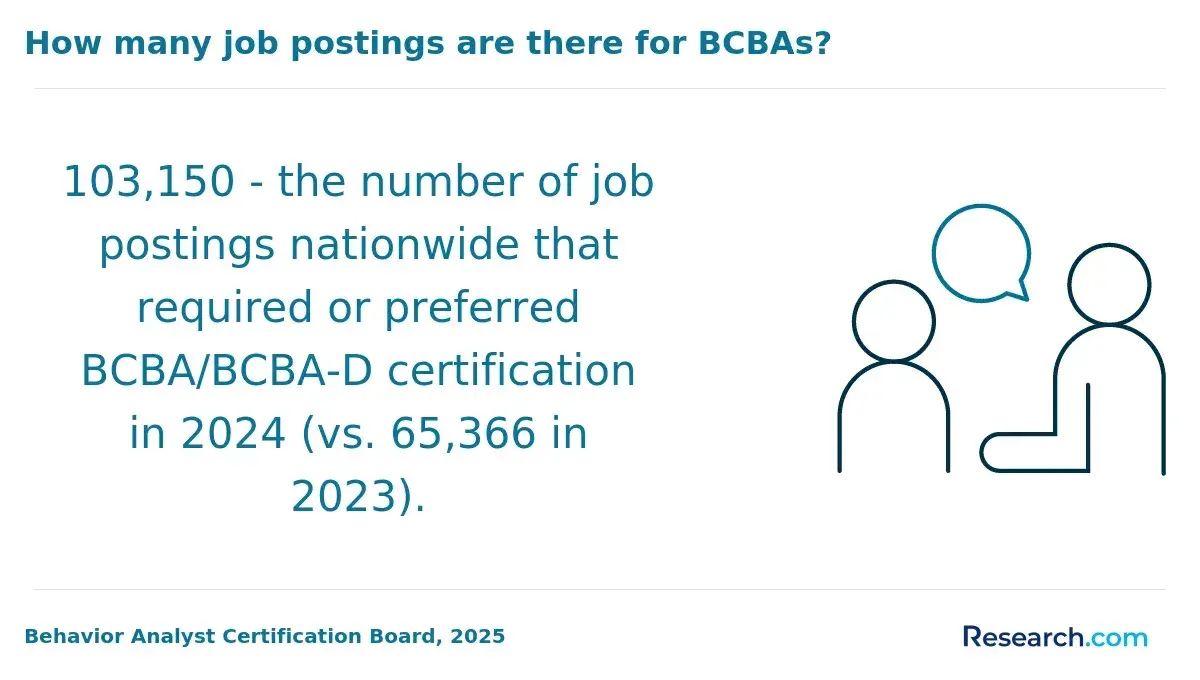
Demand for BCBA professionals is projected to grow rapidly, with the U.S. Bureau of Labor Statistics estimating a 25% increase in behavior analyst employment over the next decade. Growth is largely fueled by the expanding need for evidence-based interventions in autism treatment, developmental disabilities, and mental health care.
More than 192 training programs report first-time certification pass rates, giving prospective students a way to compare candidate preparation across institutions. Higher pass rates can indicate stronger coursework alignment, advising, and exam preparation, although students should also consider cohort size, admissions selectivity, and fieldwork support.
Job opportunities vary by setting and region. Schools may hire BCBAs for special education and behavior intervention roles. Clinics may need BCBAs to oversee ABA treatment plans and supervise direct-service staff. Community and healthcare organizations may seek behavior analysts for developmental, psychiatric, or behavioral health programs. States with investments in early intervention or mandated behavior analytic insurance coverage may offer more openings.
- Job growth is driven by healthcare, education, autism services, and behavioral health sectors.
- Certification pass rates can help signal training program quality.
- Geography and work setting affect both job availability and salary.
- Specialized expertise can improve employability in clinical, school, healthcare, or organizational roles.
- Maintaining certification and licensure through continuing education is essential for long-term career mobility.
Students who want the strongest employment position should choose a program that supports exam readiness, supervised experience, ethical practice, and the type of setting where they plan to work after certification.
Other Things You Should Know About Applied Behavior Analysis
Supervision is a required component of BCBA coursework, typically involving regularly scheduled sessions with a qualified BCBA supervisor. During this time, students receive guidance, feedback, and clinical experience working directly with clients. The supervision hours help ensure competencies are met before applying for certification.
When reviewing BCBA programs in 2027, prioritize aspects such as program accreditation, faculty expertise, practicum opportunities, pass rates for the BCBA exam, and tuition costs. Ensuring the program matches your career goals and learning preferences is essential for making a well-informed decision.
Applicants should verify that the program includes the verified course sequence, the correct number of semester or quarter credits, and required supervised fieldwork hours. They should also confirm the sequence is aligned with BACB standards and leads to eligibility for the BCBA examination administered by the Behavior Analyst Certification Board.
While the BCBA credential itself is focused on behavior analysis competencies, professionals can pursue further specialization through advanced coursework, certificates, or additional credentials. Common areas include autism spectrum disorder interventions, organizational behavior management, or gerontology. These specializations enhance expertise but are not separate certifications.
- 11 Best BCBA Programs & Schools (In-Person & Online) https://www.crossrivertherapy.com/behavioral-analysts/best-bcba-programs
- Applied Behavior Analysis (MS) Degree Requirements https://www.baypath.edu/academics/graduate-programs/applied-behavior-analysis-ms/degree-requirements/
- Applied Behavior Analysis (BCBA)® Coursework https://www.fresno.edu/graduate/program/applied-behavior-analysis-bcbar-coursework
- BCBA Career Path to Take - A New Start ABA https://www.anewstartaba.com/blog/bcba-career-path-to-take
- BCBA Job Opportunities: Career Paths, Growth, and Impact https://championsaba.com/bcba-job-opportunities/
- How Much Does it Cost to Take (Or Retake) the BCBA® Exam? https://passthebigabaexam.com/how-much-does-it-cost-to-take-or-retake-the-bcba-exam/
- Can You Become a BCBA Without a Master’s? | Kids N Heart ABA https://kidsnheartaba.com/blog/bcba-without-masters-degree/
- BCBA Job Outlook 2025 Shows Strong Growth and Demand https://blossomabatherapy.com/blog/bcba-job-outlook
- BCBA Career Outlook: Essential Guide to Salary and Growth Trends https://www.hiddenlightaba.com/bcba-career-outlook-essential-guide-to-salary-and-growth-trends/
- Top Study Tools for BCBA Exam Success in 2025 | Inclusive https://www.inclusiveaba.com/blog/best-study-tool-for-bcba-exam