2027 Paralegal Programs for Healthcare Law Firms: Patient Records, Privacy, and Litigation Skills

Co-Founder and Chief Data Scientist
A general paralegal program may teach litigation but leave little room for the patient-records and privacy issues healthcare law firms handle. If you are choosing a program or adding a specialty to existing legal training, the important distinction is between a healthcare-themed course title and practice you can use under an attorney's supervision.
This guide explains which coursework and assignments matter, how online and campus options compare, what credentials do - and do not - mean, and how to weigh cost against the skills employers may expect.
Key Things You Should Know
- Prioritize a solid paralegal foundation plus supervised assignments involving medical-record organization, HIPAA analysis, discovery, and litigation deadlines; a healthcare course title alone is not enough.
- Check institutional accreditation separately from American Bar Association (ABA) paralegal program approval. A program certificate is not professional certification, and neither is universally required for healthcare law paralegal work.
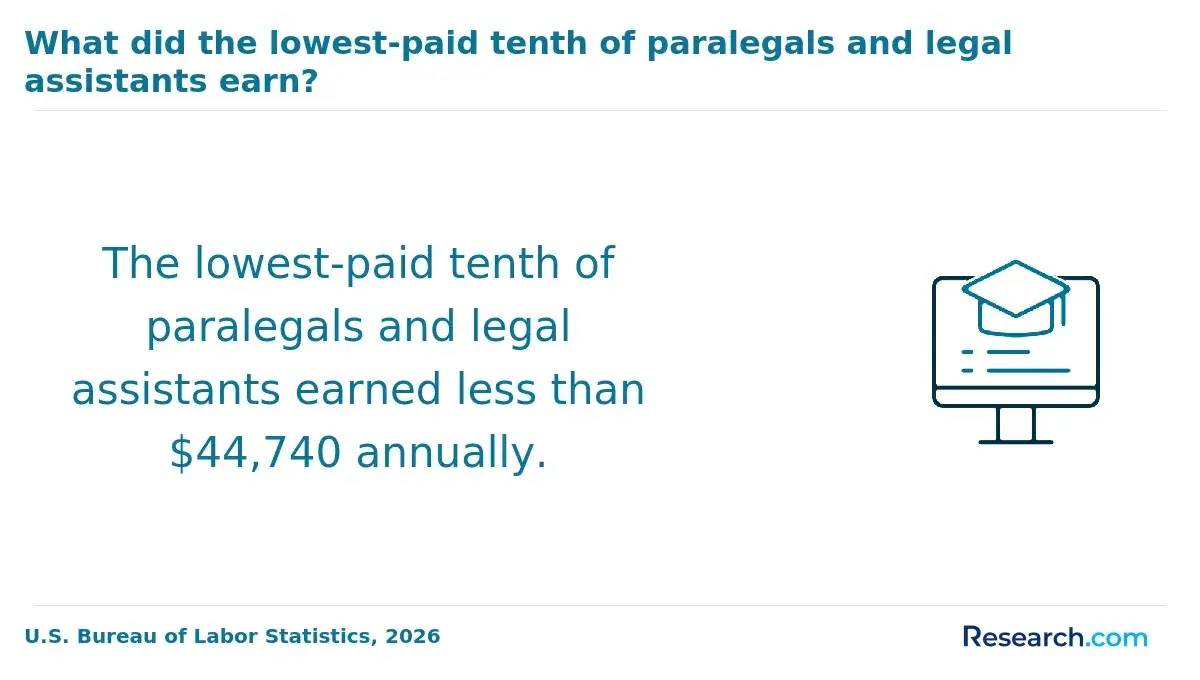
- The U.S. Bureau of Labor Statistics reports $62,890 in May 2025 median annual pay for paralegals and legal assistants, with 0% projected growth for 2025-2035. That occupation-wide figure is not a healthcare-law salary or a predicted outcome for graduates.
What are paralegal programs for healthcare law firms?
They are paralegal degree or certificate programs - or general programs supplemented by relevant coursework and experience - that prepare students to support attorneys handling healthcare-related matters. Work may involve medical malpractice, insurance disputes, provider contracting, regulatory investigations, or patient privacy. Paralegals organize information, research law, draft documents for attorney review, and manage cases; they do not independently give legal advice or represent clients.
A healthcare law concentration is not a standard credential. One school may offer a named concentration, another may offer a health law elective, and a third may cover medical records through a litigation practicum. Compare the actual assignments rather than assuming those labels signal equivalent preparation. If you are still deciding between broadly legal and specifically paralegal study, legal studies associate programs to explore can provide a point of comparison; check whether each includes the paralegal-specific drafting and procedure you want.
What education is required to become a healthcare law paralegal?
There is no single nationwide degree required specifically for healthcare law paralegals. Employers set hiring criteria, while state rules can affect paralegal titles and permitted work. Common education routes include an associate degree in paralegal studies, a bachelor's degree with substantial paralegal coursework, or a post-baccalaureate paralegal certificate. A certificate is an educational award; professional certification is a separate credential awarded through an examination or other requirements.
If you have no college experience, exploring online associate degrees for paralegal education may help you find programs that combine general education with legal skills. If you already hold a bachelor's degree, compare post-baccalaureate certificates before committing to another full degree. Prior clinical or health-information experience can make medical records more familiar, but it does not replace instruction in legal research, civil procedure, and professional boundaries.
A Master of Legal Studies or similar non-JD degree may suit a professional seeking broader regulatory knowledge, but it is not necessary for most paralegal roles and does not qualify its holder to practice law. Applicants should check each certificate's published prerequisite: some accept students with a high school diploma, while others require prior college coursework or a completed degree.
Which healthcare law courses should paralegal programs include?
Start with legal research and writing, civil litigation, ethics, and electronic discovery. Then look for healthcare content that connects those foundations to realistic work. The comparison below shows what course descriptions and sample assignments should help you identify; it does not mean every program must use these exact course names.
| Curriculum area | Useful student work product | Why it matters in a healthcare law firm |
| Medical terminology and records | Chronology with cited chart entries and identified gaps | Helps attorneys and experts locate relevant treatment events without changing the clinical record |
| Privacy and health law | Attorney-reviewed analysis of a proposed records request or disclosure | Connects privacy rules to the authority and limits for obtaining information |
| Civil litigation and discovery | Draft discovery responses, document index, or deadline calendar | Builds procedure skills applicable across malpractice and other disputes |
| Electronic discovery and ethics | Preservation checklist and privilege-review exercise | Addresses electronic health records, sensitive information, and protected communications |
Ask whether these are graded, hands-on exercises or topics mentioned only in a syllabus. A program with strong general litigation training and a relevant internship may be more useful than one with several healthcare electives but little drafting practice.
How do paralegal programs teach patient records and privacy compliance?
Good training uses fictional or properly de-identified records to practice identifying providers, treatment dates, missing pages, conflicting entries, and the source of each fact. Students should learn to distinguish a medical chronology - which organizes evidence - from a clinical opinion, which they are not qualified to provide merely by completing paralegal coursework.
Privacy instruction should distinguish the Health Insurance Portability and Accountability Act (HIPAA) Privacy Rule from state confidentiality rules and litigation procedure. HIPAA does not make every patient record unavailable in a lawsuit. The authority needed for a particular disclosure depends on who holds the information, the reason for release, and applicable federal and state rules. Attorneys direct that analysis; paralegals can help track authorizations, requests, objections, and protective-order terms.
Look for exercises in secure file handling, access controls, redaction, and documenting the source of records. Ask whether students use real client information in any placement, what supervision applies, and whether the school teaches students to follow the placement's confidentiality policies. Software demonstrations alone are not evidence of proficiency: find out whether students actually complete assignments using the tools the program advertises.
What litigation skills do healthcare law paralegal programs develop?
Healthcare litigation can involve large records sets, multiple providers, expert witnesses, and tightly managed deadlines. A useful program teaches students to build a sourced chronology, organize exhibits, draft discovery materials for attorney review, track productions, and maintain a reliable case calendar. Students should also practice spotting potentially privileged material and preserving electronically stored information without making their own legal determinations.
In a strong simulation or supervised placement, a student can follow a matter from records intake through discovery and trial preparation. Ask to see descriptions of the work product, feedback, and supervision - not confidential client files. If a program advertises an internship, confirm who arranges it and whether healthcare litigation placements are available; an internship requirement does not guarantee one in a healthcare law firm.
Are online healthcare law paralegal programs as effective as campus programs?
They can be effective if students receive comparable drafting practice, feedback, and access to instructors. Delivery format alone does not establish quality. An online program may still require live classes, scheduled exams, campus visits, or an in-person internship; "online" does not necessarily mean asynchronous or self-paced.
The practical differences below matter more than the format label when you compare programs with your work schedule and learning needs.
| Feature | Online program | Campus program |
| Case-file practice | May use shared digital files and remote feedback; confirm how work is assessed | May use classroom simulations; confirm that students also handle electronic files |
| Schedule | May offer asynchronous work but still impose live meetings and fixed deadlines | Requires travel and scheduled attendance, with potentially easier in-person access to classmates |
| Placement | May require students to locate a locally approved site | May have local contacts, but placement availability still needs verification |
Ask for the current timetable, technology requirements, assignment examples, and placement policy in writing. A flexible lecture schedule has limited value if a required internship conflicts with your job.
What are the admission requirements, program length, and costs?
Requirements vary by credential and school. An associate program generally includes general education alongside paralegal courses; a post-baccalaureate certificate generally builds on an existing degree. Published completion times depend on course sequencing, enrollment load, and whether prerequisites or an internship are required. Check the current catalog rather than assuming an advertised "fast" pathway works part-time.
Compare the full cost of attendance: tuition, mandatory fees, books, research-platform or technology charges, travel, and any placement-related expense. Ask whether the quoted price covers the entire program or only one term or credit. Also confirm whether the specific program is credit-bearing and eligible for federal aid; institutional accreditation alone does not make every certificate aid-eligible.
For someone considering graduate legal study instead of paralegal training, a guide to low-cost online legal studies master's programs offers a separate cost comparison. Weigh that route against its additional time and tuition: a lower-cost master's program may still be more education than an entry-level paralegal goal requires.
Do healthcare law paralegals need certification or state licensing?
There is no universal U.S. license or professional certification required to work as a healthcare law paralegal. State rules governing titles, registration, and legal-support work vary, so check the rules where you intend to work. Employers may prefer particular education or experience even when the law does not require it.
Keep three statuses separate: institutional accreditation concerns the school; ABA approval applies to an eligible paralegal education program; and professional certification concerns an individual who meets a credentialing body's requirements. The ABA does not certify individual paralegals. Organizations such as NALA and the National Federation of Paralegal Associations offer professional credentials with their own eligibility rules. Completing a certificate program does not automatically award one.
If a school claims ABA approval or says its graduates qualify for a particular certification, verify the program's current approval and the credentialing organization's current eligibility rules before enrolling. Neither status substitutes for attorney supervision or authorizes a paralegal to practice law independently.
What careers, salaries, and job outlook follow healthcare law training?
Potential settings include healthcare-focused law firms, general litigation firms with medical cases, insurer legal teams, and in-house legal departments. Duties differ: one role may center on malpractice discovery, while another emphasizes contracts or records requests. Healthcare coursework can support an application, but employers may also expect strong general litigation skills and relevant experience.
The Bureau of Labor Statistics reports median annual pay of $62,890 in May 2025 for paralegals and legal assistants, with 0% projected net employment growth for 2025-2035 and about 40,800 projected openings per year. These figures cover the broader occupation, not healthcare specialists; openings can occur even with little net employment growth, and individual pay varies by employer, location, and experience.
Experienced healthcare professionals considering legal or compliance work should first compare job descriptions: a paralegal role calls for legal procedure and attorney-directed casework, while a compliance role may emphasize internal policies and monitoring. If graduate-level legal knowledge is the actual goal, a guide to accelerated online legal studies master's study describes a different educational route. An accelerated non-JD degree does not qualify someone to practice law or automatically improve paralegal hiring prospects.
How can students choose an accredited healthcare law paralegal program?
Begin by confirming that the institution holds recognized accreditation, then check ABA approval separately if it matters to you or a prospective employer. Not every credible paralegal program is ABA-approved, and approval should not be inferred from school accreditation. After establishing those facts, compare the evidence of healthcare-relevant practice and the total commitment.
Use this sequence to avoid choosing on a specialty label or advertised price alone:
- Check the current catalog for the credential awarded, admission prerequisites, required courses, and graduation requirements.
- Request examples of assignments involving records, privacy, research, and litigation; ask who evaluates the work.
- Confirm live-meeting, campus, and internship requirements, including who finds a placement and whether your current workplace can qualify.
- Obtain an itemized cost and ask whether the specific program is eligible for the aid you intend to use.
- Verify institutional accreditation, any claimed ABA approval, and the rules of the state where you expect to work.
If you may continue toward a bachelor's degree, compare transfer policies for online paralegal bachelor's degrees before committing to an associate program. The receiving institution decides whether and how credits apply. A program is a stronger fit when its documented assignments build the work you want to do without requiring more time, expense, or scheduling flexibility than you can reasonably provide.
Other Things You Should Know About Law & Paralegal
Yes. Familiarity with clinical terms and records can help you understand case materials. You will still need to learn legal research, procedure, writing, and the limits of a paralegal's role.
Only when the school or employer permits that specific tool and use. Do not enter identifiable patient or confidential client information into an unapproved service; check its privacy terms, and verify any permitted output against the source records.
Yes. A placement may impose background checks, confidentiality training, or health requirements beyond the school's admission rules. Ask the program and placement site about these conditions before relying on an internship to meet graduation requirements.
That depends on the request, the record holder, applicable law, and case arrangements. A paralegal may track requests and invoices, but should not assume one fee rule applies to every patient-access request, authorization, or litigation demand.
References
- Summary of the HIPAA Security Rule | hhs.gov https://www.hhs.gov/hipaa/for-professionals/security/laws-regulations/index.html
- eCFR:: 42 CFR Part 2 Subpart E -- Court Orders Authorizing Use and Disclosure https://www.ecfr.gov/current/title-42/chapter-I/subchapter-A/part-2/subpart-E
- Electronic Health Records | Health IT Playbook https://playbook.healthit.gov/playbook/electronic-health-records/
- Online Paralegal Certificate | Hamline University - Minnesota https://www.hamline.edu/academics/graduate/online-paralegal-certificate
- Paralegal Program Details | Inver Hills Community College https://www.inverhills.edu/degrees-programs/paralegal/program-details/
- Health Care Law for Paralegals (PSLEGRET7012) | Rice University https://glasscock.rice.edu/course
- HIPAA Breach Notification Rule: Explanation and Guidance | Northern Illinois University https://www.niu.edu/doit/about/policies/hipaa-breach-notification-rule.shtml
- Paralegal Certificate - MN | North Hennepin C.C. https://www.nhcc.edu/academics/degree-pathways/business-and-information-systems/paralegal-certificate
- ABA-Approved Paralegal Program | LACC https://www.lacc.edu/academics/aos/paralegal
- What is eDiscovery and why does it matter in modern legal practice? | ASU | Sandra Day O'Connor College of Law https://law.asu.edu/asu-law-talks/ediscovery-modern-legal-practice