2027 Paralegal Certificate Programs With Remote Internship Options: What to Verify

Co-Founder and Chief Data Scientist
An online paralegal certificate may fit your schedule, but its internship may still require an in-person placement - or leave you to find a remote supervisor yourself. That distinction matters if work, location, or caregiving responsibilities make travel difficult.
This guide is for prospective students comparing programs that advertise remote practical experience. It explains how to check the placement rules, educational recognition, costs, and career relevance so you can choose a program whose requirements you can actually complete.
Key Things You Should Know
- Confirm in writing that the specific certificate permits a fully remote internship, whether the school arranges placements, and whether remote work satisfies its required hours and supervision rules.
- Check institutional accreditation separately from ABA approval of a paralegal education program; neither status proves that a remote placement is available or that a graduate holds professional certification.
- Compare total cost and usable experience, not just online tuition. The U.S. Bureau of Labor Statistics projects 0% growth for paralegals and legal assistants in 2025-2035, with about 40,800 openings per year.
What are paralegal certificate programs with remote internship options?
These programs combine paralegal coursework with an internship or practicum that may be completed away from a legal workplace. A certificate is an educational award from a school; an internship is supervised practical training. Neither automatically makes a graduate a professionally certified paralegal.
"Remote internship option" can mean several different things: a school-approved placement at an outside law office, remote work with an approved legal organization, or an alternative project supervised by program faculty. It may also mean that remote placements are considered individually, not guaranteed. An online course format does not establish that the internship can be remote.
Start with the certificate's current catalog and internship handbook, then compare its wording with what admissions staff tell you. A guide to online paralegal certificate programs can help you build a shortlist, but the school's written placement policy should decide whether a program meets your location and scheduling needs.
How do you verify accreditation for an online paralegal certificate program?
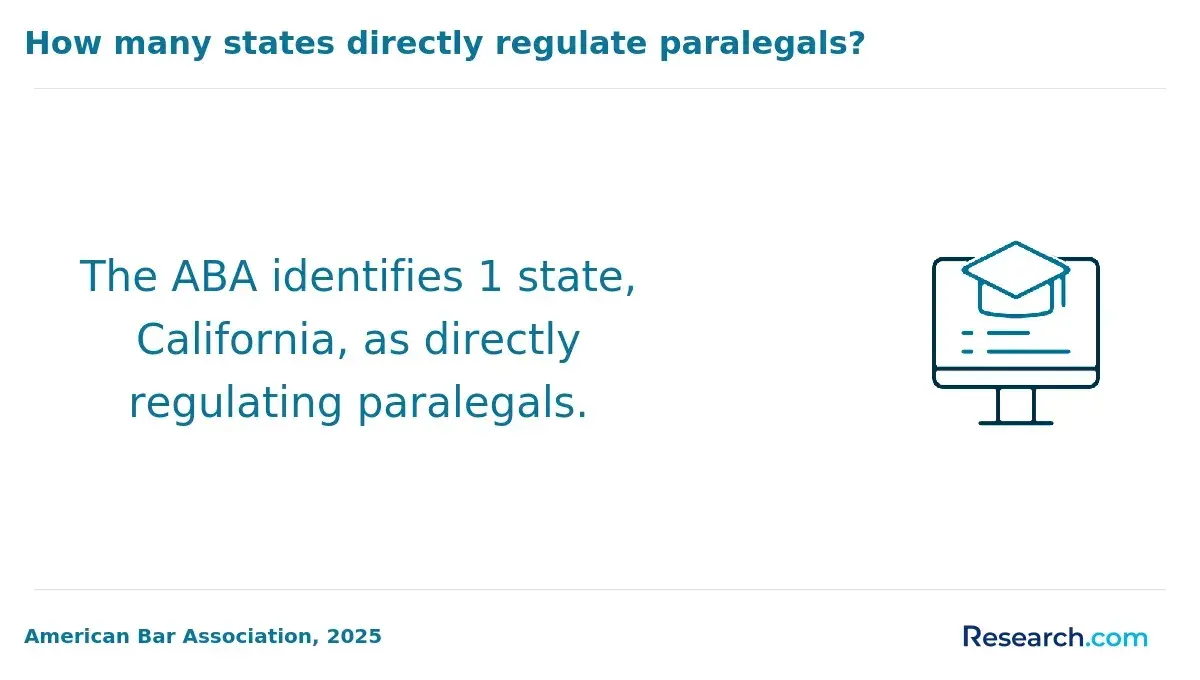
Institutional accreditation concerns the college or other educational institution. ABA approval concerns a qualifying paralegal education program; it is not institutional accreditation, and the American Bar Association does not certify individual paralegals. A program can be offered by an accredited institution without being ABA-approved.
Check the school and credential name in the U.S. Department of Education's accreditation database or the recognized accreditor's directory. If a school claims ABA approval, check the specific paralegal program in the ABA's current directory rather than relying on the college's general accreditation statement. Confirm that the certificate and delivery format you are considering fall within the program information the school publishes.
Recognition alone does not settle the internship question. Ask the program director whether its current approval and academic policies permit the proposed remote arrangement, including any required meetings, location restrictions, or on-campus coursework. If your goal includes transferring credits or obtaining financial aid, verify those separately: the receiving institution decides transfer credit, and aid eligibility depends on the specific program and student.
What should a remote paralegal internship include?
A useful remote placement should involve supervised legal-support work, not merely watching recorded demonstrations or performing unrelated administrative tasks. Appropriate assignments might include research, document organization, draft preparation, or case-management work under a lawyer's supervision. Interns should not give independent legal advice or perform work that amounts to the unauthorized practice of law.
Before accepting an offer, get the answers to these placement questions in writing. They reveal whether "remote" is a workable option rather than a marketing description.
- Who finds and approves the placement: the school, the student, or both?
- Can every required hour be completed remotely, and are there restrictions based on the student's or supervisor's location?
- Who supervises assignments, checks work, and provides regular feedback?
- What confidentiality training, secure access, equipment, and time records are required?
- Can current legal employment count, and what happens if an approved placement ends early?
Request a sample internship agreement or handbook. A clear plan for supervision, feedback, and confidential documents is especially important when the student and workplace never meet in person.
What education pathways lead to paralegal certification?
Paralegal education and professional certification are separate decisions. Schools award certificates and degrees; organizations such as NALA and the National Federation of Paralegal Associations award professional credentials to applicants who meet their respective rules. Eligibility varies by credential and can involve education, experience, an examination, or continuing education.
The right starting point depends partly on education you already have. This comparison shows why two programs called "paralegal certificates" may serve different applicants.
| Education route | Best point to verify | Relevant limitation |
| Post-baccalaureate paralegal certificate | Whether a bachelor's degree is required for admission | It does not itself confer professional certification |
| Undergraduate paralegal certificate | Required prior coursework and whether courses carry college credit | Credit may not transfer or meet another credential's eligibility rules |
| Associate or bachelor's degree in paralegal studies | General education, legal coursework, and practical training requirements | It generally requires more study than a focused certificate |
If you already work in business or compliance, a legal studies degree may be a different route to legal knowledge, not a substitute for checking paralegal hiring expectations. Online business law master's timeline comparisons may help you assess that alternative, but a non-JD legal studies degree does not qualify its holder to practice law.
What courses do paralegal certificate programs typically require?
Programs commonly cover legal research and writing, civil litigation and procedure, legal ethics, and substantive areas such as contracts or real estate. Practical coursework may involve interviewing, drafting, organizing discovery, and using legal research or case-management systems. The exact mix depends on the program and whether it assumes prior college study.
For a remote internship, look beyond course titles. Ask whether students complete graded drafting and research assignments before placement, learn to handle confidential files, and receive training on the tools their placement expects. A course description that mentions legal software does not establish that students receive access, hands-on practice, or a separate software credential.
What are the admission requirements for online paralegal certificates?
Requirements vary substantially. Some certificates are designed for students with a bachelor's degree; others admit applicants with a high school diploma or prior college coursework. A school may also require transcripts, prerequisite general education courses, or a minimum academic standing. Read the requirements for the specific certificate, not just the college's general admissions page.
Ask whether admission to the certificate also permits enrollment in every required course and internship. If you hope to apply earlier coursework, obtain a written evaluation: accreditation does not compel another institution to accept credits. That distinction also matters when comparing adjacent fields; finding business law programs that consider transfer credits is a separate inquiry from confirming that a paralegal certificate accepts yours.
How long do remote paralegal certificate programs take and cost?
Completion time depends on required courses, whether classes run every term, prerequisite work, and how quickly an approved internship can be secured. A program advertised as flexible may still have live class meetings, fixed internship hours, or a required course sequence. Ask for a term-by-term plan based on your intended start date and work schedule.
For cost, request a written estimate covering tuition, mandatory fees, books, technology, required research access, and any placement-related expenses. Also ask whether the certificate is credit-bearing and whether that specific program is eligible for federal financial aid; neither online delivery nor institutional accreditation establishes eligibility. If you need to spread out payments, paralegal degree tuition payment schedules provide a useful comparison point, but confirm the certificate's own payment terms directly.
A lower advertised price may be a poor trade if finding a remote placement delays completion or adds costs. Compare written total-cost estimates alongside the school's placement responsibilities and the credits you expect to use later.
What jobs can you get after completing a paralegal certificate?
A certificate can support applications for paralegal and legal assistant positions in law offices, corporate legal departments, government agencies, and other legal workplaces. Actual eligibility depends on the employer, prior education, experience, location, and the duties of the role. Some graduates may first seek legal administrative or case-support work while building substantive experience.
Remote internship experience can provide useful examples for interviews: describe the work you completed, the supervision you received, and how you protected confidential information. Do not disclose client details or imply that an internship guarantees a remote job. Paralegals support lawyers and legal teams; a certificate does not authorize independent legal practice or qualify someone as an attorney.
How much do paralegals earn after completing a certificate?
The U.S. Bureau of Labor Statistics reports median annual pay of $62,890 in May 2025 for paralegals and legal assistants. That occupation-wide figure is not a starting salary or an estimate specifically for certificate holders. Pay for an individual role can differ by employer, location, responsibilities, and experience.
Use the figure as context for deciding how much to spend, not as a promised return. Compare the certificate's full cost and time commitment with the qualifications in jobs you intend to pursue. If your goal is instead a graduate-level move into a business or compliance role, online master's in legal studies affordability comparisons can inform a separate cost decision; an MLS is neither required for paralegal work nor a license to practice law.
What certifications and professional standards apply to paralegals?
NALA's Certified Paralegal credential and the National Federation of Paralegal Associations' Registered Paralegal credential are examples of professional certification. Each organization sets its own current eligibility, examination, and maintenance rules. Finishing a school certificate - or attending an ABA-approved program - does not automatically award either credential.
Certification is not a universal legal requirement for paralegal employment. State rules and employer preferences can differ, so check the requirements where you intend to work and the credentialing organization's current handbook before paying for a program on the assumption that it establishes eligibility. Whatever credential you pursue, expect duties to remain within applicable supervision, confidentiality, ethics, and unauthorized-practice rules.
Other Things You Should Know About Law & Paralegal
Possibly. The placement may require a private workspace, reliable internet, and approved access to secure systems. Ask which equipment and software the organization supplies before accepting.
Only with appropriate permission and safeguards. Client documents and identifiable case details may be confidential; ask your supervisor whether an approved, redacted writing sample can be shared.
No. Whether an unpaid arrangement is lawful depends on applicable wage rules and the facts of the placement. School credit alone does not resolve that question; ask the school and placement organization how they assess it.
That depends on the employer and what you did. Document your assignments, supervision, and skills without revealing confidential information, then compare them with the requirements of the jobs you want.
References
- Fact Sheet #71: Internship Programs Under The Fair Labor Standards Act | U.S. Department of Labor https://www.dol.gov/agencies/whd/fact-sheets/71-flsa-internships
- 5.5 Unauthorized Practice Of Law | North Carolina State Bar https://www.ncbar.gov/for-lawyers/ethics-and-governing-rules/rules-of-professional-conduct/51-57-law-firms-and-associations/55-unauthorized-practice-of-law/
- Intern Supervisors | U.S. Office of Personnel Management https://www.opm.gov/intern/intern-supervisors/
- Accreditation in the U.S. | ed.gov http://www.ed.gov/laws-and-policy/higher-education-laws-and-policy/college-accreditation/accreditation-in-the-us
- F-1 Curricular Practical Training (CPT) - Study in the States https://studyinthestates.dhs.gov/sevis-help-hub/student-records/fm-student-employment/f-1-curricular-practical-training-cpt
- Pathways Internship Programs | state.gov https://careers.state.gov/interns-fellows/pathways-programs/pathways-internship-programs/
- Paralegal | UCI Division of Continuing Education https://ce.uci.edu/programs/law/paralegal
- Unpaid Internships and Volunteering - ISSO https://isso.columbia.edu/content/unpaid-internships-and-volunteering
- Paralegal Studies Certificate Program | FIU College of Law https://law.fiu.edu/programs/paralegal-studies/
- Internship Supervisors | Communication | SUNY Buffalo State University https://communication.buffalostate.edu/internship-supervisors