2027 MSL in Corporate Compliance vs. an MBA With a Compliance Concentration

Co-Founder and Chief Data Scientist
An MSL in corporate compliance and an MBA with a compliance concentration can both support compliance work, but they prepare you to approach it from different directions. A Master of Studies in Law (MSL) emphasizes legal and regulatory analysis; an MBA emphasizes business management, with compliance as one part of the degree. If you are choosing between them, the useful question is which skills your target role requires - and whether either degree adds enough value beyond your experience. This guide compares the curricula, career uses, costs, and limitations so you can make that decision.
Key Things You Should Know
- Choose an MSL when your main skill gap is interpreting legal requirements and building defensible compliance procedures; choose an MBA when you need broader management, finance, and operational skills.
- Neither degree qualifies you to practice law, and neither is generally required to become a compliance officer. Compare the actual courses and total costs before committing.
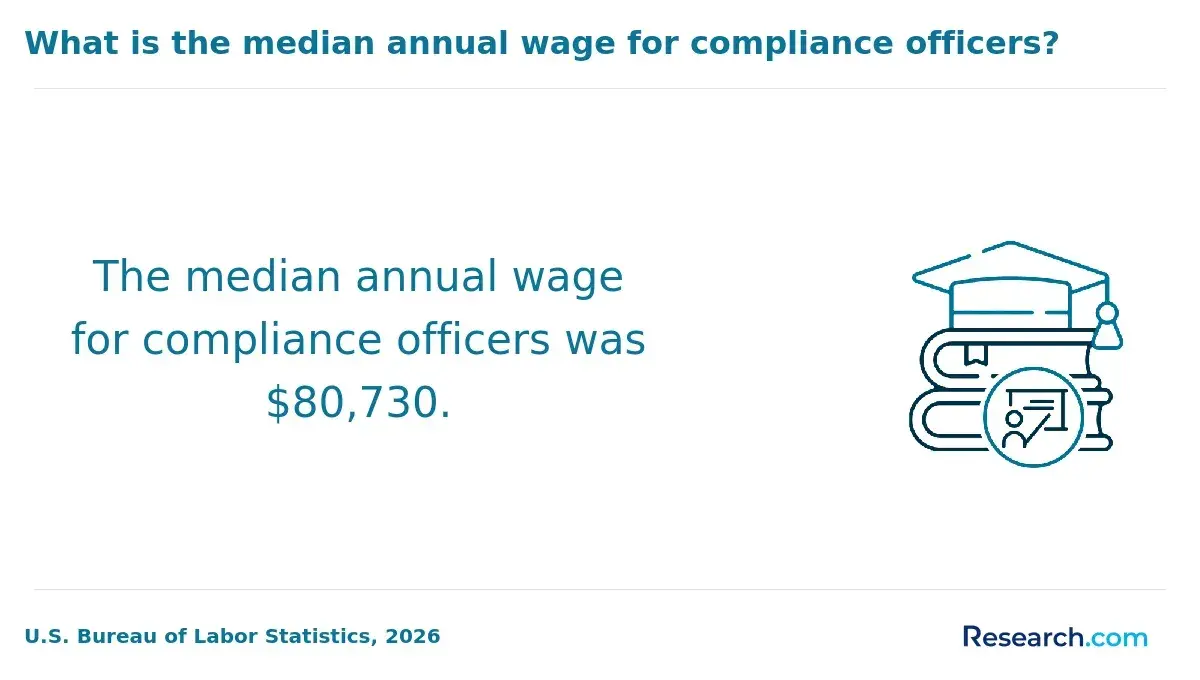
- U.S. compliance officers had median annual pay of $80,730 in May 2025, with 4% projected job growth from 2025 to 2035, according to the Bureau of Labor Statistics (BLS). Those occupation-wide figures do not measure the payoff from either degree.
What is the difference between an MSL in corporate compliance and an MBA compliance concentration?
An MSL in corporate compliance is a non-JD graduate law degree designed to help professionals understand legal rules and their application in organizations. An MBA with a compliance concentration is a business administration degree whose core usually covers management and business functions; its concentration adds compliance-focused study. Schools may use other names for similar legal-studies degrees, and an MBA's "concentration" may be a formal credential designation or simply a set of electives. Check the catalog before assuming two programs offer equivalent specialization.
The distinction is clearest when you compare what each degree makes you practice, rather than relying on its title.
| Decision factor | MSL in corporate compliance | MBA compliance concentration |
| Primary lens | Legal obligations, regulatory interpretation, and organizational controls | Business strategy, operations, and management decisions informed by compliance |
| Typical strengths | Reading rules, identifying legal risk, and translating requirements into policies | Budgeting, leading teams, measuring performance, and balancing organizational priorities |
| Potential gap | May offer limited finance or general management coursework | May devote relatively few courses to legal analysis |
| Professional status | Does not qualify a graduate to practice law | Does not qualify a graduate to practice law |
If a program advertises a compliance concentration, confirm whether it appears on the transcript, requires specified courses, or is merely suggested elective coursework. That difference matters when you need to demonstrate focused training to an employer.
Which degree is better for a career in corporate compliance?
The MSL is generally the stronger fit for a legal-knowledge gap; the MBA is generally the stronger fit for a management gap. For example, a professional who already manages projects but struggles to interpret regulatory obligations may benefit more from an MSL. Someone with compliance subject-matter experience who wants to lead a department, manage budgets, or influence enterprise strategy may get more relevant preparation from an MBA.
Neither degree is the automatic first step into compliance. Employers may value relevant experience in internal controls, auditing, investigations, operations, or a regulated industry more than an unrelated graduate degree. If you do not yet have a bachelor's degree, associate pathways into legal studies can be an earlier educational step, but an associate degree alone normally will not satisfy graduate admissions requirements.
Before applying, read several job postings for your target role. If they emphasize regulatory research and policy interpretation, compare MSL courses against those tasks. If they emphasize staff leadership and financial decisions, test whether the MBA concentration is substantial enough to complement its business core. A shorter course of study or employer training may be sufficient if only one skill is missing.
What careers can you pursue with an MSL or MBA in compliance?
Both routes can be relevant to compliance officer, compliance analyst, risk, ethics, and internal-controls roles. Work may involve monitoring requirements, reviewing procedures, training employees, investigating concerns, and reporting issues. An MSL may be especially useful where the job requires close reading of laws or regulations. An MBA may be useful where the job combines compliance oversight with operations or team management. Hiring and advancement still depend on experience, industry knowledge, and the employer's requirements.
These are not attorney-qualifying degrees. They also should not be confused with paralegal education: a paralegal supports legal work under appropriate supervision, while a corporate compliance professional helps an organization manage obligations and risk. If your actual goal is a paralegal role rather than corporate compliance, online associate degree options for paralegal study provide a more directly relevant comparison than either graduate degree.
How do MSL and MBA compliance curricula differ?
An MSL commonly builds from legal research and legal-system foundations into subjects such as business law, regulatory compliance, investigations, and organizational policy. An MBA typically builds from accounting, finance, marketing, operations, and leadership into compliance electives. Actual course requirements vary: a program labeled "corporate compliance" might focus on governance and investigations, while another might emphasize a particular regulated industry.
Look for assignments that match the work you want to do. Policy drafting or regulatory analysis is more informative for a legal-facing role than a course title alone; budgeting, process improvement, and management projects may better serve an aspiring compliance leader. Also check whether a capstone or experiential course is required rather than assuming the program provides hands-on practice.
If you are still completing undergraduate study, business law degrees with credit transfer opportunities may help you build a foundation before graduate school. The receiving school decides which credits transfer and how they apply, so confirm that decision in writing.
Are MSL and MBA compliance programs accredited?
Start by checking the university's institutional accreditation through its recognized accreditor or U.S. Department of Education records. Then ask whether any additional accreditation applies to the specific school or program. Some business schools hold specialized business accreditation; that is a separate consideration from the university's institutional accreditation and does not establish the depth of an MBA's compliance concentration.
Do not assume an MSL is separately accredited by the American Bar Association (ABA) because it is housed in a law school. ABA approval of a law school's JD program is not approval of its non-JD MSL. Likewise, ABA approval of a qualifying paralegal education program is a different status, not institutional accreditation and not an individual professional certification. Assess the compliance curriculum and the institution's status on their own terms.
What are the admission requirements for MSL and MBA compliance programs?
Both are graduate degrees, so applicants generally need a bachelor's degree from an acceptable institution. Schools set their own rules for transcripts, recommendations, statements, work experience, and any standardized-test requirement or waiver. An MSL intended for nonlawyers typically does not require a JD; an MBA may welcome applicants from many undergraduate majors but can require preparatory business coursework. Treat each school's published requirements as controlling.
If completing a bachelor's degree is your immediate hurdle, shorter online paralegal bachelor's programs to compare offer one possible route. Choose that subject only if it also serves your career goals; a bachelor's degree in paralegal studies is not generally a prerequisite for either an MSL or an MBA.
How long do MSL and MBA compliance programs take?
Completion time depends on required credits, course sequencing, enrollment pace, and whether the school offers courses year-round. Either type of program may offer full-time or part-time study; neither degree title establishes a universal timeline. A part-time option can let you keep working, but required courses offered infrequently can extend the time to graduation.
Ask for a term-by-term plan based on the pace you can actually sustain. Confirm when compliance electives run, whether prerequisites delay them, and whether a capstone, residency, or other scheduled requirement limits flexibility. Compare that plan with the time you would spend gaining the same skills through work or a narrower credential.
How much do MSL and MBA compliance programs cost?
Ask each financial aid office whether the specific graduate program qualifies for the aid you intend to use and what borrowing would mean for your circumstances. Employer tuition assistance can change the comparison substantially, but confirm its approval rules and any repayment obligation before enrolling.
A cheaper credential is worthwhile only if it prepares you for the job you want. If your goal is paralegal work rather than compliance leadership, our list of affordable ABA-approved paralegal programs points to a different educational route; ABA paralegal program approval should not be treated as a feature of an MSL or MBA.
Are online or campus-based compliance programs better?
Neither format is inherently better. An online program may make graduate study possible while working, but "online" does not necessarily mean asynchronous or self-paced. Campus study may make in-person discussion and local professional connections easier, but travel and fixed meeting times can increase its practical cost.
Check the delivery rules for the exact program and courses you would take: live-session times, examination arrangements, campus visits, group projects, and how often required compliance electives are available. If a capstone involves an employer project or placement, ask who arranges it and whether your current job can satisfy the requirement. The better format is the one you can complete while doing the work needed to gain relevant experience.
What salaries and job outlook can compliance graduates expect?
The BLS reports $80,730 in median annual pay for compliance officers in May 2025 and 4% projected job growth from 2025 to 2035, with about 32,700 openings projected each year. Openings and pay describe the occupation as a whole - not new graduates, holders of either degree, or corporate compliance specialists alone. Your results will depend on factors such as experience, location, industry, and responsibilities.
Use that benchmark to test a proposed degree's value, not to forecast your salary. Compare the roles you could reasonably pursue now with the roles you want after graduation, then identify which required skills the program would add. If the target job mainly asks for experience you have not yet gained, pursuing relevant work alongside a smaller educational investment may be more useful than taking on the full cost of a master's degree immediately.
Other Things You Should Know About Law & Paralegal
No. A degree and a professional certification are separate credentials. For example, the Society of Corporate Compliance and Ethics sets eligibility requirements for its Certified Compliance & Ethics Professional credential. Check the certifying organization's current rules; relevant coursework does not automatically confer certification.
Do not count on it. A JD-granting law school determines whether any previous graduate credits can apply under its own rules. Get a written evaluation from the school before treating transfer credit as part of your plan.
Look for responsibilities involving policy updates, internal controls, training records, audit preparation, or issue reporting in your current workplace. Document the work you performed and the decisions you supported without disclosing confidential information.
Compare programs for substantive privacy coursework and projects, not just a broad compliance label. Review job postings in your target industry to see which privacy responsibilities and technical skills employers expect before choosing a degree or a narrower training option.
References
- Cost of Attendance (Budget) | 2026-2027 Federal Student Aid Handbook https://fsapartners.ed.gov/knowledge-center/fsa-handbook/2026-2027/vol3/ch2-cost-attendance-budget
- Summary of the HIPAA Security Rule | hhs.gov https://www.hhs.gov/hipaa/for-professionals/security/laws-regulations/index.html
- Promoting Best Practices for Medical Science Liaisons... - PMC https://pmc.ncbi.nlm.nih.gov/articles/PMC8492581/
- Compliance Law - SMU Online Master of Legal Studies https://onlinemasterlegalstudies.smu.edu/curriculum/compliance-law/
- MLS - Corporate Compliance - Seton Hall Law School https://law.shu.edu/academics/mls-corporate-compliance-online.html
- Admissions | Robert H. Smith School of Business https://www.rhsmith.umd.edu/programs/full-time-mba/admissions
- Master of Business Administration | Mount St. Mary's University https://msmary.edu/academics/graduate-school/master-of-business-administration.html
- Compliance, Contracts, and Beyond: Legal Studies for Business Professionals | Drexel University Kline School of Law https://drexel.edu/law/news/legal-studies-blog/compliance-contracts-and-beyond-legal-studies-for-business-professionals/
- How To Become a Compliance Officer - UMKC https://onlinemls.law.umkc.edu/articles/how-to-become-a-compliance-officer/
- MBA Accreditation Types and Benefits | Freeman News https://freemannews.tulane.edu/2026/08/06/mba-accreditation-types-and-benefits