2027 MLS Programs for Enterprise Risk Managers Seeking Legal Training

Co-Founder and Chief Data Scientist
Enterprise risk managers often work where contracts, regulation, privacy, and internal controls overlap. Legal training can help them identify when an issue needs closer review and communicate more effectively with counsel—but a graduate degree takes time and money.
This guide compares relevant Master of Legal Studies (MLS) options, explains what to check in their curricula and costs, and shows when a certification or shorter course may be the better investment. It is for working risk professionals deciding whether legal study will improve the work they actually do.
Key Things You Should Know
What is an MLS degree for enterprise risk management professionals?
An MLS is a graduate law degree generally designed for people who need to understand legal rules in their existing professions but do not intend to practice law. Schools may use other names, including Master of Studies in Law (MSL) or Master of Jurisprudence. For an enterprise risk manager, the useful outcome is not the ability to give legal advice. It is a better grasp of how legal obligations affect risk registers, vendor oversight, policy design, escalation, and decisions made with in-house or outside counsel.
The fit depends on the job. A manager who regularly interprets regulatory requirements with counsel or oversees cross-functional compliance programs may benefit from sustained legal study. Someone whose immediate gap is a particular control framework, insurance practice, or reporting tool may get more relevant training through employer instruction or a focused credential. For a broader view of choosing a specialization for a legal studies master's, compare the coursework against the risks in your own portfolio.
Which MLS programs offer compliance and enterprise risk management training?
Two programs worth investigating are the University of Arizona's Master of Legal Studies with a Compliance and Legal Risk Management concentration and Fordham University's Master of Studies in Law in Corporate Compliance. The credentials have different names, but both are non-JD legal studies routes. Neither should be treated as a complete substitute for enterprise risk management training: review the current course catalog for the particular risks you manage.
The comparison below separates the programs' stated emphasis from the questions that determine practical fit. Concentration requirements, available electives, delivery arrangements, and tuition can change, so confirm them directly before applying.
| Program | Relevant emphasis | Best question to ask |
| University of Arizona MLS, Compliance and Legal Risk Management | Legal risk and compliance within a legal studies degree | Which required courses address your industry's regulations, contracts, and risk assessment methods? |
| Fordham University MSL, Corporate Compliance | Corporate compliance and organizational legal obligations | How much of the curriculum covers enterprise-wide risk rather than compliance program administration? |
A formal concentration is not the same as taking a few relevant electives. Ask each school whether the specialization appears on the transcript, which courses are required, whether your preferred electives run often enough to complete them on schedule, and whether a capstone can address a workplace risk problem. Compare other schools using those same criteria rather than assuming a program titled "risk management" covers every ERM function.

Do enterprise risk managers need an MLS degree or a law license?
Enterprise risk management positions do not generally require an MLS or a law license. Risk managers can identify issues, coordinate controls, document exposure, and bring legal questions to counsel without acting as attorneys. An MLS may help with those tasks, but it does not authorize its holder to practice law, represent clients, or independently provide legal advice. Attorney licensure follows a different route and is governed by state rules.
Choose the degree when sustained legal analysis is central to your next role and a graduate curriculum covers several recurring gaps. Choose a shorter course, employer training, or a professional certification when you need a specific operational skill. Paralegal education is a different route, aimed principally at legal-support work rather than leading an enterprise risk function. If you are considering that career change for cost reasons, a guide to paralegal degree tuition installment plans can help distinguish a payment schedule from a lower total price.
What do MLS programs in risk management and compliance teach?
Relevant curricula commonly connect legal reasoning with organizational decisions: interpreting regulations, understanding contracts, designing compliance policies, conducting investigations, protecting information, and communicating findings. Business law may help a risk manager spot contract and governance issues; privacy coursework may clarify when a data incident needs legal escalation. These courses build judgment, not permission to make legal determinations reserved for counsel.
Read course descriptions closely. A course that surveys a statute is different from one that requires students to analyze a vendor agreement, draft a policy, or assess a hypothetical incident. Ask for recent syllabi and examples of assessed work. If business law is your primary gap, compare the scope of a full MLS against business law graduate programs by completion time and shorter, targeted study. Faster completion is useful only if the available courses address your responsibilities.
Are online MLS programs as valuable as campus-based programs?
An online MLS can be valuable for a working risk manager when it offers the courses, instructor access, applied work, and schedule the job requires. Delivery format alone does not establish educational quality or employer recognition. Nor does "online" necessarily mean asynchronous: scheduled discussions, live classes, group projects, or campus visits can affect whether the program is workable.
Request the current course schedule and ask whether required classes are offered online, how often they run, and whether attendance is required at set times. Campus study may suit someone seeking regular face-to-face discussion or local professional connections; online study may reduce travel and make continued employment easier. In either format, assess the actual assignments and faculty feedback rather than treating convenience as evidence of equivalent practical training.
What are the admission requirements for an MLS risk management program?
Applicants should expect to document a bachelor's degree and meet the particular school's graduate admissions rules. Programs may also request transcripts, a résumé, a statement of purpose, references, or evidence of relevant work experience. Requirements—including test policies and eligibility for a specific concentration—vary by institution; do not assume that professional experience substitutes for a published academic prerequisite.
Before applying, ask admissions staff whether your undergraduate major matters, whether any prerequisite law or business courses are required, and whether previously completed graduate coursework can count. The receiving school decides whether credit transfers and how it applies to the degree. A strong application should connect your risk responsibilities to specific courses, rather than relying on a general interest in law.
How long do MLS programs take, and how much do they cost?
Completion time depends on required credits, course sequencing, and whether you study full-time or alongside work. A published fastest-completion claim may assume a course load that is unrealistic during audit cycles or major investigations. Ask for a term-by-term plan based on your intended workload, including when concentration courses are offered.
For a meaningful price comparison, obtain each school's current 2026-27 tuition and mandatory-fee schedule and calculate the cost for the credits you would actually need. Include books, technology or legal research charges, travel, and any required campus attendance. Then subtract confirmed employer assistance or aid rather than assuming either is available. Legal studies master's tuition and earning potential offers additional context, but an occupational salary figure cannot establish that a particular degree will pay for itself.
The principal opportunity cost is time: hours spent in class and on assignments cannot also be spent gaining experience or completing narrower training. Before accepting an offer, ask the school for an itemized estimate and your employer for its written reimbursement terms, including any repayment obligation if you leave.
What careers can an MLS prepare enterprise risk managers for?
For an experienced risk manager, an MLS may support a move into compliance management, regulatory affairs, corporate governance, third-party risk, privacy-related risk, or a broader ERM leadership role. Its value is strongest when paired with evidence that you have built controls, managed stakeholders, investigated issues, or advised decision-makers on risk. Employers set their own hiring criteria; the degree does not guarantee promotion or qualify someone for an attorney position.
The Bureau of Labor Statistics projects 4% growth for compliance officers from 2025 to 2035. That projection describes a broad occupation, not demand specifically for MLS graduates or enterprise risk managers. If your goal is instead hands-on legal support, investigate that occupation's education expectations separately; finding paralegal bachelor's programs that consider transfer credits may be more pertinent than earning a graduate legal studies degree.
How much do enterprise risk managers with legal training earn?
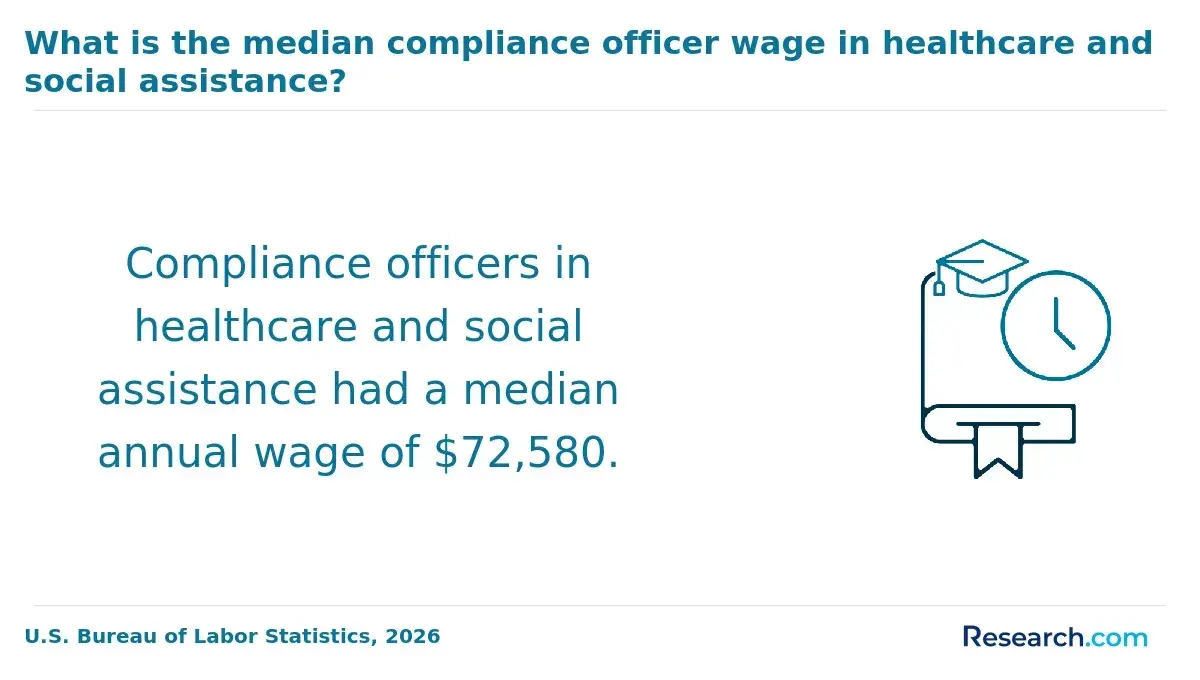
There is no dependable national salary figure that isolates enterprise risk managers with an MLS from otherwise similar managers without one. As a related benchmark, the Bureau of Labor Statistics reports median annual pay of $80,730 in May 2025 for compliance officers. That figure covers a broad occupation; it is neither an ERM salary nor a forecast of what legal training adds to pay.
For a personal return-on-investment estimate, compare local job postings for the role you want, their required credentials, your current compensation, and the full cost of study. Treat a degree as a possible qualification advantage only where employers actually request the knowledge it teaches.
Which certifications complement an MLS in enterprise risk management?
A professional certification tests against a credentialing organization's requirements; it is not the same as a university certificate, which documents completion of coursework. Depending on your responsibilities, the Risk and Insurance Management Society's RIMS-CRMP can align with enterprise risk practice, while the Compliance Certification Board's Certified Compliance & Ethics Professional (CCEP) can align with compliance program work. Information systems or privacy credentials may be more relevant for specialized portfolios.
Check each issuing organization's current eligibility rules, exam content, fees, and continuing-education requirements before enrolling in an MLS to complement a credential. If a certification covers your immediate skills gap at substantially less cost, pursue it first. If your work repeatedly requires deeper analysis across contracts, regulation, and governance, the degree may provide a broader foundation.
Other Things You Should Know About Law & Paralegal
Do not assume they will. A law school decides whether it accepts prior coursework and whether those credits can apply to its JD requirements. Get a written answer from any JD program you might attend before using an MLS as a potential stepping stone.
Possibly, but the certification body - not the university - determines whether a course qualifies. Check its current subject, documentation, and reporting rules before relying on graduate classes for continuing-education credit.
Ask both your employer and the school first. Confidential records, personal data, and privileged communications may require approval or a fictionalized scenario even when the project would improve your work.
Yes, if you want the degree to support your current role. A supervisor or legal/compliance colleague can identify recurring knowledge gaps, while you should confirm independently that the program permits the courses needed to address them.
References
- M.L.S. Insights: Navigating Enterprise Risk Management for Your Organization | miami.edu https://news.miami.edu/law/stories/2024/08/mls-insights-navigating-enterprise-risk-management-for-your-organization.html
- Compliance and Risk Management | William & Mary Law School https://online.law.wm.edu/master-of-legal-studies/concentrations/compliance-risk-management
- Governance, Risk Management and Compliance | UConn School of Law LLM Programs https://llm.law.uconn.edu/course-of-study-governance-risk-management-and-compliance/
- Curriculum - FSU College of Law - Florida State University https://law.fsu.edu/academics/academic-programs/juris-master-online-program/legal-risk-management-contracting-and-compliance-concentration/curriculum
- Legal Careers You Can Pursue Without a Law Degree | DePaul University Online Master of Legal Studies https://onlinemls.depaul.edu/articles/legal-careers-you-can-pursue-without-a-law-degree/
- Compliance Law - SMU Online Master of Legal Studies https://onlinemasterlegalstudies.smu.edu/curriculum/compliance-law/
- MLS Online | Risk Management & Compliance https://www.law.tamu.edu/degrees-programs/mls-degree/risk-management.html
- Compliance and Enterprise Risk Management (MJ) | luc.edu https://catalog.luc.edu/graduate-professional/law/compliance-enterprise-risk-management-mj/
- Online LLM in Financial Compliance and Risk Management | Albany Law School https://www.albanylaw.edu/graduate/online-llm-financial-compliance-and-risk-management
- ABA vs. Cal Bar: Differences Explained | collegesoflaw.edu https://www.collegesoflaw.edu/blog/2019/08/27/difference-between-aba-cal-bar/