2027 Paralegal Education for Litigation Data Review: Technical Prerequisites to Check

Co-Founder and Chief Data Scientist
A paralegal program can teach litigation procedure without ever letting students work through an electronic document review. That gap matters if you want to help legal teams organize evidence, search large collections, and prepare documents for production. This guide is for prospective students and career changers comparing U.S. paralegal education for litigation data review. It explains the technical skills to look for, how to verify that a program teaches them in practice, and when a shorter course or workplace training may be a better investment.
Key Things You Should Know
- Prioritize programs that require hands-on work with document review, metadata, search, coding, and production - not ones that merely mention e-discovery software.
- Check software access and equipment rules before enrolling: "online" does not establish that a review-platform lab is available remotely or on your schedule.
- The Bureau of Labor Statistics reports $62,890 in median annual pay for paralegals and legal assistants in May 2025; that broad occupation figure is not a promised salary for litigation data review.
What is litigation data review in paralegal practice?
Litigation data review is the organized examination of electronically stored information - such as email, messages, spreadsheets, and files - to help attorneys identify material relevant to a dispute. It is part of e-discovery, the process of identifying, preserving, collecting, reviewing, and producing electronic evidence.
A litigation support paralegal might track document sources, check imported records for missing fields, run approved searches, apply review tags, maintain issue lists, and prepare production checks. Work can also involve coordinating with attorneys, vendors, and information technology staff. The exact division of tasks depends on the matter, employer, and applicable court orders.
Review is not simply reading documents quickly. A mistaken date filter can omit relevant records; an incorrect confidentiality tag can affect a production. Paralegals work under attorney supervision and do not independently make legal judgments or provide legal advice.
What technical skills do paralegals need for litigation data review?
The strongest foundation combines defensible data handling with accurate, repeatable review work. You do not generally need to be a programmer, but you should be comfortable learning unfamiliar systems and checking your own results.
These skills connect directly to tasks a student should be able to practice in a course or supervised workplace exercise:
- File and metadata literacy: distinguish a document's visible content from fields such as sender, recipient, date, file type, and custodian; understand why conversion or careless editing can change evidence.
- Review-platform workflow: navigate document families, saved searches, tags, redactions, audit trails, and production sets while following a written protocol.
- Quality control: use spreadsheets and platform reports to spot inconsistent coding, unexpected counts, missing attachments, or duplicate records.
- Security: follow access controls, multifactor authentication, secure transfer procedures, and matter-specific rules for confidential information.
Ask a program whether students perform these tasks on a realistic sample collection and receive feedback. Seeing a vendor demonstration is not the same as completing a review. Artificial intelligence may assist with searching or sorting documents, but its output still requires appropriate validation, confidentiality controls, and attorney oversight; do not assume a school's mention of AI includes practical training.
What education is required to become a litigation support paralegal?
There is no single nationwide degree required for every litigation support paralegal job. Employers may prefer a paralegal associate degree, a bachelor's degree, a post-baccalaureate paralegal certificate, or relevant legal support experience. State rules and particular job postings can impose different expectations. Paralegal education prepares people to support legal work; it does not qualify them to practice law as attorneys.
Your starting education matters more than the credential's label alone. The routes below differ in breadth and opportunity cost, but none establishes litigation-review proficiency without relevant practice.
| Education route | Likely fit | Limitation to check |
| Associate-level paralegal program | New entrants who need legal foundations alongside litigation courses | Whether e-discovery includes supervised lab work |
| Post-baccalaureate paralegal certificate | Degree holders seeking focused paralegal preparation | Required prior credits and whether software practice is included |
| Bachelor's completion program | Students with transferable college credit who want a bachelor's credential | How the receiving school applies prior credits and whether specialty courses are available |
| Targeted continuing education or employer training | Working paralegals filling a specific technology gap | Whether training provides assessed practice rather than a completion badge |
If you already have college credits, paralegal bachelor's degree completion using transfer credits may be worth comparing with a shorter certificate. The receiving institution decides which credits count toward its program; do not assume that prior credits eliminate litigation or technology requirements.
Which paralegal courses prepare students for e-discovery and data review?
Look for litigation procedure and legal research first, then examine how the program applies them to electronic evidence. A useful sequence covers discovery requests and responses, evidence preservation, document review, confidentiality, and production. Information governance or cybersecurity coursework can add context, but it should not substitute for review practice.
A course description is only a starting point. Ask for a current syllabus or assignment outline and check whether students actually load or navigate a sample collection, build searches, code documents against a protocol, resolve inconsistent tags, and inspect a proposed production. Confirm whether named tools are available to students, demonstrated by an instructor, or merely discussed. Access to a product does not by itself prepare someone for that vendor's certification.
If your intended work is employment policy or workplace regulation rather than disputes and evidence, legal studies education with an employment and HR law focus may be a more relevant comparison. For litigation data review, favor coursework assessed through document-handling tasks over a concentration name that sounds relevant but contains no review lab.
Do online paralegal programs teach litigation technology effectively?
They can, if students receive secure access to practice materials, complete substantial review assignments, and get feedback on errors. Delivery format alone tells you little about the quality of technology training. A recorded lecture may explain production; a supervised remote lab can test whether a student can perform it.
Before choosing an online program, confirm its required operating system and browser, device or network restrictions, scheduled lab sessions, exam arrangements, and any campus visits. Ask whether review-platform access works outside class hours and whether a course offers an alternative when software is incompatible with your equipment. "Online" does not necessarily mean asynchronous or self-paced.
A non-JD legal studies master's program serves a different purpose: broader legal knowledge for professionals, not necessarily paralegal review-platform training or qualification to practice law. Even a guide to faster online legal studies master's programs should be used to compare schedules and opportunity costs, not as evidence that a master's degree teaches hands-on e-discovery.
What admission requirements apply to litigation-focused paralegal programs?
Requirements follow the specific credential and institution, not the litigation focus. An associate program may admit students entering college, while a post-baccalaureate certificate requires a prior degree. Other certificates may require particular college coursework. Read the current admissions page rather than assuming that every program called a "certificate" has the same entry rules.
For a program with a litigation lab or internship, check prerequisites and course sequencing separately from admission. You may be admitted to the school but unable to take the relevant course immediately. If practical experience is mandatory, ask who finds the placement, whether your current job can qualify, and whether remote placements are permitted. Get answers in writing before paying a deposit or arranging time away from work.
How long do litigation support paralegal programs take, and what do they cost?
There is no standard litigation-support program length or price. A focused course may take less time than a full degree, but its credits, depth, and access to practical training may differ. Published completion times can also assume a particular course load or sequence that does not fit a working student's schedule.
Compare the total cost to complete your intended route: tuition, mandatory fees, books, technology requirements, prerequisite courses, travel, and any internship-related expenses. Ask for a current program-specific estimate and identify which costs could change if you study part time. A low advertised tuition figure is less useful if the coursework does not include the review practice you need.
Students comparing cost-conscious options for ABA-approved paralegal training should verify each program's current approval and total charges directly. ABA approval concerns qualifying paralegal education programs; it is not institutional accreditation. Federal aid also depends on the institution, the particular program, and student eligibility - do not assume that a noncredit or short certificate qualifies.
Which certifications support careers in litigation data review?
A school certificate records completion of an educational program; professional certification is a credential granted by an organization after its requirements are met. Neither is universally required for litigation data review, and completing a school program does not automatically grant professional certification.
Depending on your experience and target role, credentials to investigate include NALA's Certified Paralegal (CP), the National Federation of Paralegal Associations' Registered Paralegal (RP) through its PACE examination, and the Association of Certified E-Discovery Specialists' Certified E-Discovery Specialist (CEDS). Product-specific credentials, such as those offered for a review platform, assess a different kind of knowledge. Check the granting organization's current eligibility, examination, renewal, and fee rules before budgeting for any credential. The American Bar Association does not certify individual paralegals.
If you are deciding whether to pursue broader graduate study instead of a focused credential, compare the legal knowledge you need against the time and cost involved. Legal studies master's degree and certificate trade-offs are distinct from the choice between a paralegal school certificate and professional certification.
What jobs and salaries can litigation data review paralegals expect?
Relevant postings may use titles such as litigation paralegal, e-discovery paralegal, document review specialist, or litigation support specialist. Some emphasize legal procedure and attorney support; others focus on review-system administration, quality control, or vendor coordination. Read the duties rather than assuming that similar titles require the same education or software skills.
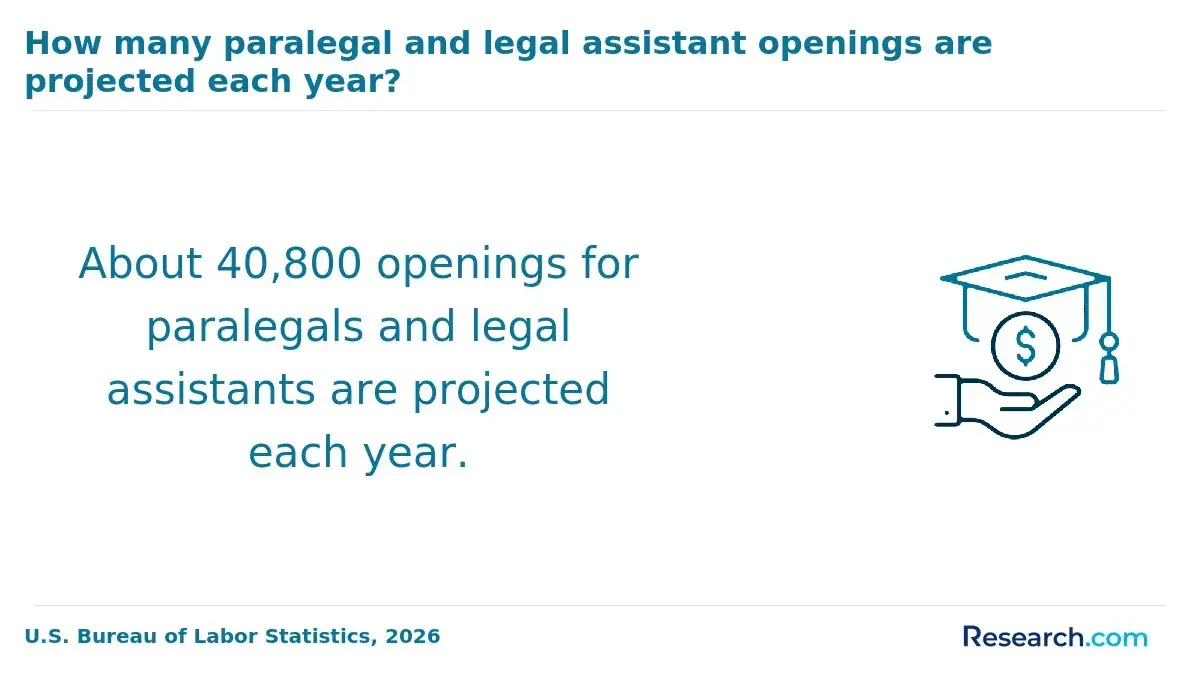
The Bureau of Labor Statistics reports $62,890 in median annual pay in May 2025 for paralegals and legal assistants, with 0% projected growth from 2025-2035 and about 40,800 projected openings per year. These figures cover a broad occupation, not litigation data review specifically. They provide a market benchmark, not an expected starting offer or a return promised by a credential.
For entry-level applications, evidence of accurate review work and familiarity with litigation procedure may be more useful than a long list of software names. With experience, paralegals may take on more complex case coordination or litigation technology responsibilities, subject to employer needs and attorney supervision.
How should students choose an accredited litigation support program?
Start with the credential you need, then test the program's claims about practical training. Institutional accreditation concerns the institution; ABA program approval, when applicable, concerns a qualifying paralegal education program. Verify each status through the relevant accreditor or the ABA's current paralegal program directory rather than treating one as proof of the other.
Use the following checks before committing. They are designed to separate a program that names litigation technology from one that gives you a realistic chance to practice it:
- Request the current syllabus for litigation and e-discovery courses; identify required review assignments and how they are assessed.
- Confirm student access to any named software, including remote access, lab hours, and device requirements.
- Compare admission prerequisites, course sequencing, internship obligations, and your likely completion schedule.
- Obtain a program-specific cost estimate and ask whether the exact credential is eligible for the aid you plan to use.
- Verify institutional accreditation and, if important to your decision, the paralegal program's current ABA approval separately.
A warning sign is a promise of job readiness based only on a software demonstration or a course title. If you already have legal training and need one review-platform skill, targeted instruction may be more efficient than another degree. If you lack litigation foundations, choose a program that teaches legal procedure alongside the technology.
Other Things You Should Know About Law & Paralegal
A paralegal may flag documents and apply review codes under a protocol, but privilege decisions require attorney direction and review. The workflow should make clear how uncertain documents are escalated.
Only if the employer or supervising attorney permits it and the device meets the matter's security requirements. Do not download evidence or use personal storage merely because the review platform is accessible in a browser.
Usually, a portfolio can use fictional or expressly authorized training materials. Remove client information and confirm the school's rules before sharing platform screenshots, assignments, or datasets.
No. Some postings require a licensed attorney, while others seek paralegals or litigation support staff. Check the stated duties and qualifications rather than assuming that "document review" describes a single job type.
References
- Fact Sheet: New Rule on the Accessibility of Web Content and Mobile Apps Provided by State and Local Governments https://www.ada.gov/resources/2024-03-08-web-rule/
- How To Get Certified | North Carolina State Bar https://www.ncbar.gov/paralegal-certification/how-to-get-certified/
- Frequent Questions about EPA's Quality Program https://www.epa.gov/quality/frequent-questions-about-epas-quality-program
- Disability Discrimination: Technology Accessibility | ed.gov http://www.ed.gov/laws-and-policy/civil-rights-laws/disability-discrimination/disability-discrimination-key-issues/disability-discrimination-technology-accessibility
- Federal Rules of Civil Procedure | United States Courts https://www.uscourts.gov/forms-rules/current-rules-practice-procedure/federal-rules-civil-procedure
- 7 Ethical Considerations for Paralegals - ANU Alumni https://alumni.an.edu/7-ethical-considerations-for-paralegals/
- Online Paralegal Certification Training | Greater Altoona CTC https://www.gactc.edu/adult-education/online-training/paralegal/
- Paralegal Specialist Certificate in Litigation - National University https://www.nu.edu/degrees/professional-studies/programs/paralegal-specialist-certificate-litigation-specialization/
- Online Certified Paralegal Training | Coastal Pines Technical College https://careertraining.coastalpines.edu/training-programs/certified-paralegal/
- Online Paralegal Certification Training | West Georgia Technical College https://www.westgatech.edu/community-education/online-paralegal-certification-training/