2027 Master of Legal Studies vs. Paralegal Certificate for Bachelor's Degree Holders

Co-Founder and Chief Data Scientist
If you already have a bachelor's degree, the choice between a Master of Legal Studies (MLS) and a paralegal certificate is less about how much education you can earn and more about the work you want to do. One route emphasizes applying legal knowledge across business and regulated workplaces; the other emphasizes practical legal support skills.
This guide compares their career uses, curricula, time commitments, costs, and credentials so you can identify the shorter or more extensive path that actually serves your goal.
Key Things You Should Know
- Choose a paralegal certificate if your goal is supervised legal support work; choose an MLS if you need broader legal knowledge for work such as compliance, contracts, or human resources. Neither qualifies you to practice law.
- The U.S. Bureau of Labor Statistics reports median paralegal pay of $62,890 in May 2025 and 0% projected employment growth for 2025-2035, with about 40,800 openings annually. Those figures describe an occupation, not a certificate's payoff.
- Before enrolling, compare total cost, hands-on training, scheduling, institutional accreditation, and - if relevant - American Bar Association (ABA) approval of the specific paralegal program.
What is the difference between a Master of Legal Studies and a paralegal certificate?
An MLS is a non-Juris Doctor graduate degree designed to help professionals understand and apply legal concepts in their work. Schools may use related names, including Master of Studies in Law (MSL) or Master of Jurisprudence. A paralegal certificate is an educational credential focused on skills used to assist lawyers. For bachelor's degree holders, the most relevant certificates are often post-baccalaureate programs, though admission and academic level vary.
The comparison below focuses on what each route is designed to teach - not on an assumed difference in prestige or earnings.
| Decision factor | MLS | Paralegal certificate |
| Primary purpose | Apply legal and regulatory knowledge to a nonlawyer role | Prepare for legal support tasks under lawyer supervision |
| Academic credential | Master's degree | Certificate; may be credit-bearing or noncredit |
| Typical emphasis | Legal analysis, regulation, and industry-specific applications | Legal research, drafting, procedure, and office or case workflows |
| Professional effect | Does not confer a license to practice law | Does not itself confer professional certification or a license to practice law |
A certificate is proof of completing a course or program. Professional certification is a separate credential awarded by a certifying organization after its requirements are met. Neither an MLS nor a paralegal certificate is a substitute for a JD and the other requirements for admission to a state bar.
Is a Master of Legal Studies or paralegal certificate better for bachelor's degree holders?
The better choice depends on the job you want next. If you want to enter a law firm or legal department as a paralegal, a certificate with substantial research, drafting, and procedural work is usually the more direct route. An MLS may be an unnecessarily expensive detour if employers are primarily seeking demonstrated paralegal skills.
An MLS may make more sense if you already work in compliance, operations, healthcare, contracts, or human resources and regularly encounter legal rules without acting as a paralegal. For example, legal studies programs combining legal knowledge and HR law may be relevant to an HR professional who handles employment policies. Check whether the subject is a formal concentration, an elective sequence, or simply a few available courses.
Neither route should be the default just because you hold a bachelor's degree. If your employer can provide targeted training, or your goal requires only one area of expertise, a shorter course or professional credential may address the gap with less tuition and time away from work.
What careers can you pursue with a Master of Legal Studies or paralegal certificate?
Paralegal certificate holders commonly pursue paralegal or legal assistant positions, where work can include organizing case materials, researching issues, and drafting documents for attorney review. An MLS may support existing or prospective work involving policies, investigations, contracts, or regulatory obligations. Employers set their own education and experience preferences; neither credential guarantees entry into a particular role.
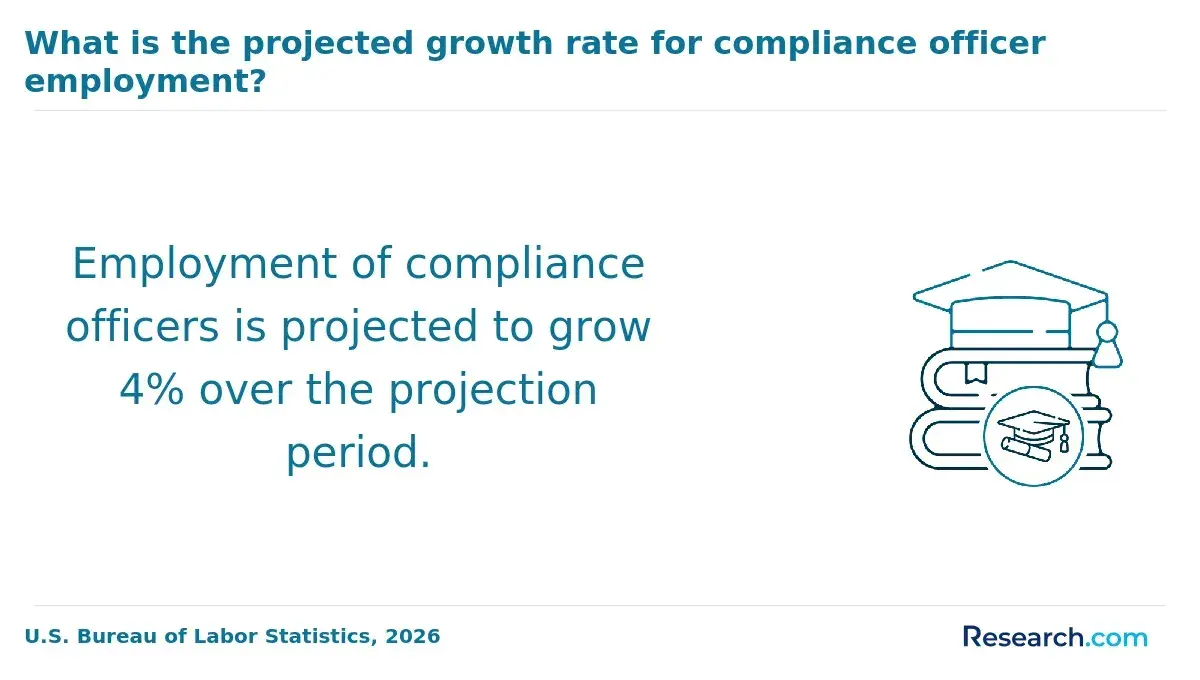
The Bureau of Labor Statistics reports median annual pay of $80,730 in May 2025 for compliance officers and 4% projected employment growth for 2025-2035. That occupational benchmark can help an MLS applicant assess a potential direction, but it does not measure MLS graduates' earnings or mean that the degree is required for compliance work.
For someone committed to paralegal work, compare certificate requirements with actual local job postings rather than assuming a second bachelor's degree is necessary. If you are considering that longer alternative, review paralegal bachelor's degree duration and salary outlook while keeping in mind that occupational wages are not credential-specific outcomes.
What are the admission requirements for each legal studies pathway?
MLS programs generally require an earned bachelor's degree and an application with academic records; additional materials vary by school. A JD is generally not required because these degrees are intended for nonlawyers. Paralegal certificate requirements vary more: some programs require a bachelor's degree, while others accept applicants with less college coursework or specified general education credits. Do not assume every program labeled "post-baccalaureate" has identical prerequisites.
If you hope to apply previous coursework toward another degree later, distinguish admission eligibility from transferable credit. The receiving school decides whether credits apply. Guidance on transferring earlier coursework into a business law degree can help frame the questions to ask, but a noncredit certificate should not be assumed to generate transferable college credit.
How do MLS and paralegal certificate curricula compare?
MLS coursework typically examines legal systems, research, and subjects such as contracts, employment law, privacy, or regulation. The value of those subjects depends on how closely assignments match decisions you make at work. A paralegal curriculum typically concentrates on legal research and writing, civil procedure, document preparation, ethics, and practice-specific workflows.
Read course descriptions and sample assignments, not just subject titles. For paralegal preparation, look for opportunities to produce attorney-supervised-style work, such as research memoranda or draft filings, and check whether an internship is required. For an MLS, look for applied projects tied to your industry. A course that mentions legal technology or artificial intelligence does not, by itself, establish hands-on proficiency or prepare you for an external software credential.
How long do MLS and paralegal certificate programs take?
MLS programs generally require a more substantial graduate course load than certificates, so they often take longer. Actual completion time depends on required credits, course sequencing, enrollment intensity, and whether courses are offered year-round. Paralegal certificates can be shorter, but a required internship or a course offered only in certain terms can extend the calendar.
Ask each school for a term-by-term plan based on the number of courses you can realistically take while working. If a certificate does not accept your prior coursework and requires substantial general education, compare the resulting timeline with online study for a paralegal associate degree rather than assuming the certificate is automatically quicker.
How much do MLS and paralegal certificate programs cost?
An MLS usually represents a larger tuition commitment because it is a graduate degree, but published prices vary by institution and enrollment status. Certificates vary in length and may be priced by credit, course, or program. A comparison based only on advertised tuition can miss mandatory fees, textbooks, research platforms, technology, campus travel, and internship expenses.
Request an itemized estimate for your intended schedule and ask what remains payable if you take fewer courses or withdraw. For an MLS comparison, our list of affordable online legal studies master's programs can provide starting options; confirm current prices and required fees directly with each school before deciding.
Federal aid eligibility also requires program-specific verification. An accredited institution does not make every certificate eligible for federal student aid, particularly if the certificate is noncredit. Ask the financial aid office whether the specific program qualifies and compare any borrowing with the work opportunity you expect it to support - not an assumed salary increase.
Are online or campus-based legal studies programs better for working adults?
Online delivery can eliminate a commute, but it does not necessarily mean self-paced study. Live class meetings, timed exams, fixed cohorts, campus visits, and internship hours can still conflict with a work schedule. Campus-based courses may offer easier access to in-person practice and local contacts, but their value depends on what the program actually provides.
For either format, ask for the published course schedule and internship policy. Confirm who finds placements, whether your current job can satisfy a placement requirement, and whether remote work is permitted. A program's stated flexibility matters less than whether its required activities fit the hours you can consistently protect.
Do MLS graduates or paralegals need licenses or professional certification?
An MLS does not grant a license to practice law. Paralegals generally work under attorney supervision rather than providing independent legal advice or representing clients as lawyers. State rules and particular roles can impose additional requirements, so check the rules where you intend to work.
Professional paralegal certification is distinct from a school certificate. Organizations such as NALA and the National Federation of Paralegal Associations award their own credentials under their own eligibility and examination rules. Certification is not a universal requirement for paralegal employment; verify an organization's current criteria and whether employers in your target market value its credential before paying to pursue it. Completing an ABA-approved education program also does not make someone an "ABA-certified paralegal": the ABA approves qualifying programs, not individual paralegals.
How should you choose an accredited MLS or paralegal certificate program?
Start with the job duties you want, then compare programs against those duties. Verify the institution's accreditation separately from any ABA approval of a paralegal program; the two statuses answer different questions. If ABA approval matters to you or a prospective employer, check the specific program in the ABA's current paralegal program directory rather than relying on a school-wide claim.
Before paying a deposit, work through these checks to catch differences that marketing summaries may hide:
- Match required courses and assessed assignments to the skills named in relevant job postings.
- Confirm admission prerequisites, credit or noncredit status, internship arrangements, and a workable completion schedule.
- Obtain the full cost and ask the financial aid office about eligibility for the specific program.
- Verify institutional accreditation, any claimed ABA program approval, and any state-specific employment or practice rules that affect your goal.
For a prospective paralegal, weak practical training is a warning sign even if a program is short. For a professional considering an MLS, a curriculum unrelated to the regulations encountered at work may not justify the extra cost and time.
Other Things You Should Know About Law & Paralegal
Do not assume so. A law school decides whether any prior coursework can receive credit under its policies and applicable rules. Ask the JD program directly before treating either credential as a shortcut.
Yes, if you meet each program's admission requirements. Consider doing both only when you can explain what the second credential adds - for example, practical legal support skills followed by broader knowledge needed in a different role.
Not necessarily. Entry-level legal support applicants may benefit from structured skills training, while someone already handling regulatory work may be able to identify a more focused learning need. Reviewing job postings and speaking with people in the target role can clarify which gap to address first.
It can demonstrate relevant tasks, but an employer decides how to weigh it against paid experience. Keep examples of permitted work products and be specific about your responsibilities; protect confidential client information when assembling a portfolio.
References
- 1G.0119 Standards For Certification Of Paralegals | North Carolina State Bar https://www.ncbar.gov/for-lawyers/ethics-and-governing-rules/governing-rules/1g-certification-of-paralegals/0100-the-plan-for-certification-of-paralegals/0119-standards-for-certification-of-paralegals/
- Cost of Attendance (Budget) | 2025-2026 Federal Student Aid Handbook https://fsapartners.ed.gov/knowledge-center/fsa-handbook/2025-2026/vol3/ch2-cost-attendance-budget
- Paralegal vs. Legal Assistant: What's the Difference? | Online Paralegal Studies Certificate Program https://paralegalonline.bu.edu/articles/legal-assistant-vs-paralegal/
- Master of Legal Studies (MLS) vs. JD: Which Is Right for You? | Wake Forest MLS https://mls.law.wfu.edu/articles/mls-vs-jd-which-is-right-for-you/
- How an M.L.S. Degree Prepares You for Employment Law | miami.edu https://news.miami.edu/law/stories/2025/09/how-an-mls-degree-prepares-you-foremployment-law.html
- Master of Legal Studies Online (MLS) | Pepperdine Caruso School of Law https://law.pepperdine.edu/online-master-of-legal-studies/
- Is an MLS Worth It? ROI and Career Outcomes for Non-Lawyers | Drexel University Kline School of Law https://drexel.edu/law/news/legal-studies-blog/is-an-mls-worth-it-roi-and-career-outcomes-for-non-lawyers/
- Paralegal | West Valley College https://www.westvalley.edu/academics/paralegal/
- Career Options with an MLS | emory.edu https://law.emory.edu/admission/online-master-legal-studies-mls/articles/career-options-with-an-mls.html
- Master of Legal Studies (MLS) vs. JD: What's the Difference? | SMU Online Master of Legal Studies https://onlinemasterlegalstudies.smu.edu/articles/mls-vs-jd/