2027 Legal Studies Master's Programs for Corporate Governance Professionals

Co-Founder and Chief Data Scientist
Corporate governance work puts professionals close to board decisions, disclosure obligations, internal controls, and legal risk—but it does not always require a law degree. A legal studies master's can build useful legal fluency without preparing you to practice law.
This guide is for compliance, risk, audit, and corporate operations professionals weighing that investment. It explains what to look for in a program, how to compare its cost with shorter alternatives, and where the degree may—or may not—help your career.
Key Things You Should Know
- A Master of Legal Studies (MLS) or similar non-JD degree can support governance work, but it is not required for every role and does not qualify graduates to practice law.
- The U.S. Bureau of Labor Statistics reports median pay of $80,730 in May 2025 for compliance officers; that occupation-wide figure is not a salary forecast for degree holders.
- Prioritize corporate law, board governance, securities disclosure, and compliance coursework; compare the full cost with a graduate certificate or employer training before enrolling.
What is a legal studies master's degree for corporate governance professionals?
Corporate governance professionals help organizations document decisions, support boards and committees, maintain policies, and monitor whether operations meet legal and regulatory obligations. A legal studies master's teaches nonlawyers to understand the rules and legal processes behind that work. Schools may call the credential a Master of Legal Studies (MLS), Master of Studies in Law (MSL), Master of Jurisprudence, or another non-Juris Doctor (JD) degree.
The label alone does not establish a governance specialty. A formal concentration has published requirements; a program with a few relevant electives may offer more flexibility but less assured course access. Compare the actual required courses, elective rotation, and applied work rather than relying on the degree title.
The degree is most plausible for someone whose responsibilities repeatedly involve contracts, corporate structure, disclosure, investigations, or regulatory interpretation. If the goal is one specific skill—such as reading board materials or managing a compliance process—a shorter graduate certificate or targeted training may impose less cost and time. See legal studies graduate study options compared when weighing those routes.
What careers can a legal studies master's degree support in corporate governance?
A legal studies degree can complement experience in compliance, audit, finance, human resources, or corporate operations. Its usefulness depends on the employer's expectations and the work involved; it is not a standard hiring requirement across these roles.
The roles below show where legal knowledge may be useful and what experience employers may still expect. Job titles vary substantially between organizations.
| Potential role | Governance-related work | Experience the degree does not replace |
| Compliance officer | Assess policies, monitor requirements, and help respond to concerns | Industry rules, controls, testing, and investigations |
| Corporate governance specialist | Coordinate board materials, records, and governance processes | Board operations, document control, and stakeholder coordination |
| Risk or internal control professional | Connect regulatory duties with operational risks and controls | Risk assessment, audit methods, and business-process knowledge |
| Corporate secretary team member | Support meetings, minutes, entity records, and disclosures | Organization-specific procedures and careful records management |
For someone already doing adjacent work, the degree may support a move into broader governance responsibilities. A career changer should also seek relevant projects or entry-level experience: classroom knowledge alone does not demonstrate that they can run a board process or test a control.
What are the admission requirements for legal studies master's programs?
Applicants generally need a bachelor's degree, but minimum grades, statements, recommendations, résumés, and standardized-test policies vary by school. A JD or prior legal coursework is not necessarily required. Professionals from finance, audit, human resources, and operations should check whether a program welcomes their background and whether it offers introductory legal-methods coursework.
Distinguish admission eligibility from transfer credit. A school may admit you without accepting prior graduate courses toward the degree. If previous study matters to your budget or completion date, request a written evaluation of which credits apply, any age limits, and how many credits you must still earn at the institution. The receiving school makes the final decision. Readers building on earlier business-law coursework can also review continuing college education in business law before asking a prospective school for its current policy.
How do online and campus-based legal studies master's programs compare?
Online study can reduce commuting, but online does not mean self-paced. Scheduled live classes, fixed deadlines, group projects, exams, or campus visits can affect whether a working professional can participate. Campus programs may make in-person discussion easier while demanding more travel and schedule flexibility.
This comparison identifies the practical differences to confirm with each school, rather than assuming every program in a delivery category works the same way:
| Factor | Online program | Campus-based program |
| Class participation | May be live, recorded, or a combination | Usually involves scheduled in-person meetings |
| Travel | May still require visits or in-person assessments | Regular travel is generally part of attendance |
| Peer interaction | Depends on discussion and group-work design | Often occurs before, during, and after class |
| Workplace application | May accommodate projects based on current employment | May offer locally based projects or events |
Ask for a sample course schedule, including time-zone expectations and any required residencies. If employment is the chief constraint, compare these details—not just the word "online"—when considering best business law degrees for working adults.
What courses do corporate governance legal studies master's programs include?
A relevant curriculum should connect legal rules to decisions a governance team actually makes. Useful subjects include business organizations and fiduciary duties, securities regulation and disclosures, contracts, compliance program design, investigations, risk management, privacy, and legal research. An introductory course should teach students how to read legal authorities and recognize when to refer an issue to counsel—not encourage independent legal advice.
Look beyond course titles. A governance elective is more valuable for this goal if assignments involve analyzing a disclosure scenario, evaluating a policy, or preparing a board-facing briefing under instructor feedback. Check whether such courses run often enough to fit your planned schedule and whether a capstone is required. If your focus is securities or regulated-industry work, confirm that the program covers the rules relevant to your sector rather than treating all "business law" courses as interchangeable.

How long do legal studies master's programs take and what do they cost?
Completion time depends on required credits, course availability, and whether you study full time or part time. A school's advertised fastest route may assume a particular start term or course load that is difficult to combine with full-time work. Request a term-by-term plan for your intended pace before treating a completion estimate as realistic.
For a meaningful cost comparison, obtain each school's published 2026-27 tuition and required-fee schedule and calculate the price for the credits you would actually need. Include books, technology or legal-research charges, travel for required visits, and any lost income from reducing work hours. Advertised tuition alone does not establish total cost; the cheapest online legal studies master's degrees is a starting point for comparing prices, not a substitute for a current school-issued estimate.
Ask the financial aid office whether the specific program is eligible for federal aid and what borrowing would add to its overall cost. Then compare the degree against a graduate certificate, employer-funded training, or relevant work experience. A lower-cost option may be the better investment if it supplies the skills needed for your next role.
Does a legal studies master's degree qualify graduates to practice law?
No. An MLS, MSL, Master of Jurisprudence, or comparable non-JD legal studies degree does not by itself qualify someone to practice law, represent clients, or give legal advice. Attorney admission requirements are set by the relevant jurisdiction and ordinarily involve an attorney-qualifying legal education and additional licensing steps.
Governance professionals can use legal knowledge to recognize issues, organize information, implement approved policies, and work effectively with counsel. They should not mistake that responsibility for authority to make legal judgments on behalf of others. If your intended career requires acting as an attorney, investigate the applicable jurisdiction's requirements before enrolling in a non-JD program.
What salaries can corporate governance professionals with legal studies degrees earn?
There is no reliable single salary figure for corporate governance professionals who hold a legal studies master's. The U.S. Bureau of Labor Statistics reports $80,730 in May 2025 as the median annual pay for compliance officers. That is an occupation-wide benchmark, not a measure of what MLS graduates earn or of the degree's salary effect.
Pay can differ by industry, location, seniority, and the scope of responsibility. When assessing a program's return, compare its full cost with openings you could realistically pursue using your existing experience plus the degree. Ask schools how they define any published career outcomes, and do not treat individual alumni examples as typical results.
What is the job outlook for corporate governance and compliance careers?
The Bureau of Labor Statistics projects 4% growth for compliance officers, 2025-2035. This broad occupational category includes work beyond corporate governance, so the projection cannot tell you how many board-focused positions will be available or whether employers will prefer a legal studies master's.
Governance work also appears within legal, finance, risk, and corporate secretary teams, sometimes under titles that do not include "governance" or "compliance." Search job descriptions for the duties you want, then note which ones call for specific regulatory knowledge, industry experience, legal training, or a credential. That evidence is more useful for choosing coursework than an occupation-wide projection alone.
How can students choose an accredited legal studies master's program?
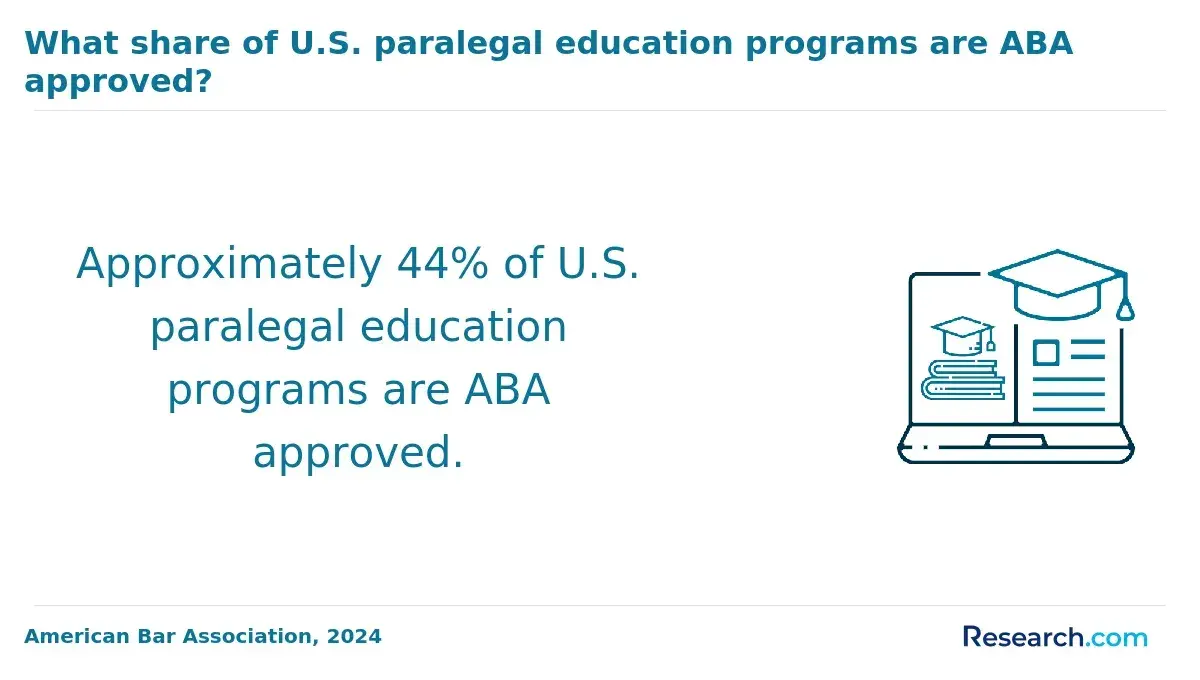
Start by checking that the institution holds accreditation from an accreditor recognized by the U.S. Department of Education, using current institutional and accreditor information. Institutional accreditation is not a guarantee that a particular governance curriculum meets your goals. American Bar Association approval of qualifying paralegal programs is a separate matter and should not be assumed to apply to a legal studies master's.
Use the following sequence to turn a shortlist into a decision. Request written answers where scheduling, cost, or degree requirements could change your plans.
- Match required courses and reliably offered electives to the governance duties you want to perform.
- Confirm the degree name, institutional accreditation, total required credits, and whether a governance concentration has formal requirements.
- Obtain a term-by-term schedule showing live meetings, campus visits, course sequencing, and any capstone or placement obligations.
- Compare current tuition and mandatory fees at your expected pace, then ask about program-specific aid and employer reimbursement.
- Check recent job postings against your experience and the curriculum before deciding whether a full master's adds enough value over a shorter option.
Be cautious if a school describes a non-JD degree as a path to attorney licensure or promotes a fast finish without showing when required courses are offered. A shorter advertised timeline is useful only if its workload and costs are workable for you; our list of fast-track online business law master's programs can help frame that comparison.
Other Things You Should Know About Law & Paralegal
Yes. Many support duties involve coordinating meetings, maintaining records, and tracking processes. Employers set role-specific qualifications, while legal advice and other attorney responsibilities must remain with authorized professionals.
Not automatically. Continuing legal education rules apply to licensed professionals and vary by jurisdiction and course approval. Ask the relevant licensing authority and program before relying on a class for credit.
Possibly. Check the employer's education-benefit policy for eligibility, grade requirements, annual limits, and any repayment obligation if you leave.
Do not assume so. Get authorization under your employer's confidentiality and information-security policies, and ask the instructor whether a fictionalized or public-information scenario can meet the assignment requirements.
References
- Types of Financial Aid: Grants, Work-Study, and Loans | studentaid.gov https://studentaid.gov/understand-aid/types
- Financial Aid 101 | dhewd.mo.gov https://dhewd.mo.gov/ppc/financial-aid-101
- Compliance & Ethics Certificate | American University https://www.american.edu/wcl/impact/initiatives-programs/business/cec/
- How Online & Virtual Courses Work | Ivy Tech Community College https://www.ivytech.edu/classes/how-online-virtual-courses-work/
- Securities Law - eCornell - Cornell University https://ecornell.cornell.edu/certificates/law/securities-law/
- Compliance and Risk Management | William & Mary Law School https://online.law.wm.edu/master-of-legal-studies/concentrations/compliance-risk-management
- MLS vs. LLM - Degree Comparison - Online LLM | Online Master of Laws (LLM) at Northeastern https://llmonline.northeastern.edu/articles/mls-vs-llm/
- How International Lawyers Qualify for the U.S. Bar | University of Dayton https://udayton.edu/law/online-llm/articles/international-lawyers-qualify-bar-exam-practice-in-us.php
- Courses - Program on Corporate Governance https://pcg.law.harvard.edu/courses/
- Online and Hybrid Programs - UChicago Professional https://professional.uchicago.edu/find-your-fit/remote