
2027 MLS Programs for Bank Vendor Oversight and Third-Party Risk Teams

Co-Founder and Chief Data Scientist
Bank vendor oversight teams review contracts, assess third-party risks, and monitor whether providers meet regulatory and security expectations. A Master of Legal Studies (MLS) can strengthen the legal knowledge behind that work, but it is a substantial investment - and not every program teaches the skills a bank needs.
This guide helps bank employees and career changers compare relevant programs, identify useful coursework, weigh costs against shorter alternatives, and decide whether graduate legal study is the right next step.
Key Things You Should Know
- An MLS or related MSL can help with vendor contracts and compliance analysis, but it is not generally required for bank third-party risk roles and does not qualify graduates to practice law.
- Compare programs by their actual courses in financial regulation, contracts, privacy, and risk - not by the degree title alone.
- The Bureau of Labor Statistics reports $80,730 median annual pay for compliance officers in May 2025 and 4% projected growth for 2025-2035; those broad figures do not predict pay or demand for bank vendor oversight specialists.
What is an MLS degree for bank vendor oversight and third-party risk teams?
An MLS is a graduate legal studies degree designed primarily for people who need to work with law but do not intend to become attorneys. Schools may use related names, including Master of Studies in Law (MSL) or Master of Jurisprudence. These are non-JD degrees: completing one does not, by itself, qualify someone to practice law or give legal advice.
In bank vendor oversight, the practical work follows a third party through selection, due diligence, contract negotiation, ongoing monitoring, and eventual exit. The federal banking agencies' interagency guidance on third-party relationships emphasizes risk management across that life cycle; outsourcing an activity does not remove the bank's responsibility for managing its risks. Legal study can help an employee recognize contract issues, interpret regulatory obligations, document decisions, and know when to involve counsel. It does not replace operational experience or a bank's internal policies.
Degree labels reveal less than course content. A reader comparing matching legal studies master's specializations to career goals should distinguish a formally named concentration from electives that merely allow a similar focus.
Which MLS programs prepare graduates for banking compliance and third-party risk management?
No MLS title alone establishes preparation for bank vendor oversight. The following programs are starting points for a comparison because they offer non-JD graduate legal study with potentially relevant business or compliance coursework. Before applying, confirm the current catalog, available electives, delivery format, and whether the subjects you want can be completed within the degree.
This table applies the same decision test to each option: whether its current curriculum lets you build usable financial-regulatory, contract, and risk-management knowledge.
| Program | Potential fit to investigate | Key question for the school |
| Arizona State University, Master of Legal Studies | A broad legal studies route for examining business, regulatory, and contract subjects | Which current courses address regulated financial services and third-party contracts? |
| Wake Forest University, Master of Studies in Law | A legal studies route for professionals comparing compliance-focused coursework | Can the current course sequence cover financial services compliance alongside contracts and privacy? |
| Fordham University, Master of Studies in Law in Corporate Compliance | A more explicitly compliance-oriented degree to assess against bank-specific needs | How much of the required curriculum addresses banking regulation or vendor oversight rather than corporate compliance generally? |
These are examples, not a ranking or a claim that any school offers a dedicated bank vendor oversight concentration. Request syllabi or detailed course descriptions: a course called "compliance" may focus on a different industry. If speed is important, compare business law master's programs with faster study pathways, but check whether the shorter schedule still permits the courses your role requires.
Is an MLS degree required for bank vendor oversight careers?
Generally, no. Banks can hire for third-party risk, procurement, information security, audit, or compliance experience without requiring an MLS. Requirements depend on the employer and role. A vendor risk analyst may spend more time reviewing controls and monitoring evidence; a contracts specialist may need stronger drafting and negotiation skills. Neither job title automatically requires a graduate legal degree.
If you already work in a bank, first compare the degree with a targeted course, employer training, or a professional certification. Ask whether your next role calls for sustained legal analysis or primarily for deeper knowledge of risk assessments and controls. The MLS is easier to justify when its curriculum fills a documented gap and your employer values that training; it is harder to justify if you need only a narrow skill.
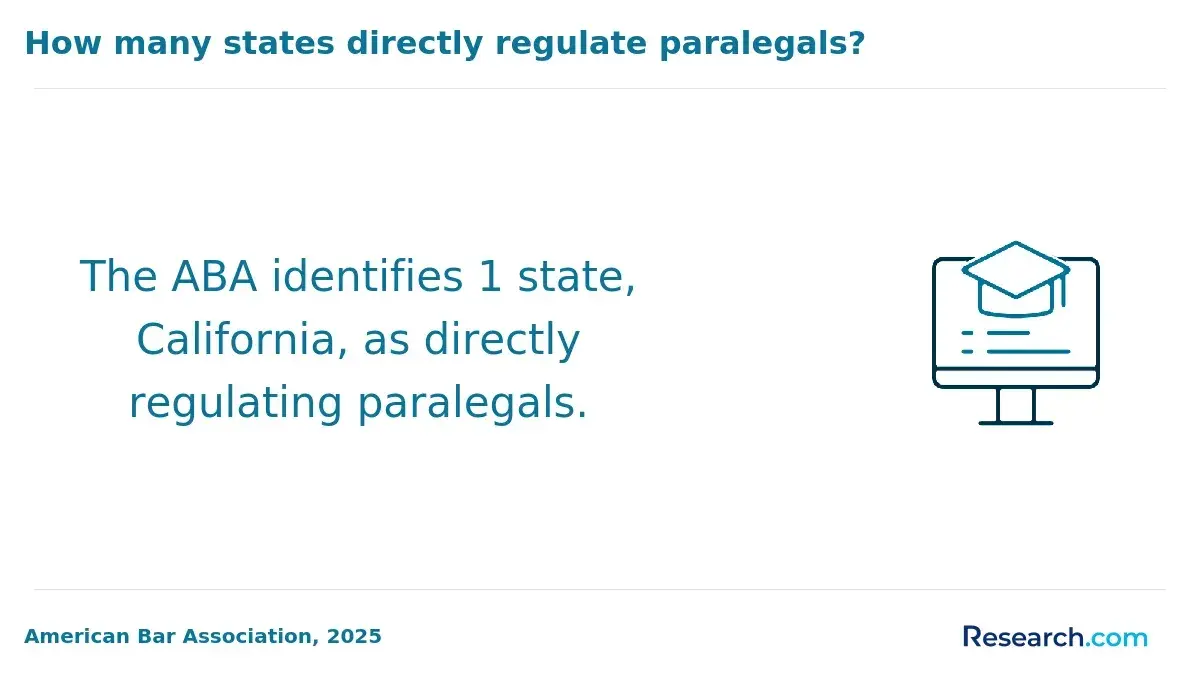
Paralegal education is a different route, usually aimed at supporting legal work rather than managing an enterprise-wide vendor risk program. For someone pursuing contract-support work on a tighter education budget, ABA-approved paralegal education on a budget may be worth comparing - but it is not a substitute for banking risk experience. The American Bar Association (ABA) approves qualifying paralegal programs; it does not certify individual graduates.
What accreditation should you look for in an MLS program?
Check that the university has recognized institutional accreditation and that the specific degree is offered by that institution. Institutional accreditation speaks to the school; it does not mean a bank-regulation course or MLS concentration has been separately accredited. Confirm the school's current status through its accreditor or U.S. Department of Education recognition resources, rather than relying on an old program listing.
Do not use ABA approval as the test for an MLS. ABA approval of paralegal education programs is distinct from institutional accreditation, and an MLS is neither an ABA-approved paralegal credential nor an attorney-qualifying JD. After checking accreditation, evaluate the more job-specific evidence: current syllabi, instructors' relevant expertise, assessed assignments, and whether courses are offered often enough to finish your intended sequence.
What courses cover vendor contracts, regulatory compliance, and third-party risk?
Look for coursework that connects legal obligations to decisions a bank actually makes about vendors. Relevant subjects include contract law, financial services regulation, privacy and data security, corporate governance, and administrative or regulatory law. Risk-management courses can be valuable, but read their descriptions to see whether they address third parties rather than risk only in general terms.
A strong assignment might ask students to identify issues in a service agreement, explain escalation triggers in a due-diligence scenario, or assess obligations involving customer information. Coursework can build analytical skill; it does not grant authority to provide legal opinions for an employer. Ask a program which required or elective courses involve applied work, whether those courses are regularly available, and whether a claimed concentration appears on the transcript or diploma.
Should you choose an online or campus-based MLS program?
Choose the format that lets you complete the right courses while meeting your work obligations. Online does not necessarily mean asynchronous or self-paced: classes may have live meetings, fixed deadlines, group work, or scheduled exams. Campus study can offer in-person discussion and networking but may add commuting or relocation costs.
Ask each school for a typical course sequence and confirm meeting times, campus visits, exam arrangements, and how often bank-relevant electives run. An online degree with a required course offered infrequently may be less flexible in practice than its advertising suggests. If your employer offers tuition assistance, also check whether the format and course load meet its reimbursement rules before enrolling.
What are the admission requirements for MLS programs?
MLS and MSL programs generally target applicants who already hold a bachelor's degree, but each school sets its own GPA, application, writing, résumé, and recommendation requirements. A law degree is generally not the point of entry. Applicants from banking, procurement, audit, technology, or operations should use their application to explain how legal study connects to responsibilities they have held or want to take on.
If you have prior graduate coursework, ask the receiving school whether it accepts transfer credit, how much can apply to this particular degree, and whether accepted courses can satisfy relevant requirements. Prior credit does not transfer automatically between accredited institutions. Resources on finding business law programs that consider transfer credits can help frame the search, but the school's current written decision controls.
How long do MLS programs take, and how much do they cost?
Completion time depends on required credits, course sequencing, and whether you study full time or alongside a job. Compare each school's current degree requirements with the schedule on which it actually offers your chosen electives. A short advertised completion path may leave little room for banking-relevant coursework.
For a meaningful cost comparison, obtain each school's 2026-27 tuition and mandatory-fee schedule, then account for the credits you must take. Add books, technology or legal-research charges, and any required travel. Published tuition alone is not total cost, and a lower per-credit rate does not establish a lower program cost when credit requirements differ. Confirm any employer reimbursement terms and the specific program's eligibility for federal aid with its financial aid office; do not assume aid is available or that loans make a degree affordable.
If your objective is narrower contract-support training, comparing paralegal programs offering tuition payment arrangements may clarify a less extensive route. A payment arrangement changes when tuition is due, not the total price or whether paralegal study meets your bank-risk career goal.
What careers and salaries can MLS graduates pursue in bank vendor oversight?
Potential paths include third-party risk analyst, vendor oversight manager, compliance officer, contracts specialist, and roles coordinating legal, security, procurement, and business teams. Analysts may evaluate due-diligence findings and monitoring reports; managers may oversee escalations, governance, and remediation. Hiring expectations and advancement depend heavily on bank experience, technical knowledge, and the scope of the position - not simply possession of an MLS.
The Bureau of Labor Statistics reports median annual pay of $80,730 in May 2025 for compliance officers, with 4% projected growth, 2025-2035. That occupation is a broad benchmark, not a salary estimate for bank vendor oversight or a forecast of MLS graduates' outcomes. When evaluating the degree's potential return, compare job postings for your target role with your existing qualifications and the full cost of study.
Which certifications complement an MLS for third-party risk management?
A certification can demonstrate a narrower body of knowledge than an MLS and may be a better first investment when your skills gap is specific. Options to investigate include the Certified Third-Party Risk Professional (CTPRP) credential from Shared Assessments, the Certified Regulatory Compliance Manager (CRCM) credential from the American Bankers Association, and information-security credentials from organizations such as ISACA. Their eligibility, exams, fees, and continuing requirements differ; check the issuing organization's current rules before treating one as an entry-level option.
Match the credential to the work you want: third-party assessments, banking compliance, or technology and security controls. A certificate from a course is not the same thing as a professional certification awarded under an organization's requirements. Neither type of credential replaces employer-specific training, and combining one with an MLS is useful only if the two develop distinct skills your target positions call for.
Other Things You Should Know About Law & Paralegal
That depends on the employer's delegation of authority. An MLS may improve contract literacy, but the bank decides who negotiates terms and when its attorneys must review them.
Not necessarily. Legal studies may cover privacy and security obligations without teaching technical testing. Review assignments and prerequisites if cybersecurity assessment is your primary goal.
Some programs may permit workplace-based projects, subject to faculty approval and employer confidentiality rules. Obtain both parties' requirements before proposing one.
Ask which qualifications are required for your target role, which skills successful applicants tend to have, and whether the team values graduate legal study over direct vendor-risk experience.
References
- Review Process for Approval of Programs in the Distance Education Format | New York State Education Department https://www.nysed.gov/college-university-evaluation/review-process-approval-programs-distance-education-format
- Interagency Guidance on Third-Party Relationships | federalreserve.gov https://www.federalreserve.gov/frrs/guidance/interagency-guidance-on-third-party-relationships.htm
- Federal Register:: Interagency Guidance on Third-Party Relationships: Risk Management https://www.federalregister.gov/documents/2023/06/09/2023-12340/interagency-guidance-on-third-party-relationships-risk-management
- Third-Party Risk Management Guideline | osfi-bsif.gc.ca https://www.osfi-bsif.gc.ca/en/guidance/guidance-library/third-party-risk-management-guideline
- Interagency Guidance on Third-Party Relationships: Risk Management | FDIC.gov https://www.fdic.gov/news/financial-institution-letters/2023/fil23029.html
- Program Eligibility, Written Arrangements, and Distance Education | 2024-2025 Federal Student Aid Handbook https://fsapartners.ed.gov/knowledge-center/fsa-handbook/2024-2025/vol2/ch2-program-eligibility-written-arrangements-and-distance-education
- Graduate Admissions & Requirements | UMBC https://umbc.edu/admissions/graduate/admissions-requirements/
- MLS vs Graduate Certificate: What's the Better Career Investment? | wsulaw.edu https://www.wsulaw.edu/news/why-choose-a-master-of-legal-studies-over-a-graduate-certificate/
- How an MLS in Compliance Prepares You for Legal Corporate Careers | William & Mary Law https://online.law.wm.edu/blog/mls-compliance-corporate-legal-careers
- MLS vs. JD: Which Legal Path Is Right for Non-Lawyers? | Goodwin College of Professional Studies https://drexel.edu/law/news/legal-studies-blog/mls-vs-jd-which-legal-path-is-right-for-non-lawyers/


