2027 MLS Programs for Compliance Consultants Serving Small and Midsize Companies

Co-Founder and Chief Data Scientist
Small and midsize companies often need help turning regulatory obligations into workable policies, training, and monitoring. If you want to advise them, a Master of Legal Studies (MLS) may strengthen your legal analysis - but it takes more time and money than targeted training. This guide explains what an MLS can and cannot prepare you to do, how to compare programs, and when another route may be the better investment.
Key Things You Should Know
- An MLS can build regulatory research and risk-management skills, but it does not authorize legal practice or replace industry experience.
- The U.S. median annual pay for compliance officers was $80,730 in May 2025; that occupational figure does not predict a consultant's earnings.
- Choose a program by its relevant coursework, applied work, schedule, institutional accreditation, and total cost - not by the word "compliance" in its marketing.
What is an MLS degree for compliance consultants serving small and midsize companies?
An MLS is a graduate legal studies degree generally designed for professionals who need to understand law without becoming attorneys. Schools may instead use names such as Master of Studies in Law (MSL) or Master of Jurisprudence. A program may offer a formal compliance concentration, allow students to assemble relevant electives, or simply include a few compliance courses; those are not equivalent curriculum commitments.
A small-business compliance consultant typically helps clients identify applicable obligations, document procedures, train staff, and monitor whether controls work. The job calls for judgment about a client's industry, size, locations, and resources. An MLS can support the legal-research side of that work, but the degree alone does not qualify its holder to practice law, represent clients, or give legal advice reserved for licensed attorneys. If you are still completing undergraduate education, best online associate degrees in legal studies describe a different, entry-level starting point rather than a substitute graduate credential.
Do compliance consultants need an MLS degree, license, or certification?
There is no general U.S. requirement to hold an MLS to work as a compliance consultant. Employers and clients may value a degree, relevant experience, or a professional certification, but expectations differ by industry and assignment. Specific regulated activities may have separate licensing rules, so the scope of the services you plan to offer matters more than the consultant title.
These routes solve different problems. The comparison is most useful when you match the credential to a skill gap rather than treating another qualification as automatically better.
| Route | Potential value | Key limitation |
| MLS or related legal studies master's | Broad legal analysis and graduate-level study of regulation | Substantial time and tuition; no law-practice authority |
| Graduate certificate | More focused coursework when the subject is already clear | Narrower coverage; a school-issued certificate is not professional certification |
| Professional certification | Recognition against a credentialing body's standards | Eligibility and renewal rules vary; it does not grant legal-practice authority |
| Work experience and targeted training | Direct exposure to a sector's controls, audits, and operations | May leave gaps in legal research or broader regulatory analysis |
If your main gap is one regulatory specialty, weighing a graduate certificate against a legal studies master's may help you avoid paying for breadth you do not need. Check any certification's requirements with its issuing organization before assuming an MLS meets them.
How can an MLS degree prepare you for small-business compliance consulting?
The most useful MLS work connects legal interpretation to an operational decision. A consultant might research which rules apply to a client, map those rules to existing processes, draft a plain-language procedure, and specify how the client will check that employees follow it. Courses with realistic fact patterns, writing assignments, or a supervised project can provide more relevant practice than lecture-only coverage.
Prior experience is equally important. Someone from human resources may understand hiring workflows but need stronger regulatory research skills; someone from legal support may read rules comfortably but need experience designing controls and working with business owners. An MLS does not erase either gap. When a client needs an attorney's opinion, representation, or a determination on a disputed legal question, the consultant should involve appropriately licensed counsel.
For readers seeking legal-support work rather than graduate-level compliance consulting, our guide to shorter paralegal bachelor's study routes covers a distinct educational path. Paralegal education prepares people for supervised legal work; it does not itself authorize independent legal practice.
What do MLS compliance programs teach about regulations and risk management?
Relevant courses may cover administrative law, statutory interpretation, employment rules, contracts, privacy, corporate governance, investigations, and compliance-program design. Risk-management study should go beyond memorizing rules: students should learn to assess where a process might fail, prioritize exposure, document controls, and evaluate whether corrective action worked.
For small and midsize clients, applicability is crucial. A privacy obligation, workplace rule, or industry-specific standard may depend on the business's activities, location, or legal status. A strong program teaches students to establish those facts before proposing a generic policy. Review actual course descriptions and assignments to see whether students practice that analysis; a course title alone cannot establish its depth.
Are online MLS compliance programs as credible as campus-based programs?
Online delivery does not, by itself, make an MLS less credible. Start with the institution's accreditation and the actual degree awarded, then evaluate instruction and assessment. An online program with substantive feedback on regulatory writing and applied projects may fit a working consultant better than a campus program whose schedule prevents consistent participation.
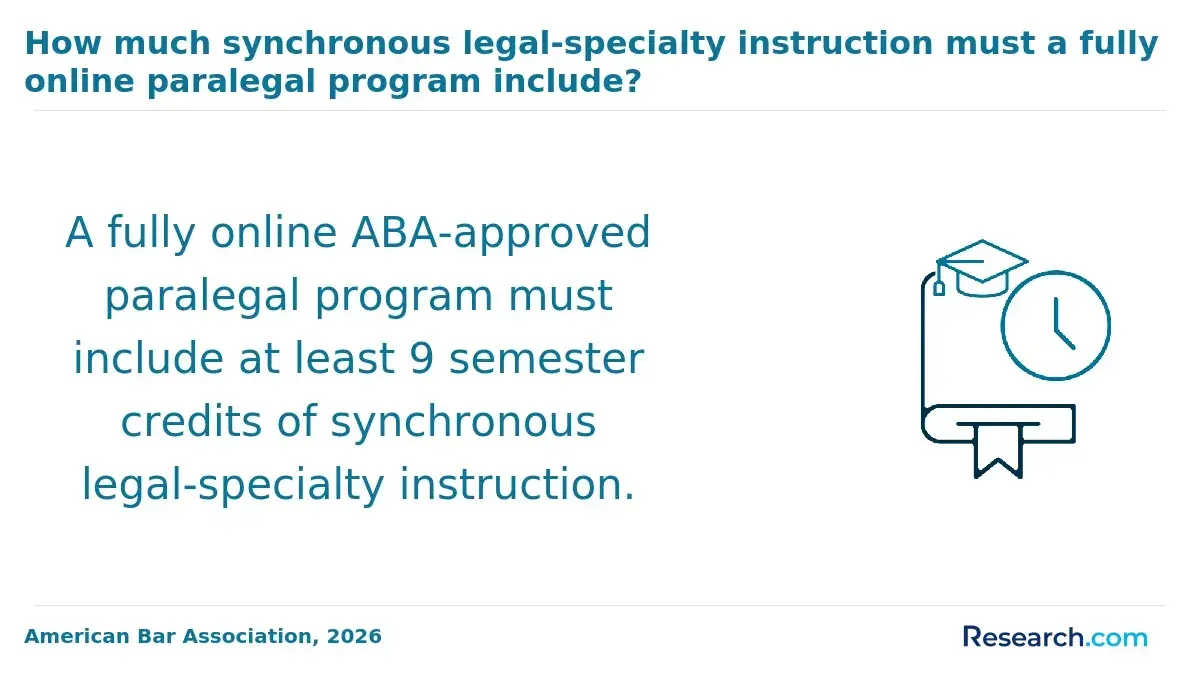
"Online" also does not necessarily mean self-paced. Before enrolling, confirm whether classes meet live, exams occur at set times, courses follow a cohort sequence, or any campus visits or placements are required. Compare faculty access and project requirements across formats. ABA approval of certain paralegal education programs is separate from institutional accreditation and is not a general quality designation for MLS degrees.
What are the admission requirements for an MLS compliance program?
MLS applicants generally need a bachelor's degree, but each school sets its own rules for GPA, transcripts, recommendations, statements, tests, and work experience. A legal background may be helpful without being required. Read the current admissions page for the specific degree rather than assuming rules for a school's JD program also apply to its MLS.
How long do MLS compliance programs take, and what do they cost?
Completion time depends on required credits, part-time enrollment options, course sequencing, and any capstone or experiential requirement. Instead of relying on an advertised "as little as" timeline, map the required courses against the terms you can realistically attend while working.
For cost, compare tuition on the same basis - per credit against per credit, or full-program estimates against full-program estimates. Request a current estimate that includes mandatory fees, books, technology or research-platform charges, and any required travel. Ask whether tuition changes during enrollment and what aid the specific program permits. Federal aid eligibility depends on the institution, program, and student; it should not be assumed from the degree name.
Our list of affordable online legal studies master's programs can help you build a shortlist, but verify each school's current price and requirements directly. The cheapest advertised tuition is not necessarily the lowest total cost - or the best preparation for your chosen consulting niche.
What careers can you pursue with an MLS focused on compliance?
Potential roles include in-house compliance officer or analyst, compliance-program manager, regulatory affairs specialist, and consultant serving businesses in a defined sector. An independent consultant needs more than subject knowledge: clients also need clear deliverables, dependable project management, and evidence that recommendations fit their operations.
A practical entry route is to gain responsibility for policies, training, monitoring, or audits within an organization before selling similar services independently. Experienced professionals may use an MLS to broaden the regulatory questions they can analyze, while newcomers may benefit more initially from an operational compliance role. Job titles and education preferences vary by employer, so review postings for the work you want - not just the title you hope to hold.
How much do compliance consultants and compliance officers earn?
The Bureau of Labor Statistics reports median annual pay of $80,730 in May 2025 for compliance officers and projects 4% job growth, 2025-2035, with about 32,700 openings per year. These figures offer a U.S. employment benchmark, not a forecast of income for independent consultants or MLS graduates.
Consultant revenue can vary with specialty, clients, billable work, and business expenses. When judging whether graduate tuition is worthwhile, compare the roles and fees realistically available to you with the time and cost of the degree; do not assume that the occupational median represents a salary increase attributable to an MLS.
How do you choose an accredited MLS program for compliance consulting?
First, confirm that the university holds institutional accreditation from a recognized accreditor; then judge the MLS on its own curriculum and delivery. Accreditation is an important baseline, not proof that every compliance course fits small-business consulting.
Use the following checks to narrow a shortlist before applying or paying a deposit:
- Choose the client sector you want to serve, then identify the laws, operational risks, and existing experience most relevant to it.
- Compare required courses, electives, and applied assignments; verify whether "compliance" is a formal concentration or simply an available set of courses.
- Ask for the current course schedule, live-session requirements, total-cost estimate, and rules for any capstone or placement.
- Compare the MLS with a focused certificate, professional certification, or employer-supported training against the specific work you expect to do.
A red flag is a program description that promises consulting readiness without showing how students practice research, writing, and risk assessment. The strongest choice is the one whose documented coursework addresses your skill gaps at a cost and schedule you can sustain.
Other Things You Should Know About Law & Paralegal
Define the project in writing. Depending on the engagement, useful deliverables might include an obligations inventory, a risk assessment, a policy draft, training materials, or a monitoring plan. Specify what information the client must provide and what falls outside the engagement.
Consider it before accepting clients. Coverage needs and policy terms depend on the services offered, the client contract, and the insurer. Insurance does not expand the legal services a nonlawyer may provide.
A defined niche can make it easier to build relevant experience and explain your services. Choose one based on regulations and business processes you can learn deeply, rather than claiming expertise across unrelated industries at the outset.
Build a routine for checking the agencies and jurisdictions relevant to each client, recording when guidance was reviewed, and revisiting policies after material changes. For legal interpretations beyond your role, coordinate with licensed counsel.
References
- Online J.D. Program FAQs | Southwestern Law School https://www.swlaw.edu/jd-llm-programs/online-jd-program/online-jd-program-faqs
- MLS - Corporate Compliance - Seton Hall Law School https://law.shu.edu/academics/mls-corporate-compliance-online.html
- MLS vs J.D.: Which Legal Degree Fits Your Career Goals? | UC Law San Francisco MLS https://mls.uclawsf.edu/articles/mls-vs-jd/
- Mastering Corporate Compliance with an M.L.S. Degree | miami.edu https://news.miami.edu/law/stories/2025/09/mastering-corporate-compliance-with-an-mls-degree.html
- Typical Law School Requirements & Prerequisites | Ohio Northern University https://law.onu.edu/news/law-school-admissions-101-typical-law-school-requirements-prerequisites
- Compliance and Legal Risk Management Emphasis | Law https://law.arizona.edu/compliance-and-legal-risk-management-concentration
- How an MLS in Compliance Prepares You for Legal Corporate Careers | William & Mary Law https://online.law.wm.edu/blog/mls-compliance-corporate-legal-careers
- Cost of Attendance | University of Portland https://www.up.edu/admissions-aid/office-of-financial-aid/costs/index.html
- How Do Asynchronous Classes Work? | Hopkins EP Online https://ep.jhu.edu/news/how-do-asynchronous-classes-work/
- MLS vs JD: Which Legal Path Is Right for You? | wsulaw.edu https://www.wsulaw.edu/news/mls-vs-jd-which-legal-path-is-right-for-you/