2027 Online Legal Studies Master's Programs With Financial Services Compliance Coursework

Co-Founder and Chief Data Scientist
If you work in banking, lending, payments, or another regulated financial business, a legal studies master's may help you understand the rules behind compliance decisions. But an online program labeled "compliance" may offer little coursework specific to financial services.
This guide shows you how to identify relevant classes, compare program costs and schedules, and decide whether a non-JD master's is worth pursuing instead of targeted training or a professional credential.
Key Things You Should Know
- Look for current, available courses on financial regulation, anti-money laundering, consumer finance, or related subjects - not just a general compliance concentration.
- A legal studies master's builds regulatory knowledge but does not qualify graduates to practice law or automatically satisfy a professional certification's requirements.
- The median pay for compliance officers was $80,730 in May 2025; that occupation-wide figure is not an expected salary for new graduates.
What are online legal studies master's programs with financial services compliance coursework?
These are graduate legal-knowledge degrees - often called a Master of Legal Studies (MLS), Master of Studies in Law (MSL), or Master of Jurisprudence - designed primarily for people who do not intend to become attorneys. Financial services compliance coursework applies legal and regulatory concepts to activities such as customer onboarding, lending, payments, securities, and internal controls.
The distinction between program title and available coursework matters. A school might offer a formal financial compliance concentration, a broader compliance track with relevant electives, or only an occasional course addressing finance. Check the current graduate catalog and course rotation before treating those options as equivalent. None is a Juris Doctor (JD) or, by itself, a license to practice law.
Which financial services compliance courses do online legal studies master's programs offer?
Offerings vary substantially by school and term. The most useful curriculum depends on the regulations your current or target role actually encounters. This table separates course topics that can sound similar but prepare students for different work.
| Course topic to look for | Where it may be useful | What to verify in the syllabus |
| Banking and financial regulation | Bank supervision, examinations, and institutional risk | Whether the course covers the type of institution you work with |
| Anti-money laundering (AML) and sanctions | Customer due diligence, transaction monitoring, and escalation | Whether students apply rules to realistic scenarios |
| Consumer financial protection | Lending, servicing, disclosures, and complaints | Whether the products and regulators covered match your goal |
| Securities regulation | Broker-dealer, investment adviser, and market compliance | Whether the emphasis is relevant to your intended role |
| Privacy and data governance | Handling customer information and managing third-party risk | Whether financial-sector obligations are covered |
A course listed as an elective may not run during your enrollment. Ask which courses are required, which are optional, how often each is taught online, and whether a substitute requires approval. A syllabus showing case analysis or policy-writing assignments is stronger evidence of applied learning than a course title alone.
Are online legal studies master's programs accredited and recognized?
Start by verifying the university's current institutional accreditation through its recognized accreditor or an authoritative education directory. Then confirm that the online master's is an officially offered degree of that institution. Accreditation does not mean a particular elective is available, that employers prefer the degree, or that the program meets certification requirements.
Do not confuse institutional accreditation with American Bar Association (ABA) approval. The ABA approves qualifying paralegal education programs; that designation is not the standard for evaluating a non-JD legal studies master's. Readers considering paralegal work instead can separately examine lower-tuition online paralegal programs with ABA approval.
What careers can an online legal studies master's prepare you for in financial services?
Potential roles include compliance analyst, compliance officer, regulatory affairs specialist, financial-crimes analyst, and risk or controls specialist. Work may involve interpreting requirements with counsel, reviewing procedures, documenting investigations, testing controls, and preparing for examinations. Employers also value familiarity with their products, operational systems, and reporting processes.
An MLS or MSL can add depth for someone already handling regulated work, but it is not a universal hiring requirement or a substitute for experience. If your immediate goal is a paralegal position rather than an in-house compliance role, a guide to online paralegal certificate programs describes a different, potentially more direct educational route. Completing an academic certificate does not itself make someone a professionally certified paralegal.
What are the admission requirements for online legal studies master's programs?
Applicants generally need a bachelor's degree, but GPA rules, essays, recommendations, résumés, and standardized-test policies differ by program. A JD or prior law coursework is generally not the premise of a non-JD legal studies degree; confirm each school's actual prerequisites rather than assuming finance experience is mandatory.
If you do not yet have a bachelor's degree, graduate admission is not the immediate step. Online legal studies associate degree programs can be one starting point, but ask any prospective bachelor's institution how it would accept those credits. The receiving school decides what transfers and how it applies.
How long do online legal studies master's programs take to complete?
Completion time depends on required credits, course availability, and how many classes you can take while working. A part-time schedule may be manageable alongside a job but can delay access to an infrequently offered financial regulation elective. "Online" also does not necessarily mean asynchronous: scheduled discussions, examinations, or occasional in-person requirements may apply.
Request a term-by-term plan showing when your intended courses run and whether a capstone or residency is required. If you still need an undergraduate degree, paralegal bachelor's degree completion using transfer credits is a separate timeline to evaluate before planning for graduate study.
How much do online legal studies master's programs cost?
There is no responsible single price for this category: schools charge differently by credit, program, and enrollment status. Compare a written estimate for the entire degree, including mandatory fees, books, technology, and any travel, rather than comparing advertised per-credit tuition with another school's total price. Ask whether employer tuition assistance applies and whether your specific program is eligible for federal student aid; institutional accreditation alone does not answer every aid question.
The opportunity cost matters too. A narrower compliance certificate or employer training may meet a specific skills gap without the expense of a master's. For readers still evaluating undergraduate options, choosing a paralegal bachelor's pathway by cost and duration is a distinct decision; its price should not be compared directly with graduate tuition.
How do online legal studies programs compare with campus-based programs?
The better format is the one that lets you complete the specific financial compliance coursework you need. Online study may reduce commuting and make continued employment easier, while campus study may offer more convenient face-to-face interaction or access to locally scheduled electives. Neither format alone establishes curriculum quality or employer recognition.
Compare actual class schedules, instructor access, group-work expectations, career services, and any required visits. An online program with live meetings during your workday may be less practical than a nearby campus program with evening classes.
What salaries and job outlook can financial services compliance graduates expect?
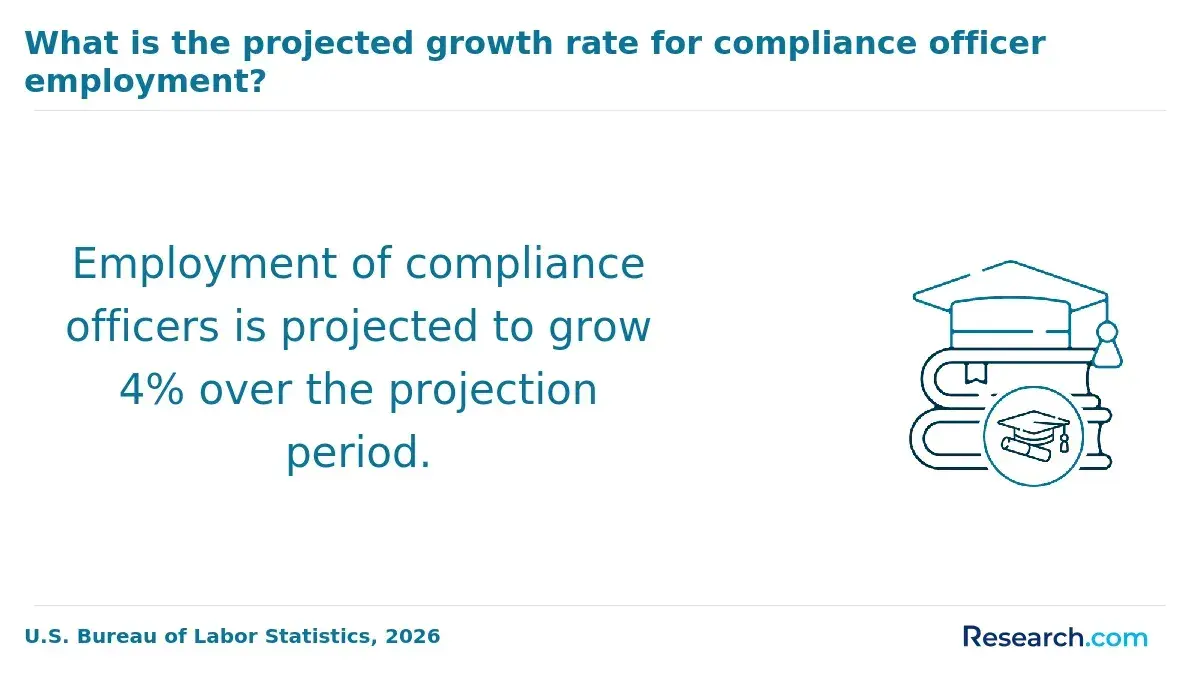
The Bureau of Labor Statistics reports median annual pay of $80,730 in May 2025 for compliance officers, with 4% projected growth, 2025-2035 and about 32,700 openings per year. These figures cover compliance officers across industries - not specifically financial services, master's graduates, or entry-level hires. Your prospects depend on prior experience, location, employer, and the role's technical demands.
Use the degree to assess a credible path to responsibilities you want, not to assume a salary increase. Before enrolling, compare job postings you would realistically qualify for with the program's courses and the experience those postings request.
How should you choose a reputable online legal studies master's program?
Shortlist programs only after identifying a target function - such as AML, consumer lending, or securities compliance. Then obtain answers in writing to the questions that can materially change your decision:
- Which relevant courses will be offered online during my expected enrollment, and are they guaranteed, required, or elective?
- What are the full degree cost and expected course sequence at my intended pace?
- Are classes live or asynchronous, and are any campus visits, placements, or scheduled exams required?
- What applied assignments, faculty expertise, and career support are available to non-JD students?
Be cautious if a program promotes a financial-services specialization but cannot identify its current courses, or if it implies the degree confers attorney eligibility or a professional certification. Choose the master's when its confirmed curriculum fills a substantial knowledge gap that a shorter option will not; otherwise, consider targeted training first.
Other Things You Should Know About Law & Paralegal
Policies vary. Some schools allow non-JD students into selected law courses; others offer separate classes or restrict enrollment. Ask about access to the particular course you want, not just access to the law school.
Not automatically. A certification body sets its own eligibility and examination rules. Check those rules directly and ask the school for course descriptions you can use when evaluating whether the study is relevant.
Only if your employer's policies and the course's requirements permit it. Ask whether you can use anonymized or fictional scenarios instead of customer, transaction, or investigation records.
Do not assume so. A JD program decides whether it accepts prior graduate coursework and how any accepted credits apply. If becoming an attorney is your goal, investigate JD admission and credit policies before paying for an MLS.
References
- Selected Sections of the Dodd-Frank Wall Street Reform and Consumer Protection Act | FDIC.gov https://www.fdic.gov/laws-and-regulations/selected-sections-dodd-frank-wall-street-reform-and-consumer-protection-act
- BSA/AML manual introduction | ffiec.gov https://bsaaml.ffiec.gov/manual/Introduction/01
- Principles of Good Practice for Distance Education | texas.gov https://reportcenter.highered.texas.gov/agency-publication/miscellaneous/principles-of-good-practice-approved-oct-2023/
- Fast Facts: Tuition costs of colleges and universities (76) | ed.gov https://nces.ed.gov/fastfacts/display.asp
- Bank Secrecy Act / Anti-Money Laundering Resources | NCUA https://ncua.gov/regulation-supervision/regulatory-compliance-resources/bank-secrecy-act-resources
- J.D. Program: Compliance Concentration | Seton Hall Law School https://law.shu.edu/academics/jd-compliance-concentration.html
- MLS in Financial Regulatory Compliance | Goodwin College of Professional Studies https://drexel.edu/law/academics/masters-certificate-programs/mls/concentrations/financial-regulatory-compliance/
- Online Master's Degree in General Legal Studies (MLS) | shu.edu https://catalogue.shu.edu/graduate/seton-hall-university-school-law/master-science-jurisprudence/
- Dodd-Frank: Title X - Bureau of Consumer Financial Protection | LII / Legal Information Institute https://www.law.cornell.edu/wex/dodd-frank_title_X
- Delivery & Modality Definitions | South University https://catalog.southuniversity.edu/delivery-modality-definitions