
2027 Legal Studies Master's Programs for Student Affairs and Campus Conduct Professionals

Co-Founder and Chief Data Scientist
Campus conduct work can require careful decisions about student rights, institutional policy, investigations, and federal law. A master's in legal studies may help professionals handle that complexity, but it is a substantial investment - and it is not required for most student affairs roles.
This guide is for conduct officers, student affairs staff, and career changers weighing graduate legal study against targeted training or another degree. It explains which courses and program features matter, what the degree cannot do, and how to compare options before committing.
Key Things You Should Know
- A master's in legal studies builds legal knowledge for nonlawyers; it does not qualify graduates to practice law or replace experience applying campus policy.
- Prioritize courses in education law, investigations, administrative procedure, and privacy over a concentration name that has little relevant coursework behind it.
- The Bureau of Labor Statistics reports $80,730 median annual pay for compliance officers in May 2025, but that broad occupation is not a salary forecast for campus conduct jobs.
What is a master's in legal studies for student affairs professionals?
A master's in legal studies - often called an MLS, MSL, or Master of Jurisprudence - is a graduate degree designed to teach legal concepts to people who do not plan to become attorneys. For a student affairs professional, its value lies in understanding how laws, regulations, institutional policies, and fair procedures interact when a college responds to student behavior.
Campus conduct staff may review reports, explain procedures, coordinate investigations or hearings, maintain records, and help apply sanctions consistently. Legal study can strengthen the analysis behind those tasks, but it does not replace institution-specific training or advice from university counsel. Program names alone reveal little: a broad legal studies degree with strong education-law electives may be more relevant than a nominal "compliance" concentration focused on another industry.
An MLS or MSL is not a Juris Doctor (JD) and does not, by itself, qualify someone to practice law. Conduct professionals should distinguish explaining institutional processes from giving legal advice or representing the institution as an attorney.
Do campus conduct professionals need a law degree or legal studies master's?
Campus conduct hiring requirements are set by institutions and vary by position. Relevant student affairs experience, sound judgment, writing ability, and training in the institution's procedures may matter more for a conduct officer role than an additional degree. Positions that involve providing legal advice, representing a college in legal proceedings, or serving as university counsel are different: they typically require an attorney qualified under the applicable state's rules.
The alternatives below solve different problems. Compare them against the work you actually want to do rather than treating them as interchangeable legal credentials.
| Route | Best fit for campus-related work | Important limitation |
| Employer training or focused professional development | Learning current conduct procedures and improving a specific skill | May be narrow or difficult to transfer between employers |
| Graduate certificate | Studying a defined topic, if the published curriculum matches the role | Credits do not automatically transfer into a master's degree |
| Legal studies master's | Building broad legal literacy for conduct, policy, or compliance responsibilities | Requires more time and tuition; does not confer attorney status |
| JD | Pursuing an attorney career, subject to state licensing requirements | A substantially different educational and licensing route |
If your intended move is into legal-support work rather than campus administration, compare associate-level paralegal education options before paying for a graduate legal studies degree. Paralegal education prepares students for work under attorney supervision; it does not confer authority to practice law independently.
What careers can a legal studies master's support in student affairs?
The most direct fit is an existing professional seeking greater responsibility in student conduct administration, case management, policy development, or staff training. Related paths include Title IX program administration, civil rights compliance, student privacy, institutional risk management, and policy work. Titles and duties differ substantially by college: a Title IX investigator, for example, needs practical investigative skills and training on applicable rules, not simply a legal studies transcript.
A degree may be most useful when job postings for your target roles consistently seek graduate education, legal or regulatory knowledge, and experience you already possess. For someone new to higher education, it is less likely to substitute for direct campus experience. Compare postings from the kinds of institutions where you want to work, and separate required qualifications from preferred ones before enrolling.
How do online and campus-based legal studies programs compare?
Online study can reduce commuting and make continued employment more feasible, but "online" does not mean asynchronous or self-paced. Published schedules, assessment rules, and any required visits matter more than the format label. The comparison below highlights commitments that can affect a conduct professional's workweek.
| Format | Potential advantage | Commitment to verify |
| Online, asynchronous | Greater choice of study hours | Weekly deadlines, group work, exam windows, and course sequencing |
| Online, scheduled live classes | Real-time discussion of cases and policy problems | Meeting times and attendance rules during on-call or hearing duties |
| Campus-based or hybrid | In-person discussion and local professional connections | Travel, campus visits, and classes offered during work hours |
If speed matters, compare the actual course rotation and enrollment load - not just the advertised minimum completion time - when considering legal studies master's study on a faster schedule. Ask whether the courses most relevant to campus conduct are available in the terms you would need to take them.
What courses do legal studies programs offer for campus conduct work?
Look first for education law and courses addressing investigations, evidence evaluation, administrative decision-making, dispute resolution, and legal research and writing. These can help staff analyze policy language, document findings, and recognize when a matter needs legal review. Courses covering the Family Educational Rights and Privacy Act (FERPA), Title IX, disability law, and civil rights can also be relevant, but a course title does not establish that its content reflects the rules currently applicable to your institution.
Read the catalog's required courses and elective schedule. A formal concentration has published requirements; a cluster of electives is not necessarily a concentration, and a separate certificate may have additional requirements. For work involving employee investigations or policy, legal studies education with an employment and HR law focus may be worth comparing with a student-facing education-law curriculum.
Practical assignments are especially useful when they require students to assess a fact pattern, write a reasoned determination, or revise a policy. Ask how faculty distinguish classroom exercises from the institution-specific legal advice that only qualified counsel should provide.
What are the admission requirements for legal studies master's programs?
Applicants generally need a bachelor's degree, but each program sets its own rules for academic records, recommendations, statements, work history, and any standardized test. A prior law degree is not ordinarily the point of a non-JD legal studies program. Check the current admissions page rather than assuming that student affairs experience either guarantees admission or is required.
In a statement of purpose, connect your current responsibilities to specific coursework: for example, explain why investigations, privacy, or policy drafting would improve the work you do. If you have not completed a bachelor's degree, resolve that prerequisite before comparing master's admissions policies. For a legal-support career path, continuing college study in an online paralegal bachelor's program is one possible route to examine; the receiving institution determines whether prior credits transfer and how they apply.
How long do legal studies master's programs take and cost?
Completion time depends on required credits, part-time or full-time enrollment, course availability, and any capstone. A working conduct professional should build a schedule around peak reporting and hearing periods, then confirm whether taking a term off would delay required courses. The fastest advertised path may not be realistic alongside full-time work.
For cost, compare the same unit across schools: per-credit tuition alone is not a total-program price. Request an estimate covering all required credits, mandatory fees, books or materials, technology, and travel for any campus visits. Ask whether employer tuition assistance applies and whether the specific degree and your enrollment qualify for federal aid; eligibility should not be assumed from a school's general financial aid page.
When budgeting for an online master's in legal studies, weigh the full cost against a shorter certificate or employer-sponsored training. A lower-priced degree is not a better value if its available courses do not address the responsibilities you want to take on.
What salaries can student affairs and campus conduct professionals earn?
Pay varies by institution, location, seniority, and the scope of the position. The Bureau of Labor Statistics does not publish a single wage figure that precisely represents campus conduct officers, so broader occupational data should be treated as context - not a prediction of what a legal studies graduate will earn.
For compliance officers, the BLS reports median annual pay of $80,730 in May 2025 and 4% projected job growth, 2025-2035. This category extends well beyond higher education, but it provides a benchmark for readers considering a move into broader institutional compliance. For arbitrators, mediators, and conciliators, the BLS reports $75,530 in May 2025 and 5% projected job growth, 2025-2035; that occupation is not equivalent to administering a college disciplinary process.
For a useful personal comparison, review posted salary ranges for jobs you could plausibly pursue now and after gaining the experience those jobs require. A master's alone does not establish eligibility for a higher-paid position.
What accreditation and professional standards should students verify?
Verify that the university holds recognized institutional accreditation and that the degree appears in its current catalog. Accreditation is a baseline check, not proof that the curriculum fits campus conduct work. Also confirm who teaches relevant courses and whether program requirements and student-support services apply to online learners.
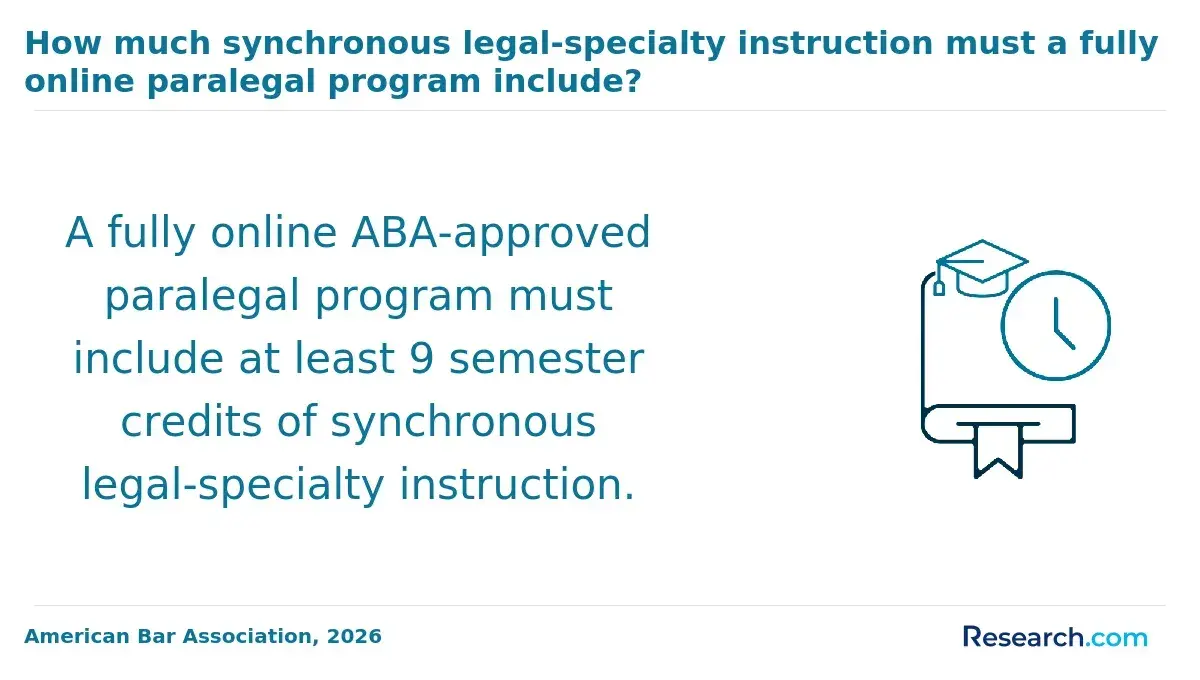
Do not confuse institutional accreditation with American Bar Association (ABA) approval of certain paralegal education programs. ABA paralegal program approval is not institutional accreditation, is not a general requirement for a legal studies master's, and does not certify individual graduates. A degree or academic certificate is also distinct from a professional certification granted under a credentialing organization's rules.
Finally, campus conduct practice depends on the institution's policies and applicable federal and state requirements. Check current guidance from the relevant authorities and your institution's counsel rather than relying on an older syllabus for a rule that may have changed.
How can you choose a reputable legal studies master's program?
Start with the responsibilities you want to handle better or the next job you intend to seek. Then use the same criteria for every program on your shortlist. This sequence helps prevent an appealing degree name or short completion claim from outweighing curriculum and cost.
Before applying, collect answers to these questions from each program and, where appropriate, your employer:
- Which required courses and reliably offered electives address education law, investigations, privacy, and reasoned decision-making?
- What are the live-class, attendance, assessment, capstone, and campus-visit requirements for a working student?
- What is the estimated total cost at your intended enrollment pace, and which expenses might employer assistance cover?
- Does your target employer value this degree for the roles you want, or would focused training plus experience be more useful?
Be cautious if a school implies that the degree qualifies graduates to practice law, describes optional courses as a guaranteed specialization, or will not explain required costs and scheduling. Choose the program only if its verified curriculum and commitments justify the time and expense relative to the smaller educational step that could meet your goal.
Other Things You Should Know About Law & Paralegal
Not without appropriate authorization. Ask your employer and instructor about privacy rules, institutional policy, and whether a hypothetical or properly de-identified case can meet the assignment requirements.
No. A non-JD legal studies degree does not grant a license to practice law. Court representation is a separate matter governed by applicable law and professional rules.
No. Legal obligations and procedural protections can differ by institution type, state, and the issue involved. Apply your own institution's current policies with guidance from qualified counsel.
Possibly, but acceptance depends on the organization granting the credential and the particular training. Check its current continuing-education rules before enrolling for credit.
References
- FERPA | Protecting Student Privacy - Department of Education https://studentprivacy.ed.gov/ferpa
- Frequently Asked Questions: Section 504 Free Appropriate Public Education (FAPE) | U.S. Department of Education http://www.ed.gov/laws-and-policy/civil-rights-laws/disability-discrimination/frequently-asked-questions-section-504-free-appropriate-public-education-fape
- Types of Financial Aid: Grants, Work-Study, and Loans | studentaid.gov https://studentaid.gov/understand-aid/types
- Cost of Attendance (Budget) | 2025-2026 Federal Student Aid Handbook https://fsapartners.ed.gov/knowledge-center/fsa-handbook/2025-2026/vol3/ch2-cost-attendance-budget
- Research Your Options: U.S. Online Learning | EducationUSA https://educationusa.state.gov/your-5-steps-us-study/research-your-options/online-learning
- Juris Doctor (JD) vs Master of Legal Studies | Pepperdine Caruso School of Law https://law.pepperdine.edu/blog/posts/jd-vs-mls.htm
- Master of Legal Studies (MLS) vs. JD: What's the Difference? | SMU Online Master of Legal Studies https://onlinemasterlegalstudies.smu.edu/articles/mls-vs-jd/
- UCR Title IX Staff Training | Office of Civil Rights https://titleix.ucr.edu/ucr-title-ix-staff-training
- MLS vs J.D.: Which Legal Degree Fits Your Career Goals? | UC Law San Francisco MLS https://mls.uclawsf.edu/articles/mls-vs-jd/
- Explore Law Degree Programs: Options, Careers & More! | Florida National University (FNU) https://www.fnu.edu/comparing-law-degree-programs-curriculum-careers-and-what-makes-each-unique/


