
2027 Legal Studies Master's Programs for Revenue Cycle Compliance Managers

Co-Founder and Chief Data Scientist
Revenue cycle compliance managers must keep billing, coding, collections, and payment practices aligned with changing healthcare rules. A legal studies master's can deepen that expertise, but it is not a standard requirement for the job - and it may not be the best use of every manager's time or tuition budget. This guide compares legal studies with other graduate and professional pathways, explains what to check in a program, and shows how to weigh the degree against certifications and experience before enrolling.
Key Things You Should Know
- Choose a non-JD legal studies master's for substantial training in healthcare law and regulatory analysis - not because the job requires a law degree or the program qualifies you to practice law.
- Compare legal studies with healthcare administration, health informatics, targeted certificates, and certifications according to the compliance work you want to lead.
- The U.S. median for the broader compliance officer occupation was $80,730 in May 2025; that figure is a benchmark, not a salary prediction for revenue cycle managers or master's graduates.
What are legal studies master's programs for revenue cycle compliance managers?
A revenue cycle compliance manager oversees whether processes from patient registration through payment and collections follow applicable rules and organizational policy. The work can involve billing audits, coding-related controls, payer contract questions, overpayment escalation, staff training, and coordination with legal counsel.
Legal knowledge is useful when a manager must interpret requirements and turn them into workable procedures. A Master of Legal Studies (MLS), Master of Studies in Law (MSL), or similarly named non-JD degree teaches law to professionals who do not intend to become attorneys.
Relevant coursework may cover healthcare regulation, administrative law, privacy, contracts, and investigations. An MLS or MSL does not itself qualify a graduate to practice law; counsel remains responsible for legal advice and representation.
Program labels need scrutiny. A formal healthcare compliance concentration has defined requirements, while a program offering a few related electives may give students much less structured preparation. Ask for the current degree requirements and course rotation rather than relying on the concentration's name.
What degree and accreditation requirements apply to healthcare compliance careers?
There is no universal U.S. rule requiring a revenue cycle compliance manager to hold an MLS, a JD, or a particular certification. Employers set requirements for most positions and may favor different backgrounds: coding and billing experience, compliance work, health information management, finance, or a relevant degree.
A bachelor's degree may be a common hiring preference, but applicants should check actual postings for the roles they want.
For a prospective graduate student, institutional accreditation is a baseline check. Confirm the school's current status with a recognized institutional accreditor and ask whether the specific graduate program has any additional accreditation relevant to its field.
Do not confuse institutional accreditation with American Bar Association approval of certain paralegal education programs. ABA paralegal program approval is not a requirement for an MLS or a healthcare compliance job.
If you are still building an undergraduate path, compare online associate degrees in legal studies as one possible starting point. An associate degree alone generally does not meet a master's program's bachelor's-degree admission requirement; the receiving school decides which credits will transfer toward a bachelor's degree.
Which master's degree pathways prepare revenue cycle compliance managers?
The best pathway depends on the problem you expect to solve at work. The comparison below separates legal interpretation from operational, data, and clinical strengths; none is automatically the best credential for every revenue cycle role.
| Pathway | Strongest fit | Potential gap to check |
| MLS, MSL, or Master of Jurisprudence | Interpreting healthcare rules, advising on policies, and coordinating with counsel | Whether billing, coding, and audit applications are actually taught |
| Healthcare administration master's | Leading revenue cycle teams, budgets, and process improvement | Depth of legal and regulatory coursework |
| Health informatics or health information management master's | Data governance, documentation, analytics, and information workflows | Coverage of reimbursement law and compliance investigations |
| Accounting or business-focused master's | Financial controls, auditing, and organizational management | Healthcare-specific regulatory content |
An MLS is most persuasive when its required courses and available electives address the rules you encounter, not just general legal reasoning. If you need one defined skill - such as healthcare privacy or compliance auditing - a graduate certificate or focused training may involve less time away from work.
A guide to choosing a legal studies graduate credential can help frame that narrower decision. A university certificate documents coursework; it is not the same as a professional certification awarded by a credentialing body.
How do online and campus-based legal studies programs compare?
Online study can make graduate education feasible for a working manager, but "online" does not mean self-paced. Programs may require live classes, fixed assignment deadlines, group projects, proctored exams, or campus visits. A campus program may offer more in-person discussion and local networking while imposing commuting and scheduling costs.
Request a current sample course schedule for the classes you would need, especially healthcare electives. Check whether they are offered online in the terms you can attend, whether attendance is synchronous, and whether a capstone can draw on workplace problems without exposing protected or confidential information. These details matter more to practical flexibility than the delivery label alone.
What courses do healthcare compliance master's programs typically include?
Legal studies programs commonly start with legal research, statutory interpretation, and regulatory processes. For revenue cycle work, the useful test is whether students can apply those skills to payment and documentation decisions rather than only describe broad healthcare law.
Look for coursework that connects Medicare and Medicaid requirements, fraud and abuse controls, privacy and security, contracts, investigations, and organizational compliance programs to realistic workflows.
Training in audits and corrective action is particularly valuable for managers who must identify an issue, document findings, escalate it appropriately, and monitor a fix. Billing and coding instruction varies substantially; a law-focused degree should not be assumed to replace hands-on coding education.
Ask to see recent syllabi or assignment descriptions. A course title may mention compliance without requiring students to analyze a reimbursement rule, draft a policy, or work through an audit scenario.
What admission requirements do legal studies master's programs have?
Non-JD legal studies master's programs generally seek applicants who already hold a bachelor's degree. Individual schools determine accepted academic backgrounds and may request transcripts, a résumé, a statement of purpose, recommendations, or evidence of professional experience.
Do not assume that a JD, a paralegal certificate, or prior healthcare employment is required unless the specific program says so. Applicants changing fields should use the statement of purpose to connect prior work - such as billing operations, auditing, nursing, finance, or information management - to a clear compliance goal.
Before paying an application fee, check prerequisites and ask how any prior graduate credit would be evaluated. Transfer credit is not automatic, even between accredited institutions. Readers completing an undergraduate credential first can review legal studies degree progression and transfer considerations before selecting courses they hope to apply toward a bachelor's degree.
How long do these master's programs take and what do they cost?
Completion time depends on required credits, course sequencing, enrollment pace, and whether needed electives run every term. Full-time enrollment may shorten the calendar, but a part-time schedule can preserve income and make it easier to apply coursework at work. Ask each school for a completion plan based on the terms in which you can enroll, not its fastest advertised timeline.
Published per-credit tuition is only one cost. The following comparison shows what belongs in a program-level estimate before you judge whether a degree is worth the investment.
| Cost or constraint | What to confirm |
| Tuition and required fees | The current rate for your enrollment status, required credits, and mandatory program or technology fees |
| Materials and attendance | Books, research resources, equipment, and any required travel or campus visits |
| Schedule and financing | Possible reduced work hours, employer assistance conditions, and aid eligibility for the specific program |
Compare schools using their current published rates and a written estimate for your intended schedule. Federal aid eligibility depends on the institution, program, and student; employer tuition assistance can also have service or grade conditions.
For a wider cost-and-benefit comparison, see legal studies master's tuition and earning potential. Do not treat a higher tuition bill as evidence of stronger career outcomes.
What careers can graduates pursue in healthcare revenue cycle compliance?
Graduates with relevant experience may pursue revenue cycle compliance manager, healthcare compliance officer, billing audit manager, reimbursement compliance specialist, or broader compliance leadership roles.
The degree can support advancement when a position requires policy analysis and cross-functional oversight, but employers may weigh a record of resolving billing issues more heavily than graduate study alone.
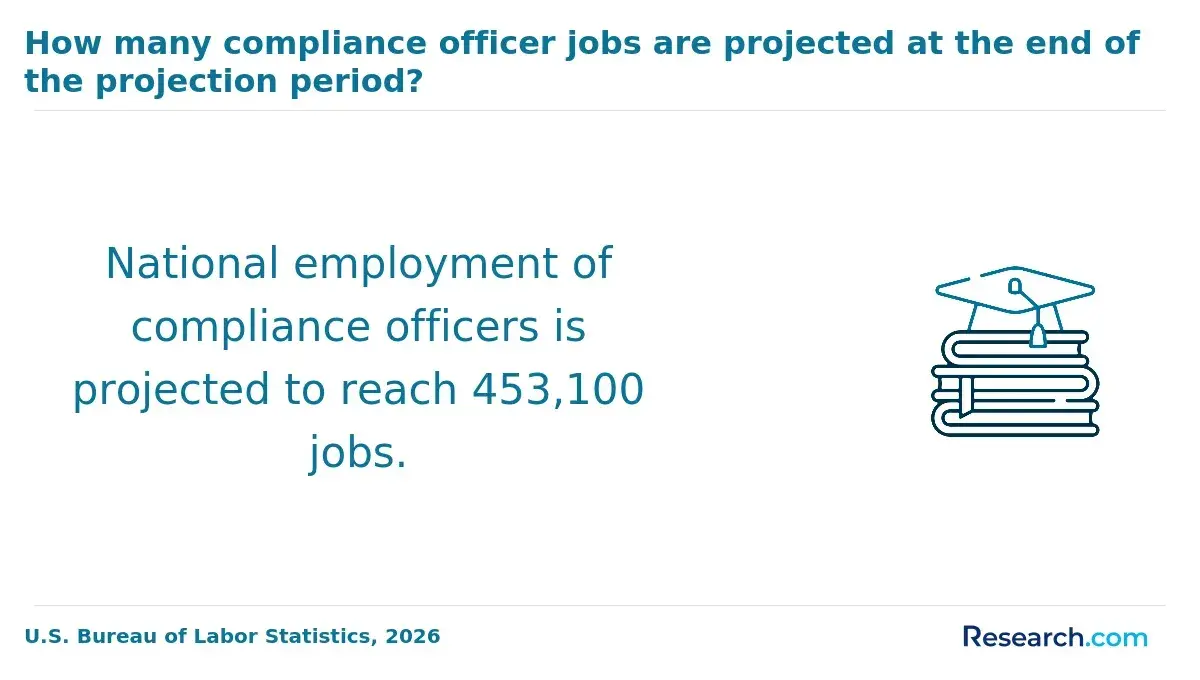
The Bureau of Labor Statistics projects 4% growth for compliance officers from 2025 to 2035. That outlook covers a broad occupation across industries, not revenue cycle compliance managers specifically, so it cannot establish demand for one specialty or credential.
For someone without revenue cycle experience, an entry route through billing, coding, audits, or health information work may be more practical than starting with a master's. An applicant comparing undergraduate options can examine shorter online bachelor's programs in paralegal studies, but should check whether a healthcare-focused degree would build more directly relevant operational skills.
What salary can revenue cycle compliance managers expect?
The Bureau of Labor Statistics reports a $80,730 median annual pay for compliance officers in May 2025. This is a useful national reference point, not a reported median for revenue cycle compliance managers. Pay for the narrower role varies with employer, location, supervisory scope, healthcare experience, and responsibility for audits or payment risk.
Evaluate a proposed degree against positions you could realistically seek, not an assumed graduate salary increase. Compare current job postings' stated pay and requirements with your experience, then consider tuition, time commitment, and whether a shorter credential would address the same hiring gap.
Which certifications strengthen a healthcare compliance career?
Certifications can demonstrate a defined professional skill set, but they serve different purposes. The Certified in Healthcare Compliance (CHC) credential is administered by the Compliance Certification Board and addresses healthcare compliance broadly.
AAPC's Certified Professional Medical Auditor (CPMA) is more closely aligned with medical record and claims auditing; its Certified Professional Coder (CPC) addresses coding. The Healthcare Financial Management Association's Certified Revenue Cycle Representative (CRCR) focuses on revenue cycle knowledge.
Choose according to the work you want to do: a broad compliance role, a coding audit function, or revenue cycle operations. Review the awarding organization's current eligibility, examination, experience, and renewal rules before enrolling in preparation courses. A master's degree does not automatically award a certification or make every applicant eligible for one.
Other Things You Should Know About Law & Paralegal
Do not assume you can. Obtain required employer and school approvals first, follow applicable privacy rules, and use appropriately de-identified or simulated information when necessary.
Do not plan on it. A law school determines whether any prior coursework receives credit, and a non-JD master's is not a substitute for the JD curriculum.
Not as a universal requirement. Some positions involving clinical review may prefer licensed clinicians, while others emphasize billing, coding, auditing, or compliance experience. Check the duties in specific postings.
Yes. Federal requirements matter, but state rules and payer contracts can also affect operations. The laws to prioritize depend on your employer's locations, services, and responsibilities.
References
- DAPIP | Homepage - Office of Postsecondary Education (OPE) https://ope.ed.gov/dapip/
- Employer-offered educational assistance programs can help pay for college | Internal Revenue Service https://www.irs.gov/newsroom/employer-offered-educational-assistance-programs-can-help-pay-for-college
- General Questions Regarding Certain Fraud and Abuse Authorities | U.S. Department of Health and Human Services https://oig.hhs.gov/faqs/general-questions-regarding-certain-fraud-and-abuse-authorities/
- Types of Financial Aid: Grants, Work-Study, and Loans | studentaid.gov https://studentaid.gov/understand-aid/types
- What is a Master of Studies in Law (MSL)? | George Washington University School of Law https://msl-law.gwu.edu/articles/what-is-a-master-of-studies-in-law/
- Online Master's Degree in Legal Studies (MLS) - Catalogue https://catalogue.shu.edu/graduate/seton-hall-university-school-law/masters-degree-in-legal-studies-health-and-hospital/
- Master of Legal Studies in Healthcare Compliance | wsulaw.edu https://www.wsulaw.edu/academics/master-of-legal-studies/
- Online Master's in Health Care Compliance, MLS | ASU Online https://asuonline.asu.edu/online-degree-programs/graduate/masters-in-healthcare-compliance/
- Different Types of Law Degrees - Pepperdine Caruso Law Blog https://law.pepperdine.edu/blog/posts/types-of-law-degrees.htm
- What Can You Do With a Master of Legal Studies? | WashU Law https://online.law.washu.edu/articles/what-can-you-do-with-master-of-legal-studies/


