2027 Paralegal Programs for Former Teachers' Aides: Comparing College Entry Routes

Co-Founder and Chief Data Scientist
Former teachers' aides may already be skilled at organizing records, following procedures, and communicating with families - but legal employers also expect training in research, writing, and legal ethics. If you are considering a career change, the right college entry route depends largely on the education you already have and the work you want to pursue.
This guide compares paralegal certificates, associate degrees, and bachelor's degrees, then shows how to check program costs, schedules, and credentials before you enroll.
Key Things You Should Know
- Already have a bachelor's degree? A post-baccalaureate paralegal certificate may be a shorter route than another degree; without substantial college credit, compare an associate degree first.
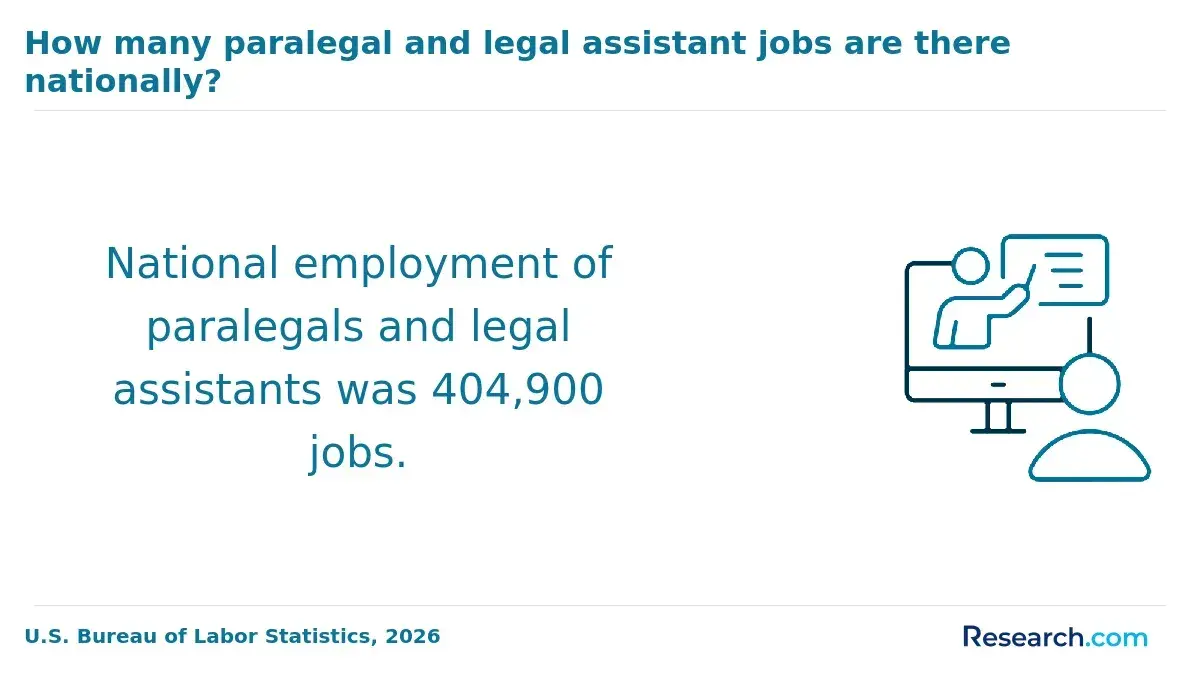
- For paralegals and legal assistants, the Bureau of Labor Statistics reports median pay of $62,890 in May 2025 and 0% projected employment growth from 2025-2035.
- Training can improve your preparation, but it cannot promise a job. Before paying a deposit, confirm the program's admission prerequisites, total required costs, schedule, internship rules, institutional accreditation, and any claimed ABA program approval.
What paralegal programs are available for former teachers' aides?
Former teachers' aides can apply to the same paralegal programs as other career changers; prior school employment is useful experience, not a separate admission category. The main college routes are an undergraduate certificate, a post-baccalaureate certificate, an associate degree, and a bachelor's degree in paralegal studies or a related field. A legal studies degree may teach broader legal concepts but may offer less occupation-specific paralegal training, so compare the actual courses rather than the title alone.
Certificate programs vary considerably. Some accept applicants with a high school diploma, while others require prior college coursework or a completed bachelor's degree. Credit-bearing college certificates also differ from noncredit continuing-education courses in how they are recorded and whether another college might accept the work. Our guide to paralegal certificate study can help you identify options, but check each college's current catalog before relying on its description.
A certificate is an educational award, not professional certification. Likewise, the American Bar Association (ABA) approves qualifying paralegal education programs; it does not accredit the college as an institution or certify its graduates as individuals.
What education does a former teachers' aide need to become a paralegal?
There is no single nationwide degree or license required to work as a paralegal. Employers set hiring standards, and some states regulate particular titles or services. For a career changer with little legal experience, a program that teaches legal research, writing, procedure, and supervised practice can provide clearer evidence of readiness than school experience alone.
Your starting education matters more than your former job title. If you have a high school diploma and little college credit, an associate degree can combine general education with paralegal coursework. If you already have a bachelor's degree, compare post-baccalaureate certificates before committing to a second degree. If you have college credits but no degree, ask how many will apply to an associate or bachelor's program; the receiving college makes that decision.
A master's in legal studies is generally a broader legal-knowledge degree, not the default entry credential for a paralegal job. For bachelor's-degree holders aiming instead at policy or compliance work, accelerated online legal studies master's options may be worth comparing with shorter training and work experience. Neither that degree nor a paralegal credential qualifies someone to practice law as an attorney.
Which paralegal entry route is best: certificate, associate degree, or bachelor's degree?
The best route is usually the one that fills your specific education gap without making you repeat substantial coursework. This comparison separates typical starting points from possible drawbacks; individual program requirements still control.
| Route | Likely fit for a former teachers' aide | Main trade-off to check |
| Paralegal certificate | Someone who meets the certificate's prerequisites, particularly a bachelor's-degree holder seeking focused legal training | May be noncredit or require a prior degree; fewer general-education courses do not necessarily mean a lower total cost |
| Associate degree | Someone starting college or returning with limited transferable credit | General-education requirements add time, but applicable credits may support later study |
| Bachelor's degree | Someone seeking a four-year credential or a broader legal studies education | Greater time and expense may not be necessary for an entry-level paralegal role |
If you might continue beyond an associate degree, examine associate-to-bachelor's legal studies transfer options before choosing courses. An articulation agreement or written degree audit is more useful than assuming that credits will transfer because both schools are accredited. If your immediate goal is paralegal work, compare each route's research, writing, procedure, and practical training - not just the credential level.
How do online and campus-based paralegal programs compare?
Online study can reduce commuting, which may help an aide who still works during the school year. It does not necessarily mean self-paced study: a program may require live classes, scheduled exams, a fixed course sequence, or an in-person internship. Campus study may make it easier to meet instructors and use local placement connections, but travel and class times can create different costs.
The format comparison is most useful when it reflects your actual weekly schedule. These are the commitments to check in either format.
| Commitment | Online program | Campus-based program |
| Class attendance | May be recorded, live, or a mix | Usually has scheduled on-site meetings |
| Practical experience | A local, in-person placement may still be required | A placement may be separate from campus classes |
| Equipment and travel | Check computer, software, and any campus-visit requirements | Check commuting, parking, and on-campus access costs |
Ask whether students find their own placements, whether an existing job could qualify, and when internship hours must be completed. A school job should not be assumed to satisfy a legal internship: the duties, supervision, and approval rules may be different.
What do paralegal programs teach students?
Paralegal coursework commonly covers legal research and writing, civil litigation, legal ethics, document preparation, and office procedures. Programs may also offer subjects such as family law, contracts, real estate, or employment law. Look for assignments that require students to locate legal authority, write clearly, manage documents, and distinguish a paralegal's work from legal advice only an authorized professional may give.
Teachers' aides may bring useful habits in documentation, confidentiality, deadlines, and communication with people under stress. Those strengths do not replace learning court rules, legal citation, client confidentiality, or attorney-supervised workflows. If a school advertises training in research databases or legal software, ask whether students receive access and complete hands-on assignments; a tool appearing in a course description is not proof of proficiency.
What are the admission requirements for paralegal programs?
Requirements depend on the credential and the college. An associate program typically asks for evidence of secondary-school completion under the college's admission rules. A post-baccalaureate certificate requires a completed bachelor's degree; other certificates may set different prerequisites. Bachelor's programs may admit first-year or transfer students, with separate rules for applying previous coursework.
Check the current catalog for minimum grades, required writing or general-education courses, transcript deadlines, and whether admission to the college also admits you to the paralegal program. Ask for a written assessment of prior credits before planning a completion date. Work experience as an aide may strengthen an application, but it does not automatically waive courses or become college credit.
How long do paralegal programs take, and what do they cost?
A focused certificate may take less time than a degree if you already meet its prerequisites. An associate degree is commonly planned around two academic years of full-time study; a bachelor's degree commonly takes four years from a first-year start. Part-time enrollment, transfer credit, prerequisites, and course sequencing can change those timelines substantially.
Compare the total cost to finish, not only advertised tuition. Request the current 2026-27 tuition and mandatory-fee schedule, then account for required books, research-platform access, technology, travel, and any internship expense. Compare programs using the same unit - total remaining credits and required costs - rather than placing one school's per-credit price beside another school's full-program price. Listings of lower-cost ABA-approved paralegal education are a starting point, not a substitute for confirming current approval, format, and your own total cost.
Federal aid depends on the student, institution, and specific program. Do not assume that a certificate - especially a noncredit course - qualifies. Ask the financial aid office whether that exact program is aid-eligible and what borrowing or payment options would remain after other aid.
Do paralegals need state licensing or professional certification?
There is no universal U.S. paralegal license or professional certification requirement. Rules for particular titles and limited legal-service roles vary by state, while employers may have their own preferences. Check the rules where you intend to work rather than treating a program's national marketing language as a statement of local requirements.
Professional certification is separate from graduating with a college certificate. Organizations such as NALA and the National Federation of Paralegal Associations offer credentials with their own eligibility and examination rules; eligibility is not automatic upon graduation. ABA approval, where a program has it, concerns the education program - not an individual graduate. Paralegals ordinarily work under attorney supervision and cannot independently practice law simply because they hold a degree or certification.
What jobs can former teachers' aides get after paralegal training?
Potential entry points include legal assistant, paralegal, litigation support assistant, and legal administrative roles. Duties may include organizing case files, researching under attorney direction, preparing draft documents, tracking deadlines, and communicating with clients within the limits of the role. Job titles are not standardized, so read the duties and education requirements rather than relying on the title.
Experience in schools may be especially relevant when applying to organizations handling education, disability, employment, or public-sector matters. It does not by itself establish expertise in those laws. If you prefer workplace policy over case preparation, compare paralegal study with legal studies degree pathways focused on human resources law; HR and compliance positions may have different experience expectations.
For a practical first step, review local job postings before enrolling. Note which credentials recur, whether employers ask for litigation or other practice-specific experience, and whether an administrative legal role could let you test the field while studying.
What are paralegal salaries and job prospects after graduation?
The Bureau of Labor Statistics reports median annual pay of $62,890 in May 2025 for the combined occupation of paralegals and legal assistants. That is an occupational midpoint, not a starting salary or a forecast for a particular graduate. Pay varies with location, employer, duties, and experience.
BLS projects 0% employment growth from 2025-2035 for that occupation, yet about 40,800 openings per year, largely because workers leave or change occupations. The distinction matters: openings may exist even without net job growth, but applicants still need to compete for them. Before committing to tuition, compare nearby openings with the program's required investment and the skills you would bring from school work.
Other Things You Should Know About Law & Paralegal
Possibly. Ask local organizations whether they accept volunteers and what tasks and training they require. Observing an attorney-supervised workflow can help you decide whether the work appeals to you, but volunteering does not automatically count for college credit.
Do not include student, family, or personnel records. Instead, create original, fictional work samples or use assignments you are permitted to share. Ask a prospective employer or program what kinds of samples it accepts.
No. A notary commission authorizes specific acts under state law; it does not teach the full range of legal research, writing, and procedure expected in many paralegal roles or authorize the practice of law.
It may help you explore legal work, but it does not replace a Juris Doctor degree or state bar admission requirements. A law school decides how to evaluate your prior education, and paralegal courses should not be assumed to transfer into a JD program.
References
- Paralegal Studies Certificate Program | Long Island University https://liu.edu/brooklyn/academics/school-of-professional-and-continuing-studies/Paralegal-Studies-Certificate-Program
- Paralegal Studies, Post-Baccalaureate Certificate | Roosevelt University Academic Catalog https://catalog.roosevelt.edu/graduate/humanities-education-social-sciences/certificate/paralegal-studies-post-baccalaureate-certificate/
- How to Become a Paralegal: 2025 Step-by-Step Guide | UC News https://www.online.uc.edu/blog/how-to-become-paralegal.html
- Course Delivery | bhcc.edu https://www.bhcc.edu/coursedelivery/
- Ways to Learn at MCC | middlesex.edu https://www.middlesex.edu/discover/waystolearn.html
- ABA: What It Does and Why It Matters to Your Career | Graduate America https://ga.edu/legal/organization/aba-what-it-does-and-why-it-matters-to-your-career
- How an ABA Approved Paralegal Program Can Advance Your Career - Peirce College https://www.peirce.edu/stories/how-an-aba-approved-paralegal-program-can-advance-your-career/
- Associate Degree vs. Bachelor's Degree | snhu.edu https://www.snhu.edu/about-us/newsroom/education/associate-degree-vs-bachelor-degree
- Law and Paralegal Studies Department Courses | NYC College of Technology Catalog https://citytech.catalog.cuny.edu/departments/LAW-NYT/courses
- What Is Legal Studies? A Comprehensive Overview | American Public University https://www.apu.apus.edu/area-of-study/security-and-global-studies/resources/what-is-legal-studies/