2027 MLS Programs for Benefits Brokers Who Work With Employer Compliance Teams

Co-Founder and Chief Data Scientist
Benefits brokers often help employers navigate enrollment, plan documents, and questions involving ERISA, COBRA, and health-plan rules. A Master of Legal Studies (MLS) can deepen that knowledge, but it takes time and money - and it does not authorize a broker to practice law. This guide is for brokers deciding whether graduate legal study would improve their work with employer compliance teams. It explains which courses matter, how to assess programs, and when a narrower credential or employer training may be the better investment.
Key Things You Should Know
- An MLS is optional for benefits brokers. Prioritize employee benefits, employment law, health-plan regulation, and practical compliance coursework over a broad program label.
- Compare the complete 2026-27 cost and actual weekly schedule with a graduate certificate or targeted training before committing to a degree.
- The median pay for compliance officers was $80,730 in May 2025, with 4% projected job growth from 2025-2035; those occupation-wide figures do not predict an MLS graduate's pay.
What is an MLS degree, and how does it support benefits broker compliance work?
An MLS is a graduate degree designed to teach legal concepts and analysis to professionals who do not intend to become attorneys. Schools may use names such as Master of Studies in Law (MSL) or Master of Jurisprudence for related non-JD degrees. An MLS does not qualify its holder to practice law or give legal advice.
In a brokerage role, legal knowledge can help with work such as recognizing when a proposed plan change raises an Employee Retirement Income Security Act (ERISA) issue, understanding a Consolidated Omnibus Budget Reconciliation Act (COBRA) notice question, or coordinating with an employer's counsel on health-plan compliance. The useful skill is often issue spotting: identifying the governing rule, documenting the question, and knowing when to refer it to an attorney. Broker duties and permitted activities depend on the engagement, employer, and applicable state rules.
Is an MLS degree required for benefits brokers who advise employer compliance teams?
No general MLS requirement applies to benefits brokers. Insurance-producer licensing, where required, is governed by state rules and is separate from earning a legal studies degree. Employers may value benefits experience, relevant licenses, and demonstrated regulatory knowledge more than an additional degree for a particular role.
An MLS is most defensible when the broker regularly works across complex plan-design and compliance questions, wants a broader legal foundation, or is moving toward an internal compliance position. If the immediate goal is to understand a specific notice, reporting task, or product, employer training or focused continuing education may be faster. Someone considering a switch into paralegal work should assess paralegal education separately; paying online paralegal tuition in monthly installments addresses cash flow for that different route, not the cost or value of an MLS.
Which MLS specializations best prepare students for employee benefits compliance?
Employee benefits, employment law, health law, and regulatory compliance are the most relevant areas to investigate. A concentration is useful only if its required courses match the broker's work. These common program features mean different things when comparing schools:
| Program feature | What it means for a benefits broker |
| Formal benefits or employment-law concentration | A defined course sequence may make it easier to build connected knowledge; inspect every required course. |
| Relevant electives without a concentration | Can offer a good fit if benefits courses are available on the student's schedule. |
| Embedded graduate certificate | May provide a separate credential along the way, but only if the school explicitly awards it. |
| Broad compliance concentration | May suit a career change, though its required courses could leave little room for benefits law. |
A business-law emphasis can also help brokers who work on contracts and employer relationships, but it should not substitute for benefits-specific coursework when plan compliance is the goal. Compare shorter pathways through a business law master's by checking their actual course requirements and schedules, rather than assuming a faster degree covers ERISA or health plans.
What courses do MLS programs cover for employee benefits and employer compliance?
Look for substantive courses in employee benefits or ERISA, employment law, health law, and administrative or regulatory law. Courses on legal research and writing can help a broker read agency guidance and communicate an issue clearly to counsel. Privacy coursework is useful when it addresses the rules relevant to group health plans; a general privacy course may focus on other industries.
Course titles alone are weak evidence. Ask for current descriptions, syllabi when available, and the next offering dates. Check whether assignments involve realistic tasks - such as analyzing a plan-related fact pattern or drafting a concise compliance memo - rather than assuming a course provides hands-on experience because its description mentions practice.
If only a few courses directly serve your goal, compare a full legal studies master's versus a graduate certificate. A graduate certificate is an academic credential, not a professional certification, and its credits should not be assumed to apply toward a later MLS unless the receiving school confirms that policy.
Are online MLS programs suitable for working benefits brokers?
They can be, provided the schedule fits the broker's busiest renewal and enrollment periods. "Online" does not necessarily mean self-paced: a program may require live classes, group meetings, fixed exam windows, a prescribed course sequence, or occasional campus attendance.
Before applying, request a sample term schedule and ask whether benefits electives are offered online often enough to finish on your intended timeline. Confirm whether a capstone, practicum, or campus visit is required and, if so, whether work with your current employer can satisfy any practical component. Also check how the program handles client information in assignments; a broker should not submit confidential employer or employee records without appropriate authorization.
What admission requirements apply to MLS programs for compliance professionals?
Requirements vary by institution. MLS applicants generally need a bachelor's degree, while schools may also request transcripts, a statement of purpose, a résumé, recommendations, or proof of English-language proficiency where applicable. Do not assume an LSAT or prior legal coursework is required; check the current admissions page for each program.
A broker without a bachelor's degree needs to address that prerequisite before treating an MLS as an immediate option. Paralegal bachelor's programs with credit transfer options are one possible undergraduate route, though they are not a required foundation for benefits brokerage. Ask any prospective undergraduate institution how it would apply existing credits; the receiving institution makes that determination.
How long do MLS programs take, and what do they cost?
Completion time depends on required credits, course availability, and whether the student enrolls full- or part-time. For a working broker, the most useful timeline is not the advertised fastest finish: it is a term-by-term plan that includes the electives needed for benefits compliance.
Published tuition is only part of the investment. Compare each school's 2026-27 tuition and mandatory fees, then account for books or materials, technology requirements, possible travel, and time away from revenue-producing work. Ask for a written estimate based on your intended enrollment pace and whether employer tuition assistance applies. Affordable options for graduate-level legal studies can provide a starting shortlist, but verify current charges and relevant courses directly with each school.
Ask the financial aid office whether the specific degree and your enrollment pattern qualify for federal aid; do not assume that a related nondegree certificate has the same eligibility. Borrowing can make the program accessible without making it a good financial return, particularly if a smaller credential would meet the same work goal.
What careers can benefits brokers pursue after earning an MLS degree?
An MLS may support advancement within brokerage or a move to an employer, consultant, insurer, or benefits administrator. The strongest transition combines legal study with evidence of work experience; the degree alone does not establish expertise in administering a plan. These roles illustrate where a broker's existing skills and legal coursework may intersect:
| Potential role | Relevant work | Experience to demonstrate |
| Senior benefits consultant | Coordinates plan recommendations and flags compliance questions for specialists or counsel. | Employer advising, plan knowledge, and clear escalation practices. |
| Benefits compliance specialist | Tracks requirements, reviews processes, and coordinates notices or documentation. | Accurate research, implementation, and recordkeeping. |
| Employer benefits manager | Oversees vendors, enrollment processes, and internal benefits procedures. | Operations, employee communication, and vendor management. |
| Compliance officer | Helps develop controls, training, monitoring, and issue-resolution processes. | Risk assessment and cross-functional communication. |
For a career change, identify the gap between advising clients and owning an employer's internal processes. Seek projects that show you can document decisions, work with counsel, and follow an issue through implementation without presenting yourself as the organization's attorney.
What salaries and job growth can MLS graduates expect in compliance roles?
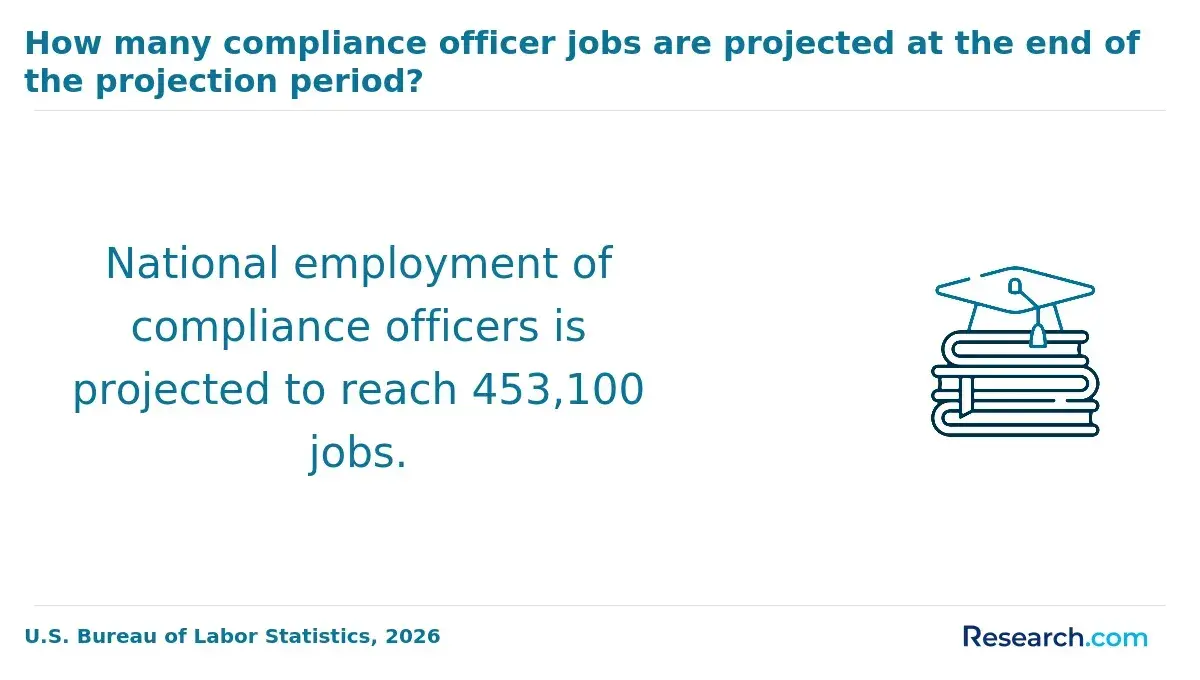
The Bureau of Labor Statistics reports median annual pay of $80,730 in May 2025 for compliance officers and projects 4% growth from 2025-2035, with about 32,700 openings per year. This is an occupation-wide benchmark, not a salary estimate for MLS graduates or benefits-specific positions. Location, responsibility, industry, and prior experience can change an individual offer.
For another relevant benchmark, compensation, benefits, and job analysis specialists had median annual pay of $78,210 in May 2025 and projected growth of 6% from 2025-2035. That category includes work beyond benefits compliance. Neither figure establishes that an MLS raises pay; compare actual job postings and promotion criteria with the degree's full cost before using salary as the reason to enroll.
Which accreditations and certifications should benefits brokers evaluate?
Check that the university has institutional accreditation from a recognized accreditor, and confirm the current status through the institution and accreditor. Accreditation of the university is distinct from any endorsement of a particular MLS concentration. American Bar Association approval concerns qualifying paralegal education programs; it is not a general approval standard for MLS degrees and does not certify individual graduates.
Professional credentials should be evaluated against the work you intend to do. State insurance-producer licensing addresses regulated insurance activity; benefits or compliance certifications may demonstrate more focused knowledge, depending on the issuer's requirements and an employer's preferences. An academic certificate documents completion of coursework, whereas a professional certification is granted under a credentialing organization's rules. Neither replaces a required license or authorizes legal practice.
Before enrolling or paying for a credential, check the current licensing rules for every state where you conduct regulated activity, the credential issuer's eligibility and renewal rules, and the qualifications in your target job postings. A red flag is any program suggesting its MLS confers attorney status or automatically satisfies licensing or certification requirements.
Other Things You Should Know About Law & Paralegal
A template can be a starting point, not proof that an employer has met its obligations. Confirm its intended use, version, and fit for the employer's plan; route legal interpretation or customization questions to qualified counsel.
No. Including legal topics - or copying an attorney - does not automatically make a communication privileged. Follow the employer's counsel's instructions for sensitive requests and avoid promising confidentiality protections you cannot establish.
Do not put identifiable client or employee information into class assignments or third-party tools without appropriate authorization and safeguards. Use de-identified or fictional examples when permitted by the instructor and your organization's policies.
A fictional issue-spotting memo can demonstrate how you identify a rule, state what facts are missing, and recommend escalation or next steps. Label it as an educational sample, not legal advice, and exclude confidential client material.
References
- Summary of the HIPAA Security Rule | hhs.gov https://www.hhs.gov/hipaa/for-professionals/security/laws-regulations/index.html
- How an MLS in Compliance Prepares You for Legal Corporate Careers | William & Mary Law https://online.law.wm.edu/blog/mls-compliance-corporate-legal-careers
- What Can You Do With an MLS: Is It Worth It? - SMU https://onlinemasterlegalstudies.smu.edu/articles/what-can-you-do-with-an-mls/
- What Can You Do With a Master of Legal Studies? | WashU Law https://online.law.washu.edu/articles/what-can-you-do-with-master-of-legal-studies/
- Healthcare Compliance MLS: Advance in Risk Management | wsulaw.edu https://www.wsulaw.edu/news/how-an-mls-in-healthcare-compliance-helps-you-advance-in-risk-management/
- How an M.L.S. Degree Prepares You for Employment Law | miami.edu https://news.miami.edu/law/stories/2025/09/how-an-mls-degree-prepares-you-foremployment-law.html
- What Can You Do With a Master of Legal Studies (MLS)? | UC Law San Francisco MLS https://mls.uclawsf.edu/articles/what-can-you-do-with-master-of-legal-studies/
- Ensuring Partnership Between Legal and Compliance | bloomberglaw.com https://www.bloomberglaw.com/external/document/XDGVKTNC000000/health-care-operations-compliance-professional-perspective-the-d
- Paid Family and Medical Leave: How Employers Can Comply: CLA | claconnect.com https://www.claconnect.com/en/resources/articles/25/paid-family-and-medical-leave-for-employers
- The Role of Compliance Officers in Healthcare Organizations | American Medical Compliance https://americanmedicalcompliance.com/general/the-role-of-compliance-officers-in-healthcare-organizations-challenges-and-responsibilities/