
2027 In-State Community College vs. National Online Paralegal Certificate Costs

Co-Founder and Chief Data Scientist
An in-state community college may advertise a low per-credit rate, while a national online paralegal certificate may advertise one all-in price. Neither figure necessarily tells you what you will pay - or what you will receive.
This guide is for prospective paralegal students comparing those routes. It explains how to build a comparable cost estimate, where fees and prerequisites can change the result, and when paying more for credit, scheduling flexibility, or practical training may be worthwhile.
Key Things You Should Know
- There is no single 2026 national price for either route. Compare a community college's required credits at your applicable tuition rate plus fees with an online program's full quoted price plus excluded expenses.
- An in-state rate can be the lower-cost choice, but a shorter online certificate may cost less overall if the college requires additional coursework, commuting, or time away from work.
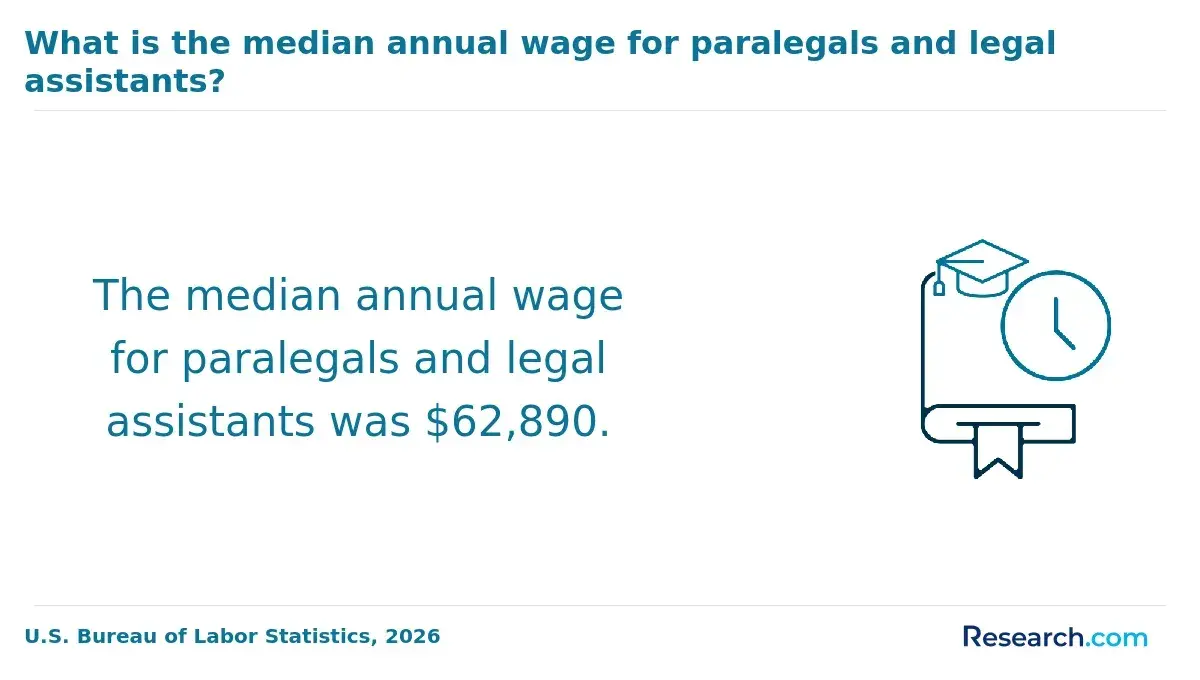
- Price alone is a weak measure of return: the Bureau of Labor Statistics reports $62,890 in May 2025 as the median annual pay for paralegals and legal assistants, not a starting salary or a promised outcome for certificate graduates.
What is the difference between community college and online paralegal certificates?
An in-state community college certificate is usually offered through a public college and may carry academic credit. A national online certificate is defined by its delivery and recruiting reach, not by a single credential standard: it may be a credit-bearing college program or a noncredit continuing-education course. Community colleges also offer online classes, so the categories can overlap.
The distinction matters because credit, admission requirements, scheduling, and employer recognition can differ even when both awards say "paralegal certificate." The receiving college decides whether certificate credits will transfer or apply to a degree. Likewise, "online" does not necessarily mean self-paced; a program may require live meetings, scheduled exams, or an in-person internship.
If your goal is understanding contracts or regulation in a current business role rather than preparing for paralegal work, a different legal-education route may be more relevant. Resources on finding a business law degree that fits working life can help frame that separate decision; a non-JD legal studies degree does not qualify someone to practice law.
How much does an in-state community college paralegal certificate cost?
The defensible answer for 2026-27 is required certificate credits multiplied by the tuition rate you actually qualify for, plus mandatory fees and required materials. There is no reliable nationwide total: colleges set different rates, programs require different courses, and an applicant's residency classification can change the bill. A published per-credit price is not a total-program quote.
Ask the college for a term-by-term estimate based on its current catalog. Include general education or prerequisite courses you have not completed, textbooks, research-platform charges, technology fees, and any required travel or placement expenses. If you already have college credit, ask which courses the paralegal department will accept before subtracting them from your estimate.
In-state tuition is often attractive for someone who qualifies for it and can use the college's schedule. But a low rate per credit may not be the lowest overall cost if the certificate requires substantially more coursework than the online alternative or if class times reduce paid work hours.
How much does a national online paralegal certificate cost?
National online programs do not have a standard 2026 price. Some charge per academic credit; others quote a package price for a noncredit course. Request the complete, current price in writing and check whether it includes books, legal research access, exam or proctoring charges, technology, and any required internship-related expenses. A single advertised price is useful only if you know what it covers.
Do not compare a bundled online quote with only one semester - or one credit - of community college tuition. The table shows which figures need to be placed side by side; it does not assume either route is cheaper.
| Cost or value to compare | Community college certificate | National online certificate |
| Base price | Tuition for every required credit at your applicable rate | Full package price or tuition for every required credit |
| Additional costs | Mandatory fees, materials, prerequisites, travel, and placement costs | Items excluded from the quote, such as materials, platform access, or proctoring |
| Value beyond completion | Whether credits apply toward a later degree | Whether the award carries academic credit and whether another college might accept it |
If financing affects your choice, confirm the specific certificate's eligibility with the school's financial aid office. Institutional accreditation alone does not make every certificate eligible for federal student aid, and a noncredit course should not be assumed eligible.
Which paralegal certificate programs offer the best value for students?
The best value is the lowest complete cost for a program that meets your actual career and scheduling needs - not necessarily the lowest advertised tuition. An in-state college may offer strong value if its credits advance a planned associate degree and its classes fit your week. A national online option may justify a higher quote if it avoids commuting and provides the instruction and supervised practice you need; it may also be poorer value if expensive noncredit coursework cannot serve your next goal.
If program approval matters to you or employers you have identified, compare verified options rather than assuming all online programs have the same status. A guide to cheaper ABA-approved online paralegal options is a starting point, but confirm each program's current approval, delivery rules, and price directly before applying.
To make the decision, obtain written total-cost estimates for the same enrollment period, check whether required courses are offered when you can take them, and ask prospective employers whether they prefer particular credentials or practical experience. Beware of a price comparison that omits prerequisites, assumes credits will transfer, or treats an internship as cost-free without checking its schedule and placement rules.
What accreditation should a reputable paralegal certificate program have?
Check the college's institutional accreditation with its recognized accreditor, then check the certificate's status separately. The American Bar Association (ABA) approves qualifying paralegal education programs; it does not institutionally accredit colleges or certify individual graduates. Not every reputable paralegal program is ABA-approved, and approval should never be inferred from the school's name or accreditation.
Use the ABA's current paralegal program directory when approval is important to your decision, and confirm that the approval applies to the program and delivery option you intend to enter. Ask the school to identify the accreditor and explain whether the certificate is credit-bearing. Those checks help you evaluate recognition and future study options, but neither accreditation nor ABA approval guarantees transfer credit, employment, or financial aid.
What do students learn in a paralegal certificate program?
Relevant coursework may cover legal research and writing, civil procedure, document preparation, ethics, and substantive areas such as contracts or litigation. For a cost comparison, look beyond course titles: determine whether students practice drafting and research, receive feedback, and complete an internship or other applied work. Ask which research tools are included in tuition and whether students actually use them in assignments.
Paralegals support legal work under appropriate supervision; a certificate does not authorize its holder to practice law independently. If your objective is broader legal knowledge for a business or compliance role, comparisons of legal studies master's specialization and career comparisons describe a different, graduate-level path - not a required upgrade from a paralegal certificate.
How long does it take to complete a paralegal certificate?
Completion time depends on the required courses, whether you study full-time or part-time, course availability, and any prerequisite or internship requirement. A short advertised duration may assume a workload or start date you cannot accommodate. Request a course sequence showing when you could actually finish, especially if you must work while enrolled.
Time is part of cost: an extended sequence can delay a job search, while an intensive online schedule can limit paid work. If you are comparing a certificate with later graduate legal study, information on online master's in business law program lengths may help you assess that separate time commitment. A master's degree is not necessary simply to obtain a paralegal certificate.
What are the admission requirements for paralegal certificate programs?
Requirements vary. A college certificate may admit students with a high school credential but require certain college courses before its paralegal classes; a post-baccalaureate certificate may require a bachelor's degree. A noncredit online course can have different entry rules. Check the current catalog for required prior education and prerequisites, rather than treating a recommendation as a condition of admission.
Ask admissions whether previous coursework can satisfy prerequisites and whether doing so changes your price or completion schedule. Application requirements for other legal studies programs should not be assumed to apply to a paralegal certificate; for example, online legal studies degrees without a personal statement address a different application decision.
What jobs and salaries can paralegal certificate graduates expect?
A certificate can support applications for paralegal or legal assistant roles, but employers may also weigh prior education, writing ability, relevant work experience, and local hiring preferences. Entry-level tasks can include organizing case files, researching under attorney supervision, and preparing draft documents. Graduating does not guarantee a job or a particular wage.
The Bureau of Labor Statistics reports median annual pay of $62,890 in May 2025 for paralegals and legal assistants and 0% projected job growth, 2025-2035, with about 40,800 openings per year projected despite little or no net growth. That occupation-wide median includes experienced workers and is not a forecast of a new certificate holder's pay. For a buying decision, weigh local job postings and their stated education preferences against the full cost of each program.
Is paralegal certification or licensing required to work in the United States?
There is no single nationwide paralegal license or professional certification required for every job. State rules and employer preferences vary, so check the rules where you intend to work. In particular, do not assume that a certificate permitting work under attorney supervision authorizes independent legal services.
A paralegal certificate is an educational award from a school or training provider. Professional certification is a separate credential granted under the requirements of a certifying organization or applicable state system. Completing a certificate does not automatically confer professional certification, and "ABA-certified paralegal" is not an appropriate description of an ABA-approved program's graduate.
Other Things You Should Know About Law & Paralegal
Possibly. Ask your employer whether its tuition-assistance policy covers the specific credit or noncredit program, whether approval is needed before enrollment, and whether repayment is required if you leave the job.
Coverage depends on the specific program's approval and your benefits. Confirm eligibility with the school's veterans benefits office and the applicable benefits administrator before relying on it to pay the bill.
Ask for the current computer, internet, webcam, and software requirements. Check whether specialized tools are supplied through the program or require a separate purchase.
Refund rules vary by provider and by when you withdraw. Read the written cancellation and refund policy before paying, particularly for a bundled or noncredit course.
References
- Program Eligibility, Written Arrangements, and Distance Education | 2024-2025 Federal Student Aid Handbook https://fsapartners.ed.gov/knowledge-center/fsa-handbook/2024-2025/vol2/ch2-program-eligibility-written-arrangements-and-distance-education
- Types of Financial Aid: Grants, Work-Study, and Loans | studentaid.gov https://studentaid.gov/understand-aid/types
- Residency Requirements | Sacramento City College https://scc.losrios.edu/residency
- Distance Learning | isothermal.edu https://isothermal.edu/distance-learning/index.html
- Residency Requirements | Admissions and Records | San Mateo County Community College District https://smccd.edu/admissionsandrecords/residencyrequirements.php
- How Important Are Professional Certifications? | The Link | Columbia Southern University https://www.columbiasouthern.edu/blog/blog-articles/2021/august/are-certifications-worth-it
- Paralegal Cost & Tuition | Inver Hills Community College https://www.inverhills.edu/degrees-programs/paralegal/cost-tuition/
- II. Tuition - The City University of New York https://www.cuny.edu/about/administration/offices/legal-affairs/university-tuition-fee-manual/ii-tuition/
- Online Certified Paralegal from City College of New York | The City College of New York https://careertraining.ccny.cuny.edu/training-programs/certified-paralegal/
- Paralegal Online Program Tuition | pennfoster.edu https://www.pennfoster.edu/programs/legal/paralegal-studies-associate-degree/tuition


